
Yes, hemp-derived CBD is legal in Michigan in 2026, as long as the product contains no more than 0.3% delta-9 THC by dry weight. Marijuana-derived CBD and stronger hemp extracts fall under the state’s cannabis regulations and typically require a licensed dispensary. The bigger risk for shoppers isn’t legality. It’s mislabeled products, failed workplace drug tests, and new rules tightening around total THC content. Read the checklist below before you buy anything.
TL;DR:
- Most CBD products sold in Michigan retail stores are compliant if they contain less than 0.3% delta-9 THC by dry weight, but lab reports are essential for verification.
- Finished products are now scrutinized more closely than raw hemp, and full lab tests for total THC, pesticides, heavy metals, and microbes are increasingly mandatory.
- CBD for workplace drug testing presents a risk because trace THC amounts in legal products can accumulate and cause positive results on drug panels.
- Michigan’s new legislation aims to require processor licensing, mandatory testing, and label accountability, with enforcement actions already starting for noncompliance.
- Always ask for a batch-specific certificate of analysis, verify lot numbers, and consider visiting licensed dispensaries for higher-potency or full-spectrum products.
Table of Contents
- Federal vs. Michigan Law: What Changed for 2026
- Where You Can Legally Buy CBD in Michigan
- Not All CBD Products Carry the Same Legal Risk
- What a Real Lab Report Should Tell You
- CBD and Workplace Drug Testing: The Risk Nobody Warns You About
- 2026 Enforcement Actions and What’s Coming Next
- A Practical Checklist for Buying CBD in Michigan
- A Local Retailer’s Take on Buying CBD the Right Way
- Shop Compliant CBD at Elevated Remedies in Ann Arbor
- Where to Verify Michigan’s CBD Laws Yourself
- Sources
Federal vs. Michigan Law: What Changed for 2026
Michigan’s hemp rules start with the federal baseline set by the 2018 Farm Bill, which drew the line between hemp and marijuana at 0.3% delta-9 THC by dry weight. Anything under that threshold counts as hemp. Anything over it is legally marijuana, regardless of what the label says or how the plant was grown.
Michigan built its consumable hemp framework on top of that federal line, but the state has been actively rewriting the rulebook. Senate Bill 599, moving through the Michigan Legislature alongside companion legislation House Bill 4964, would require consumable hemp processors to obtain state licenses, complete mandatory testing before any product reaches a shelf, and follow specific labeling standards or face penalties. That’s a meaningful shift from the looser, largely self-policed hemp market of the last several years.
Federal attention has moved in a similar direction. Lawmakers have pushed proposals that would judge products by total THC, meaning delta-9 plus THCa and other precursors, rather than delta-9 alone. That distinction matters more than it sounds. A product can test under 0.3% delta-9 THC and still contain enough THCa to convert into an intoxicating amount once heated or metabolized. Regulators are catching on to that loophole, and Michigan’s own enforcement actions in 2026 reflect it.
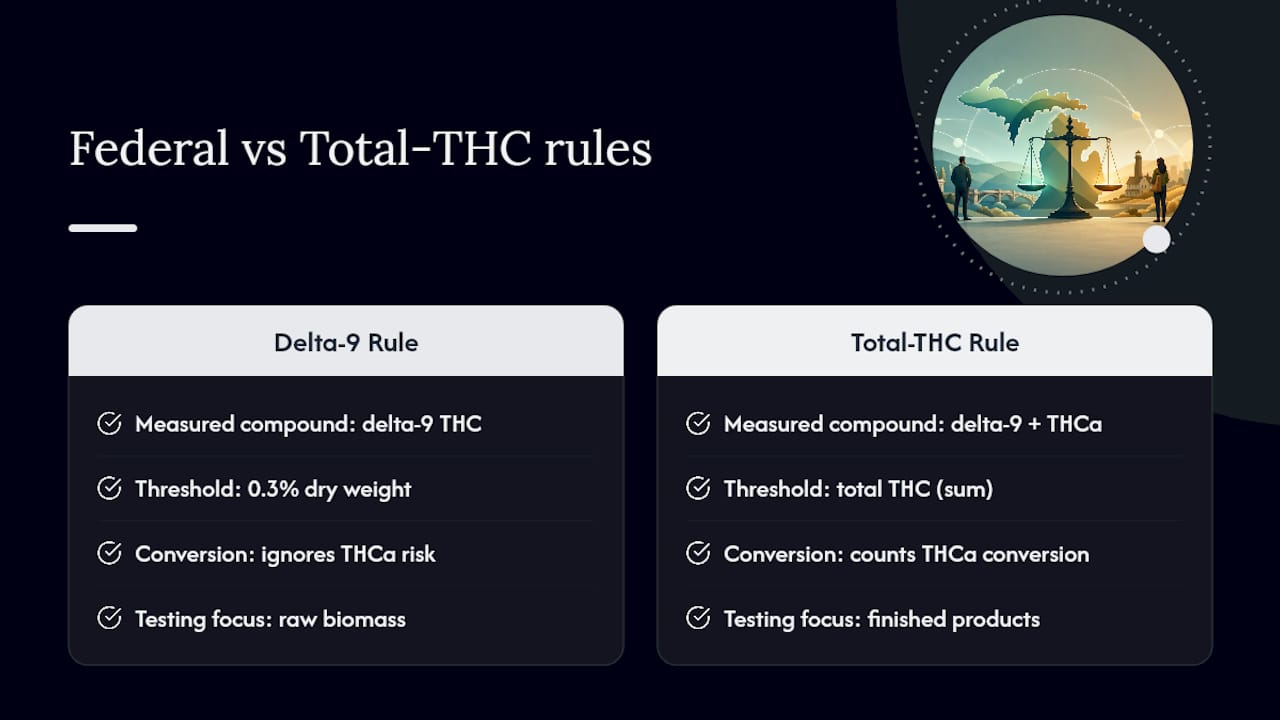
For sellers, this means the days of testing only raw hemp biomass and calling it compliant are ending. Finished products, the actual gummy, tincture, or vape a customer buys, are increasingly what gets tested and what gets scrutinized. For buyers, it means the number on the front of a label matters less than what a full lab report actually shows. LegalClarity’s breakdown of Michigan hemp and marijuana law is a useful primer if you want the statutory distinctions in plain language.
Where You Can Legally Buy CBD in Michigan
Hemp-derived CBD that meets the approved delta-9 THC threshold can be sold at general retail: smoke shops, wellness stores, gas stations, and online retailers shipping into Michigan. Marijuana-derived CBD, or any product exceeding that threshold, has to move through channels regulated by the Cannabis Regulatory Agency, meaning licensed dispensaries or medical provisioning centers.
That split creates a few practical rules worth knowing before you shop:
- General retail (hemp CBD): No state medical card or dispensary visit required; sold like any other consumer product.
- Dispensaries and provisioning centers: Required for anything over 0.3% delta-9 THC, including most full-spectrum products marketed for stronger effects.
- Online orders: Compliant hemp CBD can ship across state lines and directly to Michigan addresses; dispensary products generally cannot be shipped and require in-person or licensed-delivery pickup.
- Age policies: Michigan does not set a statewide legal age minimum specifically for hemp CBD purchase; instead, many retailers independently enforce age limits, commonly requiring buyers to be 21 or older.
If you’re buying online, check whether the seller actually lists a Michigan-compliant lab report, not just a generic “third-party tested” badge. If you’re buying in person, ask whether the staff can pull up a current certificate of analysis on request. A shop that hesitates on that question is telling you something.
Not All CBD Products Carry the Same Legal Risk
Product type changes your legal exposure more than most shoppers realize. Topicals, lotions, balms, and salves, carry the lowest regulatory risk in general retail because they’re not ingested and rarely raise total-THC concerns. Ingestible categories get more complicated fast.
- Topicals: Lowest risk category; widely sold without dispensary restrictions.
- Edibles and beverages: Legally murky for retail sale; the FDA still prohibits adding CBD to food or marketing it as a dietary supplement in interstate commerce, which puts many CBD-infused snacks and drinks in a gray zone regardless of state hemp law.
- Vapes and flower: Legal if they test under 0.3% delta-9 THC, but these categories draw the heaviest scrutiny because smoking or vaping delivers cannabinoids fast and potency claims are easy to fudge.
- Delta-8, THCa, and other intoxicating hemp derivatives: Often marketed as “hemp legal” but frequently behave like marijuana once consumed; several of these products increasingly require dispensary-level regulation in Michigan.
The mislabeling problem usually traces back to one issue: THCa. Raw hemp can test compliant for delta-9 THC, but THCa converts to intoxicating delta-9 when heated, whether that’s a lighter, an oven, or your own body processing it. A product can be technically compliant on paper and still get someone high, which is exactly the gap regulators are now closing.
What a Real Lab Report Should Tell You
A certificate of analysis, or COA, is the single most useful document a CBD buyer can ask for, and it should be specific to the batch you’re holding, not a generic report pulled from a company’s website. Industry compliance trackers now treat batch-specific COAs as the baseline expectation for any legitimate Michigan seller, not a bonus feature.
Here’s what a legitimate COA needs to show:
- Delta-9 THC percentage, confirming the product falls under the 0.3% threshold by dry weight.
- Total THC percentage, which accounts for THCa conversion and catches products that would fail once heated.
- Pesticide and solvent screening, especially for concentrates and vape products.
- Heavy metals testing, covering lead, arsenic, cadmium, and mercury.
- Microbial testing, checking for mold, yeast, and bacterial contamination.
- A matching lot number that ties the COA to the exact product in your hand, not a different batch entirely.
Look for a testing lab that’s independently accredited and lists a report date within the last several months. If a company’s COA is more than a year old, or the lot number doesn’t match the packaging, treat that as a red flag rather than a technicality.
Pro Tip: Snap a photo of the COA and lot number at the time of purchase. If you ever need to verify a product later, whether for a drug test question or a return, you’ll have it without digging through a bag or a drawer.
Vague language is another warning sign. “Full-spectrum” with no accompanying numbers, potency claims that shift between the box and the website, or a company with no listed manufacturer contact information all point toward a product that hasn’t been through the testing pipeline it claims to have.
CBD and Workplace Drug Testing: The Risk Nobody Warns You About
Legal CBD does not mean drug-test-safe CBD, and that gap catches a lot of Michigan workers off guard. Michigan employers can discipline or terminate an employee for a positive cannabis test even when the CBD product used was completely legal to buy, according to employment law guidance covering Michigan drug-testing policy. Legality and employability are two separate questions, and CBD’s legal status doesn’t protect your job.
The mechanism is straightforward. Full-spectrum CBD products contain trace amounts of THC, typically under the 0.3% delta-9 limit, but not zero. Regular use lets those trace amounts accumulate in fat tissue over weeks, and standard workplace drug panels test for THC metabolites, not “how much THC was legally permitted in the product you bought.”
If you’re subject to workplace testing, three moves cut your risk substantially:
- Choose broad-spectrum or verified THC-free isolate products, confirmed by a COA showing “non-detect” for THC.
- Stop use several weeks before any known testing date, since metabolites clear slowly, not instantly.
- Ask your employer directly about their testing policy and threshold before assuming legal CBD is a safe bet.
2026 Enforcement Actions and What’s Coming Next
Michigan regulators aren’t just writing new rules on paper. In 2026, the state issued its first-ever hemp processor license suspension over excessive THC levels, after inspectors found finished topical and concentrate batches testing well above the legal hemp threshold. That case matters because it targeted finished products already on shelves, not just raw crop testing at the farm level, signaling exactly where enforcement attention is headed.
That shift lines up with what Senate Bill 599 and House Bill 4964 would formalize: mandatory pre-sale testing, processor licensing, and labeling accountability, with real penalties attached for noncompliance. Once these bills move through the legislature, Michigan sellers without proper testing infrastructure will have a much harder time staying in business.
Federally, the push toward total-THC rules rather than delta-9-only measurements is expected to reshape product formulations after 2026 takes fuller effect. Expect conservative labeling, more consistent COA availability, and probably some products, especially THCa-heavy flower and vape lines, quietly disappearing from general retail shelves as sellers adjust or lose their licenses trying not to.
A Practical Checklist for Buying CBD in Michigan
Before you hand over money for any CBD product, run through this list. It takes about two minutes and it’s the difference between an informed purchase and a gamble.
- Ask for the batch-specific COA and confirm delta-9 THC is under 0.3% and total THC is disclosed separately.
- Match the lot number on the COA to the lot number on your actual packaging.
- Choose dispensary channels for anything marketed as high-potency, full-spectrum, or intoxicating, rather than assuming general retail covers it.
- Ask the retailer directly whether products are tested per batch or per crop, since crop-only testing misses finished-product THC conversion.
- Keep your receipt and COA together in case you need to verify a purchase later, for a return, a workplace question, or your own records.
For online orders, check three things before checkout: a clearly stated shipping policy for hemp products, specific (not vague) claims about potency and ingredients, and a real company address or phone number, not just a contact form. If you’re managing a medical condition, facing a workplace drug policy, or navigating a legal gray area, a conversation with a doctor, your HR department, or an attorney is worth more than any online guide, including this one.
Pro Tip: If a product’s website can’t answer “what’s your total THC on this specific batch” in under a minute, that’s your answer about whether to buy it.
If you’re weighing CBD against other regulated Michigan products, CBD versus kratom comparisons cover similar legal and safety territory worth understanding before you commit to either.
A Local Retailer’s Take on Buying CBD the Right Way
Elevated Remedies operates out of Ann Arbor, and the pattern we see repeatedly is simple: shoppers assume “sold in a smoke shop” means “already vetted.” It doesn’t, not automatically. Every CBD product on our shelves gets checked against its COA before it’s stocked, matching lot numbers and confirming delta-9 and total THC figures rather than trusting a label at face value.
If you’re unsure whether a product belongs in general retail or needs a dispensary trip, ask. That’s a five-second conversation that prevents a bad purchase. And if you’re weighing CBD against other regulated options, our staff can walk through the differences the same way we do for kratom’s legal status in Michigan.
— Juiced
Shop Compliant CBD at Elevated Remedies in Ann Arbor
Elevated Remedies is a smoke shop offering CBD, vapes, kratom, and smoking accessories, and the hemp products carried are checked against lab documentation before being stocked.
That means you’re not stuck squinting at a label trying to decode “total THC” versus “delta-9” on your own. When you walk into our shop at 1123 Broadway St, our staff can pull up batch testing information and talk through what’s actually in the product you’re considering, whether that’s a CBD tincture, a topical, or one of our other amanita muscaria offerings for anyone exploring alternatives beyond traditional CBD. Stop in, ask questions, and leave with something you actually understand.
Where to Verify Michigan’s CBD Laws Yourself
- Senate Bill 599 (Michigan Legislature): the actual bill text on licensing, testing, and labeling requirements.
- FDA cannabis and CBD regulation page: federal rules on CBD in food and supplements.
- USDA AMS hemp rules: federal production and testing standards for hemp growers.
- MLive reporting on Michigan’s 2026 hemp license suspension: a real enforcement case showing what noncompliance looks like in practice.
Sources
- Senate Bill No. 599 (Michigan Legislature)
- Is CBD Oil Legal in Michigan? Hemp vs. Marijuana - LegalClarity
- FDA regulation of cannabis and cannabis-derived products, including CBD