
TL;DR:
- Microdosing involves low doses of psilocybin aimed at subtle mood and focus shifts with early research showing mixed results.
- Michigan’s legal status is complex, with some cities decriminalizing possession but no statewide legalization.
- A structured routine, careful tracking, and awareness of effects are essential for safe and potentially beneficial microdosing.
Stress is up, attention spans are down, and a growing number of Michigan residents are quietly asking whether psilocybin microdosing might help. The curiosity is real and understandable, but the space between social media hype and actual science is wide. Sorting through anecdotal success stories, shifting local laws, and conflicting research can feel overwhelming before you even take a single dose. This guide cuts through the noise. You’ll get a clear, practical, evidence-grounded workflow for microdosing psilocybin, including what the science actually says, how Michigan’s legal landscape sits in 2026, and how to track whether any of it is working for you.
Table of Contents
- What is microdosing? Definitions, science, and Michigan’s legal landscape
- Preparing your microdosing workflow: What you need and how to plan
- Step-by-step guide: Setting up and following your microdosing routine
- Recognizing outcomes: Measuring wellness benefits and managing side effects
- The surprising truth about microdosing workflows: Hype meets science in Michigan
- Take the next step: Wellness solutions from Elevated Remedies
- Frequently asked questions
Key Takeaways
| Point | Details |
|---|---|
| Know the law | Michigan’s statewide psilocybin prohibition is nuanced by city-level decriminalization. |
| Prepare responsibly | Use precise tools, structured routines, and track your experience for safest outcomes. |
| Expect realistic results | Placebo effects are common and scientific benefits remain unproven, so be skeptical and self-aware. |
| Measure wellness carefully | Monitor mental health, side effects, and discontinue use if problems arise. |
| Explore legal options | Consider legal, wellness-oriented mushroom products if seeking alternative approaches. |
What is microdosing? Definitions, science, and Michigan’s legal landscape
Microdosing means taking a dose of psilocybin small enough that you don’t feel high but potentially large enough to notice subtle shifts in mood, focus, or creativity. Microdosing psilocybin involves sub-perceptual doses of 0.1 to 0.3 grams of dried mushrooms, taken on specific schedules rather than daily. The two most common protocols are the Fadiman protocol (one day on, two days off) and the Stamets protocol (four days on, three days off, often combined with lion’s mane mushroom and niacin).
At a biological level, psilocybin converts to psilocin in the body and binds to 5-HT2A serotonin receptors. This interaction is thought to promote neuroplasticity, meaning the brain becomes temporarily more flexible in forming new connections. That’s the mechanism behind claims about improved mood and creativity. However, the research is still early, and most large-scale controlled studies have not confirmed what users report anecdotally.
“The evidence base for microdosing benefits remains largely self-reported. Placebo-controlled trials have consistently produced more modest results than observational studies.”
Here’s a quick look at what the science currently supports:
| Claim | Evidence level |
|---|---|
| Improved subjective wellbeing | Moderate (self-report studies) |
| Reduced depression symptoms | Weak (mixed RCT results) |
| Enhanced creativity or focus | Low (anecdotal, limited trials) |
| Neuroplasticity promotion | Preclinical, not confirmed in humans |
On the legal side, psilocybin remains a Schedule I controlled substance under federal law. Michigan follows federal classification, meaning statewide possession is still illegal. That said, local decriminalization varies by city, with Ann Arbor, Detroit, and Hazel Park having deprioritized enforcement. Most recently, Jackson decriminalized psychedelic mushrooms in a late 2025 council vote, reflecting a clear statewide shift in public sentiment. Bills are pending in Michigan as of 2026, but no statewide reform has passed yet. If you want a deeper breakdown of safe dose ranges, the psilocybin dosage guide at Elevated Remedies is a solid starting point.
Key legal takeaways for Michigan residents:
- Statewide possession is still a criminal offense
- Ann Arbor, Detroit, Hazel Park, and Jackson have deprioritized enforcement
- No legal retail sale of psilocybin products is authorized statewide
- Laws are shifting fast, so staying current is part of responsible use
With the basics of microdosing and Michigan’s current legal framework in mind, it’s vital to know what you’ll need to try this approach responsibly.
Preparing your microdosing workflow: What you need and how to plan
Getting your setup right before you start matters more than most people realize. Walking into a microdosing routine without a plan is one of the fastest ways to get unreliable results or miss warning signs.
First, decide on your format. Dried mushrooms, capsules, and chocolates are the three most common options, and each has real differences in how consistently you can dose.
| Format | Dosing precision | Onset time | Ease of use |
|---|---|---|---|
| Dried mushrooms | Lower (requires scale) | 30 to 60 min | Moderate |
| Capsules | High (pre-measured) | 30 to 45 min | Easy |
| Chocolates | Moderate (divided portions) | 45 to 75 min | Easy |
For a closer look at how these formats compare on safety and consistency, the guide on safer psilocybin options breaks it down well. You can also browse psilocybin product examples to understand what’s available in Michigan.
Your pre-start checklist:
- A precision scale (accurate to 0.01g) if using dried mushrooms
- A dedicated journal or mood tracking app
- A printed or digital schedule template
- A clear record of any medications or mental health history
- An honest conversation with a doctor, especially if you take SSRIs or antidepressants
Schedules such as Fadiman or Stamets are specifically designed to minimize tolerance buildup and reduce the chance of side effects. Skipping rest days defeats the purpose of either protocol. Also worth noting: side effects can include elevated blood pressure, mild anxiety, and disrupted sleep, even at sub-perceptual doses.
Who should avoid microdosing:
- Anyone with a personal or family history of psychosis or schizophrenia
- People currently on SSRIs or MAOIs without medical guidance
- Pregnant or breastfeeding individuals
- Anyone under 25 (still-developing brain)
Pro Tip: Start with your lowest planned dose on a day off work. This gives you a controlled environment to notice how your body responds before integrating it into a busy schedule.
With a plan and supplies ready, you can begin implementing your microdosing workflow. The next section explains each step clearly.
Step-by-step guide: Setting up and following your microdosing routine
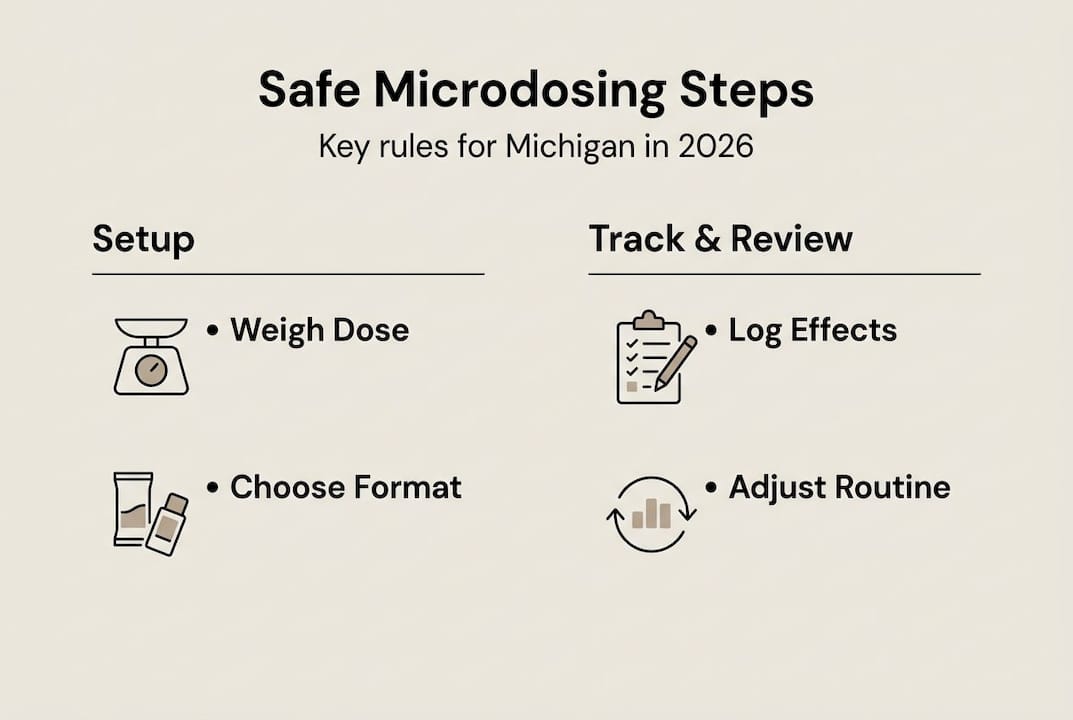
Here’s a practical workflow you can follow from day one. The goal is consistency, honest tracking, and safety.
- Choose your protocol. Pick either Fadiman (1 on, 2 off) or Stamets (4 on, 3 off). Stick with one for at least four weeks before evaluating.
- Set your dose. Start at 0.1g dried equivalent. Don’t jump to 0.3g right away. Lower is smarter when you’re learning how your body responds.
- Take it in the morning. Dosing later in the day can interfere with sleep. Morning doses align better with natural energy rhythms.
- Log everything immediately. Write down mood, energy, focus, and any physical sensations within two hours of dosing. Do the same on off days.
- Track your off days too. Many users notice the clearest benefits on their rest days, not dosing days. This is important data.
- Reassess at week four. Review your journal. Are the changes consistent? Are they positive? Is anything concerning?
- Adjust or stop. If you notice tolerance building or mood flattening, take a full two-week break before resuming.
Self-reports show improved wellbeing, productivity, and focus on dosing days across multiple observational studies. That’s genuinely encouraging. But it’s equally important to know that no significant benefit over placebo was found in a randomized controlled trial focused on depression. The gap between how people feel and what controlled studies confirm is real, and worth keeping in mind as you track your own results.

For context on what separates a microdose experience from a full psychedelic session, the article on differences between microdosing and full dose experiences is worth reading. A wellness checklist can also help you set a useful baseline before you start.
A meta-analysis on cognitive benefits found no overall cognitive improvement and a slight reduction in cognitive control in some participants. That’s a finding most microdosing advocates don’t talk about enough.
Pro Tip: Use a simple 1 to 10 scale for mood, focus, and energy each morning. After four weeks, you’ll have real data instead of vague impressions.
After following a microdosing routine, it’s important to recognize effects, spot potential issues, and troubleshoot for safety and effectiveness.
Recognizing outcomes: Measuring wellness benefits and managing side effects
Tracking results isn’t optional. It’s what separates a genuine wellness practice from wishful thinking.
What to track daily:
- Mood score (1 to 10)
- Energy level (1 to 10)
- Focus and mental clarity (1 to 10)
- Sleep quality
- Any physical symptoms (headache, nausea, elevated heart rate)
- Notable events or stressors that could skew your data
Statistic callout: A meta-analysis of cognitive impacts found no overall cognitive benefit from microdosing and identified a slight reduction in cognitive control in some participants, a result that contradicts popular claims.
Many people do report feeling better. That’s real and worth acknowledging. But neuroplasticity and microdosing research suggests the mechanisms are more complex than early enthusiasm implied. Expectancy effects, meaning feeling better simply because you believe you will, account for a significant portion of reported improvements.
Side effects are generally mild and transient, but they are dose-dependent. The most commonly reported include increased blood pressure, mild anxiety, and temporary cognitive changes. These tend to resolve within a few hours.
When to stop and seek medical advice:
- Persistent anxiety or paranoia beyond dosing days
- Noticeable increase in blood pressure
- Worsening mood or depressive episodes
- Any visual disturbances or perceptual changes
- Difficulty distinguishing microdose effects from baseline
For Michigan residents specifically interested in anxiety relief, the guide on microdosing for anxiety covers what the evidence supports. If focus is your primary goal, the article on mushrooms for focus offers a grounded breakdown of what’s realistic.
The honest answer is that microdosing works well for some people and not at all for others. Your tracking data is the only way to know which group you’re in.
Now that you know how to manage your workflow and recognize results, let’s step back and challenge the dominant narratives about microdosing for wellness.
The surprising truth about microdosing workflows: Hype meets science in Michigan
Here’s something the wellness community rarely says out loud: a lot of what people attribute to microdosing is probably the placebo effect, and that’s not necessarily a bad thing. If structured self-care, intentional journaling, and a sense of agency over your mental health make you feel better, those are real outcomes regardless of what’s causing them.
But there’s a risk in crediting psilocybin for improvements that come from the ritual around it. It can lead people to increase doses chasing stronger effects, skip the tracking that actually protects them, or ignore side effects because they’re committed to the practice working.
The science on microdose dark chocolate benefits and other delivery formats shows similar patterns: user experience and controlled trial results often diverge sharply. Michigan’s shifting laws add another layer of complexity. The cities decriminalizing enforcement are not legalizing sale or possession. That distinction matters, and staying current on local ordinances is part of responsible use in 2026. A science-first lens, combined with genuine self-tracking and a willingness to stop if results aren’t real, is the most honest approach to this practice.
Take the next step: Wellness solutions from Elevated Remedies
If you’re ready to explore microdosing with quality products and real guidance, Elevated Remedies at 1123 Broadway St in Ann Arbor is where Michigan residents come to get it right.
We carry mushroom capsules designed for consistent, pre-measured dosing, along with a mushroom chocolate bar selection sourced for quality and consistency. Not sure where to start? Our magic mushroom guide walks you through the basics before you commit to anything. Our team is here to answer questions, point you toward evidence-based resources, and help you find the right fit for your wellness goals. Come in, ask questions, and get elevated responsibly.
Frequently asked questions
Is psilocybin microdosing legal in Michigan?
Psilocybin remains a Schedule I substance under Michigan and federal law, but local decriminalization has occurred in cities like Ann Arbor, Detroit, and Jackson, where enforcement has been deprioritized.
What are the wellness benefits of microdosing shown in studies?
Self-reports consistently suggest improved mood and focus, but placebo-controlled studies show no clear benefit over placebo, meaning the evidence is promising but not conclusive.
What are the possible side effects of microdosing psilocybin?
Side effects are mild and transient in most cases, with the most common being increased blood pressure, mild anxiety, and temporary cognitive changes that resolve within hours.
How should I structure my microdosing schedule?
The Fadiman protocol (1 day on, 2 days off) and the Stamets protocol (4 days on, 3 days off) are the most widely used, and both are designed to prevent tolerance buildup. Typical microdosing schedules help reduce the risk of side effects when followed consistently.
Recommended
- Psilocybin Dosage Guide for Michigan Wellness in 2026 – Elevated Remedies
- Why microdose for anxiety? Michigan guide to natural relief – Elevated Remedies
- Magic mushroom dosage guide: safe & effective use in Michigan – Elevated Remedies
- Michigan guide: psilocybin product examples & safe use – Elevated Remedies