
Run five checks before you fire a cartridge: the packaging print quality, the QR code and batch number against a lab portal, the price against market rates, the oil’s color and thickness, and the seller’s ability to prove where the product came from. If two or more of these fail, treat the cart as counterfeit and stop using it. If you’ve already used a suspicious cartridge and feel chest pain, shortness of breath, or persistent vomiting, get emergency care right away.
TL;DR:
- Most counterfeit cartridges can be identified by blurry logos, crooked seals, and missing state-specific compliance numbers on packaging.
- Verifying batch codes and QR codes against official lab portals is crucial, as fake batch numbers are often reused or inconsistent.
- Reputable dispensaries follow strict traceability and only sell products with verifiable Certificates of Analysis and unit-specific serial numbers.
- Visual cues like oil color, motion, and hardware quality help, but cannot guarantee safety, as dangerous contaminants may still be present.
- Purchasing from licensed, traceable sources significantly reduces health risks and ensures access to authentic, lab-tested cannabis products.
Table of Contents
- The 30-Second Checklist To Run Before You Buy Or Use
- Packaging And Labeling: What To Inspect And Why It Matters
- Batch Codes, QR Codes, And COAs: Step-By-Step Verification
- Oil Appearance And Cartridge Hardware: What Visuals Can Tell You
- Where You Buy Matters More Than Almost Anything Else
- If You Already Used A Suspicious Cart: What To Do Right Now
- How Verification Looks In Practice At A Licensed Retailer
- Why Serial Numbers Matter As Much As Batch Numbers
- Smell And Taste: What Your Senses Can (And Can’t) Tell You
- The Real Health Risks Hiding In Counterfeit Cartridges
- How Labs Actually Verify What’s In A Cartridge
- A Note From Elevated Remedies On How We Think About This
- Where To Find Verified Products And Straight Answers
- Sources
The 30-Second Checklist To Run Before You Buy Or Use
You don’t need a lab coat to catch most fakes. You need thirty seconds and a willingness to actually look at what’s in your hand before it goes anywhere near your lungs. Run these five checks in order, and don’t move to the next one if an earlier check already fails.
- Packaging: Sharp printing, straight seals, correct spelling. Blurry logos or crooked holograms mean stop and inspect further.
- QR code and batch number: Scan it, land on the actual lab or brand domain, and match the batch ID to a public COA. A broken link or a cloned-looking page is an automatic fail.
- Price: If it’s a fraction of what licensed dispensaries charge for the same brand, that’s a fail. Real supply chains have real costs baked in.
- Oil: Clear to light amber, slow-moving, no dark sludge or floating particles. Watery, hazy, or bubbling-too-fast oil is a fail.
- Seller: Licensed dispensary or verified retailer passes. A stranger’s DM, a gas station in a non-legal market, or a flea market table is a fail.
Do the paper and visual checks before you ever take a hit. Documentation and packaging can be inspected without inhaling anything, and that order matters because some risks aren’t visible once vapor hits your lungs. If something feels off, photograph the packaging, save the batch number, and set the cart aside rather than tossing it. You may need that information if you have to report the product later.
Packaging And Labeling: What To Inspect And Why It Matters
Counterfeiters are good at faking the one thing you’re most likely to glance at: the logo. They’re much worse at faking the things that take actual regulatory infrastructure to produce.
Start with print quality. Legitimate brands use commercial printing with sharp edges and consistent color saturation. Fakes often show slightly blurry text, color that looks a shade off, or fonts that don’t quite match the brand’s official materials. Spelling and grammar errors on the packaging are a near-instant giveaway. So are tamper seals that look crooked, are already broken, or peel off too easily.
Here’s what to physically check:
- Print resolution on the logo and any small text, especially ingredient lists
- Font consistency between the front label and any warning text
- Color matching against a known-authentic photo of the same product
- Tamper seal alignment and whether it looks factory-applied or hand-placed
- Presence of a state-specific compliance number or tracking ID
That last point is where a lot of fakes fall apart. Legal cannabis products carry state-mandated markings, including tracking numbers tied to systems like METRC, which several states use to trace product from cultivator to retail shelf. Counterfeiters will happily copy a logo pixel for pixel, but they routinely skip the compliance text or the lab-accreditation icon entirely, because faking those invites more scrutiny than faking a brand name.
Pro Tip: Photograph the packaging next to a known-authentic version of the same product if you can find one online. Side-by-side comparison catches font and color mismatches that are nearly invisible in isolation.
Experts who study this closely point out that counterfeiters often nail one high-quality element, like a hologram, while cutting corners everywhere else. Evaluate the whole package rather than trusting a single convincing detail.
Batch Codes, QR Codes, And COAs: Step-By-Step Verification
The Certificate of Analysis is the single most reliable thing you can check, and it’s also the thing most people skip because it takes more than a glance. Here’s the process, done right.
- Scan the QR code and check the domain. Confirm the URL matches the brand’s or lab’s actual website, not a lookalike domain with a swapped letter or an extra word. A cloned landing page with a fabricated lab report is a known counterfeit tactic, and it only works if you don’t check the address bar.
- Find the batch number on the lab’s own public portal, not just on the packaging or a linked PDF. A COA is only trustworthy when it appears on the testing lab’s public database itself, independent of anything printed on the box.
- Check the test date, the lab’s license number, and the numeric results. A legitimate COA lists potency and screens for pesticides, heavy metals, residual solvents, and microbials. If any of those categories are missing, or the lab license and contact information aren’t listed anywhere, treat that as a fail.
A red flag worth knowing about: sophisticated counterfeiters sometimes lift a real, verifiable batch number from one authentic product and stamp it across thousands of fake units. The batch number checks out because it’s real. It just doesn’t belong to the cartridge in your hand. This is why matching the batch to the lab portal isn’t enough on its own. You also want to see whether a unit-specific serial number lines up, and whether the quantities and dates make sense for a single production run.
If a COA looks off, broken links, identical numeric results across supposedly different batches, or no lab contact information, call the lab directly or check your state’s cannabis regulatory agency to confirm the license is real and active. Most state programs publish licensed lab registries online, and a two-minute search beats guessing.
Oil Appearance And Cartridge Hardware: What Visuals Can Tell You
Healthy cannabis oil in a legitimate cartridge is typically clear to light amber, moves slowly when you tilt the cart, and forms bubbles gradually rather than all at once. It should look consistent from top to bottom, without floating debris or a layer of separation.
Fakes tend to show up as watery, hazy, or unusually dark oil, sometimes with a sludgy residue near the bottom or visible particles suspended in it. Fast, aggressive bubbling when you tip the cart is another common tell, since diluted or thinner oil behaves differently under gravity than properly extracted, viscous oil does.
Hardware tells its own story. Check these details:
- Mouthpiece shape and fit against known-authentic units from the same brand
- Threading quality where the cartridge screws into the battery, smooth versus gritty or cross-threaded
- Center-post alignment, since a crooked post often means rushed or careless assembly
- Any leaking around the base or mouthpiece, which points to poor sealing
- The feel of the materials themselves; cheap plastic housing where the brand normally uses glass is a strong signal
Pro Tip: Weigh the cartridge in your hand against a known-genuine one from the same brand if you can. Counterfeit hardware often uses lighter, cheaper plastic that feels noticeably different even before you look closely.
Here’s the limit you need to respect: visual inspection cannot catch everything. Dangerous adulterants like vitamin E acetate can produce oil that looks perfectly clean, since thickeners can mimic the appearance of properly extracted oil. That’s exactly why documentation should outrank appearance every time. Clean-looking oil earns a second look at the COA, not a pass.
Where You Buy Matters More Than Almost Anything Else
The riskiest carts almost never come from licensed dispensaries. They come from social media DMs, informal sellers at events, gas stations in states without a legal adult-use market, and secondhand marketplace listings where nobody can vouch for the supply chain.
Licensed dispensaries operate inside state tracking systems that assign a unique ID to a product and follow it from producer to shelf. Where states use systems like METRC, that tracking makes it far harder for a counterfeit product to enter the legal supply chain undetected, because every transfer point gets logged. That’s the single biggest reason licensed retail beats informal channels: not convenience, but traceability.
Verifying a retailer takes a few minutes:
- Look up the retailer’s state cannabis license number through your state’s regulatory agency website
- Check whether the brand itself lists authorized retailers on its own site
- Ask the seller directly for a COA and batch number before you buy, not after
- Confirm the batch matches what’s listed on the lab’s public portal, using the process above
If a seller can’t produce a COA, gets vague or defensive when you ask about batch traceability, or pushes you to buy quickly without answering questions, consider not purchasing. That reaction alone tells you most of what you need to know. You can also report a seller you suspect is moving counterfeit product to your state’s cannabis regulatory agency, which is worth doing even if you don’t buy, since it helps flag the source for other consumers.
If You Already Used A Suspicious Cart: What To Do Right Now
Stop using the cartridge immediately once you suspect it’s counterfeit, even mid-session. Don’t take “just one more hit” to see if something feels wrong; the damage from adulterated oil isn’t always immediate or obvious.
- Move to fresh air and stay somewhere you can sit down if you feel lightheaded or short of breath.
- Document everything, photograph the packaging, the batch number, the QR code, and the cartridge itself, before you dispose of anything.
- Preserve the physical cartridge in a sealed bag if possible. It may be needed for lab testing or a consumer complaint later.
- Monitor for warning symptoms over the following hours and days.
Certain symptoms mean you skip the wait-and-see approach entirely and get emergency medical care: shortness of breath, chest pain, fainting, a racing heart, or vomiting that won’t stop. These symptoms echo the pattern seen during the EVALI outbreak tied to vitamin E acetate in counterfeit and illicit-market vape products, and they are not something to wait out at home.
Beyond medical care, report what happened. Poison control can advise you on immediate symptoms and next steps, and your state’s cannabis regulatory agency can investigate the seller or brand involved. If you kept the cartridge, some state programs or independent labs can test it, which helps identify what was actually in it and may support a broader public-health response if other consumers were affected by the same batch.
How Verification Looks In Practice At A Licensed Retailer
A verification routine, done right, looks almost boring. Scan the QR code. Confirm the domain is the real one. Pull up the batch number on the lab’s public portal. Check the lab’s license number and the test date. Compare the numeric results, potency, pesticides, heavy metals, solvents, microbials, against what’s printed on the package. Five steps, no guesswork, no relying on how the oil looks in the light.
Retailers that take counterfeit risk seriously build that routine into how they stock shelves in the first place, refusing product that lacks clean batch traceability rather than leaving it to the customer to sort out at the counter.
A retailer that won’t stock a product without verifiable batch traceability is doing the verification work before you ever pick the cartridge up. That’s the difference between a shop that sells whatever moves and one that treats sourcing as part of the product.
- Refuse to stock cartridges without a matching, verifiable COA on file
- Require batch traceability from every brand before it hits the shelf
- Keep staff trained to answer questions about sourcing and lab testing on the spot
If you want to go deeper on the hardware side of things, Elevated Remedies’ guide to vaporizer technology breaks down how cartridge components are actually built, which makes it easier to spot hardware that doesn’t match a legitimate design. There’s also a practical breakdown of proper cart storage worth reading once you’ve confirmed a cartridge is authentic, since heat and light degrade even genuine oil over time.
Why Serial Numbers Matter As Much As Batch Numbers
A batch number tells you which production run a cartridge came from. A serial number, when a brand uses one, identifies that specific unit within the batch. The two aren’t the same thing, and confusing them is exactly how the reused-batch scam works.
Authentic products from brands that take traceability seriously often mark individual units separately from the batch or lot number on the packaging. Counterfeiters, by contrast, tend to either skip the serial number entirely or reuse the exact same one across a large run of fake units, because generating unique serials at scale requires more effort than most counterfeit operations bother with.
If you’re checking a cartridge and it has both a batch number and a serial number, verify that the serial isn’t identical to one you’ve seen on a different unit of the same product, whether that’s your own previous purchase, a friend’s, or something documented online. Identical serials across supposedly different units is a strong signal that the batch number was borrowed from a real product and slapped onto counterfeit inventory. This single check catches a class of fakes that pass every other test, since the batch number itself is genuine and will check out fine on the lab’s portal.
Not every legitimate brand uses serial numbers at the unit level, so their absence alone isn’t a definitive fail. But when a serial number exists on the packaging, treat any duplication as a serious warning sign worth investigating before you use the product.
Smell And Taste: What Your Senses Can (And Can’t) Tell You
Authentic cannabis oil should smell like the strain it claims to be, distinct terpene notes, whether that’s citrus, pine, or something earthier, without a harsh chemical edge underneath. The vapor itself should taste smooth and match that same profile rather than tasting flat, plasticky, or burnt from the first pull.
Fake carts frequently smell noticeably different from what’s advertised. A generic, overly sweet, or chemical smell instead of the strain-specific aroma listed on the label is a warning sign. Some counterfeit oil carries a faint solvent smell, almost like nail polish remover or acetone, which points to poorly purged extraction or the presence of unwanted residual chemicals. Taste-wise, a harsh throat hit that doesn’t match the smoothness you’d expect from a properly extracted product, or a taste that changes dramatically partway through the cartridge, both deserve attention.
Here’s the catch: smell and taste are useful supporting evidence, not proof on their own. Terpenes vary batch to batch even in authentic products, and some added flavoring agents can mask an off smell without making the oil any safer. Treat a strange smell or taste as a reason to stop and check the COA, not as a standalone verdict. If the packaging, batch code, and price checks all passed but something smells wrong the moment you open it, trust that instinct enough to dig further before you inhale again.
The Real Health Risks Hiding In Counterfeit Cartridges
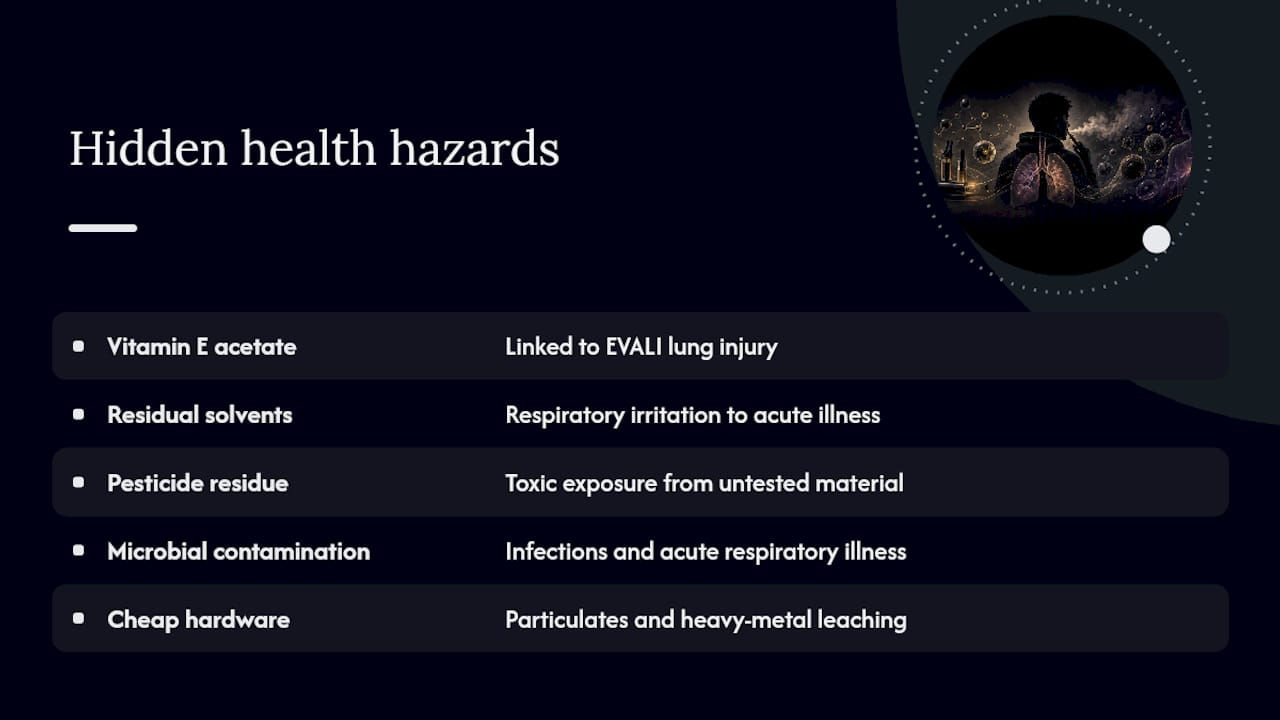
The danger isn’t hypothetical. Counterfeit vape cartridges have been linked to serious lung injury, most notably during the outbreak of EVALI cases tied to vitamin E acetate used as a cheap thickening agent in illicit-market THC oil. Vitamin E acetate behaves fine in food and cosmetics; heated and inhaled as vapor, it’s a different story entirely.
Beyond that specific additive, counterfeit oil is essentially an unknown quantity. Without lab testing, there’s no way to know whether a cartridge contains residual solvents left over from a rushed extraction process, pesticide residue from untested source material, heavy metals leaching from cheap hardware, or microbial contamination from unsanitary production conditions. Any one of these can cause harm ranging from respiratory irritation to more serious acute illness, and combinations compound the risk.
Cheap plastic hardware adds another layer of exposure. Low-quality heating elements and housing materials can degrade under heat and release additional particulates into the vapor stream, on top of whatever contamination already exists in the oil itself.
None of this is visible from the outside, and that’s the core problem with relying on looks alone. A cartridge can appear perfectly normal, smell reasonably close to the real thing, and still carry meaningful health risk. That gap between appearance and actual content is exactly why documentation, the COA, the batch verification, the licensed sourcing, carries more weight than anything you can see or smell.
How Labs Actually Verify What’s In A Cartridge
Legitimate testing labs run several distinct analyses on cannabis vape oil, and understanding what each one catches helps explain why a COA is worth more than a visual inspection.
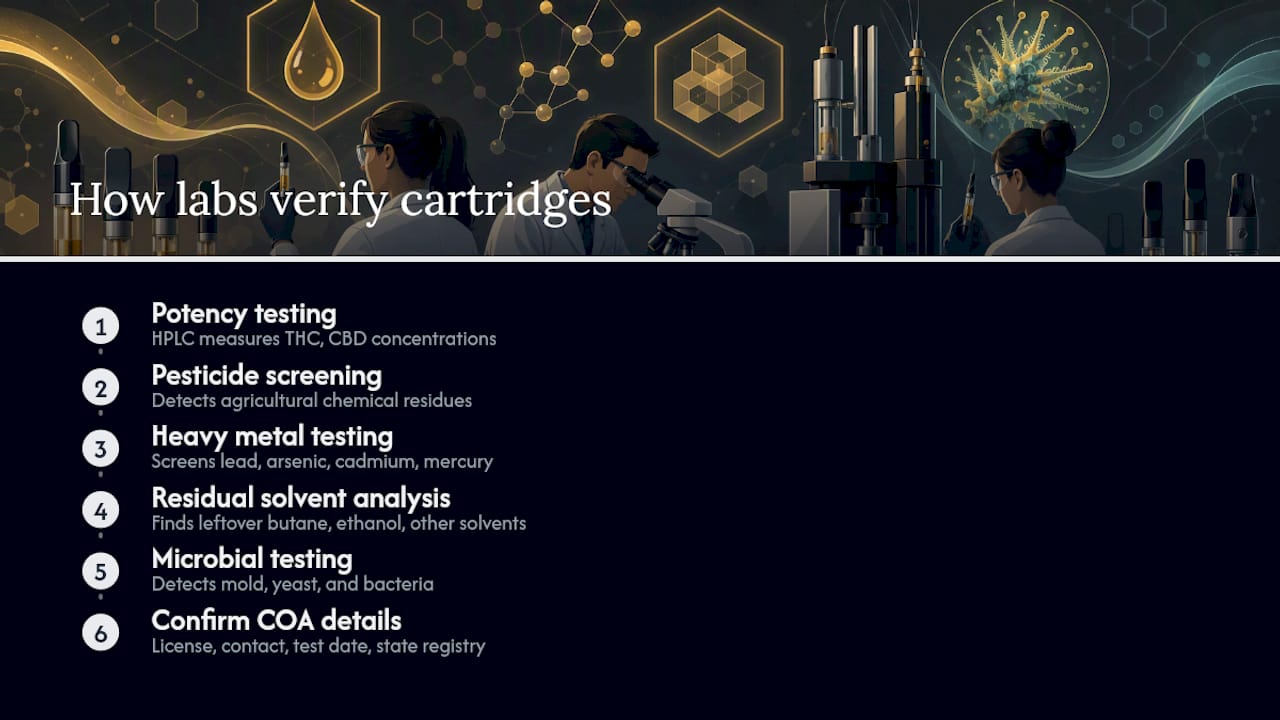
Potency testing uses high-performance liquid chromatography to measure exact concentrations of THC, CBD, and other cannabinoids, confirming the product matches what’s advertised on the label rather than being under or overpotent.
Pesticide screening checks for residue from agricultural chemicals used during cultivation, since concentrated cannabis oil can carry pesticide levels far higher than the raw plant material it came from.
Heavy metal testing screens for contaminants like lead, arsenic, cadmium, and mercury, which can enter the product through contaminated soil, water, or even leaching from low-quality hardware during the vaping process itself.
Residual solvent analysis checks for leftover extraction chemicals, like butane or ethanol, that weren’t fully purged during processing. Poorly run extractions, common in unlicensed operations, tend to leave more solvent behind.
Microbial testing looks for mold, yeast, and bacteria that can grow during improper storage or handling before the product reaches a cartridge.
A legitimate lab lists its license number, contact information, and the specific test date for each of these categories on a COA, and that same information should be independently confirmable through the state’s regulatory records. If a COA is missing entire categories of testing, or the lab can’t be found in your state’s licensed lab registry, that’s not a minor omission. It’s a sign the entire document may be fabricated.
A Note From Elevated Remedies On How We Think About This
We think about counterfeit risk the same way our customers should: as a supply chain problem first, not a visual one. Every product on our shelves needs a traceable, state-compliant source and a COA that actually checks out, because that’s the only reliable filter against what’s flooding the illicit market right now.
When you’re in our shop, ask us to see batch information on anything you’re considering. Our staff can walk you through what a legitimate COA looks like and why it matters more than how the oil looks in the cartridge. We’d rather spend two extra minutes on that conversation than have you leave with something we can’t stand behind.
Storage matters too, once you’ve confirmed a cartridge is genuine. Heat and light degrade cannabinoids over time, so check our guide on properly storing vape cartridges for the specifics on temperature and positioning. And if you’re curious about how the hardware itself is engineered, our breakdown of vaporizer technology covers what separates well-built cartridges from the cheap knockoff hardware that shows up in counterfeit products.
— Juiced
Where To Find Verified Products And Straight Answers
If everything above has you wanting a source you don’t have to interrogate every time, that’s exactly the gap some trusted retailers aim to fill. These shops source through state-compliant channels and keep batch documentation on hand, so the verification work this article just walked you through may already be done before the product reaches their shelves.

That same standard applies across what we carry, including our amanita muscaria products, where sourcing and consistency get the same scrutiny. If you’re in Ann Arbor, consider visiting local shops and asking staff directly about batch traceability on products of interest. If shopping online, browse verified product pages and reach out with questions before you buy to get clear information rather than guessing.
This article is general information, not a substitute for advice from a qualified doctor. Consult a qualified healthcare professional about your own circumstances before acting on anything here.
Sources
- How to Tell if Your Vape Cart Is Real or Fake (THC & Delta 8)
- How to Spot a Fake Vape Cart: 10 Signs to Look For | The Vaper’s Guide
- How to Spot Fake THC Cartridges: Red Flags & Checks