
Vaporizer technology converts a liquid or solid material into an inhalable vapor or aerosol without burning it. The device heats the source material to a temperature high enough to release active compounds as vapor, but below the threshold where combustion occurs. You encounter this in three very different contexts: consumer e-cigarettes and pod systems, dry-herb and concentrate devices used for botanical materials, and precision anesthetic vaporizers in clinical settings. The Cambridge English Dictionary defines a vaporizer as a device that turns a liquid or solid into vapor, a definition that holds across all three contexts.
The primary outcomes of vaporizer technology are:
- Controlled dose delivery without the combustion byproducts that come from burning
- Flavor and aroma preservation, because terpenes and volatile compounds survive at lower temperatures
- Reduced exposure to combustion byproducts such as carbon monoxide and tar
- Adjustable concentration output, which is especially critical in clinical anesthesia settings
Key Takeaways
Vaporizer technology converts liquid or solid material into inhalable vapor through controlled heating, with three core heating methods (conduction, convection, hybrid) and two fundamentally different device classes (consumer and clinical) that share a principle but almost nothing else in design, regulation, or performance standard.
| Point | Details |
|---|---|
| Core definition | A vaporizer heats material below combustion temperature to produce inhalable vapor or aerosol. |
| Three heating methods | Conduction gives fast heat-up; convection gives even extraction; hybrid balances both. |
| Medical vs. consumer | Clinical vaporizers compensate for temperature and pressure to maintain precise dosing; consumer devices do not. |
| Health trade-off | Vaporization reduces combustion byproducts but introduces its own aerosol risks; long-term outcomes remain incompletely understood. |
| Regulation | FDA, NCI, and CDC each play distinct roles; clinical vaporizers are registered medical devices, consumer vapes are not. |
See the sources section below for the authoritative references used throughout this article.
Table of Contents
- What does “vaporizer technology” actually mean?
- How do vaporizers actually heat material?
- What are the main types of vaporizers and what is each used for?
- What components make up a vaporizer?
- How do medical vaporizers differ from consumer devices?
- What are the health risks, and how does vaporization compare to smoking?
- How does U.S. regulation apply to vaporizer devices?
- When does conduction vs. convection actually matter for device selection?
- A note on perspective and editorial approach
- Sources
What does “vaporizer technology” actually mean?
The term covers a broad class of devices. At its core, a vaporizer is any device engineered to gasify a substance for inhalation by applying controlled heat instead of an open flame. The output is vapor or aerosol, not smoke.
Common synonyms and the contexts where you’ll see them:
- Vape / vape device — informal consumer term, used for e-cigarettes, pod systems, and dry-herb portables
- E-cig / e-cigarette — specifically for nicotine-delivery devices that aerosolize a liquid solution
- Vaporiser — British English spelling of the same device class
- Atomizer — technically the heating-element-plus-wick subassembly inside a liquid vaporizer, often used as shorthand for the whole device
- Diffuser — used for essential-oil devices that disperse aromatic vapor into ambient air (not for inhalation in the same sense)
- Anesthetic vaporizer — a precision clinical instrument that adds a metered concentration of volatile anesthetic agent to a patient’s breathing circuit
Consumer devices and clinical vaporizers share the same underlying principle but almost nothing else. A consumer vape is optimized for portability and user customizability. A clinical anesthetic vaporizer is calibrated laboratory equipment, installed in a low-pressure anesthesia circuit, and engineered to hold dosing accuracy across changes in ambient temperature and barometric pressure.
Pro Tip: When reading device specs or clinical labels, watch for “vaporizer” versus “nebulizer.” A nebulizer uses ultrasonic or pressurized air to create a liquid mist of medication for respiratory delivery — it does not heat the substance. Confusing the two in a clinical or procurement context leads to the wrong device class entirely.
How do vaporizers actually heat material?
Three fundamental heating strategies define how a vaporizer works: conduction, convection, and hybrid. Each produces different thermal profiles and user outcomes.
Conduction heats material by direct contact with a hot surface. The chamber wall or a metal plate transfers heat directly into the substance. It’s fast and mechanically simple, which is why compact pens and most entry-level portable devices use it. The trade-off is hotspot risk: material touching the hot surface vaporizes faster than material in the center, leading to uneven extraction.
Convection passes heated air through the material rather than heating the material directly. The air picks up heat from an element, then flows through the botanical or liquid medium. This produces more even thermal distribution and better flavor consistency, because the entire material mass reaches a similar temperature. The cost is higher power draw and longer heat-up time compared to conduction.
Hybrid designs combine both. A conduction element provides fast initial heat-up, and a convection airflow path sustains even extraction once the session is underway. High-performance portables often use this approach because it balances speed with consistency.
A short technical note worth knowing: vaporization is not the same as boiling. Vaporization occurs at the surface of a liquid or solid when the partial pressure of the substance’s vapor exceeds its saturation vapor pressure at that temperature. Temperature control matters because each target compound has a distinct vaporization point. In dry-herb devices, for example, different terpenes and cannabinoids release at different temperatures, so precise setpoint control directly affects what the user actually inhales. How terpenes shape your experience is closely tied to the temperature your device actually reaches.
Typical thermal profiles and user outcomes by heating method:
- Conduction: fast heat-up in most compact devices, higher surface-contact temperature, risk of uneven extraction, simpler hardware
- Convection: slower heat-up, more even extraction, better flavor fidelity, higher power requirement
- Hybrid: moderate heat-up time, good extraction consistency, more complex engineering, common in premium portables
According to StatPearls on electronic vaping delivery, electronic nicotine and cannabis delivery systems vary widely in design, with differing implications for aerosol composition and health risk. That design variability starts with the heating method.
Pro Tip: Chamber material matters as much as heating method. Ceramic chambers distribute heat more evenly than stainless steel and are less likely to impart off-flavors, but they take longer to reach temperature. If a device claims convection heating but uses a thin-walled metal chamber with minimal airflow path, it’s behaving more like conduction in practice.
What are the main types of vaporizers and what is each used for?
Vaporizer technology spans a wide range of device categories, each optimized for a different substance, use case, and performance priority.
Consumer nicotine/e-liquid devices:
- Cig-style e-cigarettes — slim, disposable or rechargeable, designed to mimic the form factor of a cigarette; priority is simplicity and portability
- Pod systems — compact devices with replaceable or refillable liquid pods; balance portability with some user control over nicotine concentration
- Mod/tank systems — larger, user-configurable devices with variable wattage and refillable tanks; priority is power output and customization
- Disposable vapes — single-use, pre-filled, no maintenance; the CDC describes these as battery-operated devices that heat a liquid to produce an aerosol, varying in shape from pens to larger box-style units
Dry-herb and botanical devices:
- Portable dry-herb vaporizers — battery-powered, designed for loose botanical material; chamber geometry and airflow routing are the key engineering variables
- Desktop/tabletop vaporizers — plug-in units with more consistent power delivery; common types use a bag (balloon) or a whip (flexible tube) to deliver vapor
- Bag-style desktops — fill a detachable bag with vapor for slow, measured inhalation; good for group use and precise temperature sessions
- Whip-style desktops — direct draw through a tube connected to the heated chamber; simpler, lower cost
Concentrate-focused devices:
- Dab pens / wax pens — designed for cannabis concentrates (wax, shatter, oil); use a coil or ceramic atomizer that reaches high temperatures quickly; see the beginner’s guide to dab rigs for practical hardware context
- Cartridge-based vape pens — use pre-filled oil cartridges with a 510-thread battery; the most common consumer concentrate format
- E-nail and electronic dab rigs — desktop-level concentrate devices with precise temperature control via a digital controller
Medical and clinical devices:
- Variable-bypass vaporizers — the most common anesthetic vaporizer type; a portion of the carrier gas bypasses the vaporizing chamber and mixes with saturated vapor to produce a calibrated output concentration
- Heated-blender vaporizers — heat both the bypass gas and the vaporizing chamber to maintain consistent output across flow rates
- Direct-injection vaporizers — inject liquid anesthetic directly into the breathing circuit where it vaporizes; used in total intravenous and low-flow anesthesia contexts
What components make up a vaporizer?
Understanding the parts tells you where performance comes from and where problems start.
Core components and their roles:
- Heating element / atomizer — the heat source; determines response time, maximum temperature, and energy efficiency
- Chamber — holds the material being vaporized; geometry, wall thickness, and material (ceramic, stainless steel, titanium) determine heat distribution
- Airflow path — routes air through or around the heated material; path length and cross-section affect vapor temperature at the mouthpiece and particle size
- Mouthpiece — the final contact point; material (glass, plastic, silicone) and length affect vapor cooling and draw resistance
- Power source / battery — in portable devices, battery capacity and discharge rate determine peak heating power and session consistency
- Control electronics — temperature sensors, microcontrollers, and safety cutoffs; quality varies enormously between budget and premium devices
Chamber geometry deserves more attention than most buyers give it. A shallow, wide chamber distributes heat more evenly across botanical material than a deep, narrow one. Thin metal walls heat fast but create steep temperature gradients. Ceramic or glass-lined chambers are slower to heat but maintain a more uniform temperature profile once they reach setpoint.
Airflow routing shapes the vapor the user actually receives. A long, tortuous airflow path cools vapor more before it reaches the mouthpiece, which can reduce throat irritation but also condenses some compounds along the way. Short, direct paths deliver hotter vapor with less condensation loss. Flower vaporizer design requires coordinating all of these variables because loose botanical material behaves differently than a liquid cartridge or a wax concentrate.
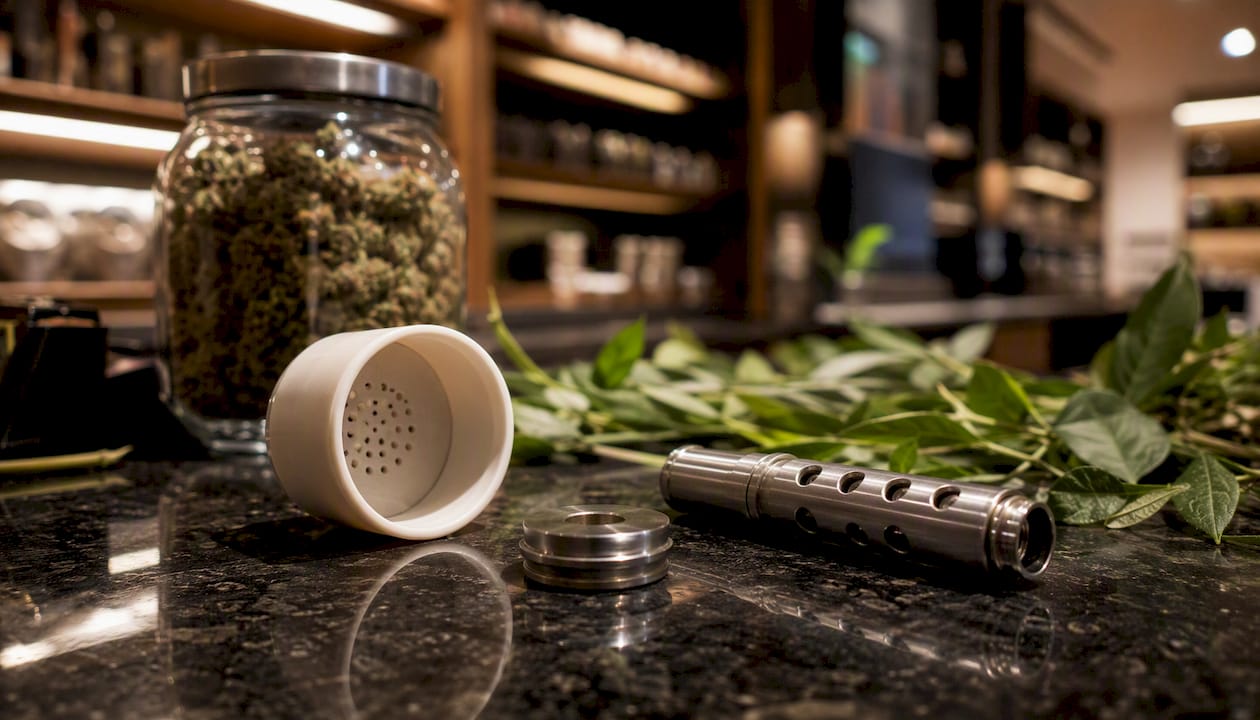
Battery management is the hidden variable in portable performance. A battery that sags under load delivers less power to the heating element mid-session, which means actual chamber temperature drops below the setpoint. Devices with active power regulation maintain more consistent output across the battery’s discharge curve.
Pro Tip: When evaluating a device’s chamber, look for: (1) a ceramic or glass-lined interior rather than bare metal; (2) a full-coverage heating element that wraps the chamber rather than a single coil at the base; (3) an airflow inlet that enters near the bottom of the material load, not just at the top. These three features together are the clearest engineering signal of a device designed for even extraction rather than fast heat-up.
How do medical vaporizers differ from consumer devices?
The clinical goal is precise, repeatable dosing. An anesthetic vaporizer must deliver a specific concentration of volatile agent, measured in volume percent, to a patient’s breathing circuit. That concentration must stay accurate even as ambient temperature changes the vapor pressure of the liquid agent, and as barometric pressure shifts in different clinical environments.
According to StatPearls on anesthesia vaporizers, clinical vaporizers are installed in the low-pressure circuit of an anesthesia delivery system and are engineered to provide accurate, adjustable concentrations of volatile anesthetic agents while compensating for ambient temperature and barometric pressure. That level of environmental compensation does not exist in any consumer device.
| Design dimension | Clinical vaporizer | Consumer vaporizer |
|---|---|---|
| Primary goal | Precise, repeatable anesthetic concentration | User-controlled vapor production and experience |
| Accuracy tolerance | Tightly calibrated to a specific agent | No formal accuracy standard |
| Environmental compensation | Temperature and pressure compensation built in | None |
| Agent compatibility | Agent-specific (keyed filling systems prevent cross-filling) | Multi-substance or cartridge-based |
| Typical installation | Low-pressure anesthesia circuit, hospital/OR | Handheld, portable, or desktop consumer use |
Safety and maintenance features unique to clinical devices:
- Agent-specific keyed filling ports to prevent accidental cross-filling of volatile agents
- Tipping indicators that shut off output if the device is tilted beyond a safe angle
- Regular calibration schedules required by biomedical engineering departments
- Leak testing as part of pre-use anesthesia machine checkout protocols
- Desflurane-specific heated vaporizers (because desflurane’s high vapor pressure at room temperature requires active heating to maintain stable output)
The BJA Education overview of anesthetic vaporizers covers the physics of saturated vapor pressure and the classification of variable-bypass versus other vaporizer types in detail for clinicians who need the full engineering picture.
What are the health risks, and how does vaporization compare to smoking?
Vaporization avoids combustion, which removes the most toxic byproducts of burning tobacco or plant material. That is a real reduction in certain exposures. It is not a risk-free alternative.
Known health concerns associated with vaping aerosols:
- Particulate inhalation — aerosol contains fine particles that reach deep lung tissue
- Additive and flavoring chemicals — some flavoring compounds (diacetyl, for example) are associated with respiratory harm
- Nicotine dependence — most consumer e-liquids contain nicotine; pod systems can deliver high concentrations quickly
- Device-related contaminants — metal particles from heating coils and plasticizers from low-quality materials can enter the aerosol
- Unknown long-term effects — vaping as a widespread practice is recent enough that long-term outcome data remains limited
PMC review literature indicates that vaping aerosol composition and particle behavior are complex, that health-effect evidence is mixed, and that long-term outcomes remain incompletely understood.
For long-term tobacco smokers, switching to vaping may reduce exposure to combustion-specific toxicants. For people who have never smoked, vaping introduces nicotine dependence and inhalation risks with no offsetting benefit. Those are two very different risk profiles, and conflating them is one of the most common errors in public discussion of vaping.
One practical note: if you are using vaporization as part of a harm-reduction or cessation strategy, evidence-based cessation programs and FDA-approved pharmacotherapy remain the best-studied paths. Monitor ingredient lists carefully, particularly for flavoring additives and carrier solvents.
How does U.S. regulation apply to vaporizer devices?
Three federal bodies shape the regulatory picture for vaporizers in the United States:
- FDA (Food and Drug Administration) — regulates e-cigarettes and nicotine delivery devices as tobacco products under the Family Smoking Prevention and Tobacco Control Act; also regulates anesthetic vaporizers as Class II or Class III medical devices depending on intended use and design
- NCI (National Cancer Institute) — provides authoritative definitions and cancer-risk context; the NCI/FDA conceptual definitions classify devices that gasify liquids for inhalation and describe purpose-built anesthetic vaporizers as regulated equipment
- CDC (Centers for Disease Control and Prevention) — issues public health advisories on e-cigarette use, aerosol composition, and associated health risks
When evaluating a device’s labeling, check for:
- Intended use statement — does the label claim medical, therapeutic, or consumer recreational use?
- Ingredient or constituent listing — FDA requires disclosure for regulated tobacco products; clinical devices list compatible agents explicitly
- Device classification — a regulated clinical vaporizer carries a 510(k) clearance or PMA approval number; a consumer vape does not
The clearest practical distinction: a clinical anesthetic vaporizer is a registered medical device with a specific intended use, a calibration requirement, and agent-specific design controls. A consumer vape is a tobacco product (if it contains nicotine) or an unregulated accessory (if it does not). The regulatory pathway, labeling requirements, and post-market surveillance obligations are entirely different.
When does conduction vs. convection actually matter for device selection?
For consumers, the decision rule is straightforward: if you prioritize fast heat-up and a compact form factor, conduction works. If you prioritize flavor consistency and even extraction across a full session, convection or hybrid is worth the extra heat-up time and cost.
For clinicians and engineers evaluating vaporizer performance, the relevant question is dose stability across varying flow rates and ambient conditions, not heat-up speed. Convection-based clinical designs handle variable flow rates more predictably than conduction-based ones.
Scenarios where conduction is the better fit:
- Short sessions where full extraction of the material load is not the goal
- Devices where size and battery life are the primary constraints
- Liquid-cartridge systems where the material is already in close contact with the heating element
Scenarios where convection or hybrid is preferable:
- Dry-herb sessions where even extraction across the full chamber load matters
- Users who want consistent flavor from first draw to last
- Any application where temperature precision at the material surface is a performance requirement
Pro Tip: To verify a device’s claimed heating method, draw slowly and note when vapor first appears. A true convection device produces vapor only when air is moving through it — no draw, no vapor. A conduction device will produce vapor (and waste material) even when you are not drawing, because the chamber stays hot. If a device marketed as “convection” produces visible vapor when you hold it without drawing, it has a significant conduction component regardless of what the spec sheet says.
A note on perspective and editorial approach
Theelevatedremedies operates a retail smoke shop and dispensary at 1123 Broadway St in Ann Arbor, Michigan, stocking vapes, dab rigs, pipes, bongs, CBD products, kratom, and related accessories alongside magic mushroom products. That retail context shapes the practical guidance in this article in specific ways.
How hands-on retail experience informs this content:
- Product familiarity — daily handling of consumer vaporizers, dab rigs, and accessories makes it possible to describe real-world engineering differences rather than spec-sheet abstractions
- Customer questions — the most common points of confusion (conduction vs. convection, medical vs. consumer, atomizer vs. nebulizer) come directly from the questions people ask in-store
- Maintenance perspective — knowing which components fail first, which chambers are easiest to clean, and which airflow designs clog fastest comes from seeing devices in use over time
This article covers both consumer and clinical vaporizer technology. The clinical sections draw on peer-reviewed and regulatory sources; they are informational and not a substitute for clinical training or medical guidance. For consumer device selection, the practical guidance here reflects general engineering principles, not a recommendation of any specific product.
Sources
- Electronic Vaping Delivery of Cannabis and Nicotine - StatPearls - NCBI Bookshelf
- E-cigarettes | About | CDC
- Ncbi
- VAPORIZER | definition in the Cambridge English Dictionary