
Store vape cartridges upright, capped, detached from the battery, and at a stable room temperature in a dark spot. Aim for roughly room temperature, keep them out of sunlight, and use them within a reasonable period under a year for the best flavor and potency. Keep everything away from kids and pets, and don’t leave carts sitting on a battery when they’re not in use.
TL;DR:
- Storing cartridges upright and at a stable temperature of 60 to 70°F helps prevent leaks, clogging, and flavor degradation over time.
- Keep cartridges away from sunlight and high humidity, and use opaque containers or original packaging to slow cannabinoid and terpene breakdown.
- Avoid cold storage or freezing, as cold thickens the oil and causes condensation, which can damage seals and reduce cartridge life.
- During travel, carry cartridges in carry-on luggage in padded, upright cases, and detach from batteries to avoid leaks and accidental firing.
- Regularly inspect cartridges for discoloration, off smells, or performance issues, and replace any showing signs of degradation before use.
Table of Contents
- Storing Vape Carts the Right Way: Position, Temperature, Light, and Seal
- Daily Use vs. Long-Term Storage: What Changes Over Time
- How Should You Pack and Transport Vape Cartridges?
- Cleaning and Care That Extends Cartridge and Battery Life
- Signs Your Vape Cartridge Has Gone Bad
- What Retailers Look for Before Selling a Cartridge
- What We See Go Wrong on the Shop Floor
- Storage Accessories That Actually Solve These Problems
- Sources
Storing Vape Carts the Right Way: Position, Temperature, Light, and Seal
Heat, light, and air are the three things that quietly ruin a good cartridge, and controlling all three is really the whole game.
Start with orientation. Keep the cartridge upright with the mouthpiece pointing up, the same way you’d store a bottle of wine you actually plan to drink soon rather than age. Laying a cart on its side or storing it upside down lets oil pool against the mouthpiece and seep past the seals, which is how you end up with a sticky mess in your pocket or a clogged airway that won’t hit right. The Vaper’s Guide points to this orientation issue as one of the most common, and most avoidable, causes of leaks.
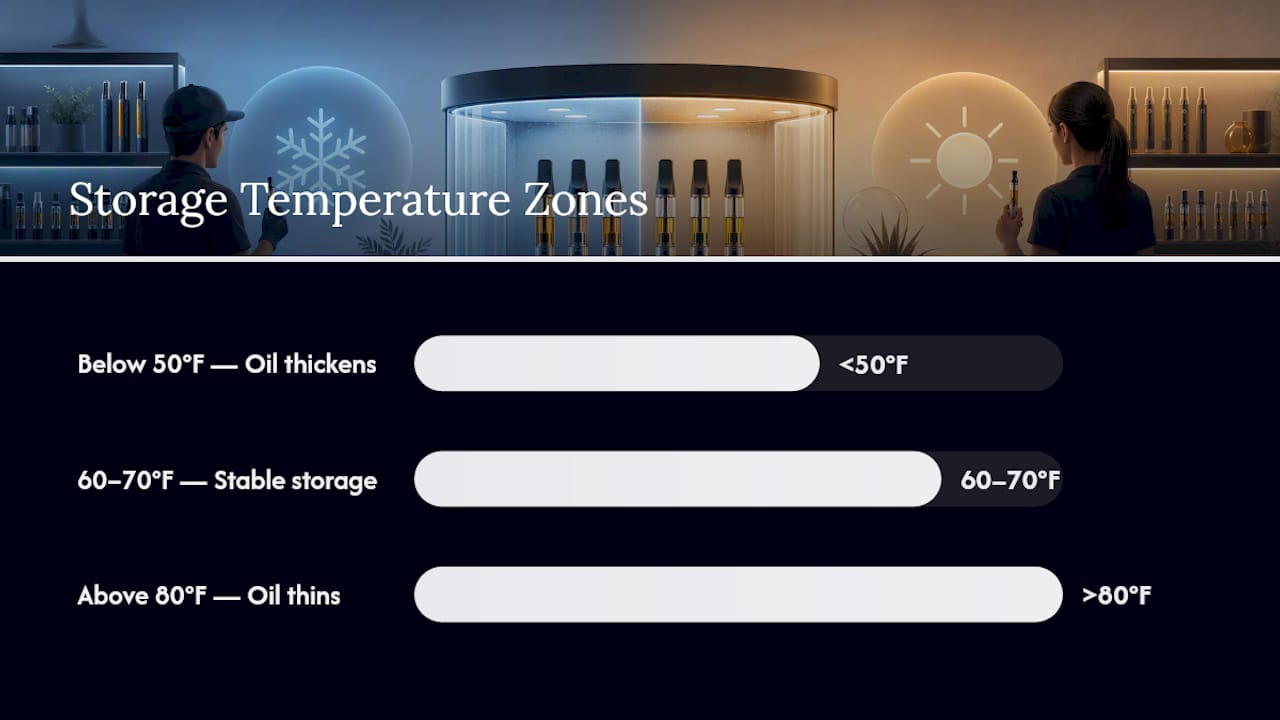
Temperature matters just as much. Vessel’s storage guidance puts the sweet spot around 60 to 70°F, and warns against letting carts sit below 50°F or above 80°F. Heat thins the oil and pushes it through seals it would normally respect; cold does the opposite, thickening the oil until it barely pulls through the coil.
Light is the sneaky third variable. UV exposure breaks down terpenes and cannabinoids over time, dulling flavor and cutting potency, which is why MunchMakers’ guide to cartridge storage recommends opaque containers or a drawer instead of a windowsill. A cartridge that lives on a sunny counter is degrading faster than one tucked in a closet, even at the same temperature.
Rounding out the list:
- Avoid bathrooms, kitchens, and other humid rooms. Moisture around the threads invites corrosion on contacts.
- Keep the original cap on whenever the cart isn’t attached to a battery.
- Save the original packaging. It’s usually opaque, snug, and built for exactly this job.
- Never store a cart loose in a junk drawer with keys or coins that can scratch the mouthpiece or crack the glass.
Pro Tip: If you lose the factory cap, a small silicone storage cap works just as well and costs almost nothing compared to a wasted cartridge.
Daily Use vs. Long-Term Storage: What Changes Over Time
How you store a cart you’re hitting daily is different from how you should treat one going into a drawer for six months. Both routines matter, and mixing them up is where quality slips.
- Daily and weekly use: Keep the cart upright and capped when it’s not attached to the battery, and detach the two whenever you’re not actively vaping. Keep it somewhere accessible but out of direct light, like a nightstand drawer rather than a sunny desk.
- Monthly rotation: If you buy in batches, label each cartridge with the purchase date and use the oldest ones first. Keeping carts in their original box makes this first-in, first-out habit almost automatic.
- Long-term storage: For anything you won’t touch for a month or more, go airtight, cool, and dark. Expect gradual terpene loss starting around the six-month mark, per Vessel, even under good conditions.
Skip the fridge or freezer. Cold oil thickens and gets sluggish in the coil, and pulling a cart in and out of a cold environment creates condensation that works its way into seals it shouldn’t touch, according to Eden Goods. Room temperature, kept steady, beats anything colder.
How Should You Pack and Transport Vape Cartridges?
Travel is where most cartridge disasters happen, and it’s rarely the cartridge’s fault. Pressure changes, heat, and rough handling do the damage.
- Keep cartridges in your carry-on rather than checked luggage. Cabin pressure and temperature are far more stable, and MunchMakers recommends this specifically to avoid the pressure swings that cause leaks in cargo holds.
- Check current TSA and FAA rules before flying, since battery handling requirements can change.
- Never leave a cartridge in a parked car. A dashboard or glovebox in direct sun can climb well past the 80°F threshold within minutes.
- Use a hard shell or padded case that holds the cart upright, not loose in a bag pocket.
- Detach the cartridge from the battery for transport. It prevents accidental activation and protects the threads if the case gets jostled.
For a quick coffee run or a day at work, a silicone cap and an upright pocket case cover you. It’s the multi-hour car ride or the flight where people get careless.
Cleaning and Care That Extends Cartridge and Battery Life
A little maintenance goes a long way toward preventing the clogs and misfires people usually blame on “a bad batch.”
- Wipe the threads and battery contacts with a dry cotton swab, or a cotton swab lightly dampened with isopropyl alcohol, and let everything dry fully before reattaching.
- Never let alcohol or any solvent get inside the cartridge itself. It can dissolve seals and contaminate the oil.
- For battery storage lasting a few weeks or longer, keep the charge around 40 to 60%. Full charges left dormant degrade battery capacity faster, a point Vessel backs up in its storage guidance.
- Unscrew the cartridge from the battery for any storage stretch longer than a day or two. It protects the seals and eliminates the risk of an accidental draw.
- Skip the microwave or hair dryer if a cart feels sluggish in cold weather. Warm it gently between your palms instead. Direct heat can warp plastic components or cook the oil unevenly.
Pro Tip: A cartridge that’s been sitting in a cold car will often “unstick” after two or three minutes of hand warming, no fancy gadget required.
Signs Your Vape Cartridge Has Gone Bad
Cartridges don’t have a hard expiration date the way food does. What they have is a gradual decline, and your eyes, nose, and tongue will tell you when it’s arrived.
- Look: oil that’s noticeably darker than when you bought it, cloudiness, visible separation, or oil pooled around the mouthpiece.
- Smell: anything musty or “off” compared to the clean, terpene-forward smell of a fresh cart.
- Taste: a metallic edge, a burnt note that wasn’t there before, or hits that feel harsher than usual.
- Performance: weak vapor production, a gurgling sound, or inconsistent draws that suggest a clog forming.
Weedmaps frames this correctly: these signs are quality indicators, not a toxicity countdown. Most cartridges hold their best quality for about 6 to 12 months when stored properly, based on findings from Clean Carts. Past that window, expect fading flavor and a slow shift in effect as some THC converts toward CBN. If you’re ever unsure whether a leak or smell means something is actually compromised, stop using it and replace it. It’s a cheaper call than a ruined pocket or a bad hit.
What Retailers Look for Before Selling a Cartridge
Running a shop floor day in and day out teaches you things a manual never will, and most of it comes down to a quick physical check anyone can learn.
Staff at a shop like Theelevatedremedies handle dozens of cartridges a week, which means spotting a bad seal or an off-color cart becomes second nature fast. That kind of hands-on pattern recognition, backed by Weedmaps’ point that visible and sensory checks beat relying on a printed date, is worth borrowing for your own inspections at home.
Run this before every fill or reattachment:
- Check the threads for cracks, residue, or stripped grooves.
- Confirm the cap seats snugly with no gaps.
- Give it a sniff. Fresh should smell like fresh.
- Warm it gently in your hand if the oil looks sluggish, and see if it clears up.
- If two or more of these checks fail, replace the cartridge rather than troubleshoot it further.
For the battery and hardware side of things, step-by-step device cleaning habits carry over well to keeping cartridge contacts corrosion-free.
What We See Go Wrong on the Shop Floor
The three mistakes we see on repeat: cartridges left in hot cars, carts kept screwed onto a battery for weeks, and pocket storage with keys and coins scratching everything up. The fix for most of it is simple. Rest the cart upright, hand warm it before a cold hit, and toss it the moment the smell turns. Build one habit: cap it and set it upright the second you’re done, every time.
— Juiced
Storage Accessories That Actually Solve These Problems
Half of good cartridge storage is habit, and the other half is having the right accessory on hand so the habit is easy to keep. Theelevatedremedies carries upright storage cases built specifically to hold carts capped and vertical, silicone mouthpiece caps for when the factory cap goes missing, and padded travel cases sized for a day bag or a glovebox without the glovebox heat risk.

Our staff can walk you through which case fits your setup, whether you’re rotating a couple of carts a week or keeping a small stash on hand for months at a time, and we can put together a curated storage kit on the spot rather than making you guess at what pairs with what. If you’re also exploring other corners of what we carry, our page on amanita muscaria breaks down one of our most-asked-about product lines. Stop by 1123 Broadway St in Ann Arbor, or check what’s in stock online, and pick up the storage setup that actually matches how you use your cartridges.
Sources
For deeper detail beyond this guide, Vessel covers temperature and battery care, The Vaper’s Guide covers the heat/light/air framework, and Weedmaps explains quality decline versus true expiration.
- How to Store Vapes and Cartridges to Make Them Last Longer - Vessel®
- How to Store Vape Juice and Carts Properly | The Vaper’s Guide
- How to Store Vape Cartridges: Keep Oil Fresh and Prevent Leaks | MunchMakers
- Do weed pens expire? | Weedmaps