
Keep dried magic mushrooms cool, dark, dry, and sealed airtight, and correctly stored mushrooms hold usable potency for months, sometimes past a year. For short-term use, that means a small glass jar with a food-safe desiccant packet, tucked in a dark kitchen cupboard. For anything you’re not touching for six months or more, vacuum-sealing or mylar bags with oxygen absorbers, kept cold, wins every time.
Skip these four things and you’ll skip most of the problems: leftover moisture, warm rooms, direct light, and opening the container over and over to grab a dose.
- Dry mushrooms until they snap like a cracker, not bend like leather.
- Store in an airtight container with a desiccant, away from heat and light.
- Portion your stash so you’re not breaking the seal on your whole supply every week.
- Never store mushrooms that still smell “mushroomy” and damp.
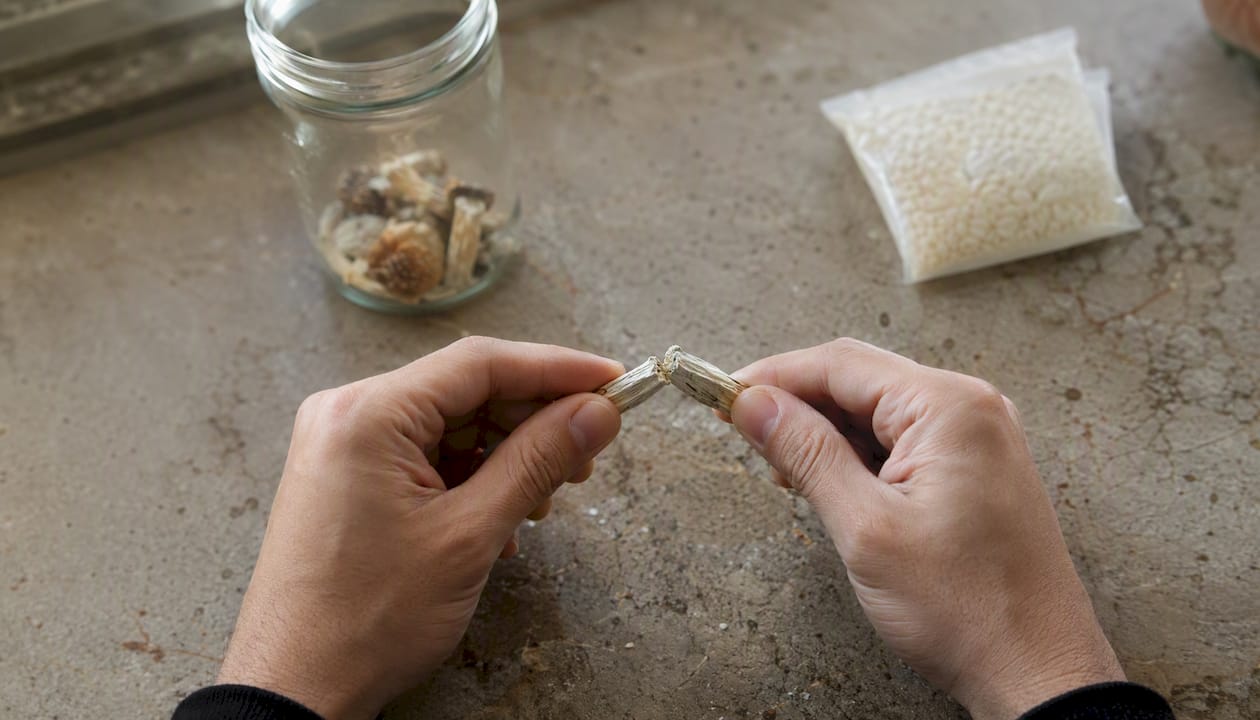
Pro Tip: Snap a stem in half. If it cracks clean with an audible snap, you’re good. If it bends or feels the slightest bit rubbery, it needs more time in the dehydrator before it ever sees a jar.
Key Takeaways
Long-term potency depends on drying mushrooms to a true cracker-dry state before sealing them airtight with a desiccant in a cool, dark, stable space.
| Point | Details |
|---|---|
| Dry completely first | Use a dehydrator at 90 to 110°F, then finish with a desiccant chamber for 24 to 48 hours. |
| Store airtight with desiccant | Vacuum-seal bags or mylar with oxygen absorbers block air, light, and moisture better than loose jars. |
| Keep it cool and dark | A stable, dark cupboard works short-term; a freezer works long-term only once fully dry. |
| Expect gradual potency loss | Properly stored dried mushrooms can last up to a year, with strength declining gradually over that time. |
| Discard any mold | Mold contamination can spread through a batch invisibly, so toss the whole container, not just the spot. |
| Consider pre-packaged options | Theelevatedremedies offers dried mushrooms already dried and sealed to consistent standards for anyone skipping home drying. |
Table of Contents
- How to Store Dried Shrooms Starts With Proper Drying
- What’s the Best Way to Store Dried Mushrooms Long Term?
- Where Should You Keep Stored Mushrooms in Your Home?
- Can You Freeze Dried Magic Mushrooms Safely?
- Do Shrooms Expire, and How Fast Does Potency Fade?
- Signs Your Dried Mushrooms Have Gone Bad
- A Quick Workflow From Drying to the Shelf
- What Does the Research Say About Stability and Storage?
- Labeling and Basic Safety Reminders
- A Pre-Packaged Alternative to Home Drying
- Where to Read More on Mushroom Storage and Safety
- Frequently Asked Questions
- Sources
How to Store Dried Shrooms Starts With Proper Drying
Storage only works if the mushrooms were bone dry before you sealed them up. Moisture is the single biggest driver of spoilage, and it’s also what feeds mold and accelerates the breakdown of psilocybin and psilocin, the two compounds responsible for potency. Peer-reviewed analytical chemistry work confirms these compounds degrade under the kind of conditions damp storage creates, which is exactly why “mostly dry” isn’t good enough.
The most reliable method is a two-stage dry:
- Run mushrooms through a food dehydrator at 90 to 110°F for 12 to 24 hours, depending on cap thickness. Thin stems finish faster than thick caps.
- Transfer them to a sealed container with silica gel or a food-safe desiccant for another 24 to 48 hours. This pulls out the residual moisture trapped deep in denser tissue that the dehydrator alone often misses.
Fan-drying or air-drying works in dry climates, but it frequently fails in humid ones. Growers on forums like r/Homesteading report that air-drying alone leaves mushrooms tacky at the core even when the outside feels crisp, which is why finishing with a dehydrator or desiccant chamber matters more in humid regions than dry ones. Whole caps and stems hold up better in storage than sliced pieces, since more surface area means faster moisture reabsorption once they’re out of the dryer.
Testing dryness is simple:
- Snap test: a stem should break cleanly with a crisp sound.
- Weight check: a fully dried mushroom feels almost weightless, like a dead leaf.
- Texture check: any give or bendiness means it’s not done.
Pro Tip: Work on a clean, wiped-down surface and wash your hands before handling. Cross-contamination from other food prep introduces bacteria that speeds up spoilage even in a fully dried product.
What’s the Best Way to Store Dried Mushrooms Long Term?
Your container choice depends on how long the mushrooms will sit and how much you have. Glass mason jars work fine for short stretches and small batches you’re actively dosing from. Vacuum-seal bags remove air entirely, which slows oxidation, the process that quietly degrades potency even in a dry, sealed jar. Mylar bags with oxygen absorbers are the standard for bulk, long-term storage because they block light completely and, paired with an absorber, strip out nearly all the oxygen inside.
Desiccants deserve their own mention. Food-safe silica gel packets are the easiest option and widely available; they absorb ambient moisture that sneaks in every time you open a container. Drop one in any jar or bag you’re using for storage longer than a few weeks.
| Container | Best for | Trade-off |
|---|---|---|
| Glass mason jar | Daily-use stash, short-term (weeks to a few months) | Needs a desiccant added; still lets in some light unless opaque |
| Vacuum-seal bag | Mid to long-term, portioned doses | No visual check without opening the seal |
| Mylar bag + oxygen absorber | Bulk, multi-month to multi-year storage | Bulkier to portion from once opened |
Layering these methods works best. A common approach is vacuum-sealing individual doses, then dropping those sealed packets into a larger jar with a desiccant for extra insurance. Whole mushrooms also store noticeably better than ground powder, since grinding exposes far more surface area to air and light. If you need powder for capsules, grind only what you’re about to use.
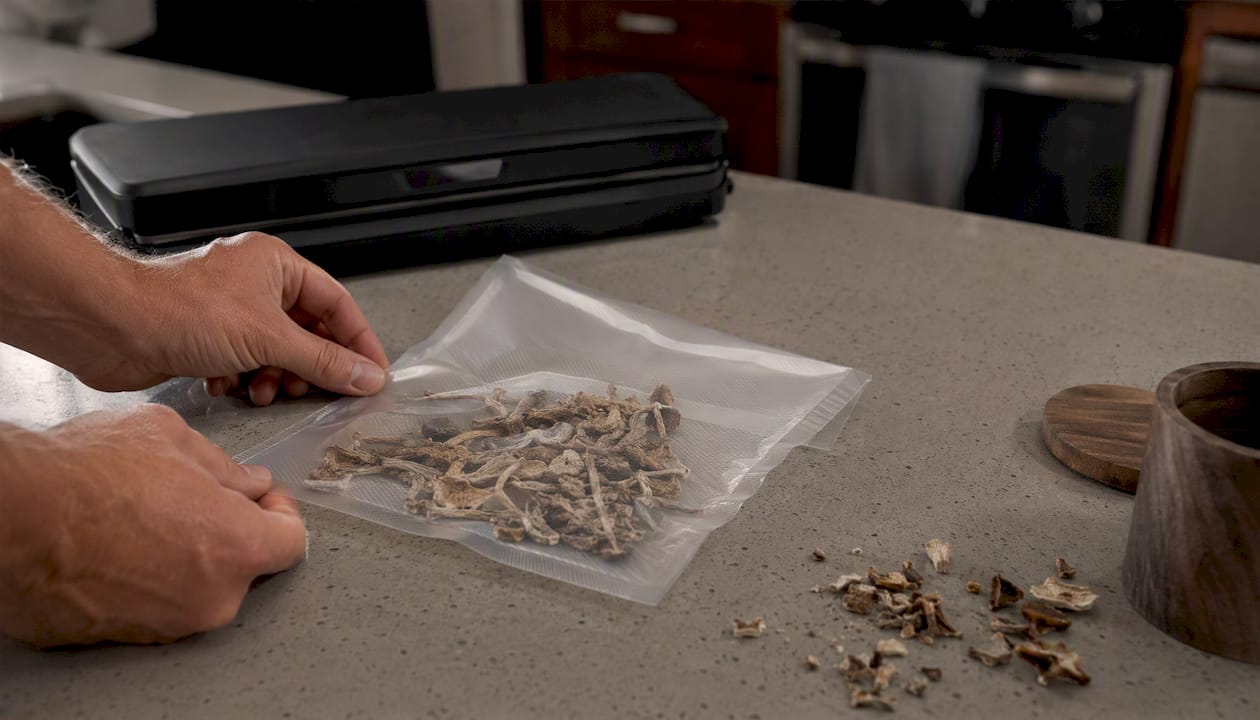
Pro Tip: Pack containers loosely enough that mushrooms aren’t crushed against the glass or bag seams. Crushed caps release more surface area to oxygen, which speeds up potency loss even inside a sealed container.
Where Should You Keep Stored Mushrooms in Your Home?
Temperature, light, and humidity are the three variables that quietly wreck a good drying job. A dark kitchen cupboard or closet, away from the stove, a window, or a heating vent, is ideal for anything you’re using within a few months. Room temperature is fine as long as it stays stable. Swings between hot and cool encourage condensation inside the container, even a sealed one.
For longer stretches, colder is better. A cool basement, a dedicated mini-fridge, or a freezer (once mushrooms are fully dry) extends stability well beyond what a kitchen cupboard offers.
- Use opaque containers, foil wrap, or amber glass. UV and even regular indoor light break down psilocybin over time.
- Keep relative humidity in the storage area low. Anything humid invites moisture back into an otherwise dry product.
- Avoid storing near appliances that generate heat, even indirectly.
- Check desiccant packets periodically. Most silica gel changes color when saturated and needs replacing.
Pro Tip: If you’re using a decorative jar because it looks nice on a shelf, put it inside a cabinet instead. Sunlight through a window will degrade potency faster than almost anything else on this list.
Can You Freeze Dried Magic Mushrooms Safely?
Freezing helps, but only under the right conditions. If mushrooms are genuinely cracker-dry and vacuum-sealed, a freezer can extend usable shelf life for years past what a cupboard offers. The catch is that any leftover moisture turns into ice crystals, which rupture cell walls and accelerate potency loss the moment the mushrooms thaw. Worse, condensation forming inside a container that isn’t fully sealed introduces the exact moisture problem you were trying to avoid in the first place.
A safe freezer routine looks like this:
- Confirm dryness with the snap test before freezing anything. Never freeze mushrooms with any bend left in them.
- Vacuum-seal in portioned amounts so you’re not thawing and refreezing your whole supply.
- Place the sealed bag inside a second airtight container or freezer bag for extra protection against ambient moisture.
- Thaw at room temperature inside the sealed bag before opening it, so any condensation forms on the outside of the packaging rather than on the mushrooms.
Refrigeration sits in between a cupboard and a freezer. It’s useful for a few months of storage but not ideal for years, and fridges cycle temperature more than people realize, which invites the same condensation risk as moving between hot and cold spaces repeatedly.
- Never move a sealed container from cold to warm and open it immediately. Let it reach room temperature first.
- Keep a frozen batch in one spot rather than moving it in and out.
Pro Tip: Label frozen batches with the freeze date. Even properly dried and sealed mushrooms benefit from a “use by” mental clock, since repeated thaw cycles chip away at potency regardless of how well you packed them.
Do Shrooms Expire, and How Fast Does Potency Fade?
Shrooms don’t expire the way fresh produce does, but they do decline. The Missouri Poison Center notes that properly stored dried mushrooms may last up to a year, with potency gradually dropping over that stretch, while fresh mushrooms spoil far faster, often within days.
Realistic expectations: a well-dried, well-sealed batch used within a few weeks to a couple of months will taste and perform close to fresh. Past six months, expect a gradual, modest dip in strength. Past a year, plan on noticeably weaker doses even if the batch looks and smells fine.
- Heat, light, moisture, and oxygen exposure are the four accelerants behind every potency drop.
- Whole dried caps and stems hold potency longer than ground powder, since powder exposes more surface area to air.
- If you’re microdosing on a schedule, rotate older stock to the front and adjust dose slightly upward as a batch ages past six months.
Signs Your Dried Mushrooms Have Gone Bad
Any visible mold means the entire batch goes in the trash, not just the affected piece. Mold spreads through mycelial threads you can’t always see, so a small green or white patch on one cap can signal contamination running through mushrooms that still look clean.
Beyond mold, trust your senses:
- A damp, musty, or ammonia-like smell instead of the normal earthy scent.
- Sticky or tacky spots on caps or stems that used to feel dry.
- Any softness or give when you try the snap test, even after storage.
If a batch feels slightly under-dried but shows no mold or odor, you can often re-dry it and salvage it. Once mold or a genuinely off smell shows up, re-drying won’t fix contamination that’s already set in. Discard it.
A Quick Workflow From Drying to the Shelf
- Dry to cracker-dry using a dehydrator, then finish with a desiccant chamber for 24 to 48 hours.
- Portion into doses before sealing, so you’re not reopening a bulk container constantly.
- Vacuum-seal or use mylar bags with an oxygen absorber, plus a desiccant packet in the outer container.
- Store in a cool, dark, stable spot, or the freezer for anything you won’t touch for months.
- Label each batch with the dry date and check on desiccants periodically.
- Keep a small “daily use” jar separate from your bulk long-term stash to limit how often the main supply gets opened.
- Wipe down tools and containers between batches to avoid cross-contamination.
What Does the Research Say About Stability and Storage?
The practical “dry it, seal it, keep it cool and dark” rule isn’t just folk wisdom. Analytical chemistry research on psilocybin and psilocin stability shows that heat, light, and moisture exposure drive chemical breakdown of these compounds over time. Separate laboratory studies have characterized how these alkaloids degrade under different environmental conditions, giving real chemical grounding to advice that used to be passed along mostly through word of mouth.
Poison-center guidance backs this from a consumer-safety angle rather than a lab-bench one. The Missouri Poison Center’s guidance on gradual potency loss lines up with what the chemistry predicts: environmental exposure, not some fixed expiration date, is what determines how long a batch stays potent.
- Labs confirm dryness and degradation using chromatography, not guesswork.
- The home version of that test is simpler: the snap test and a sealed, desiccant-backed container.
Pro Tip: You don’t need lab equipment to apply lab-backed principles. If the conditions that degrade psilocybin in a chemistry study are heat, light, and moisture, eliminating those three things at home gets you most of the benefit a controlled lab environment provides.
Labeling and Basic Safety Reminders
Write the dry date, source or strain if known, and any drying notes on every container. This tiny habit does two things: it tells you exactly when to expect potency to start slipping, and it keeps batches from getting mixed up if you’re storing more than one type.
Beyond labeling, keep mushrooms out of reach of children and pets, store them separately from food items to avoid confusion, and use a locked cabinet or box if anyone else has access to your home. For readers curious about what quality product looks like before it even reaches the drying stage, Elevated Remedies’ quality guide covers the visual cues worth knowing.
A Practical Note on Getting This Right
Most storage failures come down to skipping the snap test out of impatience, not a bad container or the wrong desiccant. Small-batch trials, where you dry a test piece, snap it, and only then commit the full harvest to long-term storage, catch the mistake before it costs you a whole batch. Elevated Remedies’ own science and safety guide is worth a read if you want the fuller picture on handling psilocybin responsibly.
A Pre-Packaged Alternative to Home Drying
Home drying works, but it takes equipment, patience, and a willingness to redo a batch if the snap test fails. Theelevatedremedies sells dried magic mushrooms that arrive already at a consistent, verified dryness in sealed packaging, which skips the entire drying and testing process for anyone who’d rather not gamble on a dehydrator setting.

If a mycelium-derived alternative interests you, Theelevatedremedies also carries amanita muscaria products worth exploring. Whatever you choose, buy only where it’s legal in your area and store anything you bring home using the same cool, dark, airtight principles covered above. Stop by the Ann Arbor location or browse the online shop to see what’s currently in stock.
Where to Read More on Mushroom Storage and Safety
- The Missouri Poison Center’s FAQ covers realistic shelf-life expectations and spoilage safety in plain language.
- Peer-reviewed analytical chemistry research explains how psilocybin behaves and degrades under lab conditions.
- Studies on alkaloid degradation pathways detail exactly which environmental factors drive chemical breakdown.
- For humidity-control principles that apply just as well to mushroom storage, this guide on humidor humidity control breaks down why consistent moisture levels matter for sensitive organic material.
Frequently Asked Questions
Do shrooms expire? They don’t spoil the way fresh food does, but they do lose strength gradually. A properly dried, sealed batch can stay usable for up to a year or longer, according to poison-center guidance, though potency drops off gradually the longer they sit.
What’s the best storage temperature for dried mushrooms? A stable, cool room temperature works for short-term storage. For anything beyond a few months, a cold, dark space or a freezer (only once fully dry) slows potency loss further.
How do I store dried shrooms if I don’t have a vacuum sealer? A glass mason jar with a food-safe desiccant packet, kept in a dark cupboard, is a solid option for smaller amounts used within a few months.
Microdose capsules vs gummies: does storage differ? Capsules made from ground mushrooms are more sensitive to air and light than whole dried product, since grinding exposes more surface area. Gummies and other edibles have their own shelf-life profile tied to the base ingredients, so check product-specific guidance rather than applying dried-mushroom rules to them.
Can I store dried mushrooms in the freezer right away? Only if they’re fully cracker-dry first. Freezing mushrooms with any residual moisture creates ice crystals that rupture cell walls and speed up potency loss once thawed.