
TL;DR:
- High-quality psilocybin mushrooms are defined by cracker-dry texture, blue bruising indicating oxidation, and verified alkaloid content. Visual cues like firmness and proper spore print analysis support safety and potency assurance, but batch-specific lab testing remains essential. Maintaining moisture control and documentation ensures consistent, safe, and effective mushroom experiences.
High quality psilocybin mushrooms are defined by four measurable traits: cracker-dry texture, blue bruising on the flesh, firm stems, and laboratory-verified alkaloid content. These are not aesthetic preferences. They are the physical and chemical markers that separate potent, safe mushrooms from degraded or misidentified ones. Whether you are exploring psilocybin for microdosing, personal wellness, or educational purposes, knowing the signs of high quality psilocybin mushrooms before you buy protects both your safety and your experience. The industry term for this evaluation process is quality assurance, and it applies to psilocybin products just as it does to any botanical supplement.
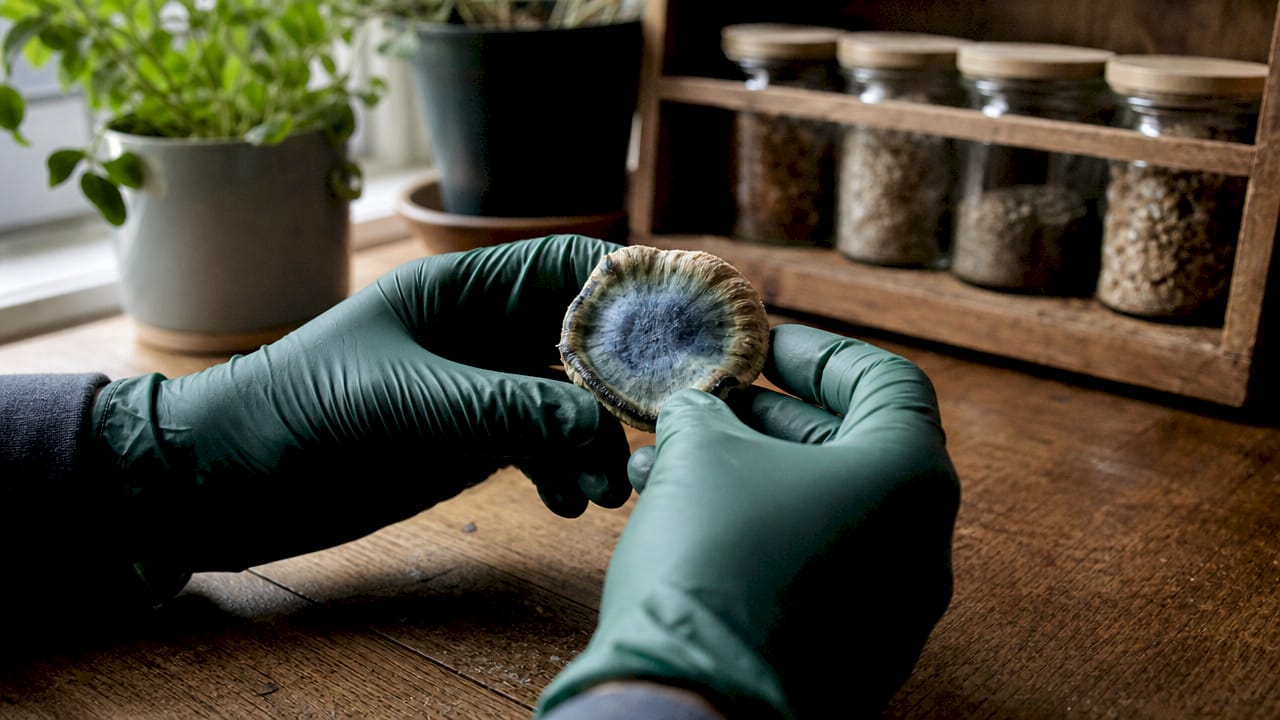
1. Signs of high quality psilocybin mushrooms start with dryness
Proper dryness is the single most reliable physical indicator of quality. High-quality dried mushrooms should snap cleanly when bent, a condition known as “cracker-dry.” If a mushroom bends without breaking, it still holds moisture. That moisture is a problem.
Damp mushrooms degrade faster. Moisture accelerates mold growth and breaks down psilocin, the active compound responsible for psychedelic effects. A mushroom that looks intact but feels rubbery has already begun losing potency and may harbor invisible microbial contamination.
The cracker-dry standard also tells you something about how the mushrooms were handled after harvest. Proper post-harvest drying requires controlled airflow, low humidity, and protection from heat. Mushrooms that arrive soft or sticky were either dried poorly or stored improperly after drying.
Pro Tip: Pinch the stem between two fingers and apply gentle pressure. A quality dried mushroom resists compression and snaps rather than bends. If it flexes, pass on it.
2. What blue bruising actually tells you
Blue bruising is one of the most misunderstood characteristics of psilocybin mushrooms. The blue color appears when the flesh is cut, pressed, or damaged, and many people assume more bruising means stronger mushrooms. That assumption is wrong.
Blue bruising indicates oxidation of psilocin, the active compound in the mushroom. Oxidation is a form of degradation. The blue color signals that psilocin is breaking down on contact with air, not that the mushroom is packed with it.
- Bruising typically appears on the cap edges, stem base, and any area of physical damage.
- Fresh bruising after handling is normal and expected.
- Heavy, widespread bruising before you even touch the mushroom suggests rough handling or age.
- Mushrooms with intense blue staining can still be low potency if harvested or stored improperly, since psilocin degrades rapidly after injury.
“Blue staining shows compound oxidation, not dose level.” — Fungi Academy
The presence of some bruising confirms the mushroom contains psilocin. The absence of bruising does not mean low quality. What matters is the context: fresh bruising from recent handling is a good sign, while old, blackened bruising across the entire surface suggests the mushrooms have been mishandled or are past their prime.
3. Firm texture and physical structure as freshness indicators
Texture communicates how a mushroom was grown, harvested, and stored. Quality psilocybin mushrooms feel firm and dry to the touch, with intact caps and undamaged gills. Crumbling caps, hollow stems, or a powdery surface are all signs of poor handling or excessive age.
The stem is particularly telling. A firm, dense stem indicates the mushroom was harvested at the right stage of development and dried correctly. A hollow or spongy stem suggests either premature harvest or moisture damage during storage.
Pharmaceutical-grade care includes protection from light, heat, and moisture throughout production and storage. That standard applies directly to psilocybin mushrooms. Products stored in opaque, airtight containers with desiccant packets consistently maintain better texture and potency than those sold in open bags or clear plastic.
Color also matters. Quality dried mushrooms range from golden tan to medium brown, with caps that may show slight blue or green tinting from bruising. Mushrooms that appear black, gray, or have visible fuzzy growth are contaminated and should not be used.
4. Spore print color and physical identification markers
Identifying a psilocybin mushroom correctly requires more than one data point. Relying on a single feature, like bruising alone, creates real risk of misidentification. The safest approach combines cap shape, gill color, stem traits, and spore print analysis.
Here is a practical identification sequence:
- Examine the cap. Psilocybe cubensis, the most common cultivated species, has a convex to broadly umbonate cap that flattens with age. The surface is smooth and pale golden to caramel brown when fresh.
- Check the gills. Gills should be closely spaced, attached to the stem, and gray to purple-brown in color. Gills that are white or yellow suggest a different species.
- Look at the stem. A partial veil remnant (annulus) on the stem is characteristic of Psilocybe cubensis. Its presence helps rule out look-alike species.
- Take a spore print. Place the cap gill-side down on paper for 6–8 hours. A dark purple-brown to black spore print confirms the species. A white or rust-brown print points to a different genus entirely.
- Cross-check with field guides. Apps provide 85–92% accuracy but should never be used alone. Pair app results with a printed field guide and, when possible, expert consultation.
Pro Tip: Always take your spore print on white paper. A dark print on white paper is unambiguous. Using dark paper can mask the true color and lead to a false confirmation.
Spore print analysis is a definitive step that most casual buyers skip entirely. That shortcut is how misidentification happens. Multi-method verification is the safety standard, not an optional extra.
5. Lab testing and Certificates of Analysis
Visual inspection tells you a lot, but it cannot tell you everything. The only way to confirm psilocybin content and rule out microbial contamination is through third-party laboratory testing. This is where quality assurance moves from observation to verification.
Psilocybin content in dried mushrooms ranges from 0.5% to 2.5% by dry weight, and the gold standard measurement method is LC-MS/MS (liquid chromatography with tandem mass spectrometry). That range is wide. A mushroom at 0.5% and one at 2.5% will produce very different experiences at the same dose.
A legitimate Certificate of Analysis (CoA) must cover:
- Potency panel: psilocybin, psilocin, and baeocystin content by dry weight.
- Microbial safety: confirmed absence of Salmonella, E. coli, and molds.
- Batch specificity: the CoA must reference the exact batch, not a generic product line.
Third-party CoAs for each batch confirm both potency and microbial safety. A generic lab report from six months ago does not apply to the product in front of you today. Batch-specific documentation is the only form that actually protects you.
| Quality indicator | Without lab certification | With lab certification |
|---|---|---|
| Psilocybin content | Unknown, estimated visually | Confirmed by LC-MS/MS |
| Microbial safety | Unverified | Tested for Salmonella, E. coli, molds |
| Potency consistency | Variable between batches | Within verified tolerance |
| Baeocystin content | Not assessed | Quantified in full alkaloid panel |
| Consumer confidence | Based on appearance only | Backed by documented data |
Premium products often homogenize material to keep dose consistency within a 5% variance. That level of consistency is only achievable when producers test every batch and adjust accordingly. Without a CoA, you are guessing at dosage, and that guesswork carries real risk for anyone microdosing or managing a specific wellness protocol.
For a deeper look at how potency varies across species, the psilocybin species effects guide at Theelevatedremedies covers the key differences in alkaloid profiles across commonly available varieties.
Key takeaways
High quality psilocybin mushrooms require cracker-dry texture, appropriate bruising, firm structure, confirmed species identity, and batch-specific lab verification to be considered safe and reliably potent.
| Point | Details |
|---|---|
| Cracker-dry texture is non-negotiable | Mushrooms that bend instead of snap contain moisture that degrades psilocin and promotes mold. |
| Blue bruising signals oxidation, not strength | More bruising means more psilocin breakdown, not higher potency. |
| Spore prints confirm species identity | A dark purple-brown to black print is required to confirm Psilocybe species. |
| Batch-specific CoAs are the only valid proof | Generic lab reports do not apply to individual batches and cannot verify current potency. |
| LC-MS/MS is the gold standard for potency testing | Psilocybin content ranges from 0.5% to 2.5% by dry weight and requires precise measurement. |
What I have learned from years of paying attention to quality
Most people focus on bruising because it is visible and feels like a signal. I understand the instinct. Blue color on a mushroom looks like proof of something. But after years of paying close attention to how quality actually translates into experience, I have come to see bruising as one of the least reliable indicators on its own.
The mushrooms that consistently deliver clean, predictable effects share one thing: they were handled carefully from harvest to storage. That means cracker-dry, properly packaged, and ideally backed by a CoA. The ones that disappoint almost always have a texture problem or no documentation at all.
Visual identification is genuinely difficult. Even experienced people get it wrong without a spore print and a field guide. Apps are useful as a first pass, but 85–92% accuracy means real error rates. That gap matters when the stakes involve your health.
My honest advice: treat the CoA as a baseline requirement, not a bonus. If a seller cannot provide batch-specific lab results, that absence tells you something. The shrooms buying guide at Theelevatedremedies walks through exactly what to ask for and what to look for before you commit to a purchase. Use it.
— Juiced
Quality psilocybin products at Theelevatedremedies in Ann Arbor
Theelevatedremedies, located at 1123 Broadway St in Ann Arbor, Michigan, sources its psilocybin products with quality and consistency as the baseline standard. The dispensary carries dried magic mushrooms, microdosing capsules, and mushroom chocolates, all selected for purity and reliable potency.
If you want to understand what you are buying before you walk in, the psilocybin guide for 2026 covers identification, potency, and safety in plain language. For those curious about mushroom varieties beyond Psilocybe cubensis, the Amanita muscaria page explains the key differences between species and what to expect from each. The team at Theelevatedremedies is there to answer questions and point you toward the right product for your goals.
FAQ
What does cracker-dry mean for psilocybin mushrooms?
Cracker-dry means the mushroom snaps cleanly when bent rather than flexing or bending. This dryness level prevents mold growth and preserves psilocin content during storage.
Does more blue bruising mean stronger mushrooms?
No. Blue bruising indicates psilocin oxidation, which is a form of degradation. Heavy bruising can actually signal lower potency due to compound breakdown from poor handling.
What should a Certificate of Analysis include?
A valid CoA must be batch-specific and cover psilocybin, psilocin, and baeocystin content measured by LC-MS/MS, plus microbial testing for Salmonella, E. coli, and molds.
How accurate are mushroom identifier apps?
Mushroom identifier apps reach 85–92% accuracy but should never be used as the sole identification method. Pair app results with a spore print, field guide, and expert consultation for safe confirmation.
What psilocybin content range is considered normal?
Psilocybin content in dried mushrooms ranges from 0.5% to 2.5% by dry weight depending on strain and growing conditions. Lab testing is the only reliable way to know where a specific batch falls within that range.