
TL;DR:
- Different psilocybin species vary widely in alkaloid content, potency, and cultivation needs, impacting dosage and experience. Recognizing species and strain differences is essential for accurate research, consistent microdosing, and safe use, as individual alkaloid profiles shape subjective effects beyond psilocybin percentage alone. Psychological factors like mindset and setting influence outcomes more than species, but precise data ensures reliable application and scientific validity.
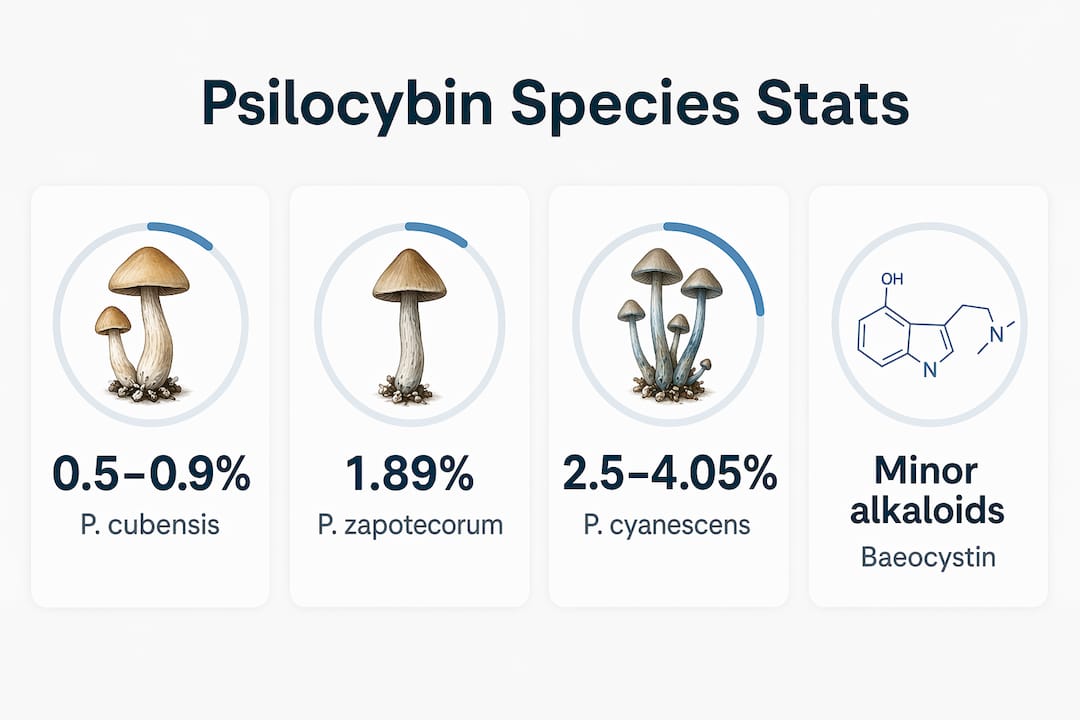
Comparing psilocybin species is the foundation of informed use because chemical composition, potency, and subjective effects differ dramatically across the more than 200 species that produce psilocybin. Psilocybe cubensis, the most widely recognized species, contains 0.5% to 0.9% total tryptamines, while Panaeolus cyanescens reaches 2.5% to 4.05%. That gap translates directly into dose calculations, experience intensity, and therapeutic suitability. Whether you are exploring psilocybin for wellness, microdosing, or clinical research, understanding the differences between species is not optional. It is the starting point for everything else.
Why compare psilocybin species: chemical composition and potency
Psilocybin content varies far more across species than most users expect. P. zapotecorum measures 1.89% psilocybin content, while P. stuntzii sits at just 0.36% to 0.45%. That fivefold difference means a dose that produces a mild experience with one species could be overwhelming with another. Potency is not just a curiosity. It is a safety variable.
Raw psilocybin percentage is only part of the picture. Minor alkaloids like baeocystin and aeruginascin are present in varying concentrations across species, and secondary alkaloids modulate the character of the experience beyond what psilocybin alone predicts. Think of it like comparing wines by alcohol percentage alone. The tannins, acids, and esters shape the actual experience just as much.
Variability does not stop at the species level. Within-species psilocybin variability exists even within a single fruiting flush, meaning two mushrooms from the same batch can differ meaningfully in potency. Storage conditions compound this further. Freezing fresh mushrooms before drying accelerates oxidation, which shifts psilocybin to psilocin ratios and alters the chemical profile you actually consume.
The table below summarizes key species and their approximate alkaloid ranges to illustrate how wide the spectrum is.
| Species | Approx. psilocybin/tryptamine content | Notes |
|---|---|---|
| Psilocybe cubensis | 0.5–0.9% total tryptamines | Most common; baseline reference |
| Panaeolus cyanescens | 2.5–4.05% total tryptamines | Significantly more potent |
| P. zapotecorum | ~1.89% psilocybin | High-potency species |
| P. stuntzii | 0.36–0.45% psilocybin | Lower-potency species |
| P. natalensis | 0.6–1.81% alkaloids | Wide intra-species range |
Pro Tip: Never assume potency from species name alone. Even within a single species like P. cubensis, alkaloid content can vary by a factor of two or more depending on genetics, growing conditions, and flush number.
How do different psilocybin species affect the experience?
Chemical differences translate into real differences in trip intensity, onset speed, and qualitative character. A higher total tryptamine load generally produces faster onset, greater visual intensity, and longer duration. Users who switch from P. cubensis to Panaeolus cyanescens without adjusting their dose frequently report unexpectedly strong experiences, because the potency gap is not intuitive from appearance alone.

The entourage effect in mushrooms describes how minor compounds interact with psilocybin to shape the experience. Some species are reported as more stimulating and visually active, while others produce a heavier, more sedating body effect. These qualitative differences are not fully explained by psilocybin percentage alone, which is why researchers and experienced users pay attention to full alkaloid profiles rather than a single number.
Here is a summary of commonly reported effect differences across major species:
- P. cubensis: Moderate potency, well-documented, predictable onset of 30 to 60 minutes, widely used for both therapeutic and recreational purposes
- Panaeolus cyanescens: High potency, faster onset, more intense visuals, shorter duration reported by some users
- P. azurescens: Among the highest natural psilocybin concentrations, reported as more neurologically intense, associated with wood-loving growth environments
- P. natalensis: Broader alkaloid range, often described as producing a warmer emotional quality compared to P. cubensis
- P. zapotecorum: High psilocybin content, traditionally used in Mesoamerican ceremonial contexts, less studied in clinical settings
One critical finding from research reframes how much species actually drives experience. Mindset and setting account for up to 58% of variability in psilocybin experience, while species differences account for at most 10%. This does not make species comparison irrelevant. It means species selection sets the chemical ceiling, but the psychological context determines how close to that ceiling you get.
Why does psilocybin species comparison matter for cultivation and research?
Cultivation requirements differ significantly across species, and choosing the wrong one for your climate or skill level produces inconsistent results. P. natalensis fruits prolifically at 68 to 74°F, while P. cubensis prefers 70 to 76°F. That narrow overlap matters in practice. A grower optimizing for one species may inadvertently stress another, which affects both yield and chemical profile.
The distinction between a strain and a species is one of the most practically important concepts in this field. A strain is a genetic variant within a species, the way Golden Teacher and B+ are both strains of P. cubensis. A species is a distinct biological category. Treating these as interchangeable leads to unreliable dosing and inaccurate chemical profiling because genetic and environmental variability within a species can be as significant as differences between species in some cases.
For clinical research, this distinction is not academic. It is a regulatory and reproducibility issue. Clinical trials require standardized psilocybin content, and natural mushroom sources introduce variability that synthetic psilocybin avoids. Researchers using whole mushrooms must document species, strain, growth conditions, and chemical testing results to meet GMP compliance expectations. Ignoring species diversity in trial design produces results that cannot be reliably replicated or compared across studies.
The table below compares cultivation parameters and chemical consistency across three commonly studied species.
| Species | Optimal temp (°F) | Alkaloid range | Research use |
|---|---|---|---|
| P. cubensis | 70–76 | 0.5–0.9% | Most studied; clinical baseline |
| P. natalensis | 68–74 | 0.6–1.81% | Emerging research interest |
| P. azurescens | 50–65 | Up to ~1.78% | Outdoor cultivation; less controlled |
Pro Tip: Match your species choice to your environment and goals. P. cubensis is the most forgiving for beginners and the most documented for therapeutic research. P. azurescens requires outdoor wood-based substrates and cooler climates, making it a poor choice for indoor cultivation.
Common misconceptions when comparing psilocybin species
The most damaging misconception is that species name guarantees a predictable experience. It does not. Significant chemical variability exists within species and even within the same fruiting flush, which means two samples labeled identically can produce meaningfully different effects. Treating a species name as a dosing guarantee is a practical error with real consequences.
Several other misconceptions consistently mislead both new and experienced users:
- Strain equals species: Golden Teacher is a strain of P. cubensis, not a separate species. Conflating the two leads to false comparisons and unreliable dosing expectations.
- Higher potency means better quality: Potency is one variable. The quality of therapeutic response, including emotional connection and insight depth, does not scale linearly with psilocybin percentage.
- Appearance predicts potency: Cap size, color, and bruising intensity are not reliable potency indicators. Chemical testing is the only accurate method.
- Storage is neutral: Improper storage degrades psilocybin and increases psilocin through oxidation, shifting the chemical profile and altering the experience in ways that are difficult to predict.
- Species alone drives the experience: As noted above, set and setting account for the majority of experience variability. Species selection matters, but it operates within a much larger context.
Understanding mushroom genetics helps clarify why these misconceptions persist. Genetic drift within cultivated strains, combined with environmental growing conditions, produces chemical profiles that diverge from published species averages. The published numbers are useful starting points, not fixed values.
Key takeaways
Psilocybin species comparison is necessary because potency, alkaloid profiles, and cultivation requirements vary so widely that treating all species as equivalent creates real risks for dosing accuracy, research reproducibility, and therapeutic outcomes.
| Point | Details |
|---|---|
| Potency varies dramatically | P. cubensis ranges 0.5–0.9% tryptamines; Panaeolus cyanescens reaches 2.5–4.05%. |
| Minor alkaloids shape experience | Baeocystin and aeruginascin modulate effect quality beyond raw psilocybin percentage. |
| Set and setting dominate | Mindset and environment account for up to 58% of experience variability; species accounts for at most 10%. |
| Strain and species are not the same | Conflating them produces unreliable dosing and inaccurate research profiles. |
| Storage alters chemical content | Freezing before drying and improper storage shift psilocybin to psilocin ratios significantly. |
The case for taking species differences seriously
The field has a habit of treating P. cubensis as a universal proxy for all psilocybin mushrooms, and that shortcut costs us precision. I have seen this play out repeatedly: a researcher designs a study using “psilocybin mushrooms” without specifying strain or documenting chemical testing, and the results are impossible to replicate because the chemical input was never actually controlled. The documenting of species and strain variability is not bureaucratic overhead. It is the difference between science and anecdote.
For users, the practical implication is simpler but equally important. If you are using psilocybin for microdosing, the difference between a 0.5% and a 1.8% alkaloid content in your capsule is not trivial. It is a threefold variation in active compound. That is not a margin of error you want to ignore, especially when the goal is consistent, low-dose therapeutic benefit. The microdosing versus full experience distinction becomes meaningless if the dose itself is unpredictable.
What I find most underappreciated is the role of minor alkaloids. Most conversations about psilocybin species focus entirely on psilocybin percentage, but aeruginascin, for example, is theorized to produce a more euphoric, less anxious quality compared to psilocybin alone. If two species have similar psilocybin content but different minor alkaloid profiles, the experiences can feel qualitatively distinct in ways that percentage comparisons completely miss. That complexity deserves more attention from both researchers and users.
The vision I hold for this field is one where species and strain data are as standard in product labeling as THC and CBD percentages are in cannabis. We are not there yet, but the research infrastructure to support it exists. The gap is awareness and demand.
— Juiced
Explore quality-controlled psilocybin products at Elevated Remedies
If this article has made one thing clear, it is that species and strain specificity matter. Theelevatedremedies carries dried magic mushrooms, microdosing capsules, and magic mushroom chocolates sourced for consistency and quality, with staff who can walk you through the differences between what we carry.
Whether you are new to psilocybin or refining your approach based on what you have learned about species differences, Theelevatedremedies at 1123 Broadway St in Ann Arbor, Michigan is the right place to start. Visit our mushroom product page to explore our current offerings and get guidance from people who take species quality as seriously as you do.
FAQ
What is the most potent psilocybin species?
Panaeolus cyanescens is among the most potent, with 2.5% to 4.05% total tryptamines compared to P. cubensis at 0.5% to 0.9%. P. azurescens and P. zapotecorum also rank among the higher-potency species documented in chemical profiling studies.
How do psilocybin species differ from strains?
A species is a distinct biological classification, while a strain is a genetic variant within a species. Golden Teacher and B+ are both strains of P. cubensis, not separate species. Treating them as equivalent leads to inaccurate dosing and unreliable chemical profiles.
Does species choice determine the quality of a psilocybin experience?
Species sets the chemical parameters, but mindset and setting account for up to 58% of experience variability while species differences account for at most 10%. Choosing the right species matters for dosing accuracy, but psychological context shapes the experience more than the mushroom itself.
Why does psilocybin content vary within the same species?
Genetic variation between strains, growing conditions, flush number, and storage all affect alkaloid content. Even two mushrooms from the same fruiting flush can differ in psilocybin concentration, which is why chemical testing is more reliable than species labeling alone.
Why does species comparison matter for clinical research?
Clinical trials require standardized psilocybin content to produce reproducible results. Using natural mushroom sources without documenting species, strain, and chemical profiles introduces variability that undermines trial validity and makes cross-study comparisons unreliable.