TL;DR:
- Recent research challenges the idea that psilocybin alone drives magic mushroom effects, highlighting the significance of the entourage effect involving multiple compounds. Evidence from computational studies and animal research suggests these compounds work synergistically to shape experiences, though human clinical proof remains absent. Consumers should favor whole-spectrum mushroom products and stay attentive to upcoming clinical trials to understand their therapeutic potential fully.
Most people assume psilocybin is the sole driver of what magic mushrooms do to the brain. Recent research is challenging that assumption in ways that matter for therapy, product development, and how you think about dosing. The role of entourage effect in mushrooms describes how multiple compounds inside a single fungus may work together to shape the experience far beyond what psilocybin does alone. This isn’t fringe thinking. Computational studies, animal models, and receptor pharmacology research published between 2024 and 2026 are now mapping exactly how that synergy might operate at the molecular level.
Table of Contents
- Key Takeaways
- The role of entourage effect in mushrooms: key compounds and mechanisms
- What recent research actually says
- Mushrooms vs. cannabis: lessons from a parallel conversation
- What this means for you as a consumer or patient
- My take on the entourage effect promise and its limits
- Explore full-spectrum mushroom products at Theelevatedremedies
- FAQ
Key Takeaways
| Point | Details |
|---|---|
| Psilocybin isn’t the whole story | Computational studies identified 15 compounds in psilocybin mushrooms, 8 with favorable pharmacokinetics that may contribute to effects. |
| Beta-carbolines may extend effects | These compounds could inhibit MAO-A, potentially prolonging psilocin activity, though real-world concentrations complicate the picture. |
| Animal studies favor whole extracts | Mice given mushroom extract showed greater synaptic protein production and anxiety reduction than those receiving synthetic psilocybin. |
| Human clinical proof is still missing | The biggest gap in the research is controlled trials comparing whole mushroom extracts to isolated psilocybin in human subjects. |
| Strain and extraction method matter | Compound variability across mushroom strains means product quality and sourcing directly affect which synergies are possible. |
The role of entourage effect in mushrooms: key compounds and mechanisms
Understanding mushroom synergy effects starts with knowing what is actually inside a psilocybin mushroom. Researchers have identified 15 compounds in psilocybin mushrooms, with 8 showing favorable pharmacokinetics and network analysis mapping interactions with 44 distinct brain proteins. Psilocybin and its active metabolite psilocin get the most attention, but that list also includes beta-carbolines, aeruginascin, baeocystin, norbaeocystin, and terpenes.
The primary mechanism for psilocin’s effects involves the HTR2A serotonin receptor. What is new is the finding that multiple mushroom compounds form stable salt bridges with the critical Asp155 residue at the HTR2A binding site, essentially mirroring the way serotonin itself docks. That means the receptor interaction is not exclusive to psilocin.
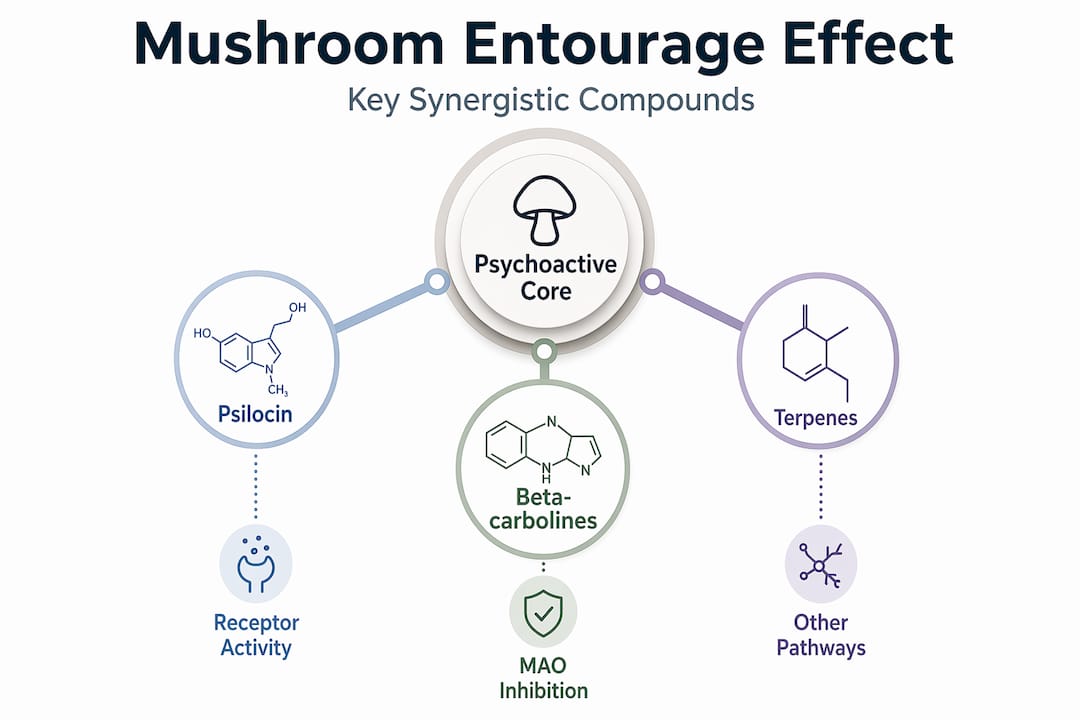
Beta-carbolines add another layer. These compounds may inhibit monoamine oxidase A (MAO-A), the enzyme that breaks down serotonin and psilocin in the body. If MAO-A activity is reduced even partially, psilocin stays active in the system longer. Molecular dynamics confirmed stable beta-carboline binding at MAO-A sites, which would mechanistically support prolonged psychedelic effects. And in one particularly striking finding from the same computational work, a compound called 4-hydroxy-N,N,N-trimethyltryptamine may actually bind serotonin receptors more strongly than psilocin, which reframes the question of what “the active ingredient” even means.
Terpenes also appear in psilocybin mushrooms, though their role is less mapped than in cannabis. You can read more about terpenes in mushroom effects and how they may contribute to the broader compound interaction picture.
Pro Tip: When evaluating mushroom products for potential synergistic benefits, prioritize whole-spectrum extracts or dried preparations over heavily processed isolates. The full chemical matrix is where the interaction of mushroom ingredients lives.
| Compound | Potential role | Mechanism |
|---|---|---|
| Psilocin | Primary psychoactive | HTR2A receptor agonist |
| Beta-carbolines | Effect modulation | MAO-A inhibition, prolonged psilocin activity |
| 4-OH-TMT | Possible co-agonist | Strong serotonin receptor binding |
| Terpenes | Experience shaping | Multi-target, possibly mood and duration |
| Baeocystin | Minor psychedelic activity | Partial HTR2A binding |
What recent research actually says
The science of explaining entourage effect in mushrooms is advancing fast, but the evidence sits across different methodologies with different levels of reliability. Here is where things actually stand:
-
The 2026 computational study published in Nature Scientific Reports used network pharmacology and molecular dynamics simulations to show synergy is plausible through multi-target engagement, not just a theoretical idea. This is a significant shift in how researchers frame the hypothesis.
-
Animal studies have produced some of the most compelling preclinical data. Mice given mushroom extract showed higher production of synaptic proteins and stronger anxiety reduction compared to mice receiving synthetic psilocybin, which points directly toward compound synergy as the variable.
-
The concentration problem is real and cannot be dismissed. Beta-carboline levels in a standard Psilocybe cubensis dose are thousands of times lower than in ayahuasca, where MAO-inhibition is pharmacologically confirmed and clinically meaningful. The same beta-carboline concentrations in mushrooms may simply be too low to produce the same effect.
-
Researchers distinguish between computational docking studies and biological assays. Showing that a molecule can bind a protein in a simulation is different from showing it does produce measurable effects in a living system. Rigorous mechanistic claims require controlling for dose and extract composition before attributing outcomes to synergy rather than concentration differences.
-
The biggest research gap is controlled human trials comparing whole mushroom extracts directly against synthetic psilocybin at matched exposures. Without that data, the entourage effect in fungi remains a well-supported hypothesis rather than a clinically proven mechanism.
The picture is genuinely promising, but the skepticism from serious researchers is also well-founded. The field is in an honest early stage where computational and animal evidence is accumulating faster than human clinical studies can catch up.
Mushrooms vs. cannabis: lessons from a parallel conversation
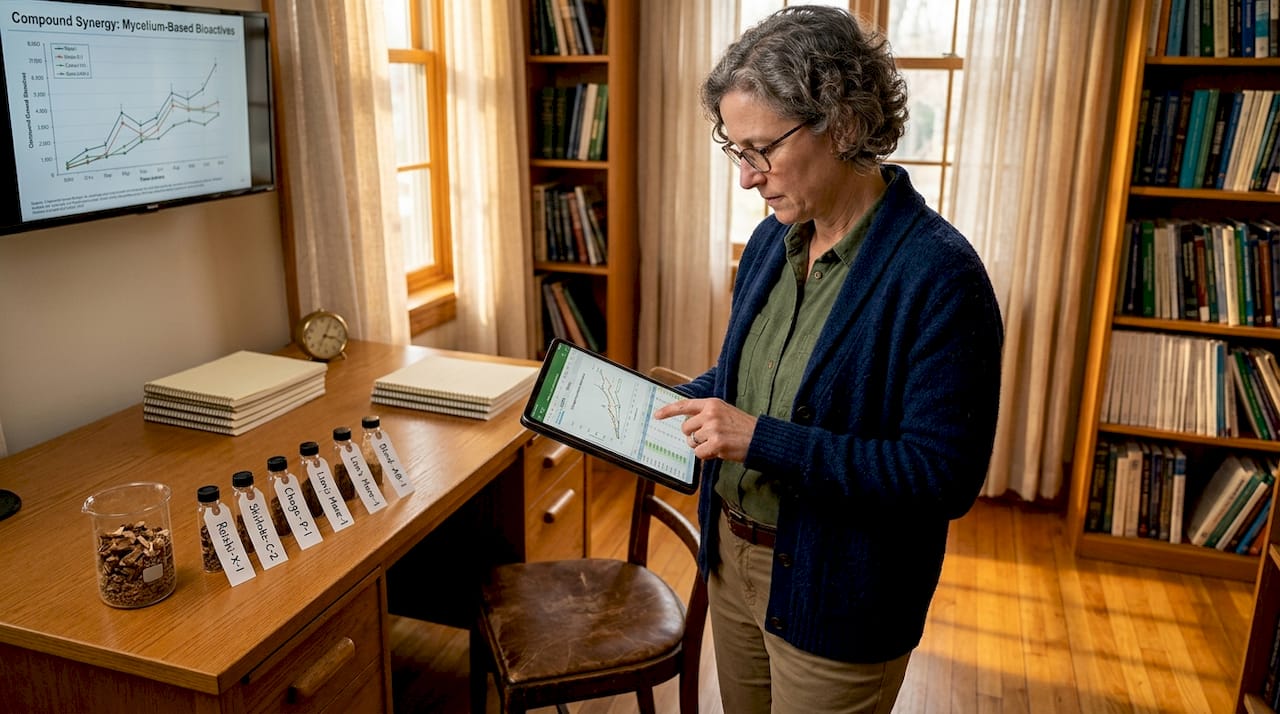
The entourage effect explained in cannabis research is where the term originated. Researcher Raphael Mechoulam and his colleagues first described it in 1998 to explain why whole cannabis extracts behaved differently than isolated THC. Decades later, the cannabis evidence base is broader but still not conclusive. Studies on botanical drug development show the cannabis entourage effect is investigated with computational and animal models, and human clinical data remain limited even there.
Mushrooms are at an earlier stage but share structural parallels with the cannabis case. Both plants (and fungi) contain dozens of compounds beyond the headline psychoactive molecule. Both show differences in effect when whole preparations are compared to isolated compounds in preclinical models. Both face the same fundamental challenge: demonstrating that synergy, not dosing variation, is responsible for the difference.
| Factor | Cannabis entourage research | Mushroom entourage research |
|---|---|---|
| Evidence stage | Computational, animal, limited human trials | Computational and animal models primarily |
| Key compounds beyond headline molecule | Terpenes, flavonoids, minor cannabinoids | Beta-carbolines, baeocystin, terpenes, aeruginascin |
| Primary receptor target | CB1/CB2 endocannabinoid system | HTR2A serotonin receptor |
| Concentration challenge | Terpene ratios vary widely by strain | Beta-carboline levels far below ayahuasca doses |
| Clinical proof status | Inconclusive | Not yet established in humans |
The lesson mushroom researchers can take from cannabis is to design studies that control rigorously for compound ratios, not just total extract weight. That is where the cannabis field lost years of credibility. Learning how terpenes shape psychoactive experience in both systems gives useful context for where mushroom research needs to go.
What this means for you as a consumer or patient
If you are thinking about psilocybin for wellness or therapeutic reasons, the entourage effect research has practical implications worth understanding. Here is how to apply it:
-
Consider whole mushroom preparations over isolates. The benefits of mushroom compounds in their natural matrix are what the preclinical evidence points toward. Dried mushrooms and whole-spectrum extracts preserve more of the chemical complexity than isolated psilocybin.
-
Pay attention to strain differences. Different mushroom strains produce different compound ratios. Comparing mushroom strains by potency and chemistry is directly relevant to understanding which entourage profile you are actually getting.
-
Do not assume “more compounds” always means better. The concentration challenge is real. Low beta-carboline levels may not produce measurable MAO-A inhibition in typical doses, which means mushroom effects on health cannot all be attributed to synergy at this stage.
-
Watch the human clinical literature over the next two to three years. Brain imaging and EEG research is already showing that psilocybin doses produce lasting brain entropy changes linked to mood and psychological outcomes. Future trials comparing whole extracts to synthetic psilocybin at matched doses will be the real test of whether entourage effects translate to clinical benefits.
-
Extraction method matters. Processing techniques that strip or isolate specific compounds change the mushroom’s compound profile. For therapeutic applications, that tradeoff needs to be understood clearly.
Pro Tip: If you are using magic mushroom capsules for microdosing, check whether they contain whole dried mushroom powder or isolated psilocybin. The former preserves the full compound matrix; the latter does not.
My take on the entourage effect promise and its limits
I’ve spent a lot of time reading through the computational pharmacology work coming out in 2025 and 2026, and what strikes me is how the conversation has shifted from “psilocybin is the molecule” to “psilocybin is one of many molecules.” That is a genuinely important reframe. But I’ve also watched similar reframes in cannabis research lead to years of overclaiming that ultimately damaged the credibility of researchers who deserved better.
What I keep coming back to is the concentration problem. The fact that beta-carbolines in a typical mushroom dose are thousands of times lower than in ayahuasca does not mean they are irrelevant. Biological systems are sensitive in ways our current measurement tools miss. But it does mean you cannot assume the mechanism proven in ayahuasca is operating at mushroom doses.
The animal data is the part I find most credible right now. Mice showing greater synaptic plasticity and stronger anxiety relief from whole mushroom extract than from synthetic psilocybin. That is a clean experimental comparison. The question is whether it scales to human neurobiology, human doses, and the incredibly complex variables of psychedelic therapy contexts.
My honest position: the entourage effect in fungi is almost certainly real in some form. The computational work shows multi-target binding is plausible. The animal work shows extract differences are measurable. What we do not have yet is the human clinical proof that would let anyone say with confidence what the right preparation, compound ratio, or delivery method should look like for a therapeutic setting. Stay curious, stay skeptical of the hype, and keep watching the clinical trial pipeline.
— Juiced
Explore full-spectrum mushroom products at Theelevatedremedies
If this research has you thinking more carefully about what goes into the mushroom products you choose, Theelevatedremedies in Ann Arbor is a good place to start that conversation in person.
The team at Theelevatedremedies carries magic mushroom capsules, dried mushrooms, and mushroom gummies designed to deliver the full spectrum of mushroom compounds rather than stripped-down isolates. If you are curious about Amanita muscaria as a distinct mushroom variety with its own compound profile, the site goes deep on what makes it different. Whether you are microdosing for focus or exploring therapeutic potential, having the right product starts with understanding what is actually in it. Stop by 1123 Broadway St in Ann Arbor or browse online.
FAQ
What is the entourage effect in mushrooms?
The entourage effect in mushrooms refers to the way multiple compounds inside a psilocybin mushroom, including psilocin, beta-carbolines, baeocystin, and terpenes, may interact to shape effects differently than psilocybin would alone. Computational and animal research support this mechanism, though human clinical proof is still pending.
Is the mushroom entourage effect scientifically proven?
Not in humans yet. Molecular docking studies and animal trials show plausible synergistic mechanisms, but the largest research gap remains controlled human trials comparing whole mushroom extracts to synthetic psilocybin at matched doses.
How do beta-carbolines contribute to mushroom synergy effects?
Beta-carbolines may inhibit MAO-A, the enzyme that breaks down psilocin, potentially extending and intensifying its effects. The challenge is that beta-carboline concentrations in typical mushroom doses are far lower than in ayahuasca, where MAO-inhibition is confirmed, so their real-world impact at standard doses is uncertain.
Does the mushroom entourage effect resemble the cannabis entourage effect?
Yes in structure, but both remain scientifically contested. Cannabis research has more data but still lacks definitive human clinical proof. Mushroom entourage research is earlier in development, with botanical drug development now treating both as important parallel cases for studying compound synergy.
Should you choose whole mushroom products over isolated psilocybin?
For those interested in potential synergistic benefits, whole mushroom preparations preserve more of the natural compound matrix. Animal studies show whole extract outperforms synthetic psilocybin on synaptic plasticity and anxiety outcomes, making it the more complete option for therapeutic exploration pending human trial data.