
TL;DR:
- Many compounds in psilocybin mushrooms, including terpenes, may influence effects beyond psilocybin alone. Terpenes serve biological functions in fungi and interact with neurological targets, potentially contributing to the entourage effect that enhances therapeutic outcomes. However, their low concentrations and volatility complicate scientific understanding, emphasizing the importance of whole mushroom products for broader medicinal benefits.
Most people who study psilocybin mushrooms fixate on one molecule: psilocybin itself. That’s understandable, but it leaves out a significant piece of the biochemical picture. The role of terpenes in mushroom effects is an emerging area of research that challenges the idea that a single compound explains everything you feel, experience, or benefit from. Terpenes contribute to aroma, flavor, and quite possibly the way mushrooms interact with your brain. Understanding what they are, how they behave chemically, and where the science currently stands gives you a more complete view of why whole mushrooms may work differently than isolated compounds.
Table of Contents
- Key takeaways
- The role of terpenes in mushroom effects: what the chemistry tells us
- How terpenes interact with psilocybin
- Therapeutic benefits of mushroom terpenes beyond psychoactivity
- Challenges in studying terpene effects in mushrooms
- My take on where this science is actually headed
- Explore full-spectrum mushroom products at Theelevatedremedies
- FAQ
Key takeaways
| Point | Details |
|---|---|
| Terpenes do more than flavor | Mushroom terpenes serve biological defense, cell structure, and signaling roles beyond aroma. |
| Psilocybin is not alone | Multiple compounds in magic mushrooms, including terpenes, may bind to serotonin receptor HTR2A. |
| Concentration is a real limit | Terpene levels in psilocybin mushrooms are far lower than in cannabis, complicating claims about their potency. |
| Whole extracts outperform isolates | Studies show whole mushroom extracts produce stronger neuroplastic effects than synthetic psilocybin alone. |
| Processing destroys terpenes | Drying and storage significantly reduce terpene content, making product selection and formulation matter. |
The role of terpenes in mushroom effects: what the chemistry tells us
Before getting into effects, you need to understand what terpenes actually are. Terpenes are a large class of organic compounds built from repeating five-carbon isoprene units. They are produced by many organisms, from plants to fungi, and they serve a wide range of biological functions that have nothing to do with human pharmacology.
In mushrooms specifically, terpenes serve biological roles including chemical defense against predators, electron transport in metabolic pathways, cell wall formation, and even symbiotic communication with other organisms. These are not passive byproducts. They are structurally and functionally active molecules that the fungus produces for specific purposes.
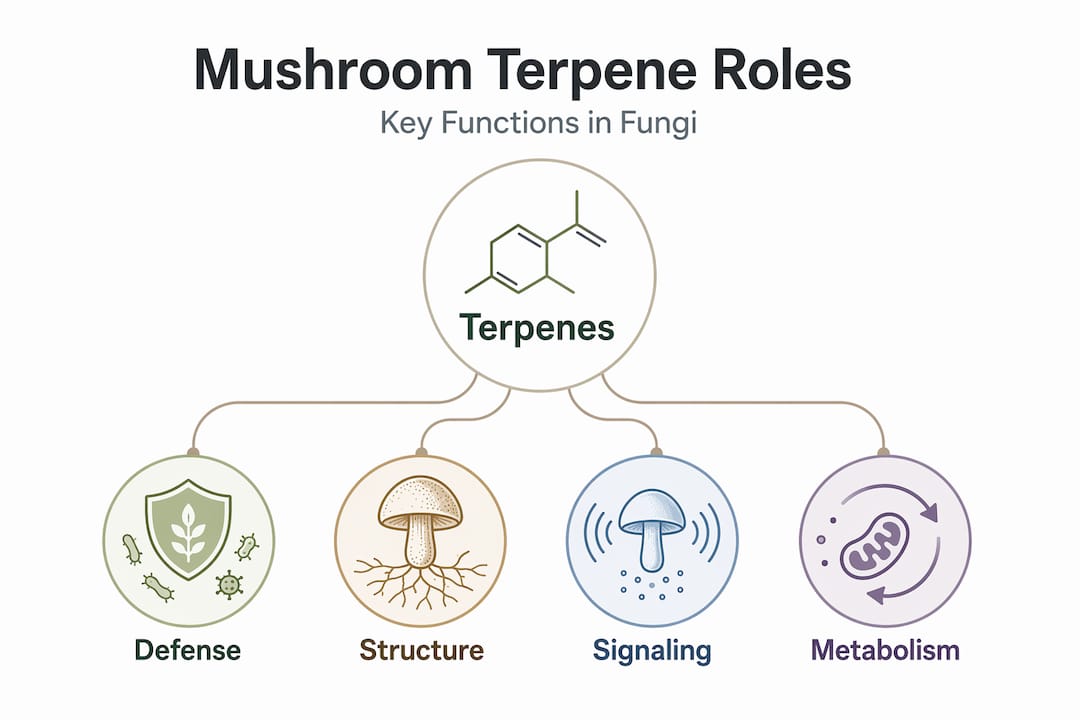
Researchers have also documented broad terpene functions including thermoprotection, signaling, pigmentation, and flavor production across plant and fungal kingdoms. What sets mushroom terpenes apart from plant terpenes is largely the chemical context. Cannabis, for example, produces terpenes in resin glands at relatively high concentrations. Mushrooms distribute terpenes throughout their tissue at much lower levels, and the specific compounds differ considerably.
Common terpenes detected in Psilocybe cubensis and other functional fungi include:
- Beta-caryophyllene: A sesquiterpene with documented anti-inflammatory properties and known affinity for CB2 receptors.
- Alpha-pinene: Found in many conifers and some fungi; associated with bronchodilation and memory retention effects.
- Limonene: Commonly studied for anxiolytic and mood-lifting properties.
- Alpha-terpineol and linalool: Detected in functional fungi like Poria cocos, both with validated calming and immunomodulatory bioactivities.
The table below gives you a quick reference for these compounds and what they do biologically.
| Terpene | Biological role in fungi | Known pharmacological activity |
|---|---|---|
| Beta-caryophyllene | Chemical defense, membrane stability | Anti-inflammatory, CB2 receptor affinity |
| Alpha-pinene | Electron transport, signaling | Bronchodilation, memory support |
| Limonene | Pigmentation, defense | Anxiolytic, mood modulation |
| Linalool | Symbiotic signaling | Sedative, antimicrobial |
| Alpha-terpineol | Cell wall component | Immunomodulatory, antioxidant |
Pro Tip: When you read about terpenes in any fungi, pay close attention to whether the research specifies fresh, dried, or extracted material. The compound profile can shift dramatically depending on how the mushroom was processed.
How terpenes interact with psilocybin
Psilocybin gets converted to psilocin in your body, and psilocin acts primarily on the serotonin receptor subtype HTR2A. That is the main mechanism behind the psychoactive experience. But “main” does not mean “only,” and this is where the science gets genuinely interesting.
Recent network pharmacology research found that 15 mushroom compounds bind HTR2A, with 8 of those showing favorable pharmacokinetics and strong molecular docking scores at neurological targets. These compounds include secondary metabolites and, in some analyses, terpenoid structures. Molecular docking studies suggest these molecules may form stable interactions at receptor sites alongside psilocin, potentially modulating the overall signal.
The concept at play here is the entourage effect, a framework borrowed from cannabis research. The idea is that the full chemical matrix of a plant or fungus produces different effects than any single isolated compound. The evidence for this in cannabis is stronger than in mushrooms, but the parallel is compelling. Whole mushroom extracts reduced anxiety behaviors in mice more effectively than synthetic psilocybin in at least one study, which suggests something else in the mushroom is contributing.
The limitation is concentration. Terpene and beta-carboline concentrations in magic mushrooms are thousands of times lower than equivalent compounds in cannabis or ayahuasca. That makes it genuinely difficult to claim that terpenes alone drive noticeable psychoactive differences. Scientific consensus has not settled this question, and anyone selling you certainty here is ahead of the data.
What researchers do agree on is that compounds interact with 44 brain proteins, spanning serotonin, dopaminergic, and other neurological pathways when whole extracts are analyzed. That multi-target engagement may explain why patient reports consistently favor whole mushroom experiences over synthetic formulations, even when psilocybin content is controlled. You can read more about how terpenes shape your psychoactive experience at Theelevatedremedies for a practical breakdown of what this means for users.
Pro Tip: Molecular docking studies are computational models, not clinical trials. They show that interactions are chemically plausible, not that they produce measurable effects at the concentrations found in actual mushrooms. Weight them accordingly when evaluating claims about terpene potency.
Therapeutic benefits of mushroom terpenes beyond psychoactivity
The psychoactive conversation tends to dominate discussions about terpenes in psilocybin mushrooms, but it is not the full story. Many functional mushrooms that contain no psilocybin at all have extensive terpenoid profiles with well-studied therapeutic applications.

Poria cocos is a strong example. Research shows that its terpenes include alpha-terpineol, linalool, carvone, and gamma-terpinene, all of which demonstrate validated anti-inflammatory, antioxidant, and immunomodulatory activities. This is not speculative: these bioactivities have been confirmed in laboratory and animal settings. The question for magic mushrooms is whether their lower terpene concentrations still contribute to any measurable therapeutic outcome.
The evidence from neuroplasticity research is encouraging. Whole mushroom extracts with trace terpenes produced significantly higher GAP43 protein expression in the frontal cortex and hippocampus of mice 11 days post-treatment compared to synthetic psilocybin. GAP43 is a marker of neuroplasticity and synaptic remodeling, which is thought to underlie the lasting therapeutic benefits of psychedelic-assisted treatment. The terpenes alone did not cause this. But the whole extract, terpenes included, performed better than the isolated compound.
This is what “synergy” means in a pharmacological context. Not magic. Not marketing language. A measurable difference in biological output when the full matrix is present versus a purified single compound. For people thinking about the role of terpenes in microdosing or therapeutic use, this distinction matters.
| Terpene | Therapeutic activity | Evidence level |
|---|---|---|
| Beta-caryophyllene | Anti-inflammatory, neuroprotective | Animal and in vitro studies |
| Linalool | Anxiolytic, sedative | Human and animal studies |
| Limonene | Mood modulation, antioxidant | In vitro, some human data |
| Alpha-terpineol | Immunomodulatory, antifungal | In vitro and animal studies |
| Alpha-pinene | Memory support, bronchodilation | Animal studies |
Pro Tip: If you are exploring mushrooms for wellness rather than recreation, look for products made from whole fruiting bodies rather than mycelium-only extracts. Fruiting bodies generally retain more of the secondary compound profile, including terpenes, that contribute to broader therapeutic effects.
Challenges in studying terpene effects in mushrooms
Here is where the science gets honest. Studying the role of terpenes in fungi is genuinely difficult, and understanding why matters for how you interpret product claims and research findings.
The biggest challenge is volatility. Volatile terpenes are lost during drying and storage, which means that most commercially available dried mushrooms have a significantly different terpene profile than fresh specimens. If you are buying dried mushrooms expecting the terpene profile that a fresh mushroom contains, you are working with incomplete information.
Other complications include:
- Species variability: Terpene profiles differ between Psilocybe cubensis, Psilocybe azurescens, and other species. What applies to one strain may not apply to another.
- Preparation method: Alcohol extracts, water extracts, and capsule forms each preserve or destroy different compounds. There is no universal terpene-preserving preparation method yet.
- Concentration thresholds: Even if terpenes bind to neurological targets in computational models, whether the concentrations in an actual dose are pharmacologically meaningful in humans remains unresolved.
- Isolating variables: In a whole mushroom, you have terpenes, beta-carbolines, aeruginascin, norpsilocin, and dozens of other secondary metabolites. Separating the terpene contribution from everything else requires experimental designs that are costly and complex.
For microdosing specifically, the role of terpenes in microdosing is an open question. Sub-perceptual doses already involve minimal psilocybin interaction. Whether trace terpenes contribute anything at those dose levels has not been tested in controlled human trials. Comparing whole mushroom strains gives you some practical guidance on potency and profile differences, even if the terpene science is still catching up.
Pro Tip: When evaluating capsule products for microdosing, ask whether the product uses whole fruiting body powder or an extract. Whole powder preserves more of the original chemical complexity, even after drying, than most extraction processes do.
My take on where this science is actually headed
I find the entourage effect framework genuinely compelling, but I am also honest about where it currently stands. The data from molecular docking studies and network pharmacology is exciting precisely because it gives us a mechanistic reason to expect synergy. Seeing that whole extracts outperform isolates in neuroplasticity markers is not nothing. That is a real biological signal.
What puzzles me is that the conversation about terpenes in psilocybin mushrooms is still so far behind the cannabis conversation. Cannabis researchers have had decades and significant funding to map terpene contributions. Mushroom researchers are still in early chapters. The scientific consensus remains fluid, and isolating terpene contributions from all the other secondary compounds in a mushroom is a genuinely hard problem.
My practical advice: treat terpene research as a reason to favor whole mushroom products over synthetic or heavily isolated formulations, not as a reason to make specific claims about which terpene does what. The complexity of the mushroom’s chemistry is likely part of what makes it therapeutically interesting. Respecting that complexity, rather than reducing it to a single compound, seems like the right instinct both scientifically and practically. More integrated pharmacological research that maps multi-target interactions in human subjects is what this field actually needs next.
— Juiced
Explore full-spectrum mushroom products at Theelevatedremedies
If this science has you thinking about product quality differently, that is exactly the right response.

At Theelevatedremedies in Ann Arbor, Michigan, the mushroom capsule products are formulated with the full fruiting body in mind, not just isolated psilocybin content. If you are curious about other species with unique compound profiles, the Amanita muscaria page breaks down a mushroom with a terpenoid chemistry all its own. For those interested in how secondary metabolites interact with overall wellness, the CBD and mushroom synergy research at Floral is worth exploring as a complementary read. The team at Theelevatedremedies is happy to walk you through your options in person at 1123 Broadway St, Ann Arbor, MI.
FAQ
What are terpenes in psilocybin mushrooms?
Terpenes in psilocybin mushrooms are secondary metabolites produced for biological functions like defense and cell structure. Psilocybe cubensis contains at least 14 distinct terpenes in trace amounts, including beta-caryophyllene, pinene, and limonene.
Do terpenes change the psychedelic experience?
Current evidence suggests they may modulate effects through multi-target receptor interactions, but their concentrations are thousands of times lower than in cannabis or ayahuasca. Definitive human trial data does not yet exist.
Why do whole mushroom extracts perform better than synthetic psilocybin?
Whole extracts engage multiple brain proteins and pathways simultaneously, producing stronger neuroplastic markers like GAP43 expression than isolated psilocybin alone. Terpenes and other secondary compounds likely contribute to this multi-target effect.
Are terpenes preserved in dried or capsule mushroom products?
Not always. Terpenes are volatile and degrade significantly during drying and storage. Products made from whole fruiting body powder tend to retain more chemical complexity than those made from heavily processed extracts.
What is the role of terpenes in microdosing?
The specific role of terpenes in microdosing has not been studied in controlled human trials. At sub-perceptual doses, the interaction between trace terpenes and psilocybin’s primary mechanism is still theoretical, though whole mushroom formats remain the preferred choice for most experienced microdosers.