
TL;DR:
- Microdosing involves taking 0.05 to 0.3 grams of psilocybin without feeling high.
- Consistent tracking and a structured workflow are more important than the exact dose.
- Results vary personally and are influenced by preparation, environment, and individual response.
Microdosing psilocybin is quietly becoming one of the most talked-about wellness approaches in Michigan, but the path forward is rarely clear. How much do you take? What should you feel? What if nothing happens, or too much does? For most people starting out, the confusion around dosing, timing, and safety creates more hesitation than the substance itself. This guide cuts through all of that. We’ll walk you through what microdosing actually does, how to prepare properly, a step-by-step first session workflow, and how to adjust your approach based on real results, not guesswork.
Table of Contents
- Understand mushroom microdosing and its effects
- Prepare: What you need before starting
- Step-by-step workflow for your first microdose session
- Verify, adjust, and troubleshoot your workflow
- A fresh perspective: Why workflow matters more than the dose
- Explore quality mushroom products and support
- Frequently asked questions
Key Takeaways
| Point | Details |
|---|---|
| Start low and track | Begin with the lowest dose and use a journal to monitor subtle effects and safety alerts. |
| Workflow matters | A consistent, reflective routine increases your chances of real benefit and error reduction. |
| Adjust for best results | Tweak your dosing plan based on your own tracked experiences, and pause if adverse effects arise. |
| Expect subtle changes | Most improvements are slight or may be placebo, so manage expectations and focus on wellbeing trends. |
Understand mushroom microdosing and its effects
Microdosing means taking a sub-perceptual dose of psilocybin, typically between 0.05 and 0.3 grams of dried mushrooms. Sub-perceptual means you should not feel high. The goal is subtle: sharper focus, a lighter mood, reduced anxiety, or a mild lift in creativity. You go about your day normally. That’s the idea, at least.
The honest picture is more nuanced. Recent microdosing studies show that self-reports show improved wellbeing, but placebo-controlled trials find no significant cognitive or mood benefits vs placebo. That gap between lived experience and clinical measurement is real, and it’s worth knowing upfront. It doesn’t mean microdosing doesn’t work for you. It means results are deeply personal, and tracking your own response matters more than any average outcome.
For Michigan users, understanding the microdose benefits in Michigan context is useful because local wellness culture, stress patterns, and lifestyle factors all shape how you respond.
Common self-reported effects Michigan users describe include:
- Improved mood and emotional steadiness
- Mild increase in focus and motivation
- Reduced social anxiety in low-stakes settings
- Better sleep quality on rest days
- Occasional mild headache or fatigue, especially at higher doses
For a broader look at safety considerations, safe mushroom wellness tips cover key ground before you begin. And if you’re wondering how this compares to a full psychedelic experience, microdosing vs full-dose is a useful reference.
| Effect Category | Common Reports | Clinical Evidence |
|---|---|---|
| Mood | Improved, lighter | Weak to none vs placebo |
| Focus | Sharper short-term | Inconsistent |
| Creativity | Elevated ideation | Limited data |
| Anxiety | Reduced in many users | Mixed results |
| Sleep | Better on off days | Anecdotal |
Important: Microdosing is not a substitute for mental health treatment. If you have a personal or family history of psychosis, schizophrenia, or bipolar disorder, psilocybin carries serious risk. Do not start without consulting a medical professional.
Pro Tip: Keep your expectations grounded. If you approach microdosing as a rigid cure, you’ll likely be disappointed. Approach it as a personal experiment and you’ll learn something valuable regardless of outcome.
Prepare: What you need before starting
Before your first session, preparation is everything. Rushing into it without the right setup is how people end up with inconsistent results or a difficult experience that could have been avoided.
Your prep checklist:
- Dried mushrooms, capsules, or mushroom chocolates (pre-dosed options simplify accuracy)
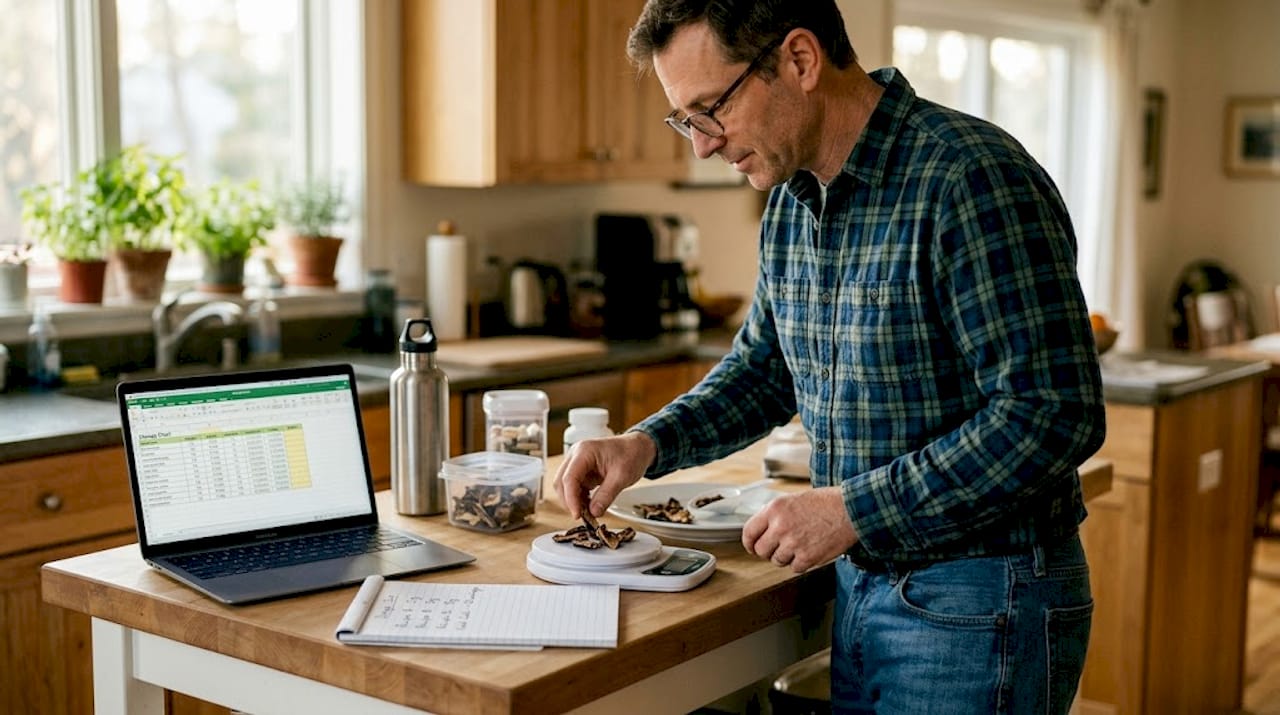
- A precise milligram scale (kitchen scales won’t cut it)
- A dedicated journal, paper or app-based
- Airtight, dark storage for your product
- A clear intention for what you’re exploring
- A low-commitment day scheduled for your first session
For guidance on quantities and formats, the Michigan dosage guide breaks down dose ranges by product type in practical terms.
Product format comparison:
| Format | Dose Control | Onset Time | Best For |
|---|---|---|---|
| Dried mushrooms | Manual weighing needed | 30 to 60 minutes | Experienced users |
| Capsules | Pre-measured, consistent | 45 to 75 minutes | Beginners |
| Chocolate bars | Pre-dosed, easy to split | 30 to 60 minutes | Convenience and taste |
For a deeper comparison, dried vs chocolate mushrooms covers safety and absorption differences worth reading before you choose. If you’re interested in layering psilocybin with other supplements, microdose stacking protocols explains common approaches like the Stamets stack.
One widely cited guideline is to start at 0.1g, journal effects, and avoid microdosing if you have a psychosis history. The Stamets stack using niacin may also cause a flushing sensation, which surprises many first-timers.
Safety first: Never drive or operate machinery after taking a dose, even sub-perceptual ones. Give yourself a full day the first time so you can observe effects without pressure.
Pro Tip: Buy capsules or pre-dosed chocolates for your first few sessions. Manual weighing of dried mushrooms requires a scale accurate to 0.01 grams, and even a small error can push you out of sub-perceptual territory.
Step-by-step workflow for your first microdose session
Here’s the exact process to follow. Each step exists for a reason, so don’t skip ahead.
- Choose your dose. Start at 0.1 grams (100mg) of psilocybin mushrooms. If using capsules or chocolates, confirm the labeled dose matches this range.
- Pick your timing. Morning is best for most people. Effects last four to six hours, and starting early keeps evenings free and avoids sleep disruption.
- Set your environment. Choose a calm, familiar space for your first session. No big social obligations. Low demands.
- Take your dose. Consume with a light meal or on an empty stomach. Both work, but an empty stomach speeds onset and may intensify effects slightly.
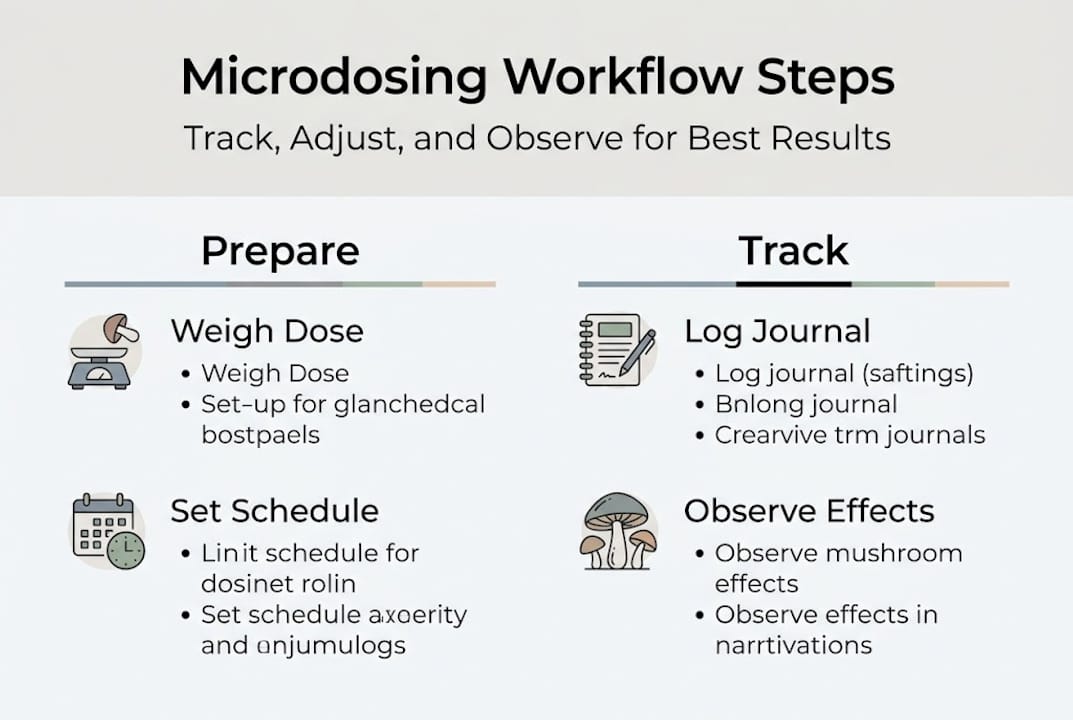
- Start your journal. Note the time, dose, product type, and your baseline mood. Rate mood, focus, and energy from one to ten before the dose hits.
- Observe at the 30, 60, and 90-minute marks. Jot down changes in mood, focus, physical sensation, or thinking style. Keep notes brief but honest.
- Continue your day normally. Do not sit and wait for something to happen. The goal is a background lift, not an event.
- End-of-day reflection. Before bed, review your notes. Was there a shift? When did it peak? How did you feel by evening?
Safe microdosing steps for Michigan users cover additional precautions worth layering into this workflow. For dose-specific questions, mushroom dosage guidance provides format-by-format breakdowns.
Journal prompts to use at each check-in:
- How does my body feel right now?
- Am I more or less distracted than usual?
- Is my mood different from my baseline this morning?
- Any physical sensations (warmth, tingling, headache)?
Tolerance builds with daily use, which is why your first session should also establish what schedule you’ll follow going forward. Most protocols suggest one day on, two days off as a starting point.
Pro Tip: Microdose on a day when you have light creative or intellectual work planned. Many users find that the subtle effect is easiest to notice and most useful when there’s actual cognitive output to measure it against.
Verify, adjust, and troubleshoot your workflow
One session tells you very little. Patterns emerge over two to four weeks of consistent tracking. That’s when the real data shows up.
Signs you may need to adjust:
- No noticeable effect after three or more sessions at the same dose: consider increasing by 0.05 grams
- Feeling foggy, anxious, or overly stimulated: you’ve gone too high, drop the dose
- Difficulty sleeping even on off days: shift your dose to earlier in the morning
- Emotional flatness or blunted mood: take a full week off
| Issue | Likely Cause | Adjustment |
|---|---|---|
| No effect | Dose too low or tolerance building | Increase slightly or take a break |
| Anxiety or overstimulation | Dose too high | Reduce by 0.05g |
| Sleep disruption | Dosing too late in the day | Move dose to early morning |
| Emotional flatness | Overuse or tolerance | Week-long break |
| Niacin flush (if stacking) | Niacin component of Stamets stack | Reduce niacin or switch protocol |
For targeted support, microdosing for anxiety walks through adjustments specific to anxiety-prone users.
Warning: Tolerance can develop quickly with daily microdosing use. If you’re no longer noticing any effect, pause entirely for one to two weeks before resuming.
It’s also important to stay honest about what’s driving any improvement. Empirical findings suggest many reported benefits may be placebo-driven rather than pharmacological. That doesn’t make the benefit less real in your daily life, but it does mean that other wellness habits (sleep, movement, social connection) should run alongside your protocol, not be replaced by it.
If adverse effects persist, or if you experience confusion, paranoia, or strong emotional disturbance, stop and seek medical input. This is rare at true microdose levels, but not impossible.
A fresh perspective: Why workflow matters more than the dose
Here’s something most guides don’t say plainly: the exact milligram amount is far less important than the consistency and structure around it. We’ve seen people obsess over whether they took 0.1 or 0.12 grams, then take zero notes and wonder why they can’t tell if it’s working.
The workflow IS the practice. Journaling, scheduling, observing, and adjusting over time is what generates real insight. A loose, untracked approach teaches you nothing regardless of the dose. A structured approach at a slightly imprecise dose teaches you a lot.
Michigan’s evolving relationship with psilocybin makes this even more relevant. In a space where clinical guidance is limited and personal experimentation is the norm, your journal is your best data set. Anecdotal self-report benefits are compelling but not always backed by placebo-controlled trials, which means your own careful record is more valuable than any general finding. Trust the process, track everything, and adjust based on what you actually observe.
Explore quality mushroom products and support
If you’re ready to put this workflow into practice, starting with the right products makes a real difference. At Elevated Remedies, we carry dried magic mushrooms, microdose capsules, and mushroom chocolate bar options sourced for quality and consistency, so you’re not guessing about what you’re working with.
For those newer to the world of fungi, it’s worth knowing there are different mushroom types beyond psilocybin. Our what is amanita muscaria page gives a clear, honest overview of the distinctions. Stop by 1123 Broadway St in Ann Arbor and our team will help you find the right starting point for your wellness goals. No pressure, just good information.
Frequently asked questions
What is the ideal starting dose for mushroom microdosing?
A common starting point is 0.1 grams, adjusted gradually based on how your body and mind respond over multiple sessions.
How soon should I expect to feel microdose effects?
Most people notice subtle shifts within 30 to 90 minutes, though some feel nothing obvious at all. Tracking effects by journaling is the best way to identify patterns over time.
Can I microdose psilocybin daily?
Daily use builds tolerance quickly, so most protocols recommend a schedule with regular off days, such as one day on and two days off.
Are there risks of negative effects when microdosing?
Yes, particularly for people with a personal or family history of psychosis. Always screen for health risks before starting and consult a doctor if you have any mental health history.
How can I tell if microdosing is working for me?
Journal your mood, focus, and energy daily and look for patterns over two to four weeks. Keep in mind that empirical effects may vary and some improvements may be placebo-driven, which is still worth understanding.
Recommended
- How to microdose safely in Michigan: A 2026 guide – Elevated Remedies
- Magic mushroom dosage guide: safe & effective use in Michigan – Elevated Remedies
- Magic mushroom consumption: Safe steps for Ann Arbor users – Elevated Remedies
- Magic mushroom terms explained: Michigan guide 2026 – Elevated Remedies