
TL;DR:
- Magic mushroom potency varies significantly due to chemistry, genetics, growing, and storage conditions.
- Different strains and species can have vastly different effects and required dosages.
- Lab testing is essential for accurate potency knowledge, especially for safe microdosing and wellness use.
Magic mushrooms can surprise you. Two batches of the same strain, grown weeks apart, can produce wildly different experiences. One person takes a gram and barely feels anything. Another takes the same amount from a different source and has an intense four-hour journey. That gap isn’t random. It comes down to chemistry, genetics, growing conditions, and how the mushrooms were stored. For Michigan residents exploring psilocybin for wellness, microdosing, or recreational use, understanding potency isn’t optional. It’s the difference between a safe, intentional experience and an overwhelming one you weren’t prepared for. This guide breaks down exactly what drives mushroom strength and what you need to know before dosing.
Table of Contents
- What is magic mushroom potency?
- How much do species and strains differ?
- What factors influence magic mushroom potency?
- How is potency measured and why does it matter?
- Expert nuances: Potency, effects, and safety in Michigan
- Why most advice about potency is misleading — our take
- Find trustworthy mushroom products and guidance
- Frequently asked questions
Key Takeaways
| Point | Details |
|---|---|
| Potency varies widely | Species, strains, and growing conditions can make mushroom strength highly unpredictable. |
| Lab testing is essential | Only chemical analysis accurately reveals true psilocybin and psilocin content. |
| Choose tested Michigan products | For safer experiences, avoid wild foraging and prioritize labeled, lab-verified options. |
| Visual cues can mislead | Appearance and stories are not reliable guides to actual potency or effects. |
What is magic mushroom potency?
Potency, in the context of magic mushrooms, refers to the concentration of active compounds in the mushroom tissue. The two main compounds are psilocybin and psilocin. Psilocybin is the more stable of the two. It’s what you mostly find in dried mushrooms. Once you consume it, your body converts psilocybin into psilocin, which is the compound that actually binds to serotonin receptors and produces psychedelic effects. Think of psilocybin as the storage form and psilocin as the active form.
According to psilocybin mushroom research, magic mushroom potency is primarily determined by psilocybin and psilocin concentrations in the mushroom tissue. These levels vary enormously between species, strains, and even individual mushrooms in the same batch.
Here’s why this matters for dosing:
- A mushroom with 0.5% psilocybin content and one with 1.5% look identical to the naked eye
- Eating the same weight of each produces very different outcomes
- For microdosing, even small differences in potency can push a sub-perceptual dose into a full experience
- New users are especially vulnerable because they have no baseline to compare against
Reviewing factors influencing potency helps clarify just how many variables are at play. The metabolic process itself also matters. Psilocin is absorbed faster than psilocybin, so the ratio between the two affects how quickly effects come on and how long they last.
“Understanding the chemistry behind potency is the first step toward using psilocybin safely and intentionally.”
For anyone following psilocybin dosage guidelines, knowing the potency of your product is the foundation of getting the dose right. Guessing is how people end up in uncomfortable situations that could have been avoided.
How much do species and strains differ?
Not all mushrooms are created equal. The species and strain you choose have a massive impact on what you experience. Psilocybe cubensis is by far the most common species used in Michigan. It’s widely cultivated, relatively forgiving to grow, and has a well-documented potency range. But even within P. cubensis, the variation is significant.
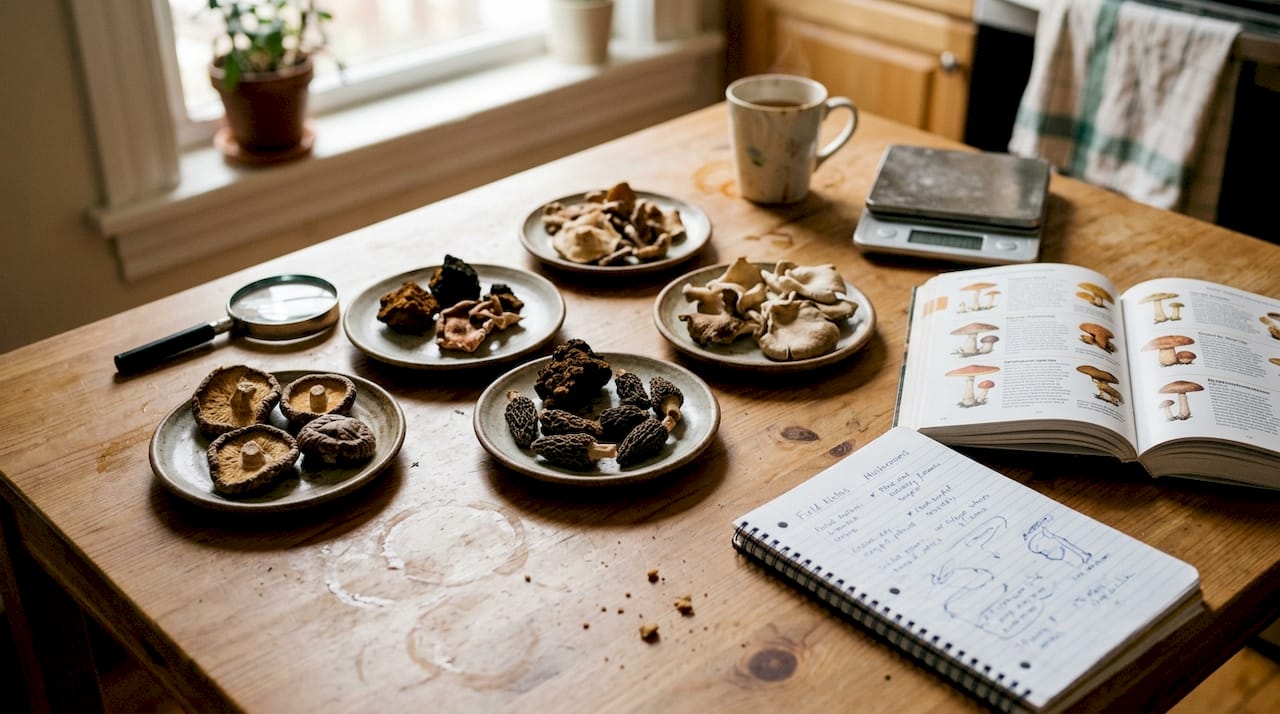
Potency varies significantly by species, strain, and even within individual strains depending on growing conditions. Here’s a general comparison:
| Strain | Relative Potency | Notes |
|---|---|---|
| Golden Teacher | Moderate (0.6-0.8%) | Great for beginners, predictable |
| B+ | Moderate (0.5-0.8%) | Mild, popular for wellness use |
| Penis Envy | High (1.0-1.5%+) | 50%+ stronger than average cubensis |
| Tidal Wave | Very High | Award-winning potency, not for beginners |
| Enigma | Very High | Mutation of Penis Envy, extremely potent |
For wellness and microdosing purposes, strains like Golden Teacher and B+ are favored because their effects are more predictable. You can find deeper strain comparison insights and explore how different strain effects play out for different goals.
Beyond P. cubensis, species like Psilocybe azurescens and Psilocybe semilanceata can be two to four times more potent than standard cubensis strains. These aren’t commonly sold in Michigan, but they exist in the wild and are sometimes misidentified.
- Never assume a mushroom’s potency based on its appearance
- Don’t apply your experience with one strain to a completely different one
- High-potency strains like Penis Envy require much smaller doses than standard cubensis
- Wild mushrooms carry identification and potency risks that cultivated products don’t
Pro Tip: If you’re switching strains, treat it like starting over. Start low, wait, and assess before taking more. What felt like a comfortable dose with Golden Teacher could be overwhelming with a high-potency strain.
What factors influence magic mushroom potency?
Even within a single strain, strength can swing wildly from one batch to the next. Environmental and genetic factors cause up to a sixfold variation in alkaloid content, meaning the same strain grown under different conditions can be six times stronger or weaker. That’s not a small margin.
Here are the key factors that shape potency:
- Genetics: The strain’s genetic baseline sets the ceiling for potency
- Substrate: The growing medium (brown rice flour, grain, manure) affects nutrient availability and final alkaloid levels
- Temperature: Fluctuations during colonization and fruiting alter chemical production
- Humidity: Consistent humidity supports healthy fruiting and alkaloid development
- Harvest timing: Mushrooms harvested just before the veil breaks tend to have higher psilocybin content
- Drying method: Heat above 35°C (95°F) degrades psilocybin; low-heat or freeze-drying preserves it better
- Storage conditions: Light, heat, and moisture all break down psilocybin over time
A common myth is that bluing (the blue-green color that appears when mushroom flesh is bruised) indicates higher potency. It doesn’t. Bluing is an oxidation reaction involving psilocin, but the degree of bluing doesn’t reliably predict alkaloid concentration. You can have a heavily blued mushroom with average potency and a barely blued one that’s quite strong.
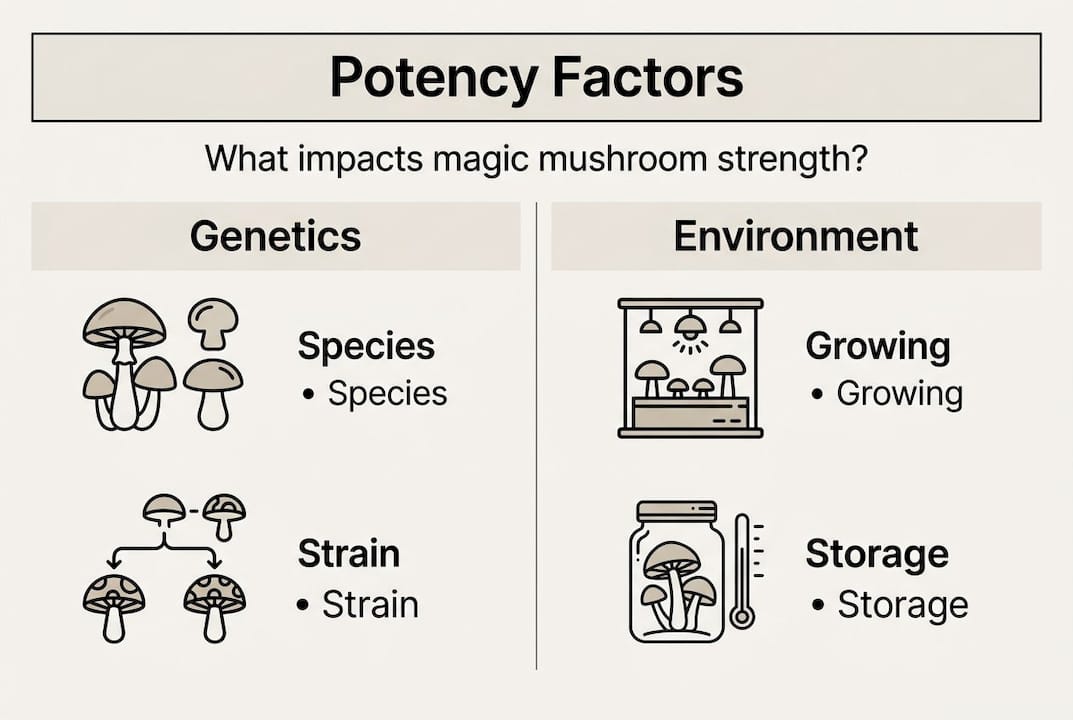
| Storage Mistake | Effect on Potency |
|---|---|
| Exposure to direct light | Significant psilocybin degradation |
| High heat storage | Accelerated alkaloid breakdown |
| Moisture or humidity | Promotes mold, destroys potency |
| Improper sealing | Oxidation reduces psilocin content |
For practical safe use tips and safe consumption advice, always store dried mushrooms in an airtight container, away from light, in a cool and dry location.
Pro Tip: For Michigan users, cultivated and consistently sourced products are far more reliable than wild-harvested mushrooms. Cultivation allows for controlled conditions that reduce potency surprises.
How is potency measured and why does it matter?
So how can you actually know the strength of what you’re taking? The honest answer is: only through lab testing. Lab testing is the only reliable method for confirming psilocybin and psilocin content in a product.
Here’s how professional testing works:
- HPLC (High-Performance Liquid Chromatography): Separates compounds in a sample and measures their concentrations with high precision
- LC-MS/MS (Liquid Chromatography with Mass Spectrometry): Even more sensitive, identifies and quantifies multiple compounds simultaneously
- Results: Expressed as a percentage of dry weight (e.g., 0.8% psilocybin) or in milligrams per gram
- Repeatability: Lab testing can be done on multiple samples from the same batch to check consistency
Without this data, you’re guessing. And in Michigan’s current market, guessing carries real risks. Unregulated edibles often lack psilocybin or contain undisclosed active substances, meaning what’s on the label may not reflect what’s actually in the product.
“The only way to know what you’re actually taking is to have it tested. Everything else is an educated guess at best.”
For microdosing, this is especially critical. A microdose is typically 0.1 to 0.3 grams of dried mushroom. If the potency is twice what you expected, you’ve just taken a full perceptual dose without intending to. That’s disruptive at work, unsafe while driving, and counterproductive for any wellness goal.
Our product safety guide covers what to look for when evaluating products in Michigan’s market. The bottom line is that adulteration evidence from recent studies makes a strong case for only purchasing from vendors who prioritize transparency and testing.
Pro Tip: Ask your vendor directly about testing. A reputable source will either have lab data or be transparent about what they know. Vague answers are a red flag.
Expert nuances: Potency, effects, and safety in Michigan
Beyond the basics, what do researchers and experienced users wish Michigan residents knew? A few things that don’t always make it into beginner guides.
First, whole mushroom extracts may behave differently than pure psilocybin. Whole mushroom extracts may have synergistic effects, meaning other compounds in the mushroom (baeocystin, norbaeocystin, and others) might interact with psilocybin in ways that alter duration or intensity. This is sometimes called the “entourage effect” in mushrooms, though research is still early.
Second, microdosing results are more complicated than social media suggests. Microdosing research shows mixed results in clinical studies, with some benefits potentially explained by placebo effects. That doesn’t mean microdosing doesn’t work for you. It means that controlled potency matters even more when you’re trying to isolate the effect.
For Michigan residents specifically:
- Focus on cultivated P. cubensis products from known sources
- Avoid wild foraging unless you have expert-level identification skills
- Be skeptical of unverified claims about specific strain effects
- Mislabeling is common in unregulated markets, so cultivated sources are far safer
For those using mushrooms for focus guidance or checking in with mental wellness resources, having accurate potency information makes every session more intentional and productive.
“Lab testing is essential for quality products, especially for microdosing and wellness use in Michigan.”
The legal landscape in Michigan is also evolving. Ann Arbor has decriminalized personal possession, but state law still applies in many contexts. Knowing exactly what you have and where it came from protects you legally as much as physically.
Why most advice about potency is misleading — our take
Here’s the uncomfortable truth: most of the potency advice circulating online is based on anecdotes, not data. Someone posts that a certain strain is “super strong” based on one experience. Someone else says the same strain is mild. Both are probably right, because without lab testing, neither of them actually knows what they took.
Visual cues don’t work. Stories don’t scale. And the idea that you can judge a mushroom’s strength by how it looks, smells, or how blue it turns is a myth that leads to real problems. We’ve seen it happen. Someone experienced with one strain tries a new batch assuming similar effects, and the experience goes sideways.
Our take is simple: treat every new batch as unknown until you have real data. Start low. Wait. Assess. This applies whether you’re microdosing for productivity or taking a larger dose for a personal experience. Following a safe dosing guide isn’t about being overly cautious. It’s about being smart with something that deserves respect.
Find trustworthy mushroom products and guidance
Knowing the science is one thing. Having access to products you can actually trust is another.
At Elevated Remedies, we carry mushroom capsules designed for consistent, low-dose use, along with 3000MG mushroom gummies for those exploring different mushroom formats. We also stock Amanita muscaria products with clear labeling so you know exactly what you’re working with. Our team at 1123 Broadway St in Ann Arbor is here to answer your questions honestly, point you toward the right products for your goals, and make sure you leave with something you feel confident using. Transparency and quality aren’t extras here. They’re the standard.
Frequently asked questions
What makes one magic mushroom more potent than another?
The main factors are psilocybin and psilocin levels, which are shaped by species, strain genetics, growing conditions, harvest timing, and storage. Two mushrooms of the same strain can differ significantly in strength based on these variables.
Can I tell magic mushroom potency by color or bruising?
No. Visual cues like bluing are an oxidation reaction and are not a reliable indicator of psilocybin or psilocin content. Only lab testing gives you accurate potency information.
Are Michigan dispensary edibles always accurately labeled for psilocybin?
Not always. Unregulated edibles are often mislabeled and may lack psilocybin entirely or contain substances not listed on the label. Always purchase from vendors who prioritize transparency.
How should I start if I’m new to magic mushrooms in Michigan?
Begin with a low dose from a tested, cultivated source, avoid wild-harvested mushrooms, and give yourself plenty of time and a safe environment before increasing your dose.