
Tidal Wave is a Psilocybe cubensis hybrid created by breeder MagicMyco (also credited to cultivator Doma Nunzio) by crossing B+ with Penis Envy. It sits among the most potent cubensis strains ever assayed by community labs, with one Enigma-variant sample testing at 3.82% total tryptamines in a Hyphae Cup entry — a result DoubleBlind described as an extraordinary outlier against typical P. cubensis values. That number is not a promise; it is a ceiling from a single exceptional specimen. What you can reliably expect is a strain that runs hotter than most cubensis, expresses wild phenotypic variability, and reverts to parent traits if you propagate carelessly. Clone from your best fruits and run serial agar isolations if you want consistency. One hard legal fact before anything else: psilocybin is a federal Schedule I controlled substance in the United States. Spore legality varies by state, and cultivation is prohibited under federal law regardless of local decriminalization.
Key facts at a glance:
- Lineage: B+ × Penis Envy
- Breeder: MagicMyco (Doma Nunzio)
- Potency signal: Community assays report higher tryptamine levels than average cubensis; one Enigma outlier reached 3.82% total tryptamines
- Stability: Genetically unstable; prone to reversion and mutation
- Propagation: Spore syringes available for microscopy; cloning/liquid culture required for sporeless mutations
- Legal status: Psilocybin is Schedule I federally; spore purchase for microscopy is legal in most U.S. states (not all)
Key Takeaways
Tidal Wave is a high-potency Psilocybe cubensis hybrid (B+ × Penis Envy) with documented assay outliers and significant variability that demands careful propagation, cautious dosing, and strict legal compliance.
| Point | Details |
|---|---|
| Lineage and breeder | B+ × Penis Envy hybrid created by MagicMyco; genetically unstable and prone to reversion |
| Potency signal | One Enigma sample hit 3.82% total tryptamines in a Hyphae Cup assay; treat as an outlier, not a baseline |
| Propagation strategy | Clone from best fruits and run serial agar isolations to stabilize traits; Enigma requires tissue cloning only |
| Dosing caution | Reduce typical cubensis dose estimates significantly; potency varies across fruits and flushes |
| Legal compliance | Psilocybin is federal Schedule I; spore legality varies by state; confirm local law before sourcing or cultivating |
| Theelevatedremedies | Carries legal Amanita muscaria gummies, microdosing capsules, and mushroom chocolates in Ann Arbor, Michigan |
Table of Contents
- Quick-reference strain facts for Tidal Wave
- How the Tidal Wave strain was created and why it matters
- How to identify Tidal Wave in the grow room and under the microscope
- Notable variants and what they mean for your cultivation plan
- What lab assays actually say about Tidal Wave’s potency
- Cultivation profile: what to expect when growing Tidal Wave
- Spore, tissue, and liquid culture propagation: choosing the right route
- Substrates and a high-level cultivation checklist
- Troubleshooting common problems in Tidal Wave grows
- Harvest timing, drying, and storage for maximum potency retention
- Effects, harm minimization, and responsible dosing guidance
- U.S. legal status: what cultivators and researchers need to know
- Community lab testing and what the evidence actually shows
- Why Tidal Wave deserves serious attention, and serious caution
- Legal mushroom products and microdosing resources at Theelevatedremedies
- Sources
Quick-reference strain facts for Tidal Wave
| Attribute | Detail |
|---|---|
| Species | Psilocybe cubensis |
| Genetic lineage | B+ × Penis Envy |
| Breeder | MagicMyco (Doma Nunzio) |
| Notable variants | Enigma, BXO, Beast, Tidalwave 2/3/4 |
| Cap shape | Wavy, irregular edges; color ranges from pale gold to caramel |
| Cap diameter | Approximately 2–5 cm |
| Stem | Long, thick, beefy; bruises blue readily; rippling below cap (PE trait) |
| Spore print | Dark purplish-brown |
| Spore dimensions | Approximately 10–14 × 6–8 µm, sub-ellipsoid |
| Typical potency range | Higher than average cubensis; assay outliers well above 1% total tryptamines |
| Difficulty | Low-intermediate |
Morphological quick-check for the grow room:
- Wavy, undulating cap margins (the defining visual trait)
- Caps shift from white-gold when young to caramel-brown at maturity
- Stems show the thick, dense structure inherited from Penis Envy
- Blue bruising appears quickly when tissue is handled
- Intra-flush variability is common: white caps, gold caps, and Enigma-like blobs can appear together from the same genetic line
How the Tidal Wave strain was created and why it matters
MagicMyco produced Tidal Wave by hybridizing B+ with Penis Envy, two of the most recognized cubensis varieties in the hobby community. B+ contributes fast colonization, forgiving fruiting behavior, and adaptability across substrates. Penis Envy brings the dense, thick-stemmed morphology and the elevated tryptamine concentrations that made it famous. The cross was designed to capture both.
The strain’s public profile stayed relatively modest until community lab testing accelerated around 2021. When Hyphae Cup assay results began circulating, Tidal Wave’s Enigma variant produced the result that changed the conversation: 3.82% total tryptamines in a single sample. That figure spread quickly through cultivator forums and strain guides, and interest in the lineage exploded.
Pro Tip: The Hyphae Cup result was from one Enigma sample under specific conditions. Treat it as a data point about what the lineage can produce, not a guarantee of what your grow will yield.
Several named iterations emerged from that wave of interest:
- Tidalwave 2, 3, 4: Numbered isolates selected by cultivators for specific phenotypic traits
- Enigma: A sporeless, brain-shaped mutation that requires tissue cloning to propagate
- BXO: A selected isolate with its own community following
- Beast: Another community-named variant emphasizing yield or morphology
Each iteration reflects a different cultivator’s selection pressure, not a formal taxonomic distinction. The underlying genetics remain the same B+ × PE cross.
How to identify Tidal Wave in the grow room and under the microscope
The most reliable macroscopic marker is the cap edge. Tidal Wave caps develop pronounced wavy, irregular margins that distinguish them from the cleaner, rounder caps of most cubensis strains. The cap surface ranges from pale white to gold when young, deepening to caramel-brown as the veil approaches rupture. Cap diameter typically falls in the 2–5 cm range, though some fruits from nutrient-rich substrates push larger.
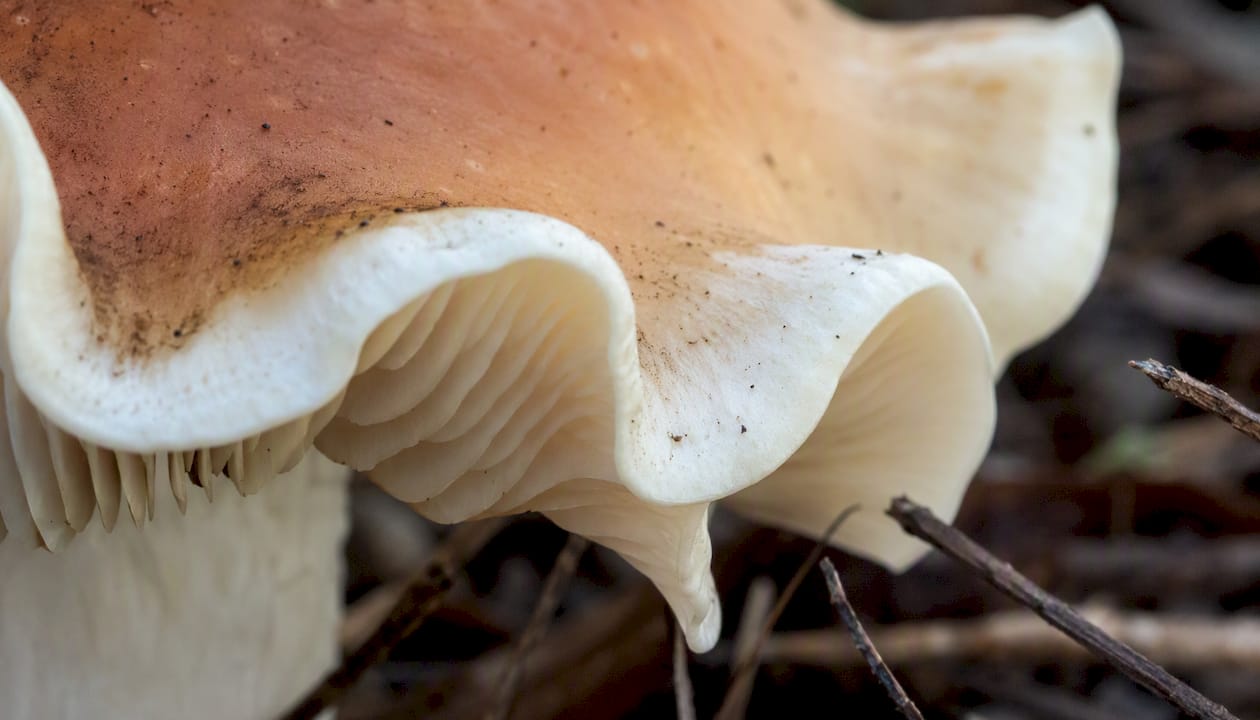
Stems are where the Penis Envy parentage shows most clearly. They run thick and dense, often with visible rippling or ribbing just below the cap junction. Blue bruising appears fast when you handle the tissue, a sign of psilocin oxidation. Dr. P. Delic notes that this wavy-cap, PE-stem combination is the strain’s signature, though mutation and instability mean not every fruit will express it cleanly.
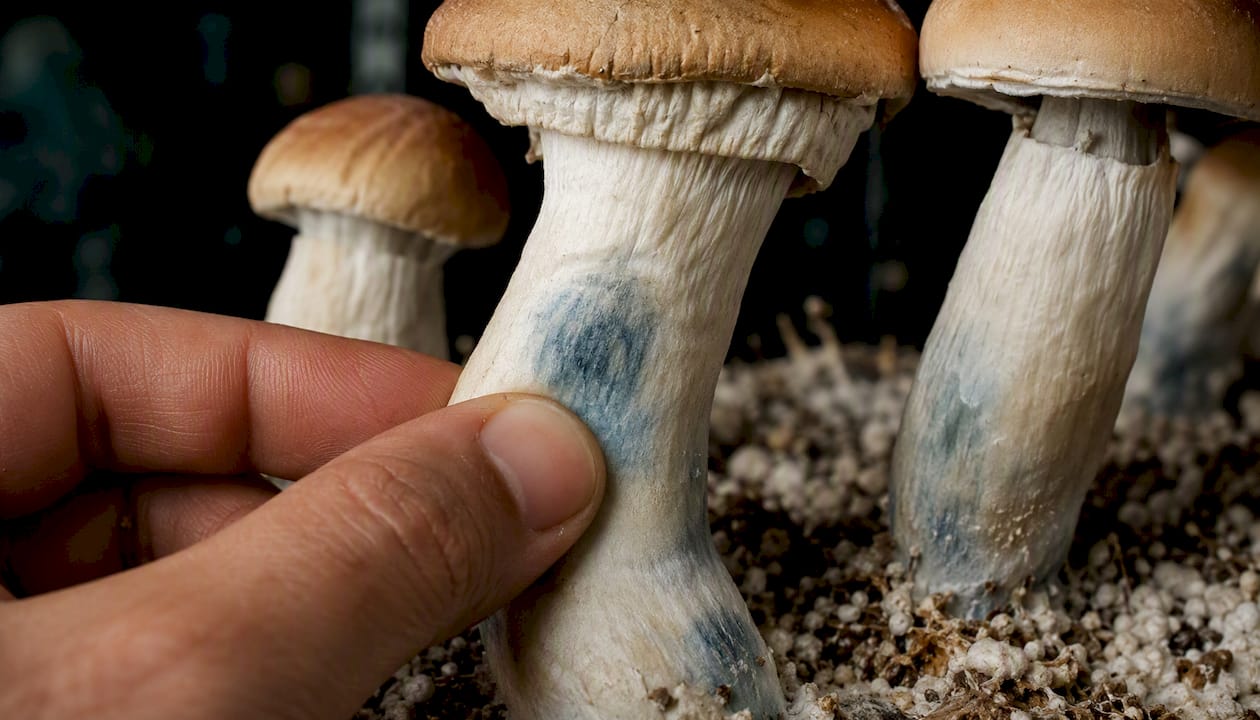
Under the microscope, spores are sub-ellipsoid and measure approximately 10–14 × 6–8 µm. The spore print color is dark purplish-brown, consistent with the cubensis species.
Pro Tip: Phenotypic variability within a single flush is normal for Tidal Wave. White-capped fruits, gold-capped fruits, and Enigma-like blobs can all appear in the same grow from the same substrate block. This is not contamination — it is the strain’s genetic instability expressing itself.
The practical warning for identification: reversion to parent phenotypes is common. A flush that looks more like B+ than Tidal Wave is not necessarily a contaminated or failed grow. It means the hybrid’s genetics have drifted toward one parent. Serial isolation on agar is the only reliable way to lock in the Tidal Wave expression you want.
Notable variants and what they mean for your cultivation plan
Tidal Wave’s instability is a feature as much as a liability. It generates variants that cultivators then select, name, and propagate. Understanding what each label means helps you choose the right propagation route.
Enigma is the most discussed. It grows in a sporeless, brain-like mass rather than a conventional fruiting body. Because it produces no spores, it cannot be propagated from a spore syringe. Tissue cloning is the only option, which means every Enigma culture traces back to a physical clone of a specific fruit. This also complicates potency claims: the 3.82% tryptamine result came from an Enigma sample, but that result cannot be reproduced from spores because none exist. Any Enigma culture you acquire is a clone of a clone.
BXO and Beast are community-named isolates selected for specific traits, typically yield, morphology, or fruiting speed. They are not formally distinct strains. Cultivators use these names to track lineages within their own collections.
Numbered isolates (Tidalwave 2, 3, 4) represent successive selection rounds. A cultivator identifies the best-performing fruit from a flush, clones it, grows it out, selects again, and repeats. Each generation can drift further from the original hybrid expression.
- Sporeless mutations (Enigma): require tissue cloning; no spore-based propagation possible
- Numbered isolates: may be available as spore prints or syringes, but genetic drift means results vary
- BXO/Beast: treat as community labels, not guaranteed phenotypic standards
Pro Tip: When sourcing a named Tidal Wave variant, ask whether the vendor is selling spores or a cloned liquid culture. For Enigma specifically, a spore syringe labeled “Enigma” is either mislabeled or derived from a different mutation — true Enigma is sporeless.
What lab assays actually say about Tidal Wave’s potency
Typical P. cubensis samples in community assays tend to cluster well below that ceiling. The Tidal Wave Enigma result sits at the far right tail of the distribution for the species.
| Sample type | Reported tryptamine range | Source context |
|---|---|---|
| Typical P. cubensis | Generally below 1% total tryptamines | Community assay baseline |
| Tidal Wave (standard phenotype) | Higher than average cubensis; varies by isolate | Community lab reports |
| Tidal Wave Enigma (Hyphae Cup) | 3.82% total tryptamines (single sample) | DoubleBlind / Hyphae Cup entry |
What that table does not show is the variability underneath each row. A single high assay result tells you what one sample produced under specific conditions: a particular substrate, drying method, storage duration, and testing methodology. It does not prove that every Tidal Wave fruit will hit that number. PsychedelicSpotlight’s cultivation notes emphasize that potency varies significantly across fruits and flushes even within the same grow.
Several factors drive that variability:
- Mutation and phenotype: Enigma-type fruits may concentrate tryptamines differently than standard fruiting bodies
- Substrate nutrition: Richer substrates can influence alkaloid expression
- Drying method: Heat degrades psilocin; improper drying lowers measured tryptamine content
- Testing methodology: HPLC and colorimetric assays produce different absolute values for the same sample
The practical takeaway for cultivators: Tidal Wave runs hotter than most cubensis, but the specific potency of any given fruit is unpredictable. Plan your dosing accordingly.
Cultivation profile: what to expect when growing Tidal Wave
Tidal Wave sits at a low-intermediate difficulty level. The B+ parentage gives it faster colonization and broader substrate tolerance than pure Penis Envy. The PE parentage introduces the quirks: slower pinning in some phenotypes, sensitivity to environmental swings, and the genetic instability that produces variable flushes.
Colonization typically runs faster than PE but may be slower than B+ alone, depending on which parent traits dominate in a given isolate. Fruiting behavior varies more than colonization. Some phenotypes pin densely and flush reliably; others produce sparse, irregular fruits that require more precise environmental management.
Environmental targets:
- Colonization temperature: 75–80°F
- Fruiting temperature: 70–75°F
- Humidity: 90–95% during pinning; 80–90% during fruiting
- Fresh air exchange: 4–6 times daily minimum; PE-derived phenotypes are sensitive to CO₂ buildup
Yield expectations depend heavily on which phenotype you are working with. Standard Tidal Wave phenotypes can produce respectable yields across multiple flushes. Enigma-type mutations tend to produce lower total biomass but concentrate tryptamines more densely, which is part of why assay results from Enigma samples skew high.
Contamination resistance is moderate. The strain is not as forgiving as B+ on its own. Sloppy inoculation technique or poor substrate preparation will cost you flushes. Numbered isolates and Enigma variants raise the technical demands further because they require aseptic cloning rather than simple spore inoculation.
Pro Tip: Run your first Tidal Wave grow on a forgiving substrate like brown rice flour or wild bird seed before moving to manure-based mixes. You will get a cleaner read on the strain’s behavior before adding substrate complexity.
Spore, tissue, and liquid culture propagation: choosing the right route
The propagation route you choose determines what you can reliably reproduce. Spore syringes are the most accessible entry point, but they carry the full genetic variability of the hybrid. Every spore is genetically unique, which means two fruits from the same syringe can express completely different phenotypes.
- Spore syringes: Good for microscopy and initial exploration; expect phenotypic diversity across germinations; not suitable for reproducing a specific phenotype
- Tissue cloning: Required for sporeless mutations (Enigma); the only way to fix a specific phenotype you want to keep; demands aseptic technique and a still-air box or flow hood
- Liquid culture (LC): Faster colonization than spore syringes; maintains a cloned genotype when made from tissue; useful for scaling a selected phenotype across multiple substrate blocks
PsychedelicSpotlight recommends cloning from your best-performing fruits and running serial agar isolations to stabilize traits across generations. The workflow looks like this: inoculate agar from a spore syringe, select the most vigorous or morphologically interesting sectors, transfer to fresh agar, grow out, select again, and repeat until the culture behaves consistently.
Pro Tip: Label every agar plate and liquid culture with the generation number and selection criteria. Tidal Wave’s variability makes record-keeping essential — without it, you cannot tell whether a phenotype shift is genetic drift or a contamination event.
Vendors like SporesMD and PNW Spore offer Tidal Wave spore syringes marketed for microscopy research. MagicMyco’s original provenance claim is widely cited across strain guides. Hyphae Labs has contributed community assay data that informs potency discussions. When sourcing, prioritize vendors who provide lab reports for their liquid cultures or syringes — product-level documentation matters more than marketing claims.
Substrates and a high-level cultivation checklist
Tidal Wave performs across a range of substrates, but substrate choice influences both yield and the phenotypic expression you see in a given flush.
Substrates that work well:
- Brown rice flour (BRF) and vermiculite: Accessible, low-contamination risk, good for initial runs and phenotype observation
- Rye grain: Fast colonization, high nutrition; increases yield potential but raises contamination risk if moisture is off
- Wild bird seed (WBS): Reliable, widely available, colonizes quickly
- Manure-based (bovine or equine) with casing: Supports multiple flushes and can influence alkaloid expression; requires proper pasteurization
- Enriched soil mixes: Useful for outdoor or naturalized grows where legal; substrate nutrition affects potency readings in assays
Richer substrates tend to produce larger fruits and higher total biomass. They may also produce higher tryptamine readings in assays, though substrate effects on potency are not fully characterized in the community literature.
High-level inoculation-to-fruiting checklist:
- Sterilize or pasteurize substrate to target water content (field capacity — squeeze a handful and only a few drops fall)
- Inoculate under aseptic conditions (still-air box or flow hood) with spore syringe, LC, or tissue clone
- Colonize at 75–80°F in darkness; check for contamination at day 5 and day 10
- Initiate fruiting conditions when colonization is complete: drop temperature to 70–75°F, increase humidity to 90–95%, begin fresh air exchange
- Harvest before or at veil break for potency; after veil break for spore prints (not applicable to Enigma)
- Collect samples for lab testing if running assays; document substrate, flush number, and drying method
- Confirm local law before sourcing spores or beginning any cultivation — federal law prohibits cultivation of psilocybin-containing fungi regardless of local decriminalization status
Run small test batches when working with a new isolate. Tidal Wave’s variability means a single block tells you little about what the next generation will do.
Troubleshooting common problems in Tidal Wave grows
Green mold (Trichoderma spp.) is the most common contamination threat. It appears as green patches on the substrate surface, usually within the first two weeks of colonization. Tidal Wave mycelium is white and rope-like; any green, black, or pink coloration is a contamination signal. Do not attempt to cut out green mold and continue — the contamination is almost always deeper than the visible patch.
Cobweb mold looks similar to healthy mycelium but is thinner, more diffuse, and does not thicken with time. A light misting and increased fresh air exchange often resolves cobweb without losing the block. Bacterial blotch presents as wet, slimy patches with a sour odor. Blotch-affected blocks should be disposed of immediately.
Tidal Wave-specific issues:
- Reversion to parent phenotypes: A flush that looks like B+ or PE is not a failed grow; it is genetic drift. Clone from the fruits that express the traits you want and discard the rest
- Uneven pinning: Some phenotypes pin sparsely or unevenly across the substrate surface; adjust humidity and fresh air exchange before concluding the block is spent
- Stubborn pins in Enigma variants: Enigma-type mutations sometimes stall at pin initiation; a cold shock (dropping temperature by 5°F for 12–24 hours) can trigger pinning
Respiratory protection (N95 minimum) is appropriate when handling contaminated substrate. Record the contamination event, the substrate batch, and the inoculation date so you can identify patterns across grows.
Pro Tip: Keep a grow log with photos at inoculation, colonization completion, first pin, and each harvest. Tidal Wave’s variability makes visual records far more useful than memory when you are trying to replicate a successful run.
Harvest timing, drying, and storage for maximum potency retention
Harvest timing is a direct potency variable. Psilocin concentration peaks before veil break. Once the veil tears and spores begin dropping, some psilocin converts or degrades. For potency-focused assays, harvest when the veil is still intact but visibly thinning. For yield-focused grows, waiting until just after veil break increases total biomass but may reduce tryptamine concentration per gram of dried material.
Drying best practices:
- Low-heat dehydrator: Set at 95–105°F maximum; higher temperatures degrade psilocin. Dry until fruits snap cleanly rather than bend
- Desiccant finishing: After initial dehydrator drying, place fruits in an airtight container with food-grade silica gel for 24–48 hours to reach cracker-dry status
- Freeze-drying: Produces the lowest moisture content and best potency retention; the preferred method for samples destined for lab assay
Pro Tip: If you are sending samples to a community lab for tryptamine assay, freeze-dry them and ship in a sealed, moisture-proof container with a desiccant packet. Moisture during transit degrades psilocin and will bias your results downward.
Storage recommendations: airtight glass containers with food-grade silica gel, stored in a cool, dark location away from heat and UV light. Properly dried and stored material retains potency for months to years, though degradation is gradual and ongoing. Freezing in vacuum-sealed bags extends shelf life further for long-term storage.
Improper drying is one of the most common reasons assay results disappoint. A sample that tested high in one lab and low in another is often a drying or storage artifact, not a strain inconsistency.
Effects, harm minimization, and responsible dosing guidance
Reported effects from Tidal Wave align with the broader cubensis profile: euphoria, visual enhancement, introspection, and mood elevation. Users frequently describe the experience as more stimulating and visually intense than average cubensis strains, with stronger body sensations and a faster onset. Some reports note pronounced depression-relieving effects at sub-threshold and low doses, though these are anecdotal and not clinical findings.
The critical practical point: because Tidal Wave’s potency varies significantly across fruits and flushes, a dose that felt moderate from one harvest can be substantially stronger from the next, so understanding how long cannabis stays in your system provides useful context for managing substance testing timelines. Practitioner communities consistently recommend reducing your typical cubensis dose estimate when working with Tidal Wave. If your baseline with a standard cubensis strain is 2 grams, starting at 1 gram or less with Tidal Wave is a reasonable harm-minimization step.
Harm-minimization checklist:
- Set and setting: Choose a safe, familiar environment; have a clear intention before beginning
- Sitter or monitor: A sober, trusted person present is strongly recommended for any dose above threshold
- Medical contraindications: Avoid combining with lithium, MAOIs, SSRIs, or other serotonergic medications without medical guidance; individuals with personal or family history of psychosis should not use psilocybin
- Start low: Given Tidal Wave’s potency variability, err significantly on the side of caution for initial doses
- Integration: Plan time afterward for rest and reflection; avoid scheduling demanding activities within 24 hours
For readers interested in preparing for a high-potency mushroom experience, Theelevatedremedies has published detailed preparation guidance covering set, setting, and integration practices. Readers new to the space may also find the beginner mushroom guide useful for calibrating expectations before working with a higher-potency strain.
This section is general information, not medical advice. Consult a qualified healthcare provider before using psilocybin, and confirm current laws in your jurisdiction.
U.S. legal status: what cultivators and researchers need to know
Psilocybin is a Schedule I controlled substance under the federal Controlled Substances Act. Possession, cultivation, and distribution are federal crimes regardless of state or local policy. That federal baseline does not change based on where you live.
State-level divergence is real and growing. Several cities and states have decriminalized personal possession of psilocybin or established supervised therapeutic frameworks. Oregon and Colorado have created regulated therapeutic access programs. A number of cities, including Ann Arbor, Michigan, have passed decriminalization resolutions that deprioritize enforcement of personal possession. None of these local policies override federal law.
Spore legality adds a specific nuance. In most U.S. states, purchasing Psilocybe cubensis spores for microscopy research is legal because spores do not contain psilocybin. The moment spores germinate and mycelium begins producing alkaloids, cultivation becomes a federal offense. California, Georgia, and Idaho prohibit even spore possession. Always verify your state’s specific rules before purchasing.
Key legal points for cultivators and researchers:
- Federal Schedule I status applies nationwide; no state law eliminates federal risk
- Spore purchase for microscopy is legal in most states but not all; check your state before ordering
- Decriminalization does not equal legalization; enforcement deprioritization is not legal protection
- If sending samples to a third-party lab for tryptamine assay, consult legal counsel about chain-of-custody documentation and your jurisdiction’s rules on transporting controlled substances
For Michigan-specific context, Theelevatedremedies has published a Michigan psilocybin product and safe use guide that covers local legal context alongside product safety information.
Community lab testing and what the evidence actually shows
The Hyphae Cup is the most cited community assay competition for Psilocybe potency. Entries are submitted by cultivators, tested by independent labs, and results are published. It is also a single data point from a competition designed to surface exceptional samples, not to characterize average strain potency.
| Evidence type | What it shows | What it does not show |
|---|---|---|
| Hyphae Cup Enigma result (3.82%) | Maximum observed tryptamine in one sample | Average potency across Tidal Wave grows |
| Community assay range data | Tidal Wave runs above typical cubensis baseline | Consistent potency across phenotypes or flushes |
| Single-seller lab reports | Specific batch quality at time of testing | Reproducibility across different cultivators |
Why single-sample outliers do not prove universal strain-level potency: mutation, substrate, drying method, and assay methodology all influence results. An Enigma-type fruit may concentrate tryptamines differently than a standard fruiting body from the same genetic line. A sample dried at high heat will test lower than one freeze-dried from the same harvest. HPLC and colorimetric methods produce different absolute values.
Best practices for contributing reproducible community assay data:
- Document substrate type, water content, colonization temperature, and fruiting conditions
- Record flush number (first-flush fruits typically test higher than later flushes)
- Freeze-dry samples before submission; note drying method in submission documentation
- Submit multiple samples from the same grow to capture intra-flush variability
- Use the same lab and methodology across grows for meaningful comparisons
Where community labs and published assays agree: Tidal Wave, particularly Enigma-type mutations, produces tryptamine concentrations above the cubensis average. Where they diverge: the magnitude of that elevation varies enormously across samples, and no reproducible average for the strain has been established from a large, controlled sample set.
Why Tidal Wave deserves serious attention, and serious caution
Tidal Wave is genuinely interesting from a research perspective precisely because it is unstable. Most cultivators treat genetic instability as a problem to solve. For researchers, it is a window into how hybridization, selection pressure, and mutation interact to produce alkaloid variability within a single species. The Enigma mutation alone raises questions about what structural changes in the fruiting body correlate with tryptamine concentration, and those questions are not yet answered in the community literature.
The practical community priority should be reproducibility. A single high assay result is a signal worth following, not a conclusion worth broadcasting. The cultivators who contribute the most useful data are the ones running multiple samples from the same grow, documenting their methods, and sharing results with enough detail that someone else could replicate the experiment. Tidal Wave’s popularity has expanded community-led lab testing and encouraged more cultivators to run chemical assays, which is genuinely good for the field.
The dosing caution is not performative. A strain with this level of potency variability across fruits and flushes is not one where you can rely on prior experience with a different cubensis strain to calibrate your dose. The gap between a moderate experience and an overwhelming one can be a single gram when the material runs this hot. Cautious dosing, good set and setting, and a sober monitor are not optional extras for Tidal Wave — they are the baseline.
Legal mushroom products and microdosing resources at Theelevatedremedies
Tidal Wave is a strain for experienced cultivators and researchers working within their legal jurisdiction. If you are exploring the benefits of mushroom compounds through legal channels, Theelevatedremedies carries a curated selection of legal mushroom products at 1123 Broadway St in Ann Arbor, Michigan. The product line includes Amanita muscaria gummies, mushroom capsules for microdosing, and mushroom chocolates, all sourced for quality and consistency. For readers building a low-dose protocol, the microdosing guide covers schedules and harm-minimization steps in practical detail. Curious about what Amanita muscaria actually is and how it differs from psilocybin mushrooms? The Amanita muscaria explainer is the place to start. Stop in or reach out to the team for guidance on legal products and safe use.
Sources
The following sources informed this guide and offer deeper reading on Tidal Wave genetics, assay methodology, and cultivation practice:
- Tidal Wave Mushrooms Are Among the Most Potent Ever Tested | DoubleBlind Mag
- Tidal Wave Mushrooms: A Guide to One of the Most Potent Varieties Ever Tested | Psychedelic Spotlight
- Tidal Wave | Dr. P. Delic
For community assay protocols and lab methodology, prioritize independent third-party lab reports over single-seller documentation. Hyphae Cup submission guidelines and community lab templates are the most reproducible starting point for cultivators running their own chemical assays. Always verify that a lab uses HPLC methodology and reports both psilocybin and psilocin separately for the most useful potency data.
This article is general information, not a substitute for advice from a qualified doctor. Consult a qualified healthcare professional about your own circumstances before acting on anything here.