
TL;DR:
- Mushroom protocols are structured psilocybin microdosing schedules that include rest days to prevent receptor desensitization. The Fadiman protocol involves a simple 3-day cycle for beginners, while the Stamets stack adds co-supplements and is suited for experienced users. Rest days are essential for maintaining effectiveness and allowing psychological insights and mood shifts to emerge, emphasizing consistent tracking and patience.
Mushroom protocols are structured psilocybin microdosing schedules designed to deliver sub-perceptual benefits while managing tolerance and tracking effects systematically. The definition of mushroom protocols centers on one core idea: taking small, carefully timed doses of psilocybin mushrooms on a repeating cycle, with mandatory rest days built in. The two most recognized schedules are the Fadiman protocol and the Stamets stack, both developed through grassroots research rather than formal clinical trials. Sub-perceptual doses nudge mood, focus, and creativity without producing a full psychedelic experience. Understanding these schedules gives you a real framework for safe, trackable exploration.
What are the most common mushroom microdosing protocols?
The Fadiman protocol and the Stamets stack are the two dominant mushroom microdosing schedules in use today. Each has a distinct structure, dosing philosophy, and target outcome. Knowing the difference between them is the first step in choosing the right approach for your goals.

The Fadiman protocol
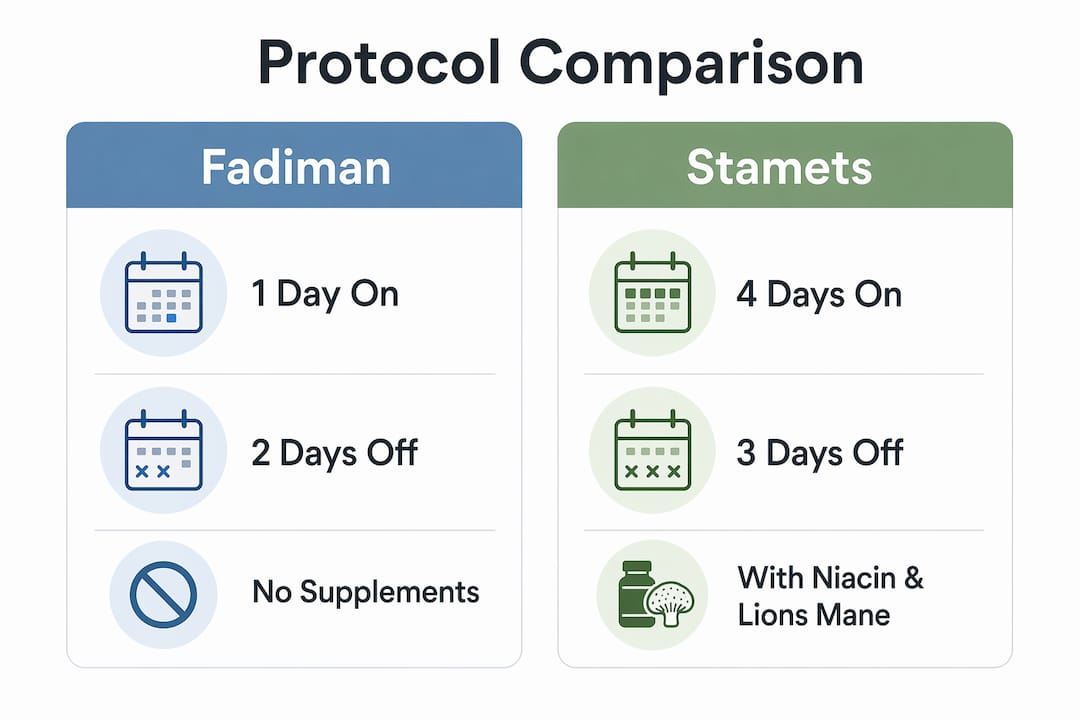
The Fadiman protocol follows a strict 3-day cycle: dose on Day 1, rest on Days 2 and 3, then repeat. Most practitioners run this cycle for 4–8 weeks, followed by a 2–4 week break. The rest period prevents rapid desensitization of the 5-HT2A receptor, which is the primary target of psilocybin in the brain. This protocol is widely recommended for beginners because its structure is simple and easy to track.
The Stamets stack
The Stamets stack runs 4 days on and 3 days off, and it adds two co-supplements: Lion’s Mane mushroom and niacin. The combination targets neurogenesis, with Lion’s Mane promoting nerve growth factor and niacin theoretically helping distribute psilocybin’s effects more broadly. Niacin causes a physiological flush that some people find uncomfortable. This stack is better suited to experienced users who have already completed at least one Fadiman cycle.
Protocol comparison at a glance
| Feature | Fadiman protocol | Stamets stack |
|---|---|---|
| Cycle structure | 1 day on, 2 days off | 4 days on, 3 days off |
| Co-supplements | None | Lion’s Mane, niacin |
| Best for | Beginners | Experienced users |
| Primary goal | Mood and focus | Neurogenesis support |
| Complexity | Low | Moderate to high |
Both protocols use dried Psilocybe cubensis in the 0.05–0.3 gram range, roughly 1/10th to 1/25th of a full clinical dose. That dose range keeps effects sub-perceptual, meaning you function normally throughout the day.
Pro Tip: Start with the Fadiman protocol for your first full cycle. Switching to the Stamets stack before you have a baseline makes it nearly impossible to know what is actually working.
Why do mushroom protocols include rest days?
Rest days are pharmacologically essential, not just scheduling preferences. Psilocybin binds to 5-HT2A serotonin receptors, and repeated activation of those receptors causes them to rapidly desensitize. Once desensitized, the same dose produces a weaker effect. Rest days allow receptor sensitivity to recover, keeping each dose effective across the full protocol cycle.
Experts stress that skipping rest days rapidly diminishes effectiveness. This is not a matter of preference. The off days are built into the schedule specifically because the biology demands them. Daily dosing would produce diminishing returns within days and defeat the purpose of the protocol entirely.
The rest day experience also carries its own value. People report psychological insights and mood shifts on transition days, even without taking a dose. Those observations are some of the most useful data points in a microdosing journal. Ignoring them means missing half the picture.
Key reasons rest days matter:
- Receptor recovery: 5-HT2A receptors regain sensitivity during off days, maintaining dose effectiveness.
- Psychological processing: Subtle mood and cognitive shifts often surface on rest days, not dose days.
- Side effect monitoring: Off days reveal whether any lingering effects are dose-related or baseline changes.
- Protocol integrity: Consistent cycling produces reliable data for tracking and adjustment.
Pro Tip: Log your mood, energy, and focus on rest days with the same detail you use on dose days. The contrast between the two is where the most useful self-knowledge lives.
How to practically implement mushroom protocols for beginners
Starting a mushroom protocol correctly matters more than starting fast. Rushing the process or skipping setup steps produces unreliable results and makes it harder to know whether the protocol is working. A methodical approach from day one saves time and confusion later.
Follow these steps to begin safely:
- Establish your baseline first. Spend one week journaling mood, sleep quality, focus, and energy before taking any dose. This gives you a real comparison point once you start.
- Choose the Fadiman protocol. Its 3-day cycle is the simplest structure available. Completing a full Fadiman cycle before trying advanced stacks is the standard recommendation among experienced practitioners.
- Measure precisely. A microdose of dried Psilocybe cubensis falls between 0.05 and 0.3 grams. Use a milligram-accurate scale. Eyeballing doses produces inconsistent results and makes tracking meaningless.
- Run a minimum 4-week cycle. Effects from microdosing accumulate gradually. Changing protocols or doses before four weeks pass confounds your ability to interpret what is happening.
- Track daily. Log mood, cognition, sleep, and any side effects every day, including rest days. Daily tracking is the only reliable way to distinguish real effects from placebo.
- Escalate doses cautiously. If you feel no effect after two weeks at the lowest dose, increase by 0.05 grams at a time. Stop escalating if you notice any perceptual changes, since that means you have crossed out of sub-perceptual territory.
Some people experience mild headaches, fatigue, or heightened anxiety in the first week. These adjustment effects typically resolve by week two. Patience during this window is not optional. It is part of the process.
Pro Tip: Potency varies between psilocybin mushroom species and even between batches of the same species. Understanding species potency differences before you dose helps you calibrate more accurately from the start.
How do psilocybin protocols compare with functional mushroom supplementation?
Psilocybin microdosing protocols and functional mushroom supplementation are fundamentally different practices. Conflating the two leads to confusion about scheduling, expectations, and outcomes. Understanding where they differ makes both approaches more effective.
Functional mushrooms like Lion’s Mane and Reishi do not target 5-HT2A receptors. They work through entirely different biological pathways, primarily supporting immune function, nerve growth, and inflammation response. Because they do not cause receptor desensitization, functional mushrooms can be taken daily without tolerance concerns. There is no cycling requirement.
Key distinctions between the two approaches:
- Psilocybin protocols require cycling with rest days due to 5-HT2A receptor tolerance. Goals center on mood, focus, and cognitive enhancement through psychedelic mechanisms.
- Functional mushroom supplementation uses daily dosing without rest days. Lion’s Mane supports nerve growth factor production. Reishi supports immune regulation. Neither produces psychoactive effects.
- The Stamets stack sits at the intersection of both. It combines psilocybin microdosing with Lion’s Mane and niacin, theoretically amplifying neurogenesis benefits while still requiring the standard cycling schedule because of the psilocybin component.
The practical takeaway is straightforward. If you are taking Lion’s Mane or Reishi alone for general wellness, daily supplementation is appropriate and you can learn more about mushroom gummies for wellness routines as a consistent format. If you are microdosing psilocybin, the protocol structure is non-negotiable.
Key Takeaways
Mushroom protocols are structured psilocybin microdosing schedules that require precise dosing, mandatory rest days, and consistent tracking to produce reliable, meaningful results.
| Point | Details |
|---|---|
| Core definition | Mushroom protocols are timed psilocybin dosing cycles designed to balance benefits and manage receptor tolerance. |
| Fadiman vs. Stamets | Fadiman uses a 1-on, 2-off cycle for beginners; Stamets adds Lion’s Mane and niacin in a 4-on, 3-off cycle for experienced users. |
| Rest days are biological | Skipping off days desensitizes 5-HT2A receptors and rapidly reduces dose effectiveness. |
| Dose range matters | A standard microdose is 0.05–0.3 grams of dried Psilocybe cubensis, kept sub-perceptual throughout. |
| Track everything | Daily journaling on both dose and rest days is the only way to distinguish real effects from placebo. |
What I have learned from watching people start microdosing
The most common mistake I see is protocol switching too early. Someone starts the Fadiman schedule, feels nothing obvious after five days, and immediately jumps to the Stamets stack. Now they have two variables in play and no way to interpret either one. The Fadiman protocol works precisely because it is boring and consistent. That consistency is the point.
The second thing that surprises most people is how much happens on rest days. The dose day is not always where the insight shows up. Day 2 or Day 3, when nothing is in your system, is often when mood shifts, clarity, or emotional processing becomes most noticeable. People who only track dose days miss this entirely. It is like reading every other page of a book and wondering why the story does not make sense.
There is also a real stigma and legal complexity around psilocybin that shapes how people approach these protocols. Ann Arbor has a more open culture around this than most cities, but people still come in with a lot of anxiety about doing it “wrong.” The honest answer is that the protocol itself is not complicated. The hard part is the patience and the tracking. Anyone willing to do both will get far more out of the experience than someone chasing a faster result.
— Juiced
Mushroom products worth knowing about at Theelevatedremedies
Theelevatedremedies carries dried magic mushrooms, microdosing capsules, and magic mushroom chocolates at 1123 Broadway St in Ann Arbor, Michigan. Every product is sourced for consistency, which matters more than most people realize when you are trying to follow a precise protocol.

If you are curious about mushroom varieties beyond Psilocybe cubensis, the team at Theelevatedremedies can walk you through what is available and what fits your goals. The Amanita Muscaria information page is a solid starting point for anyone wanting to understand the broader world of magic mushrooms before committing to a product. Stop in, ask questions, and leave with something that actually fits what you are trying to do.
FAQ
What is the definition of mushroom protocols?
Mushroom protocols are structured microdosing schedules that specify when and how much psilocybin to take, with built-in rest days to manage receptor tolerance and track effects over time.
How is the Fadiman protocol different from the Stamets stack?
The Fadiman protocol uses a 1-day-on, 2-days-off cycle with no co-supplements, while the Stamets stack runs 4 days on and 3 days off and adds Lion’s Mane and niacin to support neurogenesis.
Why can’t you microdose psilocybin every day?
Daily psilocybin use rapidly desensitizes 5-HT2A receptors, making each dose less effective. Rest days are pharmacologically required, not optional scheduling choices.
What dose counts as a microdose?
A standard microdose is 0.05–0.3 grams of dried Psilocybe cubensis, roughly 1/10th to 1/25th of a full clinical dose, kept sub-perceptual throughout the day.
Do functional mushrooms like Lion’s Mane require a protocol?
No. Lion’s Mane and Reishi do not target 5-HT2A receptors and do not cause tolerance, so they can be taken daily without cycling or rest days.