
TL;DR:
- Mushroom stacking involves combining multiple mushroom species or extracts to target various health and psychedelic benefits simultaneously. It utilizes synergy by leveraging distinct bioactive compounds, broadening effects beyond single-mushroom use, and often follows structured protocols like the Stamets or Fadiman schedules. Starting with one mushroom, tracking responses, and gradually adding others with scheduled rest days enhances safety and effectiveness in personalized routines.
Mushroom stacking is defined as the intentional combination of multiple mushroom species or extracts in a single routine to target different wellness and psychedelic benefits at the same time. Rather than relying on one species alone, stacking lets you leverage the unique bioactive compounds in Lion’s Mane, Reishi, Cordyceps, and psilocybin mushrooms together. The most cited example is the Stamets Stack, which pairs a psilocybin microdose with Lion’s Mane and niacin on a structured schedule. If you are exploring functional mushrooms for the first time, understanding stacking gives you a practical framework for building a personalized protocol.
What is mushroom stacking and why does it matter?
Mushroom stacking is the practice of combining multiple mushroom species or extracts in one regimen to cover several wellness goals simultaneously. A single mushroom like Lion’s Mane excels at cognitive support, but it does not address immune function or stress the way Reishi does. Stacking fills those gaps without requiring you to take a separate supplement for each goal.

The core logic is synergy. Different mushrooms contain different bioactive compounds. Lion’s Mane contains hericenones and erinacines that support nerve growth factor production. Reishi contains triterpenes and beta-glucans that modulate immune response and reduce cortisol. Cordyceps contains adenosine and cordycepin that support cellular energy. When you combine them, each compound works on a different pathway, and the combined effect is broader than any single mushroom delivers alone.
This matters most for microdosers. Psilocybin on its own can shift mood and perception, but pairing it with Lion’s Mane adds a layer of neurological support that many users report enhances mental clarity and focus. The stacking approach turns a single-purpose tool into a multi-target protocol.
What are the main benefits of mushroom stacking compared to single mushroom use?
The primary benefit of stacking is coverage. Combining multiple mushroom types safely enhances their individual benefits, with research showing medicinal mushrooms exhibit anticancer, antioxidant, and immunomodulatory effects, each variety excelling in different areas. That means no single mushroom does everything well, but a well-designed stack can.
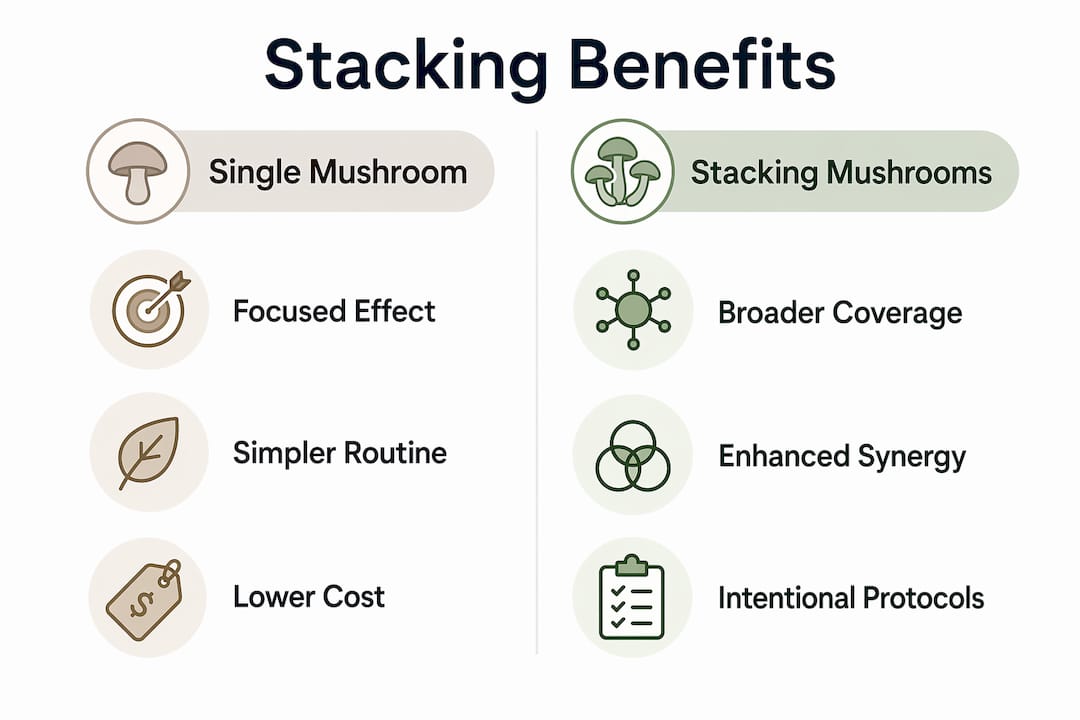
Stacking also addresses the practical problem of supplement fatigue. Instead of tracking five separate products, a single stack formula covers immune support from Turkey Tail, stress management from Reishi, and cognitive enhancement from Lion’s Mane in one serving. This consolidation makes consistency easier, and consistency is what drives results over time.
Here is what a well-designed stack can target simultaneously:
- Cognition and focus: Lion’s Mane supports nerve growth factor and mental clarity
- Energy and endurance: Cordyceps paired with Lion’s Mane creates an energy-plus-clarity combination that many users describe as clean and sustained
- Stress and sleep: Reishi’s adaptogenic properties reduce cortisol and support recovery
- Immune defense: Turkey Tail’s polysaccharopeptides provide broad immune modulation
- Mood and neuroplasticity: Psilocybin microdoses, when stacked with Lion’s Mane, may support neurogenesis and emotional flexibility
“Stacking covers more wellness bases without multiple individual supplements, making it a practical choice for people who want comprehensive support from a single daily protocol.” — DIRTEA Functional Mushrooms
The key distinction from single mushroom use is intentionality. A stack is not random combination. Each ingredient is chosen because it complements the others without duplicating effects or creating unnecessary overlap.
How do common mushroom stacking protocols work?
The most widely referenced mushroom stacking protocol is the Stamets Stack, developed by mycologist Paul Stamets. The Stamets Stack combines a psilocybin microdose with Lion’s Mane and niacin on a 4 days on, 3 days off schedule. The commonly cited starting range is 0.1 to 0.3 g of dried psilocybin mushrooms, 50 to 200 mg of Lion’s Mane extract, and 100 to 200 mg of niacin per dose.
The second major protocol is the Fadiman Protocol, developed by researcher James Fadiman. It uses a simpler schedule: one day on, two days off. This approach works well for people who want to observe effects clearly before committing to a more complex stack. Many users start with the Fadiman Protocol using a single mushroom before layering in additional species.
| Protocol | Schedule | Core Ingredients | Best For |
|---|---|---|---|
| Stamets Stack | 4 on / 3 off | Psilocybin, Lion’s Mane, niacin | Cognitive support and neuroplasticity |
| Fadiman Protocol | 1 on / 2 off | Single psilocybin microdose | Beginners observing baseline effects |
| Functional Stack | Daily or 5 on / 2 off | Lion’s Mane, Reishi, Cordyceps | Non-psychedelic wellness goals |
Scheduling is not arbitrary. The rest days in these protocols are a deliberate strategy to reduce tolerance and maintain efficacy. Without them, the body adapts and the effects diminish. The 4-on, 3-off structure in the Stamets Stack is specifically designed to prevent that adaptation from taking hold.
Niacin plays a specific role in the Stamets Stack that is often misunderstood. Niacin in the Stamets Stack is included to produce a peripheral flush that may help distribute other supplements to nerve endings. It is vitamin B3, not psychedelic, and the flush effect is intentional. No-flush niacin does not produce the same result, so substituting it defeats the purpose.
Pro Tip: Start at the lowest end of the dosing range for every ingredient in your stack. With psilocybin, that means beginning at 0.05 to 0.10 g of dried Psilocybe cubensis and only increasing after two full weeks of consistent journaling.
What are safe and effective techniques for starting a mushroom stacking routine?
The safest way to start stacking is with a single mushroom before adding anything else. A phased approach to stacking starts with one mushroom before adding others, helping users identify effects and reduce confounding. Try Lion’s Mane for a full week, then introduce Reishi, then Cordyceps, each time giving your body time to register the change.
This matters because stacking multiple new substances at once makes it impossible to identify what is working and what is causing side effects. If you add Lion’s Mane, Reishi, and psilocybin on the same day and experience headaches or disrupted sleep, you will not know which ingredient is responsible.
Follow these steps when building your first stack:
- Week 1: Introduce one functional mushroom (Lion’s Mane is the most common starting point) at a low dose
- Week 2: Assess your response. Note energy, sleep, mood, and focus in a journal
- Week 3: Add a second mushroom (Reishi for stress, Cordyceps for energy) and continue tracking
- Week 4 onward: If both are tolerated well, consider adding a psilocybin microdose using the Fadiman or Stamets schedule
Rest days are not optional. The 4-on, 3-off schedule helps users avoid tolerance buildup, and skipping rest days is the most common reason people report diminishing returns. Your off days are when your nervous system recalibrates.
Timing matters too. Lion’s Mane and Cordyceps are best taken in the morning because of their stimulating properties. Reishi is better suited to evenings because of its calming effect. Psilocybin microdoses are typically taken in the morning on an empty stomach to maximize absorption and minimize interference with sleep.
Pro Tip: Keep a dedicated stacking journal. Note the time of day you dose, what you ate beforehand, your mood before and four hours after, and your sleep quality that night. After 30 days, patterns become clear and you can adjust with real data instead of guesswork.
How does mushroom stacking enhance psychedelic microdosing experiences?
Psilocybin microdosing on its own produces subtle shifts in mood, perception, and creative thinking. Stacking amplifies and directs those shifts. The combination of psilocybin with Lion’s Mane is the most studied pairing in this context, with the hypothesis being that psilocybin’s serotonergic activity creates a window of neural plasticity that Lion’s Mane’s nerve growth factor support can then reinforce.
Niacin’s role in this process is physiological. The peripheral flush it produces increases blood flow to extremities and nerve tissue, which theoretically improves delivery of Lion’s Mane compounds to the peripheral nervous system. This is the mechanism Stamets proposed, and while formal clinical trials are still limited, anecdotal reports from the microdosing community consistently describe the combination as producing clearer thinking and more sustained mood stability than psilocybin alone.
Here is what users and preliminary research suggest stacking adds to a standard microdosing practice:
- Sustained focus: Lion’s Mane extends the cognitive clarity window beyond what psilocybin alone produces
- Mood stability: Reishi’s adaptogenic effect smooths the emotional variability some users experience with psilocybin
- Reduced anxiety: Reishi and psilocybin together appear to lower baseline anxiety more consistently than either alone
- Creative output: Multiple user reports describe enhanced divergent thinking during stacking periods compared to single-substance protocols
“Psilocybin microdosing generally uses about 0.05 to 0.10 g dried Psilocybe cubensis as a low starting point. Stack protocols build on this by adding Lion’s Mane and niacin to extend and support the neurological effects.” — Mind Lab Pro
Managing expectations is part of responsible stacking. The science is still early. Most evidence is anecdotal or from small observational studies. What the research does confirm is that medicinal mushrooms exhibit distinct and complementary bioactive profiles, which provides a rational basis for combining them. The experiential outcomes vary by individual, and tracking your own response remains the most reliable guide. You can explore microdose stacking protocols specific to Michigan wellness practices for more structured starting points.
Key takeaways
Mushroom stacking works because different species target different biological pathways, and combining them in structured protocols like the Stamets Stack produces broader, more sustained effects than any single mushroom delivers alone.
| Point | Details |
|---|---|
| Core definition | Stacking combines multiple mushroom species or extracts to target several wellness goals at once. |
| Stamets Stack structure | Pairs psilocybin (0.1 to 0.3 g), Lion’s Mane (50 to 200 mg), and niacin (100 to 200 mg) on a 4-on, 3-off schedule. |
| Rest days are required | Scheduled off days prevent tolerance buildup and maintain the efficacy of every ingredient in the stack. |
| Phased introduction | Start with one mushroom and add others gradually to isolate effects and catch side effects early. |
| Track everything | A daily journal is the most reliable tool for optimizing your stack based on real personal data. |
Why I think most people overcomplicate stacking from day one
The most common mistake I see with mushroom stacking is starting with a five-ingredient protocol before ever spending a week with a single mushroom. People read about the Stamets Stack, get excited, and immediately order psilocybin capsules, Lion’s Mane powder, Reishi extract, Cordyceps, and niacin all at once. Then they feel off on day three and have no idea why.
Stacking is not about complexity. The best stacks I have seen are simple ones built slowly. One mushroom for two weeks. Add a second. Wait. Add a third only if the first two are clearly working. The Fadiman Protocol exists precisely because James Fadiman understood that clean observation requires space between doses and between additions.
The other thing worth saying plainly: the science is still catching up to the community. Most of what we know about the Stamets Stack comes from user reports and Paul Stamets’ own advocacy, not randomized controlled trials. That does not make it invalid. It means you are your own best researcher. Your journal is your study. Your rest days are your control group.
Patience is the actual active ingredient in any stacking protocol. The people who report the most consistent results are not the ones who found the perfect formula on week one. They are the ones who tracked carefully, adjusted slowly, and gave each change enough time to show its real effect. If you are in Ann Arbor and want to talk through where to start, the team at Theelevatedremedies at 1123 Broadway St knows this space well. Check out their safe use wellness tips before your first session.
— Juiced
Explore mushroom products at Theelevatedremedies
Theelevatedremedies carries a curated selection of magic mushroom products sourced for quality and consistency, including dried mushrooms, microdosing capsules, and mushroom chocolates. Every product is chosen with the same standard: clean sourcing, reliable potency, and honest labeling so you know exactly what you are working with.

If you are curious about expanding beyond psilocybin species, Theelevatedremedies also offers a detailed resource on Amanita muscaria, a mushroom with a distinct pharmacological profile that attracts growing interest from experienced explorers. Stop by 1123 Broadway St in Ann Arbor, MI, or browse online to find the right starting point for your stacking practice.
FAQ
What is mushroom stacking in simple terms?
Mushroom stacking is the practice of combining multiple mushroom species or extracts in one daily routine to target several health and psychedelic benefits at the same time. Common combinations include Lion’s Mane for cognition, Reishi for stress, and psilocybin for mood and neuroplasticity.
What is the Stamets Stack and how does it work?
The Stamets Stack combines a psilocybin microdose (0.1 to 0.3 g), Lion’s Mane extract (50 to 200 mg), and niacin (100 to 200 mg) taken on a 4 days on, 3 days off schedule. The niacin produces a peripheral flush that may improve delivery of the other compounds to nerve tissue.
How do rest days affect a mushroom stacking protocol?
Rest days are a deliberate strategy to prevent tolerance buildup and maintain the efficacy of each ingredient in the stack. Skipping them is the most common reason users report diminishing effects over time.
How do I start a mushroom stacking routine safely?
Start with a single mushroom for one to two weeks before adding any others, and keep a daily journal to track mood, focus, energy, and sleep. This phased approach lets you identify what each ingredient contributes and catch any adverse reactions early.
Can you stack functional mushrooms without psilocybin?
Yes. A non-psychedelic functional stack combining Lion’s Mane, Reishi, and Cordyceps targets cognition, stress management, and energy without any psychedelic component. This type of stack is often used daily or on a 5-on, 2-off schedule for general wellness support.
Recommended
- Step-by-Step Mushroom Effects Workflow for Michigan Microdosing – Elevated Remedies
- Magic mushroom terms explained: Michigan guide 2026 – Elevated Remedies
- Magic Mushrooms Explained: Science, Safety & Wellness Guide – Elevated Remedies
- Magic mushroom dosage guide: safe & effective use in Michigan – Elevated Remedies