
A recycler rig is a water pipe designed specifically for concentrates, built around a closed-loop system that continuously cycles water and vapor through two or more chambers before the hit reaches your mouth. The short version: recycler rigs produce smoother, cooler, and cleaner hits than a standard dab rig because vapor never sits stale in a single chamber.
- Core benefit: The looping water action cools vapor, prevents water from splashing into your mouth, and keeps terpene flavor intact on every draw.
Key Takeaways
A recycler rig’s closed-loop water system is the single feature that separates it from a standard dab rig, producing cooler, smoother, and more flavorful hits by cycling vapor through water multiple times before it reaches you.
| Point | Details |
|---|---|
| Core definition | A recycler rig loops water continuously through two or more chambers, cooling and filtering vapor on every draw. |
| Top benefit for concentrates | Repeated water contact preserves terpenes and drops vapor temperature, producing smoother, more flavorful hits. |
| Best first purchase | A classic external recycler or incycler gives you the full recycling experience with the easiest cleaning curve. |
| Key buying checks | Confirm joint size (14mm female is standard), glass thickness (4mm minimum), and banger compatibility before buying. |
| Theelevatedremedies | Shop dab rigs, bangers, and accessories online or in-store in Ann Arbor at Theelevatedremedies. |
Table of Contents
- How does a recycler rig work?
- Main recycler types and what each is best for
- Why recyclers make concentrates hit better
- How to use a recycler rig: setup and technique
- Cleaning and maintaining a recycler rig
- What to look for when buying a recycler rig
- The recycler type most concentrate users should start with
- Recycler rigs and accessories at Theelevatedremedies
- Sources
How does a recycler rig work?
The mechanics are straightforward once you see the path vapor and water take. Recycler rigs use multiple chambers, intake tubing, and drain tubing to lower vapor temperature and increase contact time with water, which is what separates them from a standard single-chamber rig.
Here is the flow on a single inhale:
- Heat enters the banger. You apply your concentrate to a heated quartz banger (or bowl). Vapor forms and gets pulled down through the downstem into the first chamber, which holds water.
- Water and vapor mix in chamber one. The percolator in the first chamber breaks vapor into smaller bubbles, cooling it and beginning filtration.
- The intake tube carries water upward. As you draw, water is pulled up through an intake tube into a second chamber (or back into the same chamber in an incycler design).
- Vapor passes through the second chamber. More cooling and filtration happen here. The vapor path lengthens, which drops temperature further.
- Drain tube returns water to chamber one. Gravity pulls the water back down through the drain (outtake) tube, completing the loop. This is the “recycling” action.
- Vapor rises to the mouthpiece. By the time it arrives, it has passed through water at least twice and traveled a longer path than any standard rig allows.
The closed-loop action causes vapor to pass through water multiple times before reaching the mouthpiece, which is why experienced concentrate users describe recycler hits as noticeably cleaner.
Key terms worth knowing:
- Downstem: The tube that directs vapor from the banger down into the water chamber.
- Banger: The bucket-shaped quartz (or glass) attachment where you apply your concentrate.
- Intake tube: Carries water from the lower chamber upward during inhalation.
- Drain (outtake) tube: Returns water back to the lower chamber by gravity after the draw.
- Incycler: A recycler design where the entire water loop stays inside one outer chamber.
- Klein recycler: A specific external recycler style where the drain tube wraps around the outside of the rig in a distinctive looping shape.
Main recycler types and what each is best for
The glass community uses several distinct recycler styles, each with real trade-offs in flavor, cleaning difficulty, fragility, and price. An incycler keeps the water loop inside a single outer chamber, while a classic external recycler routes water between two separate chambers; both deliver continuous filtration, but the experience differs in meaningful ways.
Classic (external) recycler
Two distinct chambers connected by visible intake and drain tubes on the outside of the rig. Water travels between them in a visible loop you can watch in action. Cleaning is relatively straightforward because the tubes are accessible. The exposed tubing does add fragility.
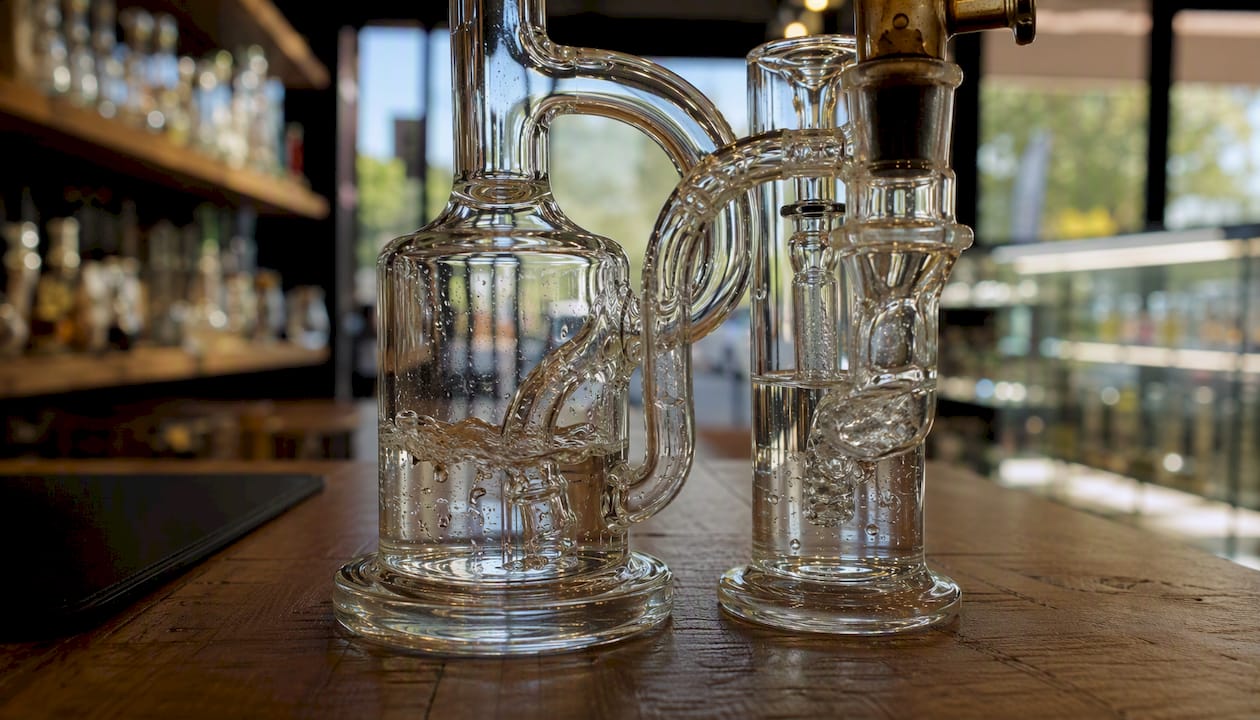
Best for: First-time recycler buyers who want to see the loop in action and keep cleaning simple.
Incycler
The water loop is contained entirely within the inner chamber, nested inside the outer body. The result is a more compact, stable piece with fewer exposed parts to break. The trade-off is that reclaim can build up in the inner tube where brushes struggle to reach.
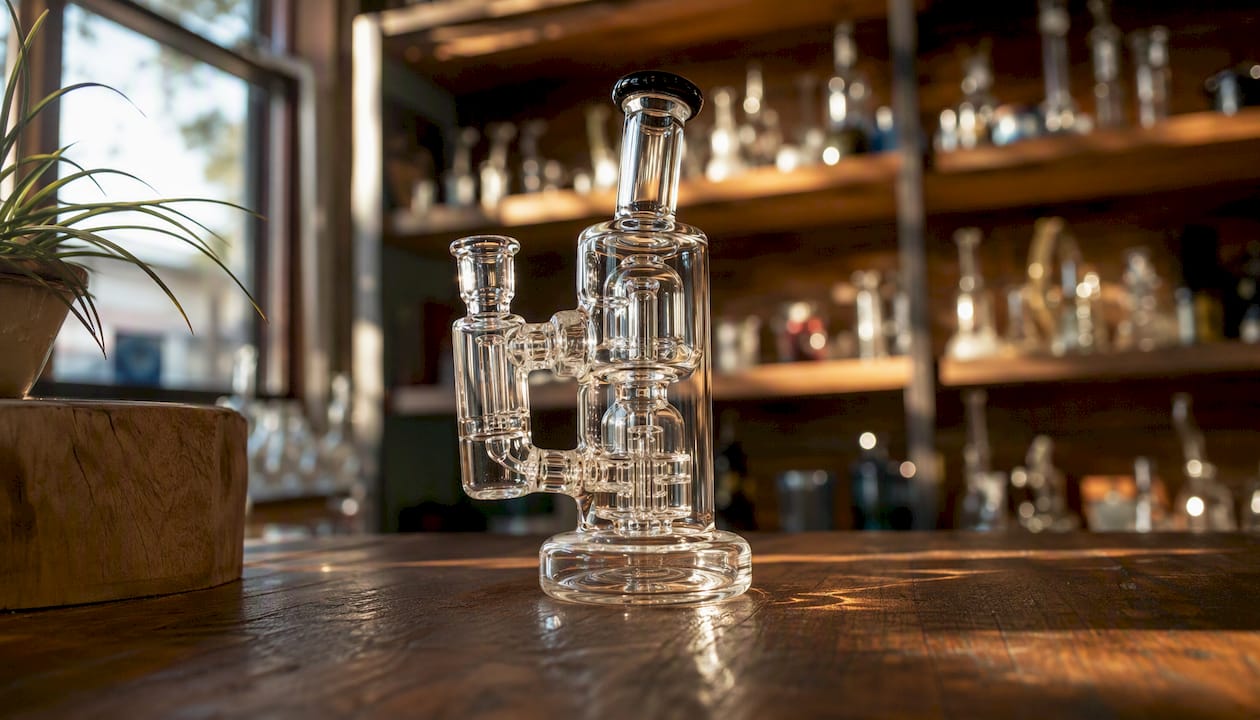
Best for: Compact setups, travel, or anyone who wants a lower profile on the desk.
Klein recycler
The drain tube wraps around the exterior of the rig in a long, curved path before returning water to the lower chamber. That extended path gives vapor more contact time with water, which many flavor-focused users prefer. Klein rigs are typically more expensive and more fragile than basic external recyclers.
Best for: Flavor-first sessions where you are willing to pay more and handle the piece carefully.
Torus recycler
The water chamber is shaped like a donut (torus), creating a circular flow path. The design is visually striking and produces a smooth, even recycling action. Torus rigs tend to sit in the mid-to-high price range.
Best for: Users who want strong cooling performance and a distinctive aesthetic.
Infinity / RBR (recycler-by-recycler) recycler
Multiple recycling loops stacked in sequence. Each loop hands vapor off to the next, compounding the cooling and filtration effect. These are among the most complex recycler designs and the hardest to clean thoroughly.
Best for: Heavy concentrate users who prioritize maximum smoothness over cleaning convenience.
Ratchet recycler
Uses a ratchet-style percolator (a disc with angled slits) as the filtration element inside the loop. The angled slits spin water and vapor in a vortex pattern, adding a diffusion layer on top of the recycling action.
Best for: Users who want extra diffusion without moving to a full multi-loop design.
| Type | Cooling performance | Flavor preservation | Cleaning difficulty | Typical price range |
|---|---|---|---|---|
| Classic external | Good | Good | Easy | $ |
| Incycler | Good | Good | Moderate | $–$$ |
| Klein | Very good | Excellent | Moderate–Hard | $$–$$$ |
| Torus | Very good | Very good | Moderate | $$–$$$ |
| Infinity / RBR | Excellent | Very good | Hard | $$$+ |
| Ratchet | Good | Good | Moderate | $–$$ |
Why recyclers make concentrates hit better
The benefits are most pronounced with concentrates specifically because terpenes are volatile and vapor temperature matters more than it does with flower.
Recycler rigs reroute water in a continuous loop to prevent splashback and help preserve flavor and terpenes during concentrate sessions. Here is what that means in practice:
- Smoother hits: Extended vapor path plus repeated water contact drops temperature before the hit reaches your lungs. Community comparisons consistently report recyclers as noticeably smoother than standard dab rigs because of that extended path and continuous cycling.
- Better terpene retention: Tighter, repeated water contact preserves terpenes better than heavy multi-perc filtration, which can strip volatile flavor compounds from the vapor before it reaches you.
- Splash prevention: The drain tube returns water to the lower chamber before it can travel up to your mouth. No more water in the face mid-dab.
- Efficient concentrate use: Cooler vapor condenses less on the glass walls, so more of your concentrate actually reaches you rather than coating the inside of the rig.
- Cleaner draws: Recycler designs differ from multi-perc bongs in that they prioritize continuous cooling and splash prevention over stacking filtration layers, which suits concentrates better than heavy percolation does.
Sessions that benefit most: large dabs where temperature control is critical, long slow draws where vapor would otherwise warm up in a static chamber, and any flavor-first session where terpene preservation is the priority.
How to use a recycler rig: setup and technique
Setup checklist:
- Fill the lower chamber with water until the downstem is submerged by about half an inch. Overfilling causes splashback; underfilling kills the recycling action.
- Seat your banger firmly in the joint. Check that the joint size and gender match (most recyclers use a 14mm female joint).
- Have your carb cap ready before you torch.
- Keep your concentrate dose small until you know how the rig pulls.
Step-by-step technique:
- Heat the banger. Use a torch and heat the bottom and walls of the quartz banger for 20–30 seconds until it glows faintly.
- Let it cool. Wait 30–60 seconds for a quartz banger. Applying concentrate to an overheated banger burns terpenes and produces harsh, acrid vapor.
- Apply the concentrate. Use a dab tool to place a small amount of concentrate into the banger. You will hear a sizzle.
- Cap immediately. Place your carb cap over the banger right away to trap heat and direct airflow across the concentrate.
- Inhale slowly. Draw at a steady, moderate pace. Watch the water loop activate. The recycling action is most visible and most effective at a controlled draw speed.
- Clear the rig. Lift the carb cap briefly at the end of the draw to clear any remaining vapor.
Safety callouts: Never torch a banger while it is seated in the rig if the joint is near the glass body. Keep the flame on the banger only. Set the rig on a flat, stable surface before you start.
Pro Tip: After your session, while the banger is still warm, swab the inside with a dry cotton swab to remove residual oil. This prevents carbon buildup and keeps your flavor clean on the next dab. For a full beginner walkthrough on dab rig setup, the dab rig beginner’s guide at Theelevatedremedies covers every step in detail.
Cleaning and maintaining a recycler rig
Cleaning difficulty is the most common real-world trade-off with recyclers. The same tubes that create the loop can trap reclaim in spots a standard rinse will not reach.
Step-by-step cleaning routine:
- Empty the water after every session. Stale water grows bacteria and leaves mineral deposits on the glass.
- Rinse with warm water to loosen fresh reclaim before it hardens.
- Add isopropyl alcohol (90% or higher) and coarse salt. Plug the openings with your hands or silicone caps and shake for 60–90 seconds. The salt acts as an abrasive without scratching borosilicate glass.
- Use pipe cleaners or flexible brushes to reach inside the intake and drain tubes. This is the step most people skip, and it is where reclaim accumulates fastest in Klein and infinity designs.
- Rinse thoroughly with warm water until no alcohol smell remains. Residual isopropyl alcohol affects flavor on the next session.
- Dry completely before storing. Trapped moisture encourages mold in enclosed chambers.
Suggested frequency: After daily use, a full iso soak every 3–5 sessions keeps the rig performing well. Light rinses after every session extend the time between deep cleans. For more detail on cleaning glass pieces, the step-by-step bong cleaning guide at Theelevatedremedies applies directly to recycler rigs.
Supplies checklist:
- Isopropyl alcohol, 90%+
- Coarse salt (kosher or sea salt)
- Flexible pipe cleaners or small bottle brushes
- Silicone plugs or your hands to seal openings
- Cotton swabs for banger maintenance
- Replacement o-rings if your rig uses a rubber seal at the joint
Troubleshooting common problems:
- Slow or stopped recycling action: Usually a partial clog in the drain tube. Run a pipe cleaner through it and follow with an iso rinse.
- Splashback returning: Water level is too high. Drain some water until the recycling loop runs cleanly without reaching the mouthpiece.
- Leaking at the joint: The o-ring is worn or missing. Replace it; they are inexpensive and available at most smoke shops.
- Cloudy glass that won’t clear: Extended iso soak (30+ minutes) followed by a salt shake usually handles mineral deposits and heavy reclaim buildup.
Handling note: Borosilicate glass handles heat well but not impact. Set the rig down on a silicone mat rather than a hard surface, and never grab it by the exposed intake or drain tubes.
What to look for when buying a recycler rig
A few specs matter more than aesthetics when you are choosing a recycler for concentrate use.
Buying checklist:
- Joint size and gender: 14mm female is the most common standard for dab rigs. Confirm your banger matches before checkout.
- Glass thickness: 4mm is the practical minimum for daily use; 5mm or thicker is worth the extra cost if you are not careful with glass.
- Percolator type: Inline, showerhead, and honeycomb percs all work inside recycler designs. More diffusion holes mean smoother hits but harder cleaning.
- Mouthpiece shape: A flared or angled mouthpiece is easier to seal your lips around during a slow draw.
- Stability: A wide, flat base matters more on a recycler than a standard rig because the tube structure raises the center of gravity.
- Banger compatibility: Quartz bangers are the standard for concentrates. Make sure the joint angle (45° or 90°) matches the rig’s geometry.
Material comparison:
Borosilicate glass is the standard for recycler rigs. It handles thermal shock well, is easy to inspect for clogs, and does not affect flavor. Quartz is used almost exclusively for bangers rather than the rig body itself, since it is more expensive to work into complex shapes. Ceramic components appear in some percolator inserts and offer good flavor neutrality, though they are more brittle than borosilicate.
Price ranges (typical consumer bands):
Entry-level recyclers ($30–$80) are usually simple external designs with basic percolation. They work, but glass thickness and joint quality vary. Mid-range ($80–$200) is where most daily users land: thicker glass, better percolators, and more consistent recycling action. High-end pieces ($200 and up) cover Klein, torus, and infinity designs with premium borosilicate, tighter tolerances, and more complex loop geometry.
Compatibility tips: If you use an e-rig or electronic nail, confirm the joint size and adapter needs before buying. Reclaim catchers attach between the banger and the joint and are worth adding to any recycler you plan to use daily. For a broader look at smoke shop accessories that pair well with recycler rigs, Theelevatedremedies has a useful overview.
The recycler type most concentrate users should start with
Most concentrate users are better served by a classic external recycler or a quality incycler than by a Klein or infinity design on their first purchase. The reasons are practical: simpler tube geometry means you can actually clean the piece, see when it needs attention, and learn how the loop feels before committing to a more complex design.
The incycler wins on compactness and stability. If your setup is a small tray or a shared space, an incycler’s lower profile and fewer exposed tubes reduce the chance of an accident. The Klein and torus designs are genuinely better for flavor-focused sessions, but that advantage only shows when your technique is already dialed in. Buying a Klein as your first recycler and then struggling to clean the drain tube is a common frustration that sends people back to simpler rigs.
For flavor-first users who have already used a basic recycler: the Klein is worth the step up. The extended drain path gives vapor more contact time with water, and the difference in terpene clarity is noticeable on quality concentrates. Just budget for the extra cleaning time and handle it accordingly.
Recycler rigs and accessories at Theelevatedremedies
Theelevatedremedies carries dab rigs, bangers, carb caps, and the accessories that make a recycler session work from start to finish, available online and in-store at 1123 Broadway St in Ann Arbor, Michigan.

Whether you are buying your first external recycler or stepping up to a Klein-style piece, the team at Theelevatedremedies can help you match joint size, glass thickness, and banger style before you commit. Check joint size against your current banger before checkout. Browse the full selection and pick up everything you need at Theelevatedremedies.
Sources
For technical diagrams and detailed mechanics, the manufacturer and retailer guides below go deeper than most community posts. For live troubleshooting and visual demos of recycler action, the community resource is the better starting point.
- What Is a Recycler Bong? Types, How It Works & More | Roots Glass
- Elevate Your Dabbing: Understanding and Using Recycler Dab Rigs|lOOKAH
- What is a Recycler Rig and How Does It Work? | MÜV
- Our Recycler Dab Rig Guide | Puffco
- Differences Between Incyclers vs. Recyclers - Thick Ass Glass