
TL;DR:
- Full-spectrum gummies contain the entire hemp plant profile, including cannabinoids, terpenes, and trace THC. They leverage the entourage effect to potentially provide broader relief for anxiety, sleep, and pain than CBD isolates. However, they carry a drug-test risk and require verified, batch-specific certificates of analysis for quality assurance.
Choose full-spectrum gummies when you want the whole plant working for you, not just one isolated compound. A true full-spectrum gummy delivers CBD alongside minor cannabinoids like CBG, CBN, and CBC, plus terpenes, flavonoids, and a trace amount of THC, all of which interact in ways that a single-ingredient product simply cannot replicate.
The short version:
- The entourage effect describes how cannabinoids and terpenes work together, producing broader relief for anxiety, sleep, and pain than CBD alone.
- Full-spectrum extracts may allow you to reach your target effect at a lower total dose than isolates, because the compounds amplify each other.
- Federal law caps hemp THC at ≤0.3% by dry weight. Even compliant products carry a nonzero drug-test risk. If you’re subject to workplace screening, read the comparison section below before buying.
Table of Contents
- What does “full-spectrum” actually mean for a gummy?
- How full-spectrum gummies may support anxiety, sleep, and pain
- Full-spectrum vs. broad-spectrum vs. isolate: which fits your situation?
- Safety, side effects, and interactions to watch for
- How to choose a quality full-spectrum gummy
- Key Takeaways
- A practical perspective on full-spectrum gummies
- Theelevatedremedies: full-spectrum guidance and local support in Ann Arbor
- Selected sources for deeper reading
What does “full-spectrum” actually mean for a gummy?
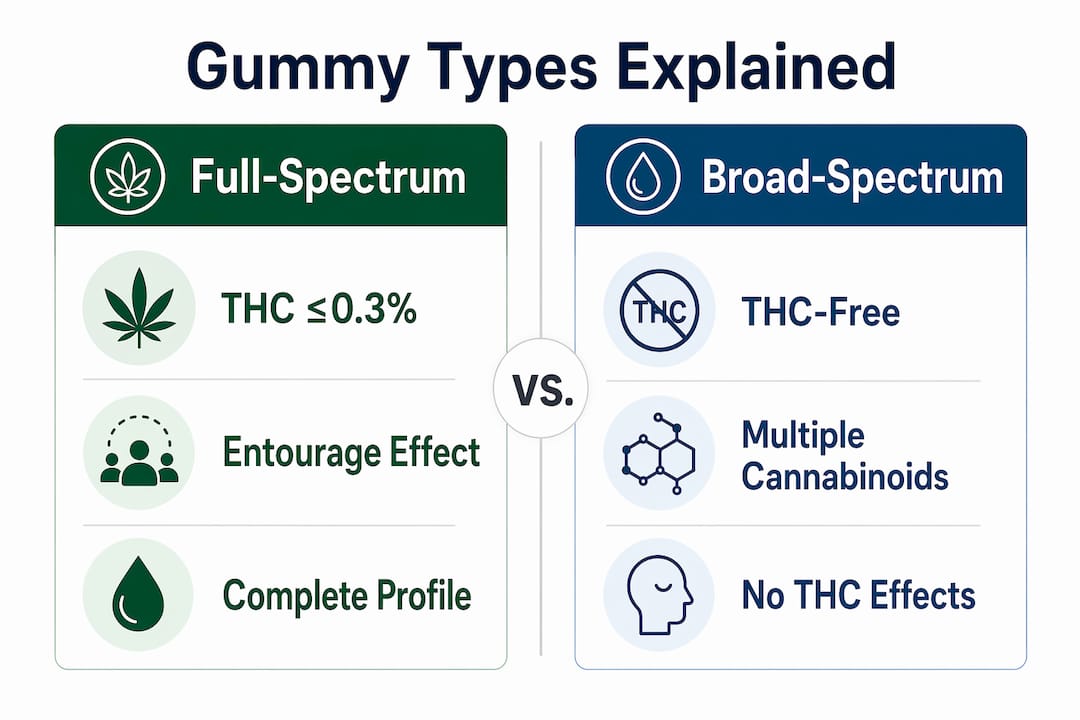
A full-spectrum gummy contains every naturally occurring compound in the hemp plant: CBD, minor cannabinoids (CBG, CBC, CBN, and others), terpenes, flavonoids, and trace THC. Nothing is stripped out. That’s the defining difference from other extract types.
The U.S. federal threshold is ≤0.3% THC by dry weight. Products that meet this standard are federally legal hemp, though individual state rules vary, and a handful of states impose stricter limits. Always check your state before purchasing.
The fastest way to verify a product’s claims is a Certificate of Analysis (COA). A legitimate COA from an ISO/IEC 17025 accredited lab will show quantified levels of multiple cannabinoids and a detectable terpene profile, not just a single CBD number. If a brand can’t produce a batch-specific COA, that’s a reason to walk away.
How full-spectrum gummies may support anxiety, sleep, and pain
The mechanism behind most of the reported benefits is the entourage effect. Terpenes influence how cannabinoids cross the blood-brain barrier and carry their own calming or anti-inflammatory properties. Cannabinoids modulate each other’s receptor activity. The result is a broader biological response than any single compound produces alone.

Preclinical and some clinical research suggests full-spectrum cannabis extracts outperform isolates for neuropathic pain, inflammation, and anxiety in several models. A key finding: in a rat model of chronic nerve injury, full-spectrum extract completely relieved thermal hyperalgesia and mechanical allodynia, while purified CBD or THC at equivalent doses produced only partial effects. The mechanism involved TRPV1 receptor activation rather than the classical CB1/CB2 pathway, which helps explain why the full plant profile behaves differently from its parts.
For mental health specifically, full-spectrum CBD is associated with reducing chronic pain, easing anxiety and depression, and improving sleep. Terpenes like linalool and myrcene tend toward relaxation and sleep support; limonene and alpha-pinene lean toward mood and daytime focus.
What the evidence actually supports: Preclinical findings are strong. Human clinical trials are still limited in scale and rigor. A 2020 Johns Hopkins review concluded that controlled evidence for CBD’s therapeutic efficacy “is lacking for many health conditions.” Full-spectrum products show more promise than isolates in the available literature, but individual response varies considerably by dose, product profile, and biology.
Honest limitations to keep in mind:
- Most robust data comes from animal models, not large human trials.
- Product variability is real. Two “full-spectrum” gummies can have very different cannabinoid and terpene ratios.
- Onset via gummies is typically 30–90 minutes. Effects can last 4–6 hours. Dose and timing matter.
Full-spectrum vs. broad-spectrum vs. isolate: which fits your situation?
| Feature | Full-Spectrum | Broad-Spectrum | CBD Isolate |
|---|---|---|---|
| THC content | ≤0.3% (trace) | Non-detectable | None |
| Minor cannabinoids | Yes | Yes | No |
| Terpenes & flavonoids | Yes | Yes | No |
| Entourage effect | Maximum | Partial | None |
| Drug-test risk | Nonzero | Lower (not zero) | Minimal |
| Best for | Max whole-plant benefit; no testing concerns | Entourage effect without THC exposure | THC sensitivity; simplest profile |
From a clinical standpoint, full-spectrum hemp often outperforms isolate for most users, but the right choice depends on your drug-testing situation, THC sensitivity, and how your body responds. Broad-spectrum is a reasonable middle ground. Isolate makes sense if you have extreme THC sensitivity or need a guaranteed single-ingredient product.
The key distinction: full-spectrum retains THC, broad-spectrum removes it, isolate is pure CBD. That THC difference is what drives both the stronger entourage effect and the elevated drug-test risk.
Safety, side effects, and interactions to watch for
Common side effects with full-spectrum gummies are generally mild: drowsiness, dry mouth, and occasional GI upset. THC-sensitive individuals may notice mood shifts or mild anxiety, particularly at higher doses. CBD in the full-spectrum extract tends to blunt THC’s more unpleasant effects by competing at CB1 receptors, but sensitivity still varies.
Drug interactions are the bigger concern. CBD inhibits CYP450 liver enzymes, particularly CYP2C and CYP3A. This affects how your body metabolizes anticoagulants like warfarin, certain seizure medications, and a range of other chronic drugs. If you’re on any long-term medication, consult a clinician before starting full-spectrum products.
Red flags that warrant stopping use and seeking medical advice: significant mood changes, persistent nausea or vomiting, dizziness that doesn’t resolve, or any sign of liver stress (jaundice, unusual fatigue, upper-right abdominal pain).
On drug testing: THC metabolites accumulate over time. Even a federally compliant product can trigger a positive screen with frequent use. “THC-free” labeling on broad-spectrum products reduces but does not eliminate this risk.
Pro Tip: If you’re subject to random workplace drug testing, treat full-spectrum products as carrying real risk regardless of the label’s THC percentage. A COA showing 0.28% THC is still THC.
How to choose a quality full-spectrum gummy
- Request a batch-specific COA. The lab must be ISO/IEC 17025 accredited. The COA should show multiple cannabinoids quantified, a terpene panel, and screens for heavy metals, pesticides, mycotoxins, and residual solvents. Mislabeling is documented in the CBD market; a COA is your only real verification.
- Confirm the multi-cannabinoid profile. A genuine full-spectrum gummy lists CBD plus detectable CBG, CBN, or CBC alongside a terpene profile. A product showing only CBD is not full-spectrum.
- Check the terpene listing. For sleep or anxiety, look for linalool, myrcene, or caryophyllene. For daytime mood support, limonene or alpha-pinene. Read more about how terpenes shape your experience before committing to a product.
- Verify THC is within the federal limit. The COA number, not the label claim, is what matters.
- Check ingredients and allergens. Gummies often contain gelatin, artificial dyes, or high-fructose corn syrup. If you have dietary restrictions, read the full ingredient list.
- Ask the brand or retailer: What extraction method was used? Where was the hemp grown? Can you see the COA for this specific batch?
Dosing: Start at 5–10 mg CBD per serving. Wait the full 30–90 minute onset window before considering a second dose. Increase by 5 mg increments over several days, not hours. Tracking your response in a simple notes app makes titration far more reliable than guessing.
Pro Tip: For sleep, take your gummy 60–90 minutes before bed. For daytime anxiety, a lower dose mid-morning with food tends to smooth the onset and reduce the chance of drowsiness.
Key Takeaways
Full-spectrum gummies are worth choosing when you want the complete hemp plant profile working together, verified by a COA, and matched to your specific wellness goal.
| Point | Details |
|---|---|
| Entourage effect drives the advantage | Cannabinoids and terpenes together produce broader relief than CBD alone, especially for anxiety, sleep, and pain. |
| COA verification is non-negotiable | Only an ISO/IEC 17025 accredited lab COA confirms cannabinoid profile, THC level, and contaminant screening. |
| Drug-test risk is real | Trace THC accumulates with frequent use and can trigger positive screens even in federally compliant products. |
| Match terpenes to your goal | Linalool and myrcene for sleep; limonene and alpha-pinene for daytime mood and focus. |
| Theelevatedremedies in Ann Arbor | Staff can walk you through COA review and help you select a product matched to your anxiety, sleep, or pain goals. |
A practical perspective on full-spectrum gummies
The conversation around full-spectrum products often gets stuck in two unhelpful places: either breathless enthusiasm about the entourage effect, or reflexive skepticism because the clinical trial base isn’t yet as deep as pharmaceutical research.
The more useful frame is this: the preclinical evidence for full-spectrum extracts over isolates is genuinely compelling, and the mechanism makes biological sense. What’s missing isn’t a reason to try them. It’s a reason to expect identical results across different people and products.
The terpene and cannabinoid profile of a gummy matters as much as the CBD milligram count on the label. Two products with the same CBD dose but different terpene ratios will behave differently. That’s not a marketing claim. It’s why matching the product to your specific goal, whether that’s sleep, daytime calm, or pain management, is worth the extra ten minutes of COA reading.
Theelevatedremedies’ staff in Ann Arbor fields this question constantly. The most common mistake they see: people buying on potency alone, ignoring the terpene panel entirely. A 25 mg gummy with a linalool-forward profile will serve a sleep goal better than a 50 mg gummy with no terpene data at all.
Theelevatedremedies: full-spectrum guidance and local support in Ann Arbor
If you’ve read this far and want to actually try a full-spectrum gummy rather than just research one, Theelevatedremedies at 1123 Broadway St in Ann Arbor is the place to start in person. The staff will pull batch COAs on request, walk you through the cannabinoid and terpene breakdown, and help you match a product to your specific goal, whether that’s better sleep, lower daily anxiety, or pain management.
What sets the in-store experience apart is the education piece. You’re not handed a product and sent out the door. You can ask about extraction method, hemp sourcing, and terpene profile before you buy. And if you’re on medications, the team will tell you plainly to check with your doctor first, because that’s the right call.
Before you purchase, review your COA, flag any medications you take with your clinician, and be honest about your drug-testing situation. Then visit Theelevatedremedies or stop by the store to find a product that actually fits your needs.
Selected sources for deeper reading
- Entourage effect and cannabinoid-terpene interactions (PubMed 32986936)
- Full-spectrum vs. isolate efficacy for pain and inflammation (PubMed 32201189)
- Molecular mechanisms of full-spectrum cannabis extract (ScienceDirect)
- Full-spectrum CBD: benefits, safety, and drug interactions (Verywell Health)
- Full-spectrum vs. broad-spectrum vs. isolate explained (RethinkTHC)
- Does full-spectrum CBD work better? (Dr. Diana Rangaves, PharmD)
- CBD mislabeling and quality control (JAMA Network Open)
- Full-spectrum CBD gummies guide (NuLeaf Naturals)
- Full-spectrum CBD benefits overview (Medical News Today)
- [How to read a COA: look for ISO/IEC 17025 accreditation, a multi-cannabinoid panel, a terpene profile, and contaminant screening for heavy metals, pesticides, and residual solvents. If any of these panels are missing, the COA is incomplete.]
This article is general information, not medical advice. Confirm current rules and any medication interactions with a qualified healthcare provider before using full-spectrum hemp products.