
TL;DR:
- CBD interacts with the body’s endocannabinoid and serotonin systems, offering nuanced support for anxiety.
- Evidence supports CBD’s effectiveness for anxiety, but results for depression and sleep are inconsistent.
- Safety concerns include potential liver stress and drug interactions, emphasizing the need for third-party tested products.
CBD is everywhere in Ann Arbor right now, from coffee shops to wellness studios, and the claims can feel overwhelming. Some say it fixes anxiety overnight. Others say it’s pure placebo. The truth sits somewhere in between, and knowing where requires more than a quick Google search. This guide cuts through the noise by looking at what CBD actually does in your body, what the research genuinely supports, and where the risks are real. Whether you’re curious about trying it or already using it, you’ll walk away with a clearer, more honest picture of what CBD can and can’t do for your mental wellness.
Table of Contents
- How does CBD work for wellness?
- What does the evidence say about CBD for mental health?
- Risks, safety, and what you need to know
- Making an informed decision: Is CBD right for your wellness routine?
- Our take: Balancing science, hope, and hype around CBD
- Connect with trusted natural wellness options
- Frequently asked questions
Key Takeaways
| Point | Details |
|---|---|
| CBD’s brain effects | CBD influences mental wellness via receptors and neurotransmitter systems, but does not cause a high. |
| Evidence is mixed | Research supports CBD for anxiety in some cases but not for depression, stress, or sleep. |
| Safety and risks | CBD can cause side effects and interact with medications, making informed use and professional guidance important. |
| Buy wisely | Choose third-party tested, clearly labeled products and prioritize safety and expert consultation. |
How does CBD work for wellness?
Before you can judge whether CBD is worth your time, you need to understand what it actually does inside your body. The good news: the science here is more solid than most people realize.
CBD (cannabidiol) is a compound found in the cannabis plant. Unlike THC, it doesn’t make you feel high. That’s because CBD doesn’t bind directly to CB1 receptors in the brain the way THC does. Instead, it works through a more indirect set of pathways, which is part of why its effects are subtler and more nuanced.
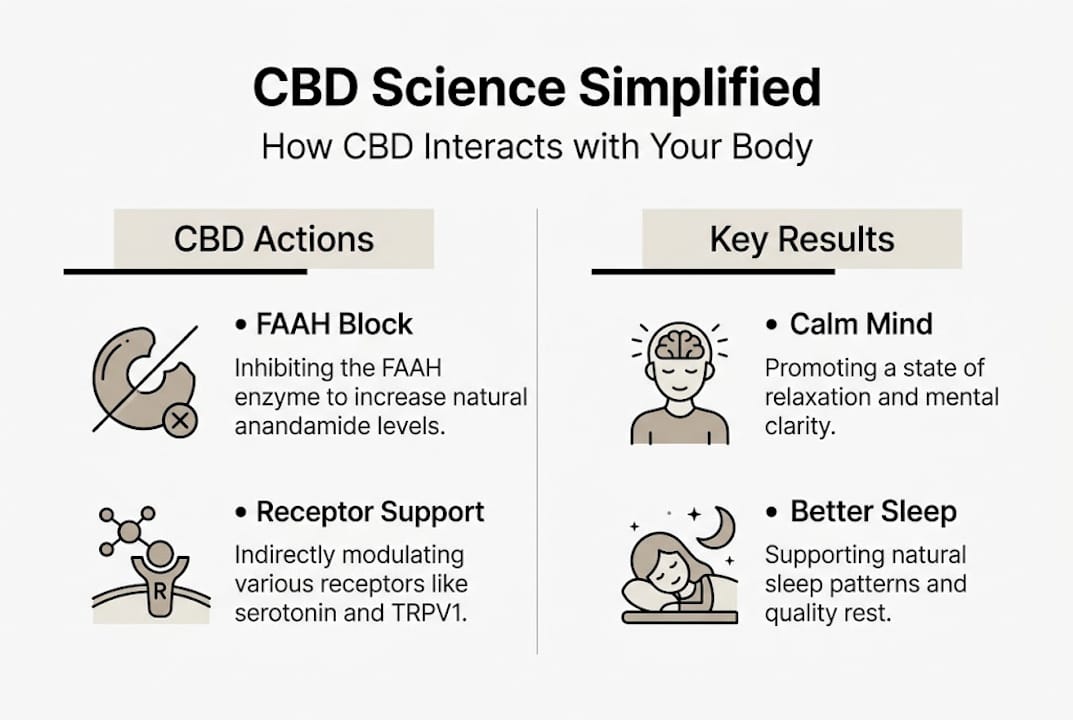
According to CBD expert perspectives, CBD’s mechanisms are genuinely complex. Specifically, CBD inhibits FAAH, an enzyme that breaks down anandamide (your body’s natural “bliss molecule”), which raises anandamide levels in the brain. It also acts as a negative allosteric modulator at CB1 receptors and agonizes 5-HT1A serotonin receptors, contributing to its anxiolytic (anxiety-reducing) effects.
Here’s a quick breakdown of the key receptor interactions:
| Receptor/Target | CBD’s Action | Wellness Relevance |
|---|---|---|
| FAAH enzyme | Inhibits breakdown | Raises anandamide, improves mood |
| CB1 receptor | Negative allosteric modulator | Modulates THC effects, non-intoxicating |
| CB2 receptor | Partial/inverse agonist | Immune and inflammation regulation |
| 5-HT1A receptor | Agonist | Anxiety and stress reduction |
What this means in plain terms:
- CBD doesn’t flood your brain with signals. It fine-tunes existing systems.
- It supports your endocannabinoid system without overpowering it.
- The serotonin pathway is the same one targeted by many prescription antidepressants, which is why CBD and anxiety relief is one of the most researched areas.
“CBD’s non-intoxicating profile, combined with its action on serotonin and endocannabinoid receptors, makes it a genuinely interesting candidate for anxiety-related wellness applications.”
Pro Tip: Understanding these mechanisms helps you set realistic expectations. CBD isn’t a switch you flip. It’s more like a dimmer that gradually adjusts your baseline. If you expect immediate, dramatic relief, you’ll likely be disappointed. If you approach it as a slow-building support tool, you’re more likely to notice real changes.
For a broader look at how natural options fit your overall routine, check out this mental wellness checklist built for Michigan residents.
What does the evidence say about CBD for mental health?
With the science of how CBD works under our belt, let’s turn to what research actually says about its real-world mental health benefits.
The honest answer is: it depends on what you’re treating. The evidence is not uniform across all mental health applications.
For anxiety, the data is the most encouraging. Some RCTs report symptom improvement at doses of 300 to 600mg, and several reviews have flagged CBD as a promising option for generalized anxiety and social anxiety disorder. For sleep, depression, and chronic stress, results are far less consistent.
Here’s how CBD stacks up against other common wellness approaches:
| Wellness approach | Evidence strength for anxiety | Evidence strength for depression | Evidence strength for sleep |
|---|---|---|---|
| CBD | Moderate | Weak | Mixed |
| Mindfulness/meditation | Strong | Strong | Strong |
| Exercise | Strong | Strong | Strong |
| Magnesium supplements | Moderate | Weak | Moderate |
| Prescription SSRIs | Strong | Strong | Moderate |
One important caveat: a placebo-controlled RCT on low-dose CBD in students showed no significant difference from placebo for stress or depression, which tells us that the placebo effect in mental health studies is powerful and CBD’s benefits may be smaller than enthusiastic headlines suggest.
When evaluating any CBD study, look for these things:
- Was it randomized and placebo-controlled?
- What was the dose used? (Under 100mg is often too low to show effects.)
- Was the CBD product independently verified for purity?
- How long was the study? (Short trials often miss delayed effects.)
- Was the population similar to you in age, health status, and diagnosis?
“A majority of high-quality anxiety studies using CBD at therapeutic doses showed measurable symptom improvement, but effect sizes vary widely.”
For Ann Arbor wellness seekers, the key takeaway is this: trial results don’t always translate cleanly to real-world use. Dosing, product quality, and individual biology all affect outcomes. Explore more wellness tips to see how CBD fits alongside other natural approaches.
Risks, safety, and what you need to know
While effectiveness matters, safety is critical. Here’s what to consider before adding CBD to your wellness plan.
CBD is generally well-tolerated, but it’s not risk-free. Common side effects include dry mouth, diarrhea, fatigue, drowsiness, and appetite changes. More seriously, elevated liver enzymes appear in roughly 5% of users even at lower doses, which signals potential liver stress.
CBD also inhibits a family of liver enzymes called CYP450, which process many common medications. This means CBD can raise or lower the effective dose of drugs like blood thinners, antidepressants, and seizure medications without you realizing it.
| Side effect | Frequency | Severity |
|---|---|---|
| Dry mouth | Common | Mild |
| Fatigue/drowsiness | Common | Mild to moderate |
| Diarrhea | Occasional | Moderate |
| Elevated liver enzymes | ~5% of users | Potentially serious |
| Drug interactions (CYP450) | Varies by medication | Potentially serious |
Who should be especially cautious:
- People taking prescription medications (especially blood thinners or antidepressants)
- Those with existing liver conditions
- Pregnant or breastfeeding individuals
- People with a history of substance sensitivity
On the regulatory side, the FDA has only approved one CBD-based drug: Epidiolex, for rare forms of epilepsy. Every other CBD product on the market is unregulated and often inaccurately labeled, with some products containing more or less CBD than stated, or unexpected contaminants.
Pro Tip: Before buying any CBD product, ask for a Certificate of Analysis (COA) from a third-party lab. This document confirms the actual CBD content and checks for pesticides, heavy metals, and residual solvents. If a brand won’t share one, walk away. For guidance on safe wellness practices more broadly, we’ve got you covered.
Making an informed decision: Is CBD right for your wellness routine?
With information on both potential and pitfalls, here’s a step-by-step guide for Ann Arbor wellness seekers to decide if and how to try CBD.
CBD is appealing for mental wellness because of its non-intoxicating nature and real anxiolytic mechanisms. But the evidence is still preliminary, placebo effects are strong, and the risks around liver health and drug interactions make it unsuitable as a first-line approach without some medical input.
Here’s how to approach it thoughtfully:
- Talk to your doctor first. Especially if you take any medications. This isn’t optional if you’re on blood thinners, antidepressants, or anything processed by the liver.
- Start with a realistic goal. CBD works best as a support tool, not a cure. Define what “working” looks like for you before you start.
- Choose a third-party tested product. Full-spectrum CBD (which includes minor cannabinoids and terpenes) tends to outperform isolates in studies, likely due to the entourage effect.
- Start low, go slow. Begin at 15 to 25mg per day and give it at least four weeks before judging results.
- Track your experience. Keep a simple journal noting mood, sleep, anxiety levels, and any side effects. This makes it easier to assess real change versus wishful thinking.
- Know when to pivot. If you notice liver discomfort, unusual fatigue, or your medications feel “off,” stop and consult a professional.
Pro Tip: Ann Arbor has a strong community of integrative health practitioners who are familiar with CBD and other natural options. Seeking out a local professional who takes natural wellness seriously gives you a much better starting point than relying solely on product packaging.
If CBD doesn’t feel right for you, there are other safe natural alternatives worth exploring, including mindfulness practices and psilocybin microdosing, which has its own growing body of research.
Our take: Balancing science, hope, and hype around CBD
Here at Elevated Remedies, we sell CBD and we believe in its potential. But we’d be doing you a disservice if we oversold it.
The honest picture, as proponents and critics both note, is that CBD has real science behind it for anxiety and possibly sleep, but for most other wellness applications, the evidence is thin and the hype is thick. Ann Arbor’s openness to natural health options is genuinely one of our favorite things about this city. That curiosity is a strength. But curiosity without skepticism can lead you to spend money on products that don’t work or, worse, interact badly with something you’re already taking.
Our position: approach CBD the way you’d approach any new wellness tool. With genuine interest, honest questions, and a willingness to stop if it isn’t working. Explore microdosing as an alternative if CBD doesn’t resonate. Natural wellness isn’t one-size-fits-all, and the best path forward is the one built on real information, not marketing.
Connect with trusted natural wellness options
Ready to explore more natural options for your wellness journey? Here are resources for taking the next step, locally and safely.
At Elevated Remedies, located at 1123 Broadway St in Ann Arbor, we carry quality CBD products alongside a curated selection of natural wellness alternatives. Our team knows the products we stock and can help you navigate your options without the sales pressure.
If you’re curious about other plant-based wellness tools, we also carry natural mushroom capsules for those exploring microdosing, and our staff can walk you through what’s known about amanita muscaria and how it differs from psilocybin products. Come in, ask questions, and leave with something that actually fits your needs.
Frequently asked questions
Is CBD safe to use with other medications?
CBD interacts with drug-metabolizing enzymes and can raise or lower the effective level of many common medications, so always check with your healthcare provider before combining them.
How do you choose a safe and effective CBD product?
Prioritize brands that provide third-party Certificates of Analysis, since over-the-counter products are unregulated and may not contain what the label claims.
Does CBD really help with anxiety or depression?
CBD shows potential for anxiety reduction in several studies, but results for depression are inconsistent and both areas are heavily influenced by placebo effects.
Are CBD products legal in Ann Arbor?
Hemp-derived CBD with under 0.3% THC is legal under federal and Michigan law, but product quality varies widely, so buying from a trusted local source matters more than the legal status alone.
Recommended
- Top magic mushroom wellness tips for safe, effective use – Elevated Remedies
- Why microdose for anxiety? Michigan guide to natural relief – Elevated Remedies
- Why Compare Mushroom Strains? Potency, Safety & Results – Elevated Remedies
- Dried mushrooms vs chocolates: safer psilocybin in 2026 – Elevated Remedies