
Routine workplace and pre-employment drug tests, the standard 5-panel and 10-panel urine screens, do not test for psilocybin or its active metabolite, psilocin. Detecting shrooms requires a specialized, targeted test that most employers never order, and even then the detection window is short. The Mandatory Guidelines for Federal Workplace Drug Testing Programs don’t authorize psilocybin biomarker screening as a routine analyte, and any lab that wants to confirm it needs LC-MS/MS or GC-MS equipment, not the immunoassay strips used for standard panels.
- Standard panels look for THC, cocaine, opioids, PCP, and amphetamines, not psilocybin.
- Confirmatory psilocin testing exists, but it’s rare, expensive, and ordered for specific reasons (courts, probation, certain federal roles).
- Timing is everything: psilocin clears the body within about 24 hours in urine, often faster.
So the honest answer isn’t a flat yes or no. It’s “almost never, unless someone specifically goes looking for it, and does so fast.”
Key Takeaways
Routine drug panels are not built to catch psilocybin, and detecting it requires a specific, time-sensitive, and uncommon test.
| Point | Details |
|---|---|
| Standard panels miss psilocybin | 5-panel and 10-panel tests screen for THC, cocaine, opioids, PCP, and amphetamines, not psilocybin. |
| Timing decides detection | Urine and blood windows run from a few hours to about 24 hours after ingestion. |
| Confirmation requires specialized methods | Labs use LC-MS/MS or GC-MS for confirmatory psilocin testing, not routine immunoassays. |
| Contamination is the real risk | Laced or adulterated products can trigger unexpected positives for other substances. |
| Ask before you’re tested | Request the panel list, lab name, and confirmatory testing policy in advance. |
Primary Sources and Further Reading
- Drugs
- Do Shrooms Show Up on a Drug Test? — Healthline
- Analytical toxicology resources — NCBI PMC
- Federal Register — Mandatory Guidelines for Federal Workplace Drug Testing Programs
- MedlinePlus — Drug testing
Table of Contents
- Do Shrooms Show on a Drug Test in Standard Panels?
- What Are the Detection Windows by Test Type?
- How Do Labs Confirm a Positive Psilocybin Test?
- Can You Get a False Positive for Shrooms?
- What Should You Do if You’re Told to Take a Drug Test?
- Curious About Quality Psilocybin Products in Ann Arbor?
- An Editorial Take on Psilocybin Testing Anxiety
- Frequently Asked Questions
- Sources
Do Shrooms Show on a Drug Test in Standard Panels?
Standard employer drug tests are built around a short, federally influenced list of analytes, and psilocybin isn’t on it. The 5-panel test typically screens for marijuana (THC), cocaine, amphetamines, opiates, and phencyclidine (PCP). The expanded 10-panel version adds benzodiazepines, barbiturates, methadone, propoxyphene, and methaqualone. None of these categories overlap with psilocybin or psilocin.
That’s not an oversight. It reflects how federal testing policy actually works. The Mandatory Guidelines set the authorized analyte list for federal workplace testing, and psilocybin biomarkers aren’t part of that authorized set. A lab can’t just tack on a new analyte because it seems relevant. It has to seek authorization, validate an assay, and prove the test holds up to forensic scrutiny before reporting results that could end someone’s job or trigger legal consequences.
Most routine urine drug tests used by employers, including common 5-panel and 10-panel formats, are not designed to detect psilocybin or psilocin. Specialized testing is required, and it’s uncommon outside specific legal or forensic contexts.
In practice, this plays out predictably:
- Pre-employment screening almost always uses the standard panel, since it’s cheaper and faster to process at scale.
- Probation and parole testing usually relies on the same commercial panels unless a court specifically orders a broader screen.
- Random workplace testing in most private-sector jobs follows the same limited analyte list, even in safety-sensitive industries like transportation.
The practical takeaway: unless someone has a specific reason to suspect psilocybin use and orders a targeted test, the standard screen simply isn’t looking for it.
What Are the Detection Windows by Test Type?
Detection windows for psilocybin depend heavily on which biological sample gets tested, and every window shrinks fast because the body metabolizes psilocin quickly. Healthline notes that timing relative to ingestion is the single most important variable in whether any test can catch it at all. There’s no universal cutoff, but the patterns below hold up across the available research.
| Sample type | Typical detection window | Practical reliability |
|---|---|---|
| Urine | Roughly 24 hours, sometimes less | Short window; requires a targeted assay, not a standard panel |
| Blood | A few hours after ingestion | Narrow window; useful mainly in acute medical or forensic settings |
| Saliva | A few hours after ingestion | Rarely used for psilocybin; limited validated methods |
| Hair | Weeks to months, in theory | Technically difficult, expensive, and rarely performed for psilocybin |
| Fingernail | Weeks to months, in theory | Similar limitations to hair; not routine |
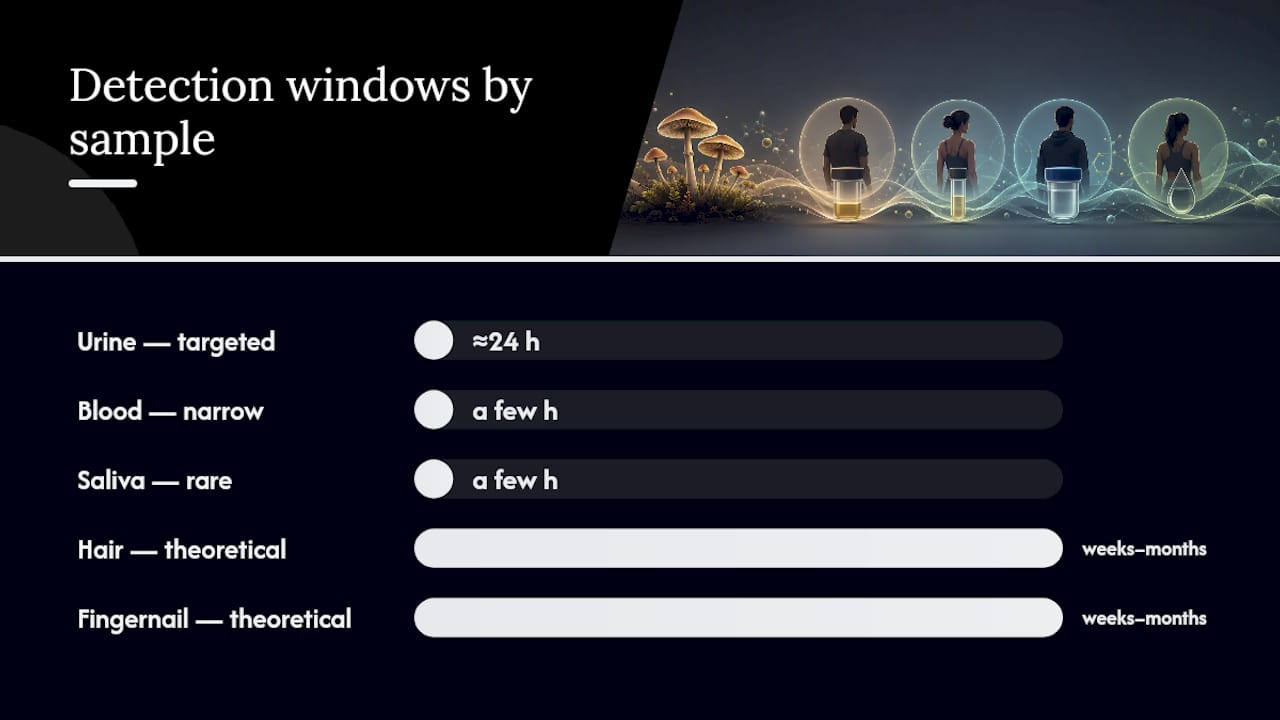
Urine and blood are the two sample types most likely to actually catch psilocin, and only if the sample is collected within hours to about a day of use. Hair and fingernail testing can theoretically stretch the detection window out for weeks, but forensic toxicologists rarely run these tests for psilocybin specifically. The assay development and cost don’t make sense for most cases, so labs default to it only when there’s a compelling legal reason.
Every one of these windows assumes someone actually ordered a psilocybin-specific test. Absent that, none of these samples get screened for it at all.
How Do Labs Confirm a Positive Psilocybin Test?
Specialized psilocybin testing gets ordered in a fairly narrow set of circumstances: court cases, forensic investigations tied to an incident, probation conditions that specifically name psychedelics, and certain federal or military testing policies. The Federal Register documentation on Mandatory Guidelines shows that federal programs can and do update testing scope, meaning readers in safety-sensitive federal roles should assume stricter rules might apply to them specifically.
- Court-ordered testing tied to a specific case or allegation.
- Probation or parole terms that explicitly list psychedelics.
- Certain military or federal testing programs with expanded panels.
When a targeted test does get ordered, labs turn to confirmatory analytical chemistry: LC-MS/MS or GC-MS. These methods separate and identify molecules with enough precision to confirm psilocin at low concentrations, something the antibody-based immunoassays used in routine screens were never built to do.
Pro Tip: If you’re ever told a “comprehensive” panel is being run, ask specifically whether psilocybin is named on the requisition. “Comprehensive” is a marketing term, not a technical one, and it rarely includes psychedelics.
This kind of testing costs more and takes longer to process than a standard panel, which is another reason it stays rare outside forensic and legal contexts.
Can You Get a False Positive for Shrooms?
False positives on standard panels almost never come from psilocybin itself, since it’s not being screened for. The real risk comes from what’s mixed into the product. Illicit mushroom products sometimes get adulterated or laced with other substances, and if that happens, a standard panel could flag something else entirely, like an opioid or synthetic compound that wasn’t disclosed.
- Contaminated or laced products can trigger a true positive for a different, unexpected drug.
- Confirmatory testing (LC-MS/MS or GC-MS) distinguishes a true positive from a lab error or cross-reactivity issue.
- A Medical Review Officer (MRO) reviews any positive result before it’s reported to an employer, checking for legitimate explanations.
- Keep original packaging and note the date and time of use. It helps if a confirmatory review becomes necessary.
Buying from a source that tests for potency and contaminants matters more than people realize. Elevated Remedies covers what to look for in its guide to signs of high-quality psilocybin mushrooms, which is worth a read before assuming a product is what the label says it is.
What Should You Do if You’re Told to Take a Drug Test?
If a test is coming up and psilocybin use is a concern, a few direct questions and quick steps make a real difference in how the result gets interpreted.
- Ask what panel is being used. Request the specific analyte list, not just “standard” or “comprehensive.”
- Ask which lab processes the sample and whether confirmatory testing happens automatically on any positive result.
- Request MRO review if you get a positive result you believe is inaccurate or unrelated to the substance in question.
- Document your timeline. Note dates, times, and any prescriptions or over-the-counter products you’ve taken recently.
- Contact legal counsel if the test is tied to probation, a DOT-regulated job, or military service, since these carry the strictest and most specific rules.
Pro Tip: Ask for the confirmatory testing policy in writing before you’re tested, not after. Many labs run confirmatory tests automatically on positives, but not all do, and knowing the policy ahead of time protects you either way.
Curious About Quality Psilocybin Products in Ann Arbor?
Understanding how testing works is only half the picture. What you actually put in your body matters just as much, especially since sourcing and contamination are bigger real-world risks than any drug test. Elevated Remedies stocks dried mushrooms, microdosing capsules, and mushroom edibles sourced for consistency, plus a full range of smoke shop accessories. If you’re curious about the amanita muscaria products carried in-store and online, the amanita muscaria product guide breaks down what these products are and how they differ from psilocybin mushrooms. Stop by 1123 Broadway St in Ann Arbor, or shop the full selection online.
An Editorial Take on Psilocybin Testing Anxiety
The anxiety around shroom testing is almost always bigger than the actual risk. Most people picture a lab tech running some universal drug panel that catches everything, but that’s not how forensic toxicology works. Tests are built for specific analytes, validated for specific purposes, and psilocybin simply isn’t part of the standard commercial toolkit yet.
Where conventional advice falls short is treating “drug test” as one monolithic thing. It’s not. A pre-employment cup test and a court-ordered forensic panel are different animals entirely, run by different labs, for different reasons, with wildly different price tags. Conflating them creates unnecessary panic.
What actually matters is asking specific questions before assuming the worst: what panel, what lab, what happens if something flags. That single habit does more to protect someone than any amount of general worry ever will. Read the CBD and military testing comparison from High Fashion Smokes & Prints if you want a sense of how differently product categories get treated once federal testing policy gets involved.
Frequently Asked Questions
Will shrooms show up on a drug test at a new job? Almost never on a standard pre-employment panel, since those tests don’t screen for psilocybin.
Do psychedelics show on drug tests used by probation officers? Only if the probation terms specifically name psychedelics and a targeted test gets ordered.
How long do shrooms stay in your system for testing purposes? Psilocin typically clears urine and blood within about 24 hours, though hair testing can theoretically detect use for weeks if it’s ever performed.
Can microdosing show up on a drug test? Microdosing carries the same detection profile as any other dose. It only shows up on a targeted psilocybin test, and the small amount involved makes detection even less likely within the short window.
What happens if a psilocybin test comes back positive? A Medical Review Officer typically reviews the result, and confirmatory testing with LC-MS/MS or GC-MS verifies whether the finding holds up before anything gets reported further.
This article is general information, not a substitute for advice from a qualified lawyer. Consult a qualified legal professional about your own circumstances before acting on anything here.
Sources
This guide draws on federal testing guidance, peer-reviewed toxicology methods, and consumer health explainers from Drugs and Healthline, cross-checked against federal analyte authorization records.
Testing policy shifts. A safety-sensitive federal job today may fall under different rules next year than it does now, so specifics matter more than assumptions.
Elevated Remedies, located in Ann Arbor, Michigan, publishes practical guides on psilocybin products and safe purchasing, including a breakdown of Michigan psilocybin product options. None of this replaces legal or medical advice for anyone facing a specific testing situation.
- Drugs
- Do Shrooms Show Up on a Drug Test? — Healthline
- Analytical toxicology resources — NCBI PMC
- Federal Register — Mandatory Guidelines for Federal Workplace Drug Testing Programs (2026)