
Low temp dabbing means vaporizing concentrate below the point where terpenes and cannabinoids scorch, typically in the 400–475°F range, with many guides using 450°F as the practical ceiling. Go lower and you trade some vapor density and a slower onset for a hit that tastes like the strain instead of lighter fluid. That’s the entire trade, and it’s why so many dabbers switch and never go back.
TL;DR:
- Staying within the 400–475°F range preserves terpenes and flavor, while higher temperatures produce harsher vapor and quicker effects.
- Consistent low-temp dabbing requires precise cooldown timing and accurate temperature measurement, best achieved with e-rigs or infrared thermometers.
- Lower temperatures yield smoother inhalation and nuanced effects but result in lighter vapor clouds and more residual concentrate.
- Thermal degradation of terpenes and cannabinoids increases at higher temperatures, so temperature control is vital for safety and quality.
- Using the right accessories, such as quartz bangers and carb caps, helps achieve repeatable low-temp dabs and prevents overheating.
Table of Contents
- What Is Low Temp Dabbing, and Which Temperature Bands Matter?
- How Do You Get Consistent Low Temp Dabs Every Time?
- What Do You Actually Gain (and Lose) With Low Temp Dabs?
- What Does the Research Say About Dabbing Temperature and Safety?
- How Do You Fix Common Low Temp Dabbing Problems?
- Why Reproducibility Beats Ritual in Low Temp Dabbing
- Shop the Gear That Makes Low Temp Dabbing Repeatable
- Sources
- FAQ
What Is Low Temp Dabbing, and Which Temperature Bands Matter?
Dab temperature ranges aren’t a single number, they’re bands, and each one changes what happens the second concentrate hits quartz.
The low band runs roughly 350–475°F. This is where Leafly defines a low temp dab as anything at or below about 450°F. Terpenes survive largely intact here, so the vapor carries the actual flavor of the strain, whether that’s diesel, citrus, or gas. Vapor is thinner and the effects build gradually instead of hitting all at once.
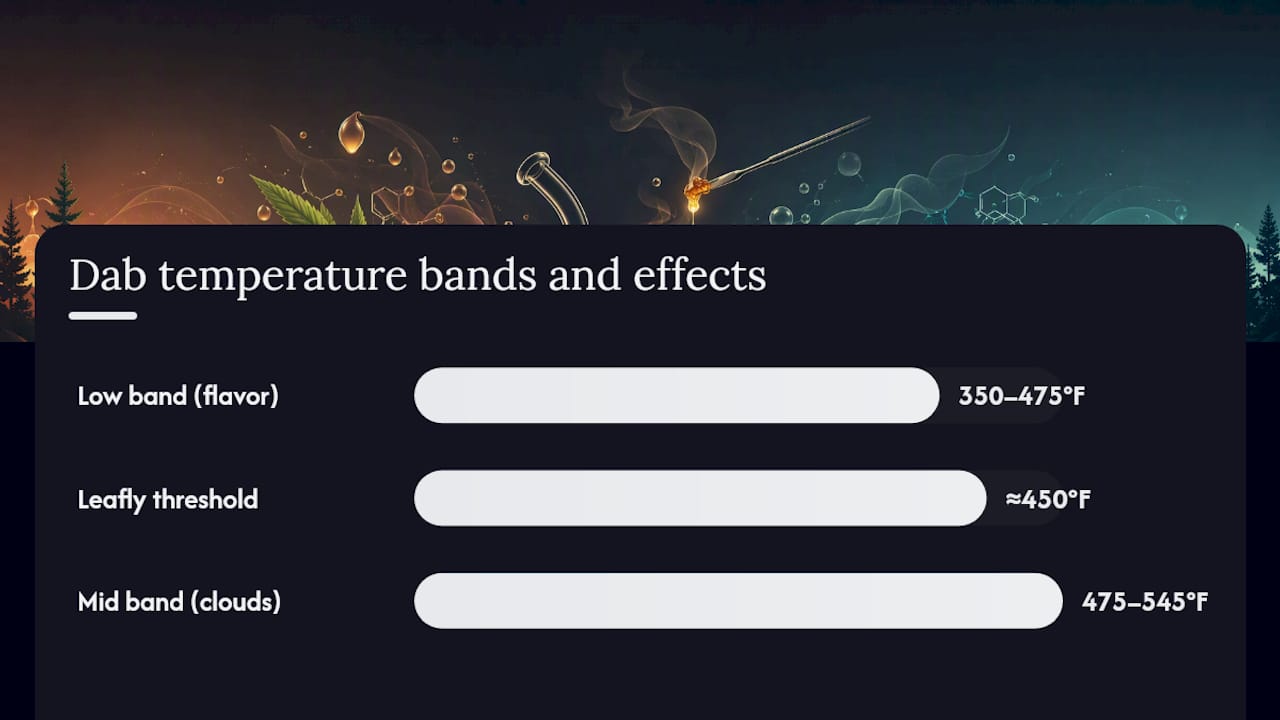
The mid band sits around 475–545°F. You get a fuller cloud, faster onset, and still-decent flavor, though some of the lighter terpenes start cooking off. This is the range most casual dabbers land in without trying.
The high band is 545°F and up. Big, harsh clouds, immediate effects, and flavor that ranges from muted to burnt. Puffco’s temperature guide puts the flavor-first sweet spot around 420–475°F, which lines up with what most experienced dabbers settle on by trial and error.
Concentrate type matters too:
- Live resin rewards low temps (400–450°F) because it’s terpene-rich and built for flavor.
- Rosin does well in the low-to-mid range (425–475°F) depending on how wet or dry the press was.
- Shatter tolerates mid-range heat (475–525°F) better since it has less volatile terpene content to lose.
How Do You Get Consistent Low Temp Dabs Every Time?
Consistency is the actual challenge with low temp dabbing. Anyone can get lucky once. Doing it the same way every session requires either the right hardware or a disciplined process.
E-rigs and e-nails solve this by letting you punch in a number and hold it there. No guesswork, no cooldown timing, no glowing quartz to eyeball. If repeatability matters more to you than ritual, this is the simpler path.
Torch-and-quartz setups take more skill but plenty of dabbers prefer the process. Here’s a workflow that actually holds up:
- Heat the banger until it glows, then let it sit unused for a few seconds. Glow color is not a temperature gauge. It corresponds to surface temperatures far hotter than anything you want for a flavor-first dab.
- Time the cooldown. For a standard quartz banger, that’s usually 40 to 55 seconds; thicker bangers hold heat longer and need 60 seconds or more. Thinner bangers cool faster and can hit your target in 30 seconds.
- Drop the concentrate and cap it immediately with a carb cap to trap heat and control airflow.
- Inhale slowly and steadily. Aggressive pulls in more air than your target temperature can vaporize cleanly.
An infrared thermometer takes the guesswork out entirely. Point it at the banger floor before you drop, note the reading, and record how many seconds of cooldown got you there. That number becomes your rig-specific setting going forward, since banger thickness, torch strength, and even ambient temperature all shift the math.
Pro Tip: Log your cooldown time and reading the first few sessions on a new banger. Once you find the sweet spot for that specific piece, you stop guessing every single dab.
For cold start and reverse dab methods, which flip the traditional order and give you even tighter control, a dedicated cold-start guide walks through the timing differences.
What Do You Actually Gain (and Lose) With Low Temp Dabs?
The benefits of low temp dabbing come down to three things: flavor, smoothness, and a more manageable high.
- Terpene retention. Less heat means less degradation, so the vapor tastes closer to the actual concentrate rather than a scorched approximation.
- Smoother inhale. Lower temps mean less harsh vapor hitting your throat and lungs.
- A more nuanced effect profile. Slower onset lets you gauge how high you’re getting before you take another hit, which matters if you’ve ever overdone it on a hot dab.
The trade-offs are just as real:
- Lighter vapor clouds, which can feel underwhelming if you’re used to high-temp hits.
- Slower onset, meaning the effects build over a minute or two instead of hitting instantly.
- More reclaim and leftover concentrate, since lower heat doesn’t fully vaporize everything on the first pass.
Here’s the part most people get wrong: cranking the temperature doesn’t mean more THC delivered. It mostly means faster, harsher vaporization of what’s already there, not a higher total dose. You’re just burning through the same material faster and losing flavor in the process.
What Does the Research Say About Dabbing Temperature and Safety?
The idea that staying under a terpene’s boiling point guarantees a “clean” dab isn’t quite right. Peer-reviewed research on cannabis aerosols found that dabbing produces thermal degradants, including methacrolein, benzene, and isoprene, and that the levels depend on both temperature and the terpene profile of the concentrate itself.
Higher temperatures and richer terpene content can increase the formation of these gas-phase compounds. The practical goal isn’t hitting some exact number under a terpene’s boiling point. It’s controlled vaporization that minimizes thermal stress overall.
Separate analysis on terpene thermal degradation backs this up: terpene-heavy extracts, the same live resins people love for flavor, can produce more of these degradants under certain conditions than THC-only material. That doesn’t mean avoid terpene-rich concentrates. It means don’t overheat them.
Harm reduction here is straightforward. Buy lab-tested concentrates with a current certificate of analysis, skip products with unknown additives or diluents, measure your temperature instead of eyeballing it, and avoid chain-hitting the same banger without letting it cool. Repeated reheating without full cooldown stacks thermal stress on residue that’s already been through one heating cycle.
How Do You Fix Common Low Temp Dabbing Problems?
Most low-temp frustration traces back to one thing: inconsistent cooldown timing. If your dabs taste harsh one session and flavorless the next, you’re probably not hitting the same temperature twice.
- Recalibrate when you switch bangers. A new banger, even the same brand and size, can cool at a slightly different rate than your last one.
- Manage reclaim deliberately. A tight-fitting carb cap traps more concentrate on the nail instead of pulling it into your rig’s neck, so you get more from a single dab and less mess to reheat later.
- Adjust airflow for your rig style. A recycler rig can run slightly hotter than a straight tube and still feel smooth, since the water path adds cooling the straight design doesn’t.
Pro Tip: If your carb cap has adjustable airflow, start more closed and open it slowly. Too much airflow too fast pulls cool air over hot concentrate and wastes flavor before it ever reaches your lungs.
Why Reproducibility Beats Ritual in Low Temp Dabbing
Most dabbing advice treats temperature like folklore. Count to twenty, wait for the glow to fade, you’ll know when it’s ready. That approach fails the moment you switch bangers, torches, or concentrate types, because none of those variables stay constant between rigs.
The dabbers who get consistent flavor are the ones who measure, log, and adjust rather than trust a countdown they read somewhere once. Juiced has spent time testing e-rig and torch-and-quartz setups side by side, and the pattern holds: an infrared thermometer plus a written log of what worked beats memorized timing every time. Accessories that make that process easier, from quartz bangers to carb caps, are available at some smoke shops, where staff can walk you through a demo if you want to see the difference in person before you commit to a setup.
— Juiced
Shop the Gear That Makes Low Temp Dabbing Repeatable
Getting a reliable low-temp setup usually comes down to having the right pieces on hand rather than chasing a perfect countdown. Accessories such as quartz bangers in multiple thicknesses, carb caps for airflow control, and e-rigs can help take the guesswork out of hitting the same temperature session after session.
If you’re building a setup from scratch or replacing worn-out quartz, stop by 1123 Broadway St or browse the shop’s beginner dab rig guide for a rundown of what pairs well together. And if concentrates aren’t your only interest, Elevated Remedies’ magic mushroom offerings cover microdosing capsules and edibles for anyone curious about exploring beyond the dab rig. Come in, ask questions, and walk out with gear that actually fits how you dab.
Sources
- Low-temp dab | Cannabis glossary | Leafly
- Dab Temperature Guide: The Best Temp for Dabs | Puffco
- Cannabis concentrate vaping chemistry - PMC
FAQ
Do Cold Start Dabs Get You Higher?
Not inherently. Cold start dabs tend to preserve terpenes and produce a smoother, more gradual onset since you’re heating the concentrate from a cool banger rather than dropping it onto a preheated one, but the total effect depends more on dose and concentrate potency than the starting method.
What Is the Ideal Temperature for Dabbing?
There’s no single ideal number. Flavor-first dabbers generally aim for 400–475°F, with 450°F commonly cited as the low-temp cutoff, while those prioritizing bigger clouds and faster onset go higher.
Do Lower Temperature Dabs Have a Stronger Flavor?
Yes. Lower heat causes less thermal degradation of terpenes, which preserves more of the aromatic compounds responsible for a concentrate’s actual flavor profile.
Do Higher Temperature Dabs Get You Higher?
Not necessarily. Higher temperatures vaporize concentrate faster and produce bigger, harsher clouds, but they don’t deliver more total cannabinoid content than a properly vaporized low-temp dab of the same amount.