
For most beginners, honeycomb or showerhead percs give the best balance of smoothness, low drag, and easy cleaning, while tree and matrix percs offer heavier filtration if you don’t mind pulling harder. Diffused downstems are the simplest entry point if you’re just getting started. Every family listed here breaks smoke into smaller bubbles before it hits your lungs, and the rest comes down to how much diffusion you want versus how much airflow resistance and cleaning hassle you’re willing to accept.
TL;DR:
- Honeycomb and showerhead percs are recommended for beginners due to their balance of smoothness and ease of cleaning, while tree and matrix percs offer heavier filtration with increased maintenance.
- More diffusion chambers, such as stacked percs or multiple filtration types, improve cooling and smoothness but also significantly increase water resistance and cleaning complexity.
- Regular rinsing and weekly deep cleaning with alcohol and salt are essential to maintain percolated bongs, especially for intricate designs like tree and matrix percs.
- Choosing the right perc depends on your priorities: honeycomb or showerhead for daily use and flavor, or tree and matrix for maximum filtration and cooling.
- Sturdier glass and easy-to-access chambers can greatly extend the lifespan and reduce cleaning difficulties for percolator bongs.
Table of Contents
- What Are the Main Percolator Types (And What Does a Perc Actually Do)?
- How Percolators Actually Change the Smoke You Inhale
- Comparing Percolator Families Side by Side
- How to Clean and Maintain a Percolated Bong
- A Buying Checklist for Choosing the Right Percolator
- Notes From the Shop Floor
- When a Percolator Bong Beats a Simpler Rig (And When It Doesn’t)
- Find Your Percolator Bong at Elevated Remedies
- Sources
What Are the Main Percolator Types (And What Does a Perc Actually Do)?
A percolator is a chamber built into a bong or attached to a downstem that forces smoke through water before it reaches you. Instead of one column of smoke bubbling up through a single hole, a perc splits that smoke into dozens or hundreds of smaller bubbles. More bubbles mean more surface area touching water, and that extra contact is what makes percolator bongs produce smoother, cooler hits than a straight tube.
Quick note before we go further: if you landed here searching “percolator types” hoping to read about stovetop or electric coffee makers, you’re in the wrong aisle. Coffee percolators are a completely separate category with their own brewing mechanics. This guide covers bong percs, the filtration hardware that changes how smoke feels in your throat and lungs.
Here’s how the common designs actually work:
- Tree percs branch out into several arms, each with slits or holes, so smoke exits through dozens of points at once. They produce a wall of tiny bubbles and some of the coldest hits you’ll find, but those thin glass arms are fragile and awkward to clean.
- Honeycomb percs are flat glass discs drilled with anywhere from a dozen to over a hundred small holes. Smoke pushes straight up through them in an even curtain of bubbles. They’re sturdy, easy to rinse out, and a favorite for people who want filtration without much fuss.
- Showerhead percs use a tube with slits cut around the bottom edge, spraying smoke outward like, well, a showerhead. They diffuse well with noticeably less drag than a tree perc, which makes them a common pick for daily use.
- Inline percs sit horizontally in the tube and use slits along their length to diffuse smoke as it travels sideways before rising. They’re low profile and less prone to breaking than vertical designs, though they filter a bit less aggressively.
- Matrix percs combine multiple diffusion points arranged in a circular or layered pattern, pushing smoke through several angles at once. They rank among the heaviest filtration options available, right alongside tree percs, and they’re just as demanding to keep clean.
- Turbine percs cut slits at an angle so incoming smoke spins the water into a visible whirlpool. The spin adds extra water contact without much added drag, and it looks good doing it.
- Diffused downstems are the entry-level option: a stem with a slitted or slotted tip instead of a plain open end. They’re the cheapest way to add real diffusion and the easiest thing in this list to clean, since there’s no separate chamber involved.
- Disc, donut, and UFO percs are variations on the honeycomb idea, flat or ring-shaped discs positioned partway up the tube. Fritted discs use a porous, sintered glass surface instead of drilled holes, creating even finer bubbles, though that fine texture also traps resin more stubbornly.
- Stacked percs refers to running two or three percolator chambers in the same piece, tree over honeycomb, for example. Stacking increases filtration and smoothness noticeably, but it also means you’re pulling harder to move air through every chamber, and cleaning takes proportionally longer.
How Percolators Actually Change the Smoke You Inhale
Smaller bubbles are the whole trick. When smoke splits into fine bubbles instead of rising as one big glob, it exposes far more surface area to the water surrounding it. That extra contact strips out heat and some particulate before the smoke ever reaches your throat, which is why a percolated hit feels cooler and less harsh than a straight tube of the same size.
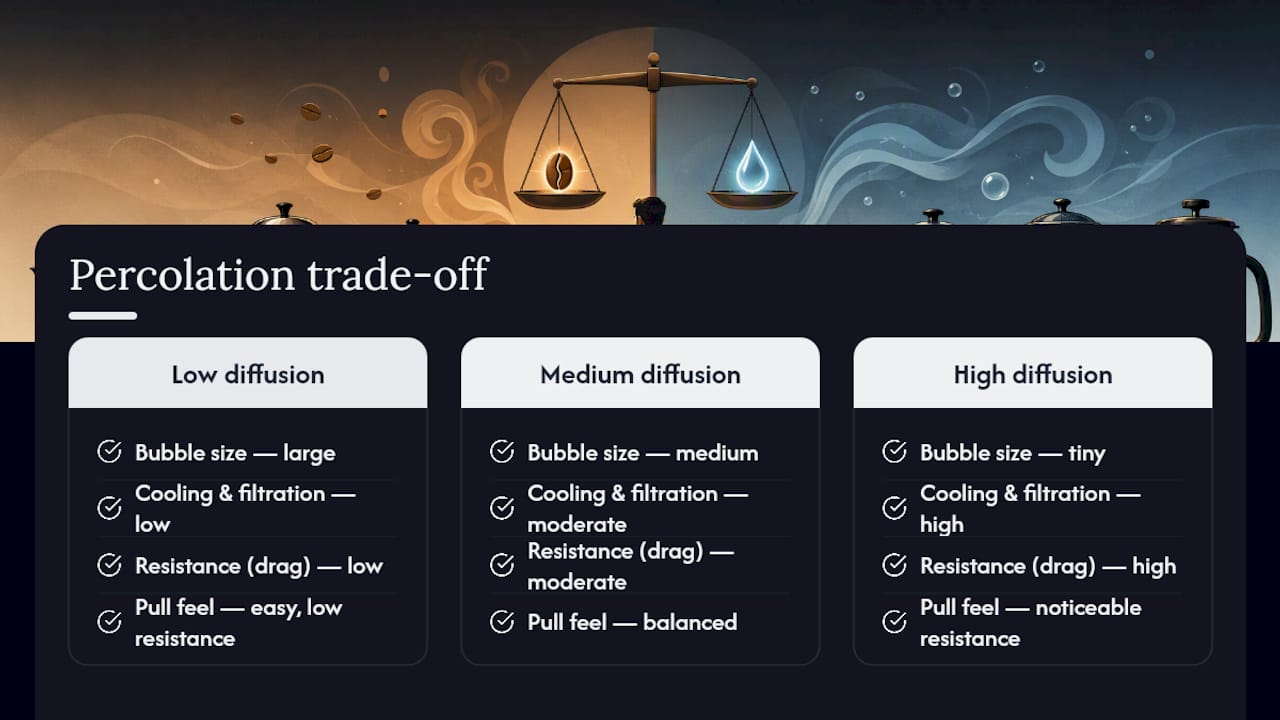
Bubble size, the distance smoke travels through water, and how long it stays in contact with that water all interact to shape flavor and throat feel. A tree perc’s dozens of tiny slits create more bubbles than a single showerhead slit, so it cools more aggressively. But that same fine diffusion adds resistance. Every bubble the smoke has to form and push through is friction, and friction is drag.
This is the actual trade-off running through every perc on the market. The Social Dispensary’s breakdown of percolator mechanics frames it as a choice between the coldest, cleanest hit and a low-resistance pull with decent filtration, and that framing holds up whether you’re comparing a tree perc to a diffused downstem or a single honeycomb to a stacked triple-perc setup. More diffusion chambers in a row multiply both benefits: more cooling, more drag, stacked on top of each other.
You can feel this difference yourself without any special equipment. Take a fast, sharp pull on a heavily percolated piece and you’ll notice real resistance, almost like sipping a thick milkshake through a narrow straw. Slow the pull down and the resistance eases, but the smoke has less time to diffuse before you inhale it. That’s not a flaw in the glass. It’s the same physics showing up at a different speed.
Comparing Percolator Families Side by Side
Matching your priority to a perc family gets easier once you see the trade-offs lined up together. Honeycomb and showerhead percs tend to win for everyday use because they diffuse well without punishing your lungs on every pull, while tree and matrix percs sit at the other end of the spectrum: maximum filtration, maximum drag, maximum cleaning time.
- Tree percs: excellent smoothness and cooling, higher drag, fragile arms, hardest to clean thoroughly. Best for users chasing the coldest possible hit who don’t mind extra upkeep.
- Honeycomb percs: strong smoothness with noticeably lower drag than tree designs, and easier maintenance since the disc has no thin arms to fracture. Best for beginners and flavor-focused users.
- Showerhead percs: comparable smoothness to honeycomb with slightly different airflow, sturdy build, moderate cleaning effort. Best for daily, low-fuss use.
- Inline percs: solid diffusion, low drag, durable horizontal design. Best for users who want filtration without added height or breakage risk.
- Matrix percs: heavy filtration on par with tree percs, similarly demanding to clean, moderate fragility depending on the arm count. Best for heavy filtration seekers who already tolerate drag.
- Diffused downstems: modest smoothness gain over a plain tube, minimal drag, simplest to clean of any option. Best for beginners and anyone upgrading from a basic bong.
The cheat sheet version: chasing the coldest, smoothest hit points you toward tree or matrix. Wanting an easy daily driver points you toward honeycomb or showerhead. Starting out on a budget points you toward a diffused downstem.
How to Clean and Maintain a Percolated Bong
Percs reward you with smoother hits and punish you with dirtier glass, since every extra bubble chamber is another surface where resin and residue can build up. The fix is a simple rhythm rather than a heavy chore.
Rinse your piece with warm water after every session to keep resin from setting. Beyond that, plan on a full clean roughly every three to seven days depending on how often you smoke.
- Empty and rinse the piece with warm water to clear loose debris.
- Plug the openings and add 91% isopropyl alcohol along with coarse salt, which acts as a mild abrasive.
- Shake and swirl gently, letting the salt scrub resin off the glass walls and perc holes.
- For narrow tree or matrix arms, skip the shaking and soak instead, since forced agitation can crack thin glass.
- Rinse thoroughly with warm water until no alcohol smell or residue remains, then let it air dry.
Cotton swabs or pipe cleaners handle spots you can reach directly, but narrow percolator tubes need patience more than tools. Extended soaking with gentle agitation clears stubborn buildup without risking a fracture, which matters most on tree and matrix pieces where the glass is thinnest.
Pro Tip: If resin has hardened into a yellowish film that won’t budge, extend the soak to a few hours instead of scrubbing harder. Heat or forceful shaking on a cold piece is what actually cracks percs, not patience.
Full cleaning steps, soak times, and troubleshooting for stuck-on resin are covered in detail in Elevated Remedies’ step by step bong cleaning guide.
A Buying Checklist for Choosing the Right Percolator
Before you buy, run through joint size and compatibility, perc type, glass wall thickness, how easy the chambers are to reach for cleaning, and your actual budget. Skipping any one of these is how people end up with a beautiful piece they can’t clean or a cheap piece that cracks in a month.
- Match the joint size (usually 14mm or 18mm) to any accessories you already own.
- Pick honeycomb or showerhead if you’re new to percolated pieces and want low drag with easy upkeep.
- Pick honeycomb or fritted disc if flavor preservation matters more to you than maximum cooling.
- Pick tree or matrix only if you’re comfortable with more drag and a longer cleaning routine in exchange for heavier filtration.
- Check listed wall thickness and look for borosilicate glass, which resists thermal stress far better than cheaper soda lime glass. Elevated Remedies’ guide to evaluating glass craftsmanship breaks down what separates durable pieces from fragile ones.
- Buy from a shop that stands behind what it sells rather than an unmarked listing with no return policy.
When in doubt, pick the simplest perc that still meets your top priority. A diffused downstem that gets cleaned regularly beats a triple tree perc that sits dirty in the corner.
Notes From the Shop Floor
Juiced covers smoke shop hardware and psilocybin products for Elevated Remedies, working the counter in Ann Arbor where questions about percs come up daily. The pattern is consistent: people gravitate toward tree percs for the visual and cooling appeal, then come back weeks later asking how to clean them once resin has settled into the arms.
Our practical advice hasn’t changed much over the years. Buy the sturdiest glass your budget allows, since a thick-walled honeycomb piece will outlast a thin-armed tree perc that gets bumped once. If a percolator’s chambers look nearly impossible to reach with a brush or swab, that’s worth weighing before checkout, not after your first clean. Elevated Remedies stocks percolator bongs across that whole spectrum, from beginner-friendly diffused downstems to heavier tree and matrix setups, along with the isopropyl alcohol and cleaning supplies to keep any of them running clear.
When a Percolator Bong Beats a Simpler Rig (And When It Doesn’t)
Percolator bongs earn their keep when smoothness matters more than portability or upkeep. A honeycomb or showerhead piece turns a harsh pull into something you can actually enjoy slowly, and that difference is obvious the first time you switch back to a plain tube.
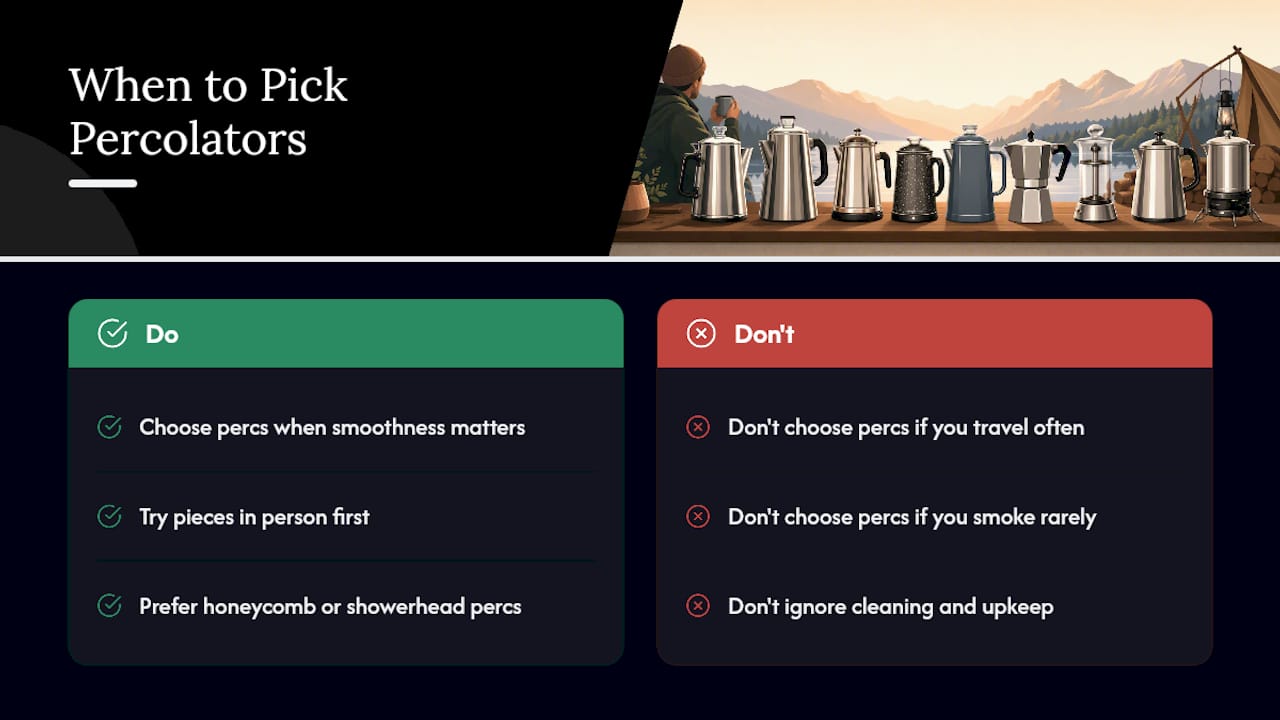
But percs aren’t automatically the right call for everyone. A basic diffused downstem or a simple recycler often makes more sense for someone who travels often, smokes infrequently, or just doesn’t want another cleaning chore added to their week. Heavier filtration always comes with a maintenance bill attached, and pretending otherwise sets beginners up to abandon a beautiful piece the first time it gets grimy.
If you’re deciding between a few options, come test pieces in person. Handling the glass and feeling the actual drag of a tree perc versus a showerhead tells you more in thirty seconds than any spec sheet can.
— Juiced
Find Your Percolator Bong at Elevated Remedies
Elevated Remedies stocks the full range covered here, from beginner-friendly diffused downstems to honeycomb, showerhead, and tree perc pieces, plus the cleaning supplies and replacement parts that keep them working smoothly for years instead of months.

If cleaning is what’s holding you back from buying a heavier-filtration piece, our step by step bong cleaning guide walks through the exact alcohol-and-salt method that keeps percs clear without cracking the glass. And if you’re curious about pairing your new piece with something beyond flower, our page on Amanita muscaria products covers what makes that category different from typical mushroom edibles. Stop by 1123 Broadway St in Ann Arbor to handle pieces in person, or browse the current selection online and get your next percolator bong on the way.
Sources
- Percolator Bongs: Types & How They Work - Social Dispensary
- Types of Coffee Percolators: Stovetop, Electric and Camping - KudosCompare