
TL;DR:
- Psilocybin gene clusters spread across fungi mainly through horizontal gene transfer, not inheritance from common ancestors. Many species outside the Psilocybe genus produce psilocybin, and some within it, like Psilocybe fuscofulva, do not. The compound likely evolved as a defense mechanism against invertebrates, not for human use or consciousness alteration.
Psilocybin genealogy is the study of the evolutionary and genetic lineage of psilocybin-producing mushrooms, tracing how the capacity to synthesize this compound emerged and spread across fungal species. The field draws on molecular biology, mushroom phylogenetics, and anthropology to explain why certain fungi produce psilocybin at all. The Psilocybe genus sits at the center of this story, but the genetic origins of psilocybin reach far beyond a single group of mushrooms. Understanding this lineage changes how you think about psilocybin classification, species identification, and the cultural history of psychedelics.
What is psilocybin genealogy and where did it begin?
Psilocybin genealogy is the formal term researchers use to describe the evolutionary and genetic history of psilocybin biosynthesis in fungi. The more technical discipline is called mushroom phylogenetics, which maps species relationships using DNA sequence data. Together, these approaches reveal that psilocybin did not evolve once and pass neatly down through generations. The story is far more complicated, and more interesting.
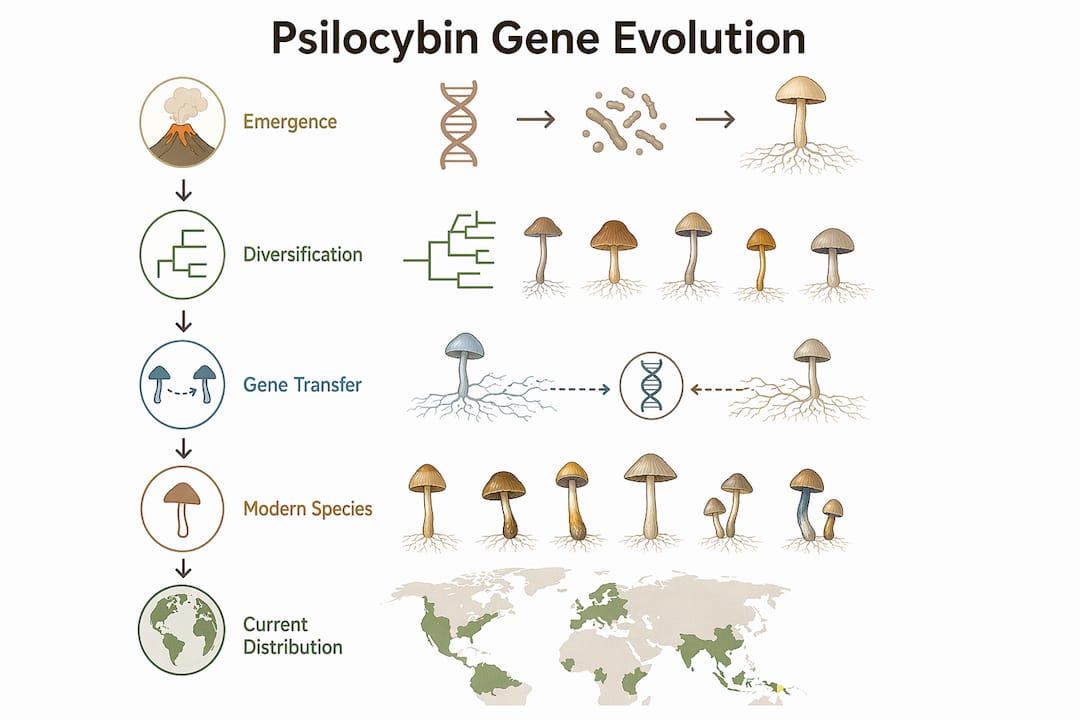
The Psilocybe crown group emerged approximately 28 million years ago, with major clades diversifying during the Miocene epoch. That timeline places the origins of these mushrooms well before any human civilization. The implication is clear: psilocybin evolved for reasons that had nothing to do with human use.
The core biochemical pathway converts tryptophan into psilocybin through four enzymes. These enzymes are encoded by the genes PsiD, PsiK, PsiM, and PsiH, first characterized in Psilocybe cubensis. Each gene plays a specific role in the biosynthetic chain, and the entire cluster tends to travel together as a single mobile unit across fungal genomes.
Pro Tip: If you want to understand why two distantly related mushroom species both produce psilocybin, look at the gene cluster, not just the species name. The cluster moves independently of the organism’s broader evolutionary history.
Here is how the genetic origin story unfolds step by step:
- The ancestral Psilocybe lineage diverged roughly 28 million years ago during the Miocene.
- The psilocybin biosynthetic gene cluster (PGC) formed as a linked set of genes capable of moving between organisms.
- Four independent horizontal gene transfer events spread the PGC across multiple fungal genera, including Gymnopilus, Panaeolus, and Inocybe.
- Three distinct arrangements of the gene cluster have been identified, reflecting different transfer histories.
- Stage-specific gene expression controls when psilocybin actually appears in a mushroom, with some genes like PsiK active mainly during fruiting body formation.
This sequence explains why psilocybin appears in over 200 species across at least a dozen genera. It also explains why the compound’s presence does not always align with what you might expect from a species’ classification.
How are psilocybin-producing mushrooms classified?
Psilocybin classification relies on both morphological traits and molecular phylogenetics. The Psilocybe genus contains the largest number of known psilocybin-producing species, but it is not the only genus that matters.
| Genus | Psilocybin gene cluster present | Notes |
|---|---|---|
| Psilocybe | Yes (most species) | Largest producing genus; some species lack PGC |
| Gymnopilus | Yes (select species) | Acquired via horizontal gene transfer |
| Panaeolus | Yes (select species) | Includes Panaeolus cyanescens |
| Inocybe | Yes (rare species) | Phylogenetically distant from Psilocybe |
| Pluteus | Yes (rare species) | Independent acquisition suspected |
The table above shows that psilocybin production cuts across phylogenetic boundaries. A mushroom does not need to be closely related to Psilocybe cubensis to produce psilocybin. It only needs the gene cluster.
Taxonomic classification of these fungi has shifted significantly as molecular tools improved. Earlier systems grouped species by physical appearance, which led to misclassifications that molecular phylogenetics later corrected. The psilocybin gene cluster is now recognized as a mobile genetic element, meaning its presence in a species tells you about horizontal gene transfer history, not necessarily about evolutionary relatedness.
The most striking example of classification complexity is Psilocybe fuscofulva. This species sits at the earliest branch of Psilocybe Clade I, yet it lacks the psilocybin gene cluster entirely. Its genome suggests the PGC was acquired independently by the major clades within Psilocybe rather than inherited from a common ancestor. That single finding rewrites the assumption that all Psilocybe species produce psilocybin.
Psilocybin species identification therefore requires genetic testing, not just visual inspection or genus membership. Two mushrooms from the same genus can have completely different biochemical profiles depending on whether horizontal gene transfer delivered the PGC to their lineage.
What is the cultural and historical significance of psilocybin mushrooms?
The history of psychedelics involving psilocybin mushrooms is often romanticized beyond what the evidence supports. Anthropological narratives frequently claim ancient global use, but the verified record is more specific.
“Ancient ritualistic use of psilocybin mushrooms is reliably evidenced mainly in pre-Columbian Mexico. Broader claims of widespread ancient use across other continents are largely exaggerated and not supported by direct archaeological evidence.”
The strongest physical evidence comes from Mesoamerica. Mayan mushroom stones dating back several thousand years suggest ritual significance in Central American cultures. The Tassili cave paintings in Algeria are sometimes cited as evidence of prehistoric mushroom use in Africa, but that interpretation remains contested among archaeologists.
Key milestones in the modern history of psilocybin include:
- 1958: Albert Hofmann first isolated psilocybin chemically from Psilocybe mexicana, giving science a pure compound to study.
- 1971: The United Nations Convention on Psychotropic Substances classified psilocybin as Schedule I, halting most research for decades.
- 1990s onward: A research resurgence began, driven by psychiatric interest in psilocybin’s effects on depression and anxiety.
- 2020s: Clinical trials at institutions including Johns Hopkins and NYU produced results strong enough to shift regulatory conversations worldwide.
The legal classification imposed in 1971 created a research gap of nearly 30 years. That gap is why so much of the genetic and evolutionary science around psilocybin is relatively recent. The resurgence in psychiatric research after decades of legal restrictions now drives some of the most detailed work on psilocybin genealogy and mushroom phylogenetics.
The cultural history of psychedelics also intersects with cannabis and other plant-based compounds. Societies that used psilocybin ritually often used multiple psychoactive plants alongside it, which is why the history of cannabis through the ages provides useful comparative context for understanding how humans have long sought altered states through natural compounds.
What ecological role does psilocybin play in fungi?
Psilocybin did not evolve to produce mystical experiences in humans. The leading hypothesis is that it functions as a chemical defense mechanism, specifically by modulating the behavior of invertebrates that would otherwise consume or damage the mushroom.
Experimental evidence supports this directly. Studies on Drosophila larvae exposed to psilocybin show developmental stress and reduced survival rates. That finding points to psilocybin as a selective pressure against insect predation, not a compound with any evolutionary relationship to human neurology.
The key ecological points are:
- Psilocybin’s structural similarity to serotonin means it disrupts serotonin signaling in invertebrates, which rely on serotonin for motor control and feeding behavior.
- Fungi that produce psilocybin gain a survival advantage in environments with high insect pressure.
- The maintenance of the biosynthetic gene cluster across millions of years suggests consistent selective pressure, not a genetic accident.
- Species that acquired the PGC through horizontal gene transfer likely gained this same ecological advantage, which explains why the cluster spread.
The parallel to other natural defense compounds is instructive. Caffeine in coffee plants, capsaicin in peppers, and psilocybin in fungi all evolved as deterrents against specific predators or competitors. Humans later found uses for all three that the plants and fungi never “intended.” Understanding this ecological role clarifies that psilocybin’s effects on human consciousness are a byproduct of its chemistry, not its purpose.
Pro Tip: When evaluating a psilocybin mushroom strain’s potency, remember that psilocybin concentration varies by life stage. The PsiK gene expresses differently in mycelium versus fruiting bodies, so the same genetic lineage can yield very different compound levels depending on harvest timing.
Key Takeaways
Psilocybin genealogy reveals that the capacity to produce psilocybin spread across fungi primarily through horizontal gene transfer, not vertical inheritance, making species classification and identification more complex than genus membership alone can explain.
| Point | Details |
|---|---|
| Psilocybe crown group age | The Psilocybe lineage emerged roughly 28 million years ago during the Miocene epoch. |
| Horizontal gene transfer | Four independent HGT events spread the psilocybin gene cluster across multiple genera. |
| Classification complexity | Psilocybe fuscofulva lacks the psilocybin gene cluster despite belonging to the Psilocybe genus. |
| Cultural evidence | Verified ritualistic use is documented in pre-Columbian Mexico, not broadly across ancient civilizations. |
| Ecological function | Psilocybin likely evolved as a chemical defense against invertebrate predators, not for human use. |
The part most people skip over
Most conversations about psilocybin jump straight to effects or legal status. The genetic lineage gets treated as a footnote. That is a mistake, and I say that as someone who has spent years watching people engage with psilocybin products without understanding what they are actually holding.
The Psilocybe fuscofulva finding genuinely changed how I think about species identification. The assumption that genus membership guarantees psilocybin production is wrong, and that matters practically. If you are sourcing mushrooms based on species names alone, you are missing the most important variable: whether the gene cluster is actually present and expressed.
The cultural history piece also deserves more honesty. The idea that ancient humans across every continent were using psilocybin in sophisticated rituals is a compelling story. The archaeological record does not fully support it. Verified use in pre-Columbian Mexico is real and significant. Extrapolating that into a universal ancient tradition flattens the actual history and, frankly, does a disservice to the Mazatec and other Central American cultures where this practice was genuinely documented.
What the genetic science and the honest cultural history share is this: psilocybin is a compound with a specific, traceable origin story. That story makes it more interesting, not less. The CBD and psychiatric research space has learned this lesson too. Compounds with well-understood mechanisms earn more trust than compounds wrapped in mythology. Psilocybin deserves the same rigorous treatment.
— Juiced
Psilocybin products and education at Theelevatedremedies
Theelevatedremedies, located at 1123 Broadway St in Ann Arbor, Michigan, carries a curated selection of psilocybin products alongside genuine education about what you are choosing and why.

Whether you are exploring microdosing capsules, dried mushrooms, or mushroom chocolates, the team at Theelevatedremedies can walk you through the differences in species, potency, and format. For those curious about the broader world of psychoactive mushrooms, the Amanita muscaria page covers a compound profile that sits entirely outside the psilocybin gene cluster story. Ann Arbor has always supported informed, curious exploration. Theelevatedremedies is built for exactly that.
FAQ
What is psilocybin genealogy in simple terms?
Psilocybin genealogy is the study of how psilocybin-producing mushrooms evolved and how the genes responsible for psilocybin biosynthesis spread across fungal species over millions of years.
How did psilocybin genes spread to so many different mushroom species?
The psilocybin biosynthetic gene cluster spread primarily through horizontal gene transfer, with four independent transfer events identified across genera including Gymnopilus, Panaeolus, and Inocybe.
Do all Psilocybe mushrooms produce psilocybin?
No. Psilocybe fuscofulva is a confirmed example of a Psilocybe species that lacks the psilocybin gene cluster entirely, showing that genus membership does not guarantee psilocybin production.
When was psilocybin first scientifically identified?
Albert Hofmann first isolated and chemically characterized psilocybin in 1958 from Psilocybe mexicana, marking the beginning of modern scientific research on the compound.
Why did psilocybin evolve in mushrooms?
Psilocybin most likely evolved as a chemical defense against invertebrate predators. Studies show that insect larvae exposed to psilocybin experience developmental stress and reduced survival, suggesting a clear ecological function.