
TL;DR:
- Adaptogens are natural substances that enhance stress resistance without disrupting normal physiology, unlike psychedelics which alter consciousness through serotonin 2A receptor agonism. They primarily modulate the HPA axis to promote baseline stress regulation and are non-psychoactive, serving best in pre- and post-psychedelic therapy phases. Functional mushrooms differ from psychedelic varieties by providing immune and cognitive support through non-psychoactive compounds like beta-glucans.
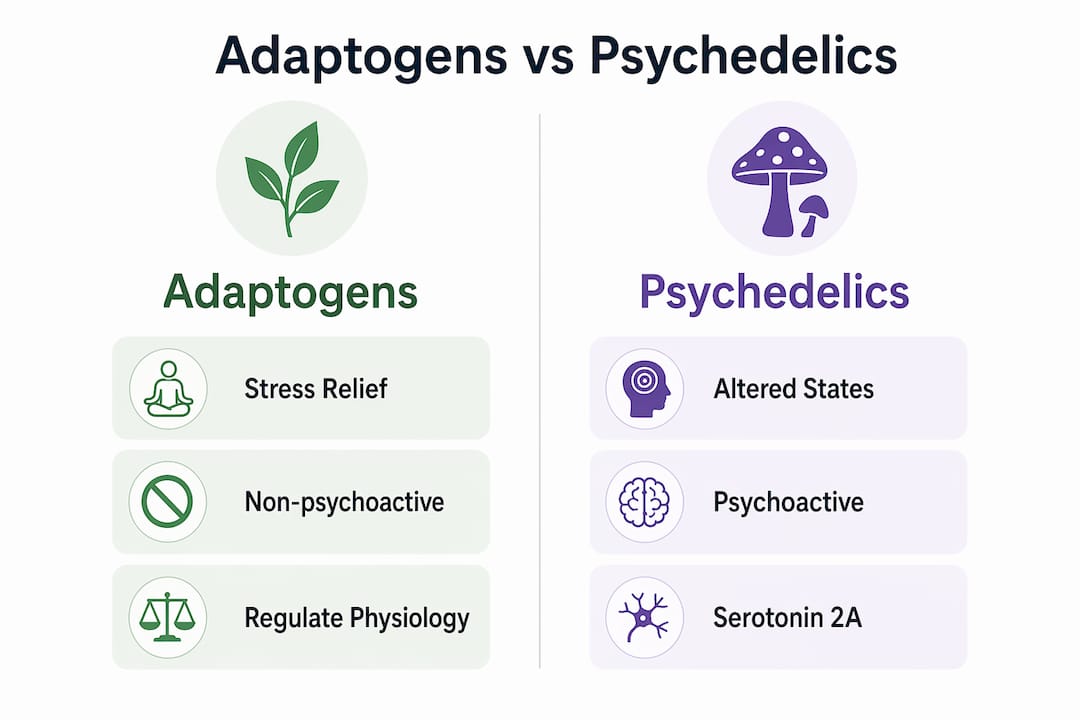
Adaptogens are natural substances defined as increasing non-specific stress resistance without disturbing normal physiology, and that definition places them in an entirely different category from psychedelics. Psychedelics like psilocybin produce altered states of consciousness through direct serotonin 2A receptor agonism. Adaptogens like Ashwagandha and Rhodiola modulate your stress-response baseline through HPA-axis regulation. Defining adaptogens in psychedelics contexts matters because the wellness industry routinely blurs these lines, and that confusion has real consequences for safety, expectations, and therapeutic outcomes. This article draws a clear boundary between the two, explains how functional mushrooms differ from psychedelic mushrooms, and shows where adaptogens genuinely fit inside psychedelic wellness frameworks.
What are adaptogens and how do they work biologically?
Adaptogens are a pharmacological category first named by Soviet scientist Nikolai Lazarev in 1947. His original criteria required three things: low toxicity, broad resistance to physical and psychological stressors, and a normalizing effect on physiology regardless of the direction of imbalance. That third criterion is the most important one. An adaptogen does not simply sedate or stimulate. It pushes your system back toward equilibrium from whichever direction it has drifted.

The primary biological mechanism is HPA-axis modulation with antioxidant and immunomodulatory effects. The HPA axis, which connects the hypothalamus, pituitary gland, and adrenal glands, governs your cortisol response to stress. Adaptogens regulate how aggressively that axis fires and how quickly it returns to baseline. This is why people report feeling calmer under pressure without feeling sedated, and more focused without feeling wired.
The most clinically studied adaptogens include:
- Ashwagandha (Withania somnifera): Reduces cortisol levels and supports thyroid function, with documented effects on anxiety and physical endurance.
- Rhodiola rosea: Improves cognitive performance under fatigue and reduces burnout markers in clinical populations.
- Eleutherococcus senticosus (Siberian ginseng): Demonstrates antioxidant, immunomodulatory, and HPA-axis activity across both human and animal studies.
Current research in 2026 continues to validate these mechanisms, though the field still lacks large-scale randomized controlled trials for most individual herbs. The evidence base is strongest for Ashwagandha and Rhodiola, where multiple peer-reviewed studies confirm stress-resilience effects in healthy adults.
Pro Tip: If you are evaluating an adaptogen product, check whether the active compound is standardized. Ashwagandha products standardized to withanolide content deliver more consistent effects than generic root powder.
How do psychedelics differ from adaptogens in mechanism and effect?
Psychedelics and adaptogens operate through entirely separate pharmacological pathways, and treating them as variations of the same thing is a category error with real consequences. Psychedelics are defined by altered consciousness mediated by serotonin 2A receptor agonism, not by stress modulation or homeostatic support.
Researchers measure psychedelic effects using tools like the 5-Dimensional Altered States of Consciousness scale, which tracks oceanic boundlessness, anxious ego dissolution, visionary restructuralization, auditory alterations, and vigilance reduction. No adaptogen produces scores on this scale. The distinction is not a matter of degree. It is a matter of mechanism.
Here is how the two categories separate across five key dimensions:
- Primary receptor target. Psychedelics bind serotonin 2A receptors and trigger downstream neuroplasticity cascades. Adaptogens act on glucocorticoid receptors and stress-signaling pathways without direct serotonergic activity.
- Subjective experience. Psychedelics produce perceptual, emotional, and cognitive alterations that are measurable and dose-dependent. Adaptogens produce no altered state at any therapeutic dose.
- Onset and duration. Psilocybin produces effects within 30 to 60 minutes that last four to six hours. Adaptogenic effects accumulate over days to weeks of consistent use.
- Therapeutic mechanism. Psychedelics open neuroplasticity windows that allow rapid belief and behavior change. Adaptogens reduce the physiological cost of chronic stress over time.
- Regulatory and safety profile. Adaptogens are sold as dietary supplements with established safety records. Psychedelics remain Schedule I substances federally, though decriminalized in Ann Arbor and several other jurisdictions.
Confusing adaptogens with psychedelics misleads consumers who may expect stress relief from a psychedelic session or expect perceptual effects from an adaptogen supplement. Both errors carry risk.
What is the difference between functional mushrooms and psychedelic mushrooms?
This is where the most widespread consumer confusion lives. The mushroom category contains two entirely distinct groups, and marketing language has made them nearly indistinguishable to the average buyer.
| Feature | Functional mushrooms | Psychedelic mushrooms |
|---|---|---|
| Active compounds | Beta-glucans, triterpenes, polysaccharides | Psilocybin, psilocin |
| Primary effect | Immune support, cognitive function, stress resilience | Altered states of consciousness |
| Examples | Lion’s Mane, Reishi, Chaga, Turkey Tail | Psilocybe cubensis, Psilocybe semilanceata |
| Psychoactive? | No | Yes |
| Regulatory status | Dietary supplement | Controlled substance (federally) |
| Mechanism | Adaptogenic, antioxidant, immunomodulatory | Serotonin 2A receptor agonism |
Functional mushrooms provide adaptogenic, non-psychoactive benefits through compounds like beta-glucans, which support immune regulation and reduce neuroinflammation. Lion’s Mane, for example, stimulates nerve growth factor production, which supports cognitive health without producing any subjective high. Reishi modulates immune activity and has documented anti-anxiety properties at clinical doses.
Psychedelic mushrooms contain psilocybin, which the body converts to psilocin. Psilocin then binds serotonin 2A receptors and produces the characteristic altered state. The experience is dose-dependent, context-dependent, and pharmacologically distinct from anything a functional mushroom can produce. You can learn more about functional mushroom distinctions before making any purchasing decisions.
Misidentifying psilocybin mushrooms as adaptogens is not just a semantic problem. It shapes dosing expectations, safety planning, and the entire framing of a person’s experience. A consumer who thinks they are taking a stress-support supplement and receives a full psychedelic experience is not prepared for what follows.
How can adaptogens support mental health within psychedelic therapy frameworks?
The most accurate framing of the role of adaptogens in mental health is this: they are baseline regulators, not experience enhancers. Within psychedelic therapy, that distinction determines where they belong in a protocol and what you can reasonably expect from them.
Psychedelic therapy protocols organize into distinct phases: priming, acute dosing, consolidation, and reintegration. Adaptogens are most relevant in the priming and reintegration phases, where reducing chronic stress load and supporting nervous system recovery are the primary goals. They have no documented role in amplifying or modifying the acute psychedelic experience itself.
Here is where adaptogens fit practically within a wellness-oriented psychedelic framework:
- Pre-session stress reduction. Ashwagandha and Rhodiola used consistently in the weeks before a session may reduce baseline cortisol, which could support a calmer psychological starting point.
- Post-session recovery. Adaptogens with anti-inflammatory and neuroprotective properties may support the consolidation phase, when the nervous system is integrating new patterns.
- Ongoing mood and cognitive support. Between sessions or during microdosing periods, adaptogens provide steady-state stress resilience that complements the neuroplasticity effects of low-dose psilocybin. You can explore how microdosing differs from full experiences to understand where each tool fits.
- Immune and energy support. Functional mushrooms like Reishi and Lion’s Mane support immune regulation and cognitive clarity during demanding integration periods.
Claims that adaptogens enhance psychedelic experiences lack direct trial data. Best practice frames them as stress regulation support rather than experiential amplifiers. The pharmacokinetics of psilocybin are well-characterized. Adaptogens do not meaningfully interact with serotonin 2A receptor binding, so they do not change the nature of the psychedelic experience itself.
Pro Tip: Timing matters more than most people realize. Adaptogens taken consistently for two to four weeks before a psychedelic session have more physiological relevance than a single dose taken the morning of. Think of them as infrastructure, not acute intervention.
Phase-specific adjuncts in psychedelic therapy must align with plasticity windows and pharmacodynamics to have any real effect. Generic timing recommendations, like “take adaptogens with your mushrooms,” ignore the pharmacological reality of how each compound operates. Precision matters here, and the evidence base for specific protocols is still developing.
Key takeaways
Adaptogens and psychedelics are pharmacologically distinct categories that serve complementary but non-overlapping roles in mental health and wellness frameworks.
| Point | Details |
|---|---|
| Adaptogens defined by Lazarev | Low toxicity, broad stress resistance, and normalizing effects are the three required criteria. |
| Psychedelics operate differently | Serotonin 2A receptor agonism produces altered states that no adaptogen can replicate. |
| Functional vs. psychedelic mushrooms | Beta-glucan-rich functional mushrooms are non-psychoactive; psilocybin mushrooms induce a measurable altered state. |
| Adaptogens fit in priming and reintegration | They support baseline stress reduction before and after sessions, not during the acute psychedelic experience. |
| Timing determines efficacy | Consistent adaptogen use over weeks outperforms single-dose strategies in any therapeutic context. |
Where the lines actually matter: a perspective from Juiced
I have watched the wellness space collapse the distance between adaptogens and psychedelics for years, and it keeps causing the same problems. Someone reads that Lion’s Mane “supports neuroplasticity” and assumes it works like a microdose of psilocybin. Someone else hears that psilocybin mushrooms are “just another functional mushroom” and walks into an experience they were not remotely prepared for.
The honest truth is that these are useful tools that happen to share a category label in casual conversation. They do not share a mechanism, a timeline, or a risk profile. Ashwagandha taken daily for a month will make you measurably more stress-resilient. It will not open a neuroplasticity window, dissolve your ego, or produce anything the 5D-ASC scale would register. Psilocybin will do all of those things and will not lower your cortisol baseline over time.
What I find genuinely interesting is how well they complement each other when used correctly. A person who enters a psilocybin session with a well-regulated nervous system, lower baseline cortisol, and solid sleep from weeks of Rhodiola use is starting from a better place than someone who is chronically stressed and depleted. That is not the same as saying adaptogens enhance the trip. It is saying that your baseline physiology shapes every experience you have, psychedelic or otherwise.
The consumer space needs clearer language, not more hype. Adaptogens are stress modulators. Psychedelics are consciousness modulators. Both have real value. Neither replaces the other.
— Juiced
Explore mushroom wellness at Theelevatedremedies

At Theelevatedremedies, located at 1123 Broadway St in Ann Arbor, Michigan, we carry products that reflect the real distinctions this article covers. Our dispensary stocks dried magic mushrooms, microdosing capsules, and psilocybin chocolates for those exploring the psychedelic side of wellness. For readers curious about the adaptogen-adjacent mushroom space, our Amanita muscaria page covers one of the most misunderstood fungi in the market. We source for quality and consistency, and our team is available to help you understand what you are actually buying before you buy it. Come in, ask questions, and get informed.
FAQ
What is the definition of an adaptogen?
An adaptogen is a natural substance that increases non-specific resistance to stress without disturbing normal physiology, as originally defined by Lazarev in 1947. The three required criteria are low toxicity, broad stress resistance, and a normalizing effect on the body.
Do adaptogens have psychedelic properties?
No. Adaptogens do not bind serotonin 2A receptors and produce no altered states of consciousness at any therapeutic dose. They modulate the HPA axis and immune function, which is a fundamentally different mechanism from psychedelic compounds.
What is the difference between Lion’s Mane and psilocybin mushrooms?
Lion’s Mane is a functional mushroom with beta-glucans and nerve growth factor-stimulating compounds. It is non-psychoactive. Psilocybin mushrooms contain psilocybin, which converts to psilocin in the body and produces measurable altered states via serotonin receptors.
Can adaptogens be used alongside psychedelic therapy?
Yes, but with clear expectations. Adaptogens are best used in the priming and reintegration phases of psychedelic therapy protocols to support baseline stress regulation. They do not modify the acute psychedelic experience and should not be framed as experiential enhancers.
Are there risks to combining adaptogens with psychedelics?
Direct pharmacological interactions between adaptogens and psilocybin are not well-documented, but generic timing claims are insufficient for safe protocol design. Anyone combining substances in a therapeutic context should work with a qualified practitioner who understands the pharmacokinetics of each compound.
Recommended
- Defining Psychedelic Blends: Types, Effects, and Safety – Elevated Remedies
- Defining Functional Mushrooms: What You Need to Know – Elevated Remedies
- Magic mushroom blends: Evidence, wellness & practical tips – Elevated Remedies
- Microdosing vs psychedelic experiences: 5 key differences – Elevated Remedies