TL;DR:
- Psychedelic blends are deliberate combinations of psychoactive substances that vary widely in ingredients, dosage, and purpose. Safety heavily depends on transparent sourcing, proper testing, and understanding each component’s effects, especially in unregulated products. Clinical protocols differ from recreational use, emphasizing supervision, precise dosing, and informed consent for safer experiences.
Most people assume a psychedelic blend is just two substances taken together. The reality is far more nuanced. Defining psychedelic blends properly means understanding how specific ingredients interact, what therapeutic or recreational goals they serve, and why two blends with similar-sounding names can produce wildly different effects. From MDMA-psilocybin stacking in clinical trials to unregulated mushroom chocolates sold online, the range is enormous. This guide breaks down what psychedelic blends actually are, the key categories, what the science says about their effects, and how to approach them safely.
Table of Contents
- Key takeaways
- Defining psychedelic blends and their core ingredients
- Types of psychedelic blends: therapeutic vs. recreational
- Safety considerations and risks of psychedelic blends
- How psychedelic blends affect the mind and body
- Practical guidance: selecting and using blends safely
- My take on defining psychedelic blends and where this is all headed
- Explore trusted psychedelic products at Theelevatedremedies
- FAQ
Key takeaways
| Point | Details |
|---|---|
| Blends vary widely | Psychedelic blends differ by ingredient, dose, and intent, making no two formulas identical. |
| Therapeutic vs. recreational | Clinical blends follow strict protocols; recreational products are often unregulated with unknown safety profiles. |
| Safety risks are real | Unregulated edibles have caused severe illness and death due to toxic or unlabeled compounds. |
| Effects depend on mechanisms | Different psychedelic ingredients target different brain receptors, producing distinct perceptual and emotional outcomes. |
| Source and testing matter | Knowing your ingredient profile and sourcing from verified vendors significantly reduces risk. |
Defining psychedelic blends and their core ingredients
At its most basic level, a psychedelic blend is any intentional combination of two or more psychoactive substances designed to produce altered states of consciousness. That definition sounds simple. What makes it complex is the extraordinary range of what those substances can be, how they are combined, and what “intentional” actually means in practice.
The most discussed psychedelic blend ingredients include:
- Psilocybin mushrooms: The active compound psilocybin converts to psilocin in the body, binding primarily to serotonin 5-HT2A receptors. Psilocybin’s toxic dose is more than 500 times its effective dose, giving it one of the most favorable safety profiles among psychedelic substances.
- MDMA: A synthetic empathogen that releases serotonin, dopamine, and norepinephrine simultaneously. Used both recreationally and, increasingly, in clinical settings for PTSD treatment.
- Amanita muscaria: A mushroom that works through muscimol and ibotenic acid rather than psilocybin. Its mechanism is entirely different, acting on GABA receptors rather than serotonin. This distinction matters enormously for understanding psychedelic blend effects.
- Synthetic analogues: Lab-created compounds that mimic natural psychedelics. These are increasingly found in commercial edible products, often without disclosure on the label.
- Herbal psychedelics: Plants like Syrian rue, used as monoamine oxidase inhibitors (MAOIs), often combined with DMT-containing plants to create ayahuasca-style blends. Defining herbal psychedelics as a category requires recognizing that “natural” does not automatically mean “safe.”
Making psychedelic blends in an unregulated context raises serious transparency issues. Many commercial products list only vague terms like “mushroom blend” without specifying species, dosage, or whether any synthetic compounds are present. Understanding psychedelic mixtures starts with demanding specificity about what is actually inside the product.
Pro Tip: Before trying any pre-made blend product, search the ingredient list for the actual species names. “Mushroom extract” tells you nothing. “Psilocybe cubensis 250mg” tells you something useful.
Types of psychedelic blends: therapeutic vs. recreational
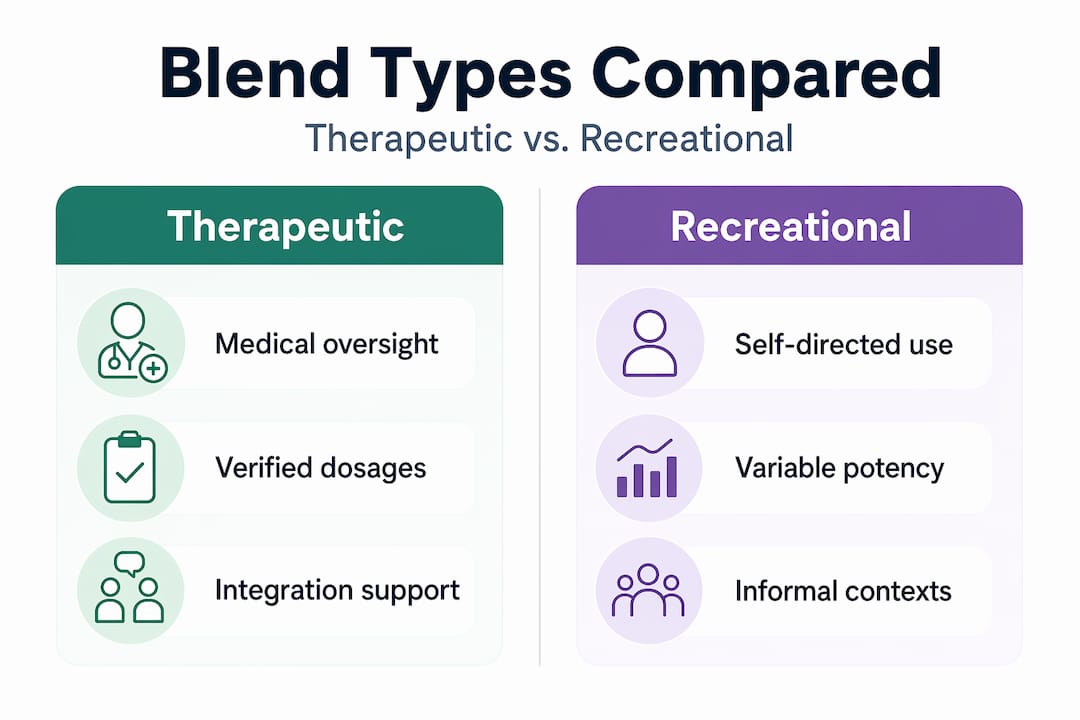
Not all psychedelic blends belong in the same category. The intended purpose shapes everything from dosage and timing to safety expectations. Here are the primary types worth understanding:
-
Therapeutic stacking protocols. These involve precise combinations studied in clinical settings. The most prominent example is MDMA combined with psilocybin for PTSD. Clinical trials are investigating giving MDMA first, followed by psilocybin 30 to 45 minutes later, with researchers tracking CAPS-5 score reductions to measure PTSD symptom relief. This is not casual experimentation. These protocols involve medical supervision, screening, and integration support.
-
Microdosing stacks. Small, sub-perceptual doses of psilocybin combined with adaptogens or nootropics. The Paul Stamets stack, for example, combines psilocybin with lion’s mane mushroom and niacin. The goal is cognitive or mood benefits without full perceptual distortion. You can explore microdose stacking protocols developed specifically for wellness contexts in Michigan.
-
Recreational blends. These range from ceremonial ayahuasca preparations to products sold in novelty shops. The regulatory situation here is murky. MDMA-assisted therapy shows large, replicated CAPS-5 reductions in Phase 3 trials, reinforcing how dramatically different a medically supervised blend is from a recreational product with unknown dosing.
-
Commercial edible blends. Chocolates, gummies, and capsules sold with mushroom-forward branding. These occupy the most uncertain legal and safety territory. Many contain multiple species and, sometimes, compounds not listed on the label.
-
Ceremonial and cultural blends. Ayahuasca, peyote ceremonies, and traditional preparations that have existed for centuries. These come with cultural protocols and experienced facilitators, which serve a harm reduction function that commercial blends lack entirely.
The legal distinctions across these types are significant. MDMA remains a Schedule I substance federally, while psilocybin decriminalization has expanded in cities including Ann Arbor. Knowing the legal status in your specific location is non-negotiable before exploring any of these categories.
Safety considerations and risks of psychedelic blends
This is where defining psychedelic blends gets genuinely serious. The word “natural” on a product label does not guarantee safety. Many commercial mushroom blends have caused real harm.
| Risk factor | Regulated products | Unregulated products |
|---|---|---|
| Ingredient transparency | Full disclosure required | Often vague or missing |
| Contaminant testing | Mandatory in licensed contexts | Rarely performed |
| Dosage accuracy | Verified by testing | Highly variable |
| Toxic compound presence | Screened out | Possible without disclosure |
Mushroom-containing edible products have caused severe illness and death, specifically linked to products like Diamond Shruumz chocolate bars containing muscimol, ibotenic acid, and synthetic psychedelics. These are not fringe incidents.
The FDA has declared that muscimol and ibotenic acid are not approved for conventional food use due to their toxicity profiles. This puts Amanita muscaria products in a complicated regulatory gray zone that consumers often do not realize exists.
Equally concerning, testing of unregulated nootropic mushroom edibles has found caffeine, ephedrine, and mitragynine alongside psilocybin and Amanita compounds. These are stimulants and opioid-receptor agonists that interact unpredictably with psychedelic compounds, and they are not listed on labels.
“The most dangerous psychedelic blend is the one you cannot fully identify. Every unknown compound is an unknown risk.”
Pro Tip: If a product does not provide a certificate of analysis (COA) from a third-party lab, treat it as unverified. This single step filters out most of the problematic products on the market.
For more context on how to evaluate the safety of specific mushroom products, the guide on psilocybin product safety in Michigan is a practical reference point.
How psychedelic blends affect the mind and body
The effects of any psychedelic blend depend almost entirely on which receptors each ingredient targets and how those systems interact. This is what makes understanding psychedelic mixtures so different from understanding single compounds.
| Ingredient | Primary receptor target | General effect profile |
|---|---|---|
| Psilocybin | 5-HT2A (serotonin) | Visual perception, emotional openness, ego dissolution |
| MDMA | Serotonin/dopamine/norepinephrine release | Empathy, energy, reduced fear response |
| Amanita muscaria (muscimol) | GABA-A receptor | Sedation, dissociation, dream-like states |
| Ayahuasca (DMT + MAOI) | 5-HT2A plus MAO inhibition | Intense visuals, emotional purging, extended duration |
The MDMA-psilocybin combination is particularly studied because the compounds appear to work synergistically. MDMA reduces fear and increases trust, which may make the deeper introspective work that psilocybin facilitates more accessible and less distressing. This is why the stacking sequence matters: MDMA first creates an emotional window that psilocybin then deepens.
Studying these combinations rigorously is difficult, though. Psychedelic blends in clinical trials pose serious methodological challenges because participants almost always know they received an active treatment. That awareness complicates double-blind controls, making it harder to separate true pharmacological effects from expectation. This is not a reason to dismiss the research. It is a reason to read it carefully.
Key subjective effects reported across different types of psychedelic blends include:
- Enhanced emotional processing and reduced psychological defensiveness
- Altered sensory perception, ranging from mild to profound depending on dose
- Shifts in time perception and self-referential thinking
- In some cases, anxiety, confusion, or psychological distress, particularly with unfamiliar ingredients or uncontrolled settings
The setting, your mental state, and the specific ratio of compounds in a blend all shape outcomes as much as the pharmacology itself.
Practical guidance: selecting and using blends safely
If you are exploring psychedelic blends for wellness or personal growth, a few principles separate genuinely informed use from unnecessary risk.
-
Know exactly what is in your blend. This means species names, not marketing names. A product labeled “chill mushroom blend” without specific ingredient disclosure is not a product worth trusting.
-
Understand the difference between microdosing and full experiences. The differences between microdosing and full psychedelic experiences are not just about dose. The set, setting, and integration practices are fundamentally different. Treating a full-dose blend like a microdose, or vice versa, leads to outcomes nobody wants.
-
Verify local legal status. Psilocybin decriminalization in Ann Arbor does not extend to all psychedelic substances. MDMA, for example, remains federally scheduled. Know exactly what legal framework applies to each ingredient in a blend before purchasing or consuming it.
-
Source from verifiable vendors. Ask directly about third-party lab testing. A reputable vendor will have this information readily available. One that deflects the question is telling you something important.
-
Build in integration time. Especially for stronger blends, planning how you will process the experience afterward, whether through journaling, conversation, or working with a therapist, shapes long-term benefit significantly more than the experience alone.
Pro Tip: Start with single-ingredient products before experimenting with blends. Understanding how psilocybin alone affects you before combining it with adaptogens or other compounds gives you a baseline that makes any combined experience far easier to interpret.
My take on defining psychedelic blends and where this is all headed
I’ve spent enough time watching this space to say clearly: the biggest mistake people make is treating “psychedelic blend” as a single category. It is not. A clinically studied MDMA-psilocybin protocol and a chocolate bar labeled “magic mushroom blend” occupy completely different universes of evidence, safety, and regulatory status.
What I find genuinely exciting is the coexistence of pharmaceutical and natural medicine pathways in psychedelics. These approaches are not enemies. They address different needs, serve different populations, and can coexist. The tension between them gets overblown in online debates, but in practice, I’ve seen people benefit meaningfully from both.
What concerns me is the hype cycle around commercial products. The market is moving faster than the science, and that gap is where people get hurt. When testing finds unlabeled stimulants and opioid-receptor compounds in mushroom gummies, that is not a footnote. It is a serious public health issue dressed up in wellness branding.
My advice is this: stay curious, stay skeptical, and prioritize transparency over brand aesthetics. The products worth your trust are the ones with clear ingredient disclosures and verified sourcing. Everything else is a gamble with your neurology.
— Juiced
Explore trusted psychedelic products at Theelevatedremedies
If this article has made one thing clear, it is that the source of your psychedelic products matters as much as the products themselves. Theelevatedremedies in Ann Arbor carries quality-verified magic mushroom products, from dried psilocybin mushrooms to microdosing capsules and mushroom chocolates, all sourced for consistency and transparency. The team is also deeply knowledgeable about one of the most misunderstood ingredients in the psychedelic space. If you want to understand Amanita muscaria as both a product and a botanical, that dedicated page is the most honest introduction to what it actually is, how it differs from psilocybin, and why those differences change everything about how you approach it. Come visit at 1123 Broadway St, Ann Arbor, MI, and get guidance you can actually trust.
FAQ
What are psychedelic blends exactly?
Psychedelic blends are intentional combinations of two or more psychoactive substances designed to produce altered consciousness, often for therapeutic or recreational purposes. The ingredients, ratios, and dosing vary widely across products and protocols.
What ingredients are most common in psychedelic blends?
Common psychedelic blend ingredients include psilocybin mushrooms, MDMA, Amanita muscaria, DMT combined with MAOIs, and various synthetic analogues. Many commercial products also contain unlabeled compounds, which makes lab-verified sourcing critical.
Are psychedelic blends safe to use?
Safety depends entirely on the ingredients, their dosages, and whether the product has been tested. Unregulated mushroom edibles have caused serious illness and death due to toxic compounds like muscimol, ibotenic acid, and unlabeled synthetics.
How do therapeutic and recreational blends differ?
Therapeutic blends follow clinical protocols with medical supervision, verified dosing, and structured integration. Recreational blends are largely unregulated, often with unknown safety profiles. The same ingredients can appear in both, but the context and controls are completely different.
Can psychedelic blends be studied in clinical trials?
Yes, though it is difficult. Studying psychedelic blends in trials is complicated because participants typically know they received an active treatment, making it hard to maintain true double-blind controls. Researchers are actively developing methods to address this challenge.
Recommended
- Magic mushroom blends: Evidence, wellness & practical tips – Elevated Remedies
- Magic Mushrooms Explained: Science, Safety & Wellness Guide – Elevated Remedies
- How magic mushroom strains affect mind and body – Elevated Remedies
- Michigan guide: psilocybin product examples & safe use – Elevated Remedies