
TL;DR:
- A real magic mushroom protocol includes dose, schedule, setting, intention, and integration.
- Evidence shows microdosing offers subjective benefits, but clinical data indicates limited and placebo effects.
- Legal status varies, with local Michigan cities deprioritizing enforcement but federal law remaining restrictive.
Magic mushroom protocols are everywhere right now. Online communities share stacks, schedules, and testimonials that make psilocybin sound like a simple fix. But Michigan residents face a reality that most of those posts skip entirely: a complex legal landscape, real medical risks, and a body of clinical research that tells a more complicated story than the hype suggests. Whether you’re a first-time microdosing curious or a seasoned psychonaut refining your approach, understanding what a real protocol actually involves, and what the evidence does and does not support, is the foundation for any safe and meaningful experience.
Table of Contents
- Understanding magic mushroom protocols: What does it really mean?
- Legal status and safety in Michigan: Navigating risk and responsibility
- Building an evidence-informed protocol: What research actually says
- Harm reduction and contraindications: Protocols for safer experiences
- Why most Michigan magic mushroom protocols overlook the essentials
- Looking for safe, educational experiences? Explore mushroom options
- Frequently asked questions
Key Takeaways
| Point | Details |
|---|---|
| Protocols require clarity | Effective protocols rely on clear intention, dosage, and integration, not just repetition of online recipes. |
| Michigan laws are nuanced | Even where local enforcement is lax, psilocybin remains illegal across Michigan and federal law. |
| Evidence is mixed | Self-reports claim benefits for microdosing, but research often finds no significant improvement over placebo. |
| Harm reduction first | Know contraindications and practice safety steps to minimize risks, especially for vulnerable groups. |
| Journaling aids outcomes | Track your experiences and stay connected to community resources for safer, more intentional use. |
Understanding magic mushroom protocols: What does it really mean?
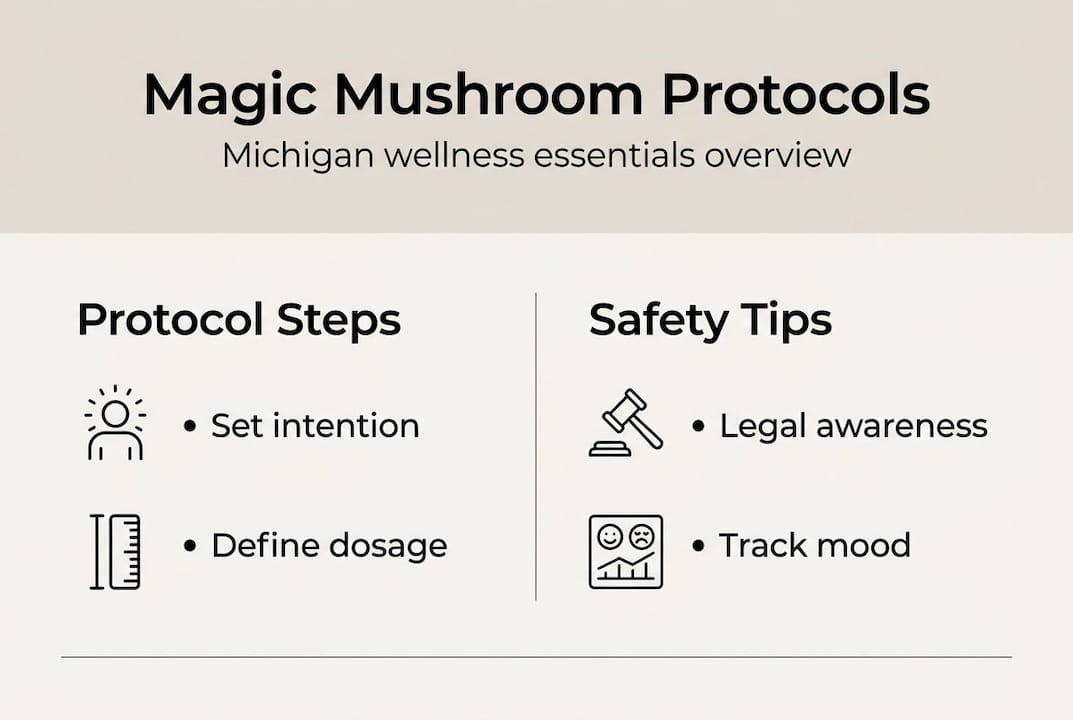
The word “protocol” gets thrown around loosely in psilocybin communities. For some people, it just means “what I do when I trip.” But a real magic mushroom protocol is a structured framework that covers five core elements: dose, schedule, setting, intention, and integration. Skipping any one of those pieces is like building a house without a foundation.
There are three main categories of protocols you’ll encounter:
- Microdosing protocols: Sub-perceptual doses (typically 0.1 to 0.3 grams of dried mushrooms) taken on a schedule, such as one day on, two days off. The goal is functional improvement without a full psychedelic experience.
- Macrodosing protocols: Moderate to high doses (2 to 5 grams or more) intended for a full psychedelic journey. These require careful preparation and are not beginner territory.
- Therapeutic protocols: Structured experiences often used alongside integration therapy. These mirror clinical trial designs and involve specific dose targets, trained support, and post-session follow-up.
Understanding magic mushroom terminology before building a protocol is not optional. It directly shapes how you dose and what you’re aiming for.
Here’s where the evidence gets interesting. Self-reports online are overwhelmingly positive. Users describe improved mood, sharper focus, and reduced anxiety. But empirical data tells a more nuanced story, showing that placebo and expectancy effects are far more influential than most people expect. What you believe will happen often shapes what does happen.
Clinical microdosing trials using structured doses around 2mg weekly for major depressive disorder show acceptable safety and tolerability, but results on efficacy are mixed, with no consistent advantage over placebo on primary outcomes.
The gap between anecdote and research is not a reason to dismiss psilocybin. It is a reason to approach it thoughtfully. Understanding the difference between microdosing vs psychedelic experiences helps you set realistic expectations before you commit to any schedule.
Legal status and safety in Michigan: Navigating risk and responsibility
Let’s be direct about the law. Psilocybin is still a Schedule I controlled substance at the federal level, and Michigan state law follows that classification. Possession, sale, or cultivation carries real legal risk. That said, legal realities in Michigan have shifted meaningfully at the local level.
Several Michigan cities have deprioritized enforcement for personal use, meaning local police are directed not to make it a priority. Here’s how that breaks down by city:
| City | Enforcement priority | Personal use risk level |
|---|---|---|
| Ann Arbor | Lowest priority | Lower |
| Detroit | Deprioritized | Lower |
| Ypsilanti | Deprioritized | Lower |
| Jackson | Deprioritized | Lower |
| Rest of Michigan | Standard enforcement | Higher |
Deprioritized does not mean legal. It means local law enforcement has other priorities. Federal law has not changed, and state charges remain possible.
Before engaging with any protocol, work through this safety checklist:
- Know your local ordinance and understand the distinction between decriminalized and legal
- Avoid use in public or in vehicles
- Never purchase from unknown or unverified sources
- Review the Michigan psilocybin product guide for sourcing context
- Read the safety tips for Ann Arbor if you’re local
- Keep a journal from day one, noting your mental state before and after each dose
- Tell at least one trusted person what you are doing
Pro Tip: Mental preparation matters as much as the mushrooms themselves. Entering a session with clear intentions and a calm mindset significantly reduces the chance of a difficult experience. Write down your intention before you begin, every single time.
Building an evidence-informed protocol: What research actually says
Once you understand the legal landscape, the next challenge is separating what the research actually supports from what enthusiasts want it to support. These are not the same thing.
Self-reports show improved wellbeing, productivity, and emotional clarity in microdosers. But randomized controlled trials and meta-analyses consistently find no statistically significant cognitive benefits compared to placebo. Expectancy effects are large in this space, meaning people who believe microdosing works tend to report that it works, regardless of whether the dose was active.

| Protocol type | Self-report outcomes | RCT outcomes |
|---|---|---|
| Microdosing (weekly) | Positive mood, focus | Mixed, no significant edge |
| Macrodosing (therapeutic) | High satisfaction | Promising, but limited data |
| Placebo-controlled trials | N/A | No cognitive benefit detected |
Here’s a numbered approach to building a protocol grounded in evidence rather than hype:
- Start with a clear goal. Are you exploring emotional insight, habit change, or creativity? Your goal shapes your dose and schedule.
- Choose a structured schedule. The Fadiman protocol (one day on, two days off) is the most studied self-report framework. Stamets stack adds lion’s mane and niacin.
- Use the 2026 psilocybin dosage guide to calibrate your starting dose based on your body weight and experience level.
- Track everything. Use a daily journal to log mood, sleep, focus, and any unusual sensations. This is how you separate real effects from expectancy.
- Build in off-weeks. Most protocols include at least one week per month without any dose to prevent tolerance and allow honest self-assessment.
- Use integration time. After any dose, give yourself space to reflect. The microdosing chocolate science article is a solid read on how delivery format affects experience.
Pro Tip: Track your mood and focus scores on a simple 1 to 10 scale every day, including days when you do not dose. This creates a baseline that shows you what is actually changing versus what you are hoping is changing.
Harm reduction and contraindications: Protocols for safer experiences
No protocol guide is complete without an honest section on who should not use psilocybin and what everyone else should do to reduce risk. This is not a scare tactic. It is basic respect for your own safety.
These groups face significant contraindications and should avoid psilocybin protocols entirely or only proceed under direct medical supervision:
- People taking SSRIs or other serotonergic medications (risk of serotonin syndrome and blunted effects)
- Individuals with a personal or family history of psychosis or schizophrenia
- Those with heart conditions or arrhythmias
- Pregnant or breastfeeding individuals
- Anyone currently using antipsychotic medications
- People who plan to combine psilocybin with alcohol, stimulants, or other psychedelics
For everyone else, here is a numbered harm reduction checklist:
- Start at the lowest effective dose. Going low the first time is not weakness. It’s intelligence.
- Never use alone. Have a trusted, sober person nearby, especially for macrodoses.
- Stay hydrated and avoid alcohol before, during, and after your session.
- Choose a familiar, comfortable setting. New environments add unpredictability.
- Keep benzodiazepines accessible if you are doing a macrodose session (as a trip abort option, not a recreational addition).
- Schedule integration time the next day. Rest, journal, and avoid major decisions.
If you are exploring microdosing safety in Michigan, that resource goes deeper into daily routines that support safer low-dose practice. First-timers especially should read it before committing to any schedule.
Why most Michigan magic mushroom protocols overlook the essentials
Here’s what we see too often: people arrive with a “protocol” they copied from a Reddit thread, using doses calibrated for someone else’s body, in a setting they haven’t thought through, with no integration plan. They focus on the recipe and skip the relationship.
The biggest gap in most Michigan protocol guides is not dosing information. It’s the absence of honest conversation about legal context, individual variability, and what happens after the experience. The mushroom is not the protocol. You are the protocol. The dose is just one variable.
Documenting your experience in a journal is not optional busywork. It is the only way to distinguish real shifts from wishful thinking. Connecting with others who approach psilocybin thoughtfully, whether online or locally, builds the kind of accountability that keeps experimentation honest. A mental wellness checklist can help you assess your baseline before starting.
The most meaningful outcomes we hear about come from people who iterate slowly, adjust based on what they actually observe, and treat each session as data rather than a destination. Rigid protocol mimicry rarely produces that. Reflective, personalized practice usually does.
Looking for safe, educational experiences? Explore mushroom options
If this guide has helped clarify your thinking, the next step is knowing where to find quality products with real sourcing transparency. At Elevated Remedies in Ann Arbor, we carry options designed for the full spectrum of explorers.
For those interested in precise, consistent dosing, our mushroom capsules are a practical starting point. If you prefer a more enjoyable format, our mushroom chocolate bars offer a measured, approachable experience. Curious about something different? Our amanita muscaria info page breaks down a non-psilocybin option that is growing in interest. Stop by 1123 Broadway St in Ann Arbor and talk with our team. We are here to help you find the right fit.
Frequently asked questions
Is microdosing magic mushrooms legal in Michigan?
Microdosing with magic mushrooms is illegal statewide in Michigan, but personal use is deprioritized in Ann Arbor, Detroit, Jackson, and Ypsilanti. Federal law classifies psilocybin as Schedule I regardless of city policy.
What should I include in a magic mushroom protocol?
A solid protocol covers dose, schedule, intention, setting, and an integration plan for after the experience. Leaving any of those out increases risk and reduces the chance of meaningful outcomes.
Who should not try a magic mushroom protocol?
Anyone on SSRIs, antipsychotics, or with heart conditions, a history of psychosis, or who is pregnant should avoid psilocybin protocols entirely without direct medical supervision.
Do clinical studies support microdosing benefits?
Microdosing clinical trials confirm that low-dose psilocybin is generally safe and well-tolerated, but controlled studies show it does not consistently outperform placebo on depression or cognitive measures.
How do I stay safe if I choose to use magic mushrooms in Michigan?
Research your local ordinance, start with a low dose, never use alone, avoid all other substances, and prioritize harm reduction practices including journaling and post-session integration.
Recommended
- Magic mushroom dosage guide: safe & effective use in Michigan – Elevated Remedies
- Magic mushroom terms explained: Michigan guide 2026 – Elevated Remedies
- Top magic mushroom wellness tips for safe, effective use – Elevated Remedies
- Magic mushroom consumption: Safe steps for Ann Arbor users – Elevated Remedies