
A randomized controlled trial published in 2024 found that a 10 microgram dose of LSD, taken every third day, added roughly 24 extra minutes of sleep the following night. That’s a real, measured effect, not folklore. But the trial was small, male only, and doesn’t prove microdosing fixes insomnia. If you’re considering it for sleep, morning dosing, careful screening for psychiatric risk, and honest tracking matter more than the substance you pick.
TL;DR:
- The 2024 controlled trial found that a 10 microgram dose of LSD taken every third day increased sleep duration by about 24 minutes the following night.
- LSD’s sleep benefits tend to appear on the night after dosing, with no effects observed on the dosing night itself, indicating a delayed response.
- Psilocybin appears to impact sleep architecture differently, mainly delaying REM sleep entry rather than increasing total sleep time, and effects are short-lived.
- Self-reports show mixed experiences, influenced by timing, dose, and individual sensitivity, with some users experiencing worse sleep on dosing days.
- Microdosing should be approached cautiously by individuals with psychiatric risks, cardiovascular issues, or those taking certain medications, due to unpredictable effects and potential harms.
Table of Contents
- What the Research on Microdosing for Sleep Actually Shows
- Why LSD and Psilocybin May Affect Sleep Differently
- A Safer Microdosing Protocol for Better Sleep
- Who Shouldn’t Microdose for Sleep
- Tracking Your Sleep While Microdosing
- What Elevated Remedies Has Learned From Customer Experiences
- Where to Find Consistent Microdose Products for Your Sleep Experiment
- Primary Sources and Further Reading
- Sources
What the Research on Microdosing for Sleep Actually Shows
Most of what people believe about microdosing and sleep comes from forums, not labs. That changed in 2024, when researchers finally ran a controlled trial that measured sleep with wearable sensors instead of asking participants to guess how well they slept.
The Translational Psychiatry randomized controlled trial enrolled 80 healthy men and gave them 10 micrograms of LSD every third day for six weeks, compared against a placebo group. Participants wore sleep trackers throughout the study, which removed a lot of the guesswork that plagues self-reported sleep research. The headline finding: on the night after a microdose, participants slept significantly longer than on placebo nights, and they went to bed notably earlier. Nothing changed on the dosing night itself. The effect showed up the following night, which tells you something important about how this works. It’s a delayed response, not an immediate sedative one.
That distinction separates microdosing from something like a sleep aid you take at 10 p.m. and feel by 10:30. Here, the dose goes in during the day, and the sleep benefit (if there is one) shows up roughly 24 hours later.
The PMC review of psilocybin’s effects on daytime sleep tells a different story. Psilocybin appears to extend REM latency, meaning it takes longer to enter REM sleep after dosing, and may shorten total REM duration. That pattern echoes what some antidepressants do to sleep architecture, which raises an interesting question about whether psilocybin’s sleep effects run through the same serotonergic pathways implicated in mood regulation. The review draws on a mix of human and animal data, and the authors are careful to frame it as an early signal rather than a settled mechanism.
Outside the lab, the picture gets messier. Community surveys and smaller observational studies report a split experience: many people say their sleep improves on days they don’t dose, while a subset report worse sleep specifically on dosing days. That variability likely comes down to timing, dose size, and individual sensitivity to stimulation, since self-report studies rarely control for any of those variables the way a formal trial does.
What we don’t know yet matters as much as what we do. The 2024 RCT only included men, so there’s no data on whether hormonal cycles, which affect sleep architecture in women, change the response. The study also relied on consumer wearables rather than polysomnography, the gold-standard sleep lab test that tracks brain waves directly. Wearables estimate sleep stages using movement and heart rate, which is useful for spotting trends but not as precise as a lab-based read on REM and deep sleep. Six weeks of dosing is also a short window. Nobody has published data yet on what happens after six months or a year of regular microdosing.
Here’s what the current evidence base actually supports:
- A same-substance, next-night sleep increase of about 24 minutes has been measured in a controlled trial, not just reported anecdotally.
- Psilocybin’s effect on REM latency suggests it works through a different pathway than LSD’s next-night sleep extension.
- Dosing night itself shows no measurable sleep benefit, and in some self-reports, mild disruption.
- Wearable data and self-report surveys both carry real limitations that a single well-designed trial can’t erase.
A roughly 24-minute increase in total sleep time is generally considered clinically meaningful, not just statistically notable. Sleep researchers often treat a 20-minute threshold as the point where an intervention starts to matter for someone who’s chronically short on rest. That’s a useful frame for the finding, even with only one trial behind it.
Why LSD and Psilocybin May Affect Sleep Differently
Both LSD and psilocybin work primarily through the 5-HT2A serotonin receptor, which sits at the center of most classic psychedelic effects. Activating that receptor triggers downstream changes in cortical excitability and synaptic plasticity, the brain’s capacity to reorganize connections. That shared mechanism is why both substances get lumped together in casual conversation, but their pharmacokinetics diverge in ways that likely explain their different sleep signatures.
LSD binds to the 5-HT2A receptor and stays bound longer than psilocin (the active compound your body converts psilocybin into). That extended receptor engagement may be why the Translational Psychiatry trial found effects showing up a full day later rather than on the dosing night. The theory researchers point to is that LSD’s longer signaling window nudges the body’s sleep homeostasis, the internal pressure that builds toward sleep, in a way that only becomes measurable once the acute stimulation has worn off.
Psilocybin clears the body faster. Its active window runs shorter, which may explain why its documented effects show up more directly in sleep architecture, specifically REM latency, rather than in next-night total sleep time. Both substances also affect the default mode network, the brain system tied to self-referential thinking and rumination. Reduced activity there during the psychedelic experience is one proposed reason people report calmer, less anxious mental states in the days following a dose. Better emotional regulation during the day plausibly makes it easier to wind down at night, even if that pathway hasn’t been directly measured in a sleep trial yet.
The practical takeaway: dose-day arousal and dose+1 sleep improvement appear to be two separate phenomena, not two sides of the same coin.
- 5-HT2A agonism drives most acute effects and likely underlies delayed changes in sleep drive.
- LSD’s longer receptor engagement may explain why sleep benefits appear the night after dosing rather than immediately.
- Psilocybin’s shorter half-life may concentrate its effects on REM timing rather than total sleep duration.
- Default mode network changes could contribute an indirect, mood-mediated route to better sleep that current trials haven’t isolated.
Pro Tip: If you’re comparing substances, don’t judge either one by how you sleep on the dosing night itself. The current evidence suggests LSD’s sleep benefit, where it exists, shows up on night two. Judging it too early is the most common mistake in self-experimentation.
A Safer Microdosing Protocol for Better Sleep
The most common regimen, known as the Fadiman protocol, spaces doses every third day, dosing, then two rest days, then repeating. Some people prefer twice-weekly or strict alternate-day patterns instead, but the built-in rest days matter regardless of the exact schedule. They give your body time to avoid building tolerance and let you separate a dosing day’s effects from an ordinary day’s baseline.
Starting doses tend to run low: roughly 5 to 15 micrograms for LSD, or about 0.05 to 0.15 grams of dried psilocybin mushrooms. Going in at the low end and adjusting slowly beats guessing high and dealing with unwanted stimulation.
Timing is arguably the single biggest lever you control. Dose in the morning, and avoid dosing within six to eight hours of your intended bedtime. Microdoses are still active substances with stimulating properties for several hours after ingestion, and dosing too late in the day risks the exact dose-night disruption some observational reports describe. Morning dosing gives the acute effects time to clear well before your body starts winding down for sleep.
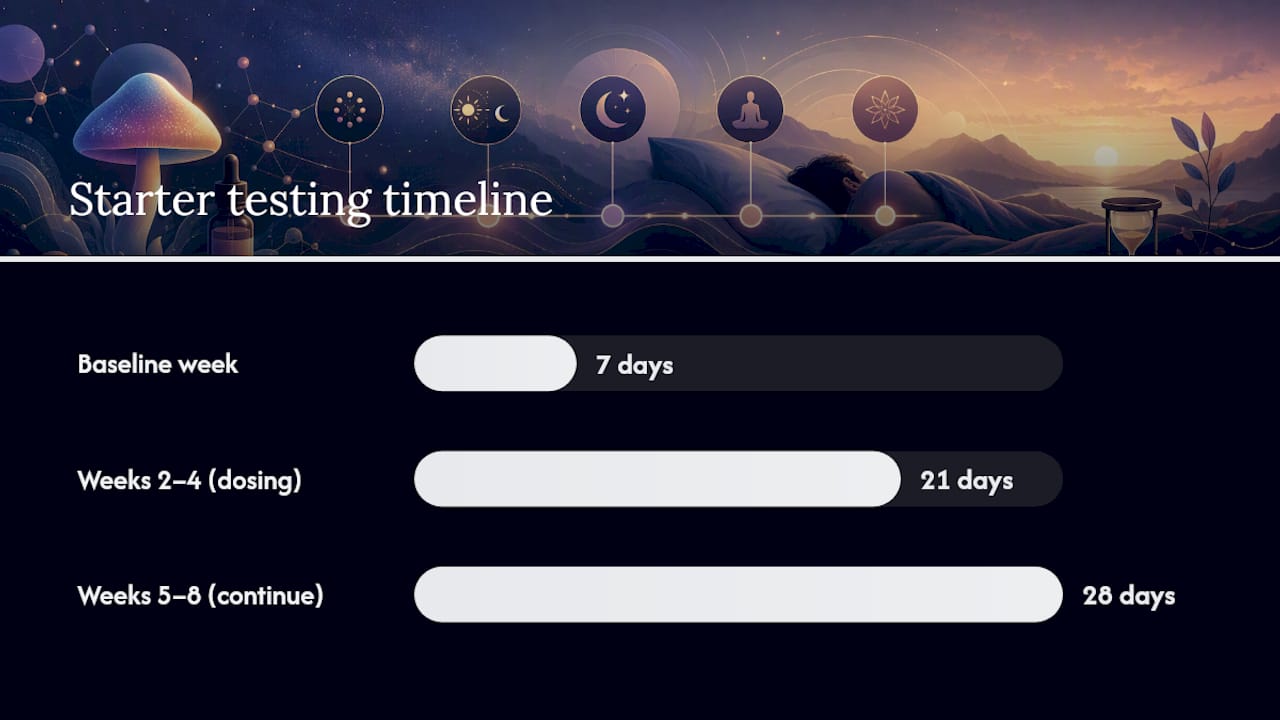
Here’s a straightforward starter framework if you want to test whether microdosing affects your own sleep:
- Baseline week. Track your sleep for seven days with no dosing at all, using a wearable and a simple nightly log. This gives you a real comparison point instead of relying on memory.
- Weeks two through four. Begin dosing on your chosen schedule (every third day is the most studied pattern), always in the morning, and keep logging every night, dosing and non-dosing alike.
- Week four check-in. Compare your average total sleep time and bedtime consistency against your baseline week. Look for patterns tied to dosing days versus rest days.
- Weeks five through eight. Continue the same schedule if you’re seeing a positive trend, or adjust dose size slightly if effects feel too strong or too weak.
- Week eight decision point. Decide whether to continue, adjust, or stop, based on your actual data rather than how you think it’s going.
A few harm-reduction basics apply no matter which substance or schedule you choose. Never combine microdoses with alcohol or sedatives; the interaction isn’t well studied, and mixing depressants with a serotonergic compound adds risk without any evidence of benefit. Don’t adjust prescribed psychiatric medication on your own to “make room” for microdosing. And keep your log honest, including the bad nights, since the point of tracking is finding out the truth, not confirming what you hoped would happen.
Pro Tip: If a dosing day consistently coincides with worse sleep that night, that’s data, not a failure. Shift your schedule so dosing days fall on nights you can afford lighter sleep, and let the pattern guide you instead of forcing a protocol that isn’t working for your body.
Who Shouldn’t Microdose for Sleep
Microdosing isn’t appropriate for everyone, and the risk profile matters more than the sleep upside for certain people. A personal or family history of psychosis or bipolar disorder tops that list. Psychedelics, even at low doses, carry a documented risk of triggering or worsening symptoms in people with a predisposition to these conditions, and sleep improvement isn’t worth that trade-off. Unstable cardiovascular conditions and pregnancy are also firm reasons to avoid microdosing altogether, given the lack of safety data in those populations.
Drug interactions deserve specific attention. SSRIs, the most commonly prescribed antidepressants, can blunt psychedelic effects by competing for the same serotonin receptors, which creates an unpredictable dose response, not a safer one. MAOIs and sedative medications raise separate concerns around unpredictable interactions and shouldn’t be combined with psychedelics without direct medical guidance.
Even in otherwise healthy people, a handful of adverse patterns show up consistently:
- Dose-day arousal or agitation that disrupts sleep rather than helping it.
- Increased anxiety, particularly at doses higher than intended.
- Hallucinogen Persisting Perception Disorder (HPPD), a rare but documented condition involving lingering visual disturbances after use.
- Worsened nightmares or intrusive memories in people with a trauma history, since psychedelics can intensify emotional processing rather than soften it for everyone.
A next-night sleep gain of 24 minutes, the size measured in the Translational Psychiatry trial, is a modest effect. It doesn’t offset a night of genuine dose-day disruption or a psychiatric setback. That asymmetry is the core argument for caution: the upside is real but small, while the downside for the wrong person can be serious.
Stop and seek medical advice if you notice new or worsening psychiatric symptoms of any kind, perceptual changes that persist beyond the dosing window, or sleep disruption that gets worse rather than better over several weeks. None of those are situations to push through on the theory that it’ll improve with time.
Tracking Your Sleep While Microdosing
Total sleep time (TST), sleep onset latency (how long it takes to fall asleep), and wake after sleep onset (WASO) are the three numbers worth watching closely, alongside subjective ratings of sleep quality and next-day alertness. A wearable gives you the objective side; a short nightly note covering mood, stress, and how rested you felt gives you the subjective side. Neither is complete alone.
A simple weekly review works better than obsessing over single nights, since one bad night rarely means much on its own.
- Log every night for a full baseline week before introducing any dose.
- Dose on your chosen schedule and keep logging without exception, including off days.
- Average your weekly TST and compare it against baseline every seven days.
- Flag any change of roughly 20 minutes or more as potentially meaningful, in line with the threshold researchers use to call a sleep intervention clinically relevant.
- Reassess at week four and again at week eight before deciding whether to continue.
| Metric | Tool | What it tells you |
|---|---|---|
| Total sleep time | Wearable sensor | Whether you’re getting more actual sleep, not just more time in bed |
| Sleep onset latency | Wearable or self-timed | How quickly your body is winding down |
| Sleep quality (subjective) | Nightly journal | How rested you feel, which wearables can’t measure directly |
| Daytime alertness | Journal or simple scale | Whether sleep gains translate to real-world function |
Wearables estimate sleep stages from movement and heart rate rather than brain activity directly, so treat REM and deep sleep estimates as directional, not exact — for detailed evidence and dosing guidance, see CBD bei Schlafproblemen: Evidenz, Dosierung & Anwendung. If your tracking shows persistent disruption or no improvement after eight weeks, that’s a reasonable point to consult a sleep clinician about polysomnography or a referral to CBT-I, the first-line, evidence-based treatment for chronic insomnia.
What Elevated Remedies Has Learned From Customer Experiences
We hear from a lot of people exploring microdosing for sleep, and the pattern that shows up again and again is simple: the people who see real change are the ones who track consistently, not the ones who dose the biggest amount. Consistency in timing and dose size beats intensity every time.
We’re also upfront that microdosing isn’t a substitute for CBT-I or a clinician’s evaluation if you’re dealing with chronic insomnia. Think of it as a complementary experiment layered on top of established sleep care, not a replacement for it. If you want a structured way to start, our first-week microdosing plan walks through baseline tracking before you dose anything at all.
— Juiced
Where to Find Consistent Microdose Products for Your Sleep Experiment
Running the protocol above only works if your dose is actually what the label says it is. That’s the part most people underestimate: inconsistent potency between batches makes it nearly impossible to tell whether a bad night came from the substance or from a dosing error you didn’t know you made.
Some vendors offer microdose capsules and microdose chocolate formulated for consistent, repeatable dosing, which matters far more for a sleep-tracking protocol than for casual use. Microdose capsules can make the baseline week, titration, and eight-week check-in schedule described above actually usable, since they provide the same measured amount every time rather than relying on approximations. If you’re newer to psilocybin products generally, our amanita muscaria guide is a good place to start before committing to a schedule. Consider visiting a local dispensary or exploring online options for capsules and chocolate products to build your own eight-week starter kit.
Primary Sources and Further Reading
- LSD increases sleep duration the night after microdosing — Translational Psychiatry, 2024 randomized controlled trial.
- The effects of daytime psilocybin administration on sleep — PMC review on REM latency and antidepressant parallels.
- Microdosing LSD may enhance sleep — Sleep Foundation summary and caveats.
- CBT for insomnia effectiveness — meta-analytic review on first-line insomnia treatment.
This article is general information, not a substitute for advice from a qualified doctor. Consult a qualified healthcare professional about your own circumstances before acting on anything here.
Sources
- LSD increases sleep duration the night after microdosing | Translational Psychiatry (2024)
- The effects of daytime psilocybin administration on sleep: implications for antidepressant action (2020) | PMC