
Your first week microdosing is calibration, not transformation. You are gathering data, not chasing a breakthrough. Start with a conservative dose, pick a simple schedule like the Fadiman protocol, and log mood, energy, focus, and anxiety every dose day. If anything feels frightening or physically wrong, stop and reassess before your next dose.
TL;DR:
- Week one microdosing often yields subtle or no perceptible effects, mainly mood or focus improvements on dosing days that do not carry over.
- Common side effects are mild headaches, gastrointestinal upset, transient anxiety, or sleep disruption, with intense symptoms indicating dose adjustments are necessary.
- The Fadiman schedule of one dose followed by two off days is recommended, providing clear data points and reducing residual effects for beginners.
- Starting with a dose below 0.1 grams of dried mushrooms is safest, with small incremental increases only after confirming no adverse effects over several dose days.
- Accurate, consistent tracking of mood, focus, energy, and anxiety each day is crucial for interpreting effects and adjusting dosage, rather than relying on subjective memory or guesses.
Table of Contents
- What Should I Expect During My First Week Of Microdosing?
- Which Microdosing Schedule Should Beginners Use In Week One?
- How Much Psilocybin Should You Take In Week One?
- What Should You Track During Your First Week?
- What Are The Safety Red Flags To Watch For In Week One?
- When Do Microdosing Effects Actually Show Up?
- Sourcing Notes From Elevated Remedies On Product Consistency
- What The Research Actually Supports About Week One
- How Elevated Remedies Helps You Start Microdosing Right
- Where To Go For Deeper Research On Microdosing
- Sources
What Should I Expect During My First Week Of Microdosing?
Nothing dramatic. That is the honest answer, and it’s the one most people don’t want to hear after reading forum threads about sudden clarity or euphoric focus sessions.
The most common report from week one is subtlety bordering on nothing at all. Some people notice a faint lift in mood or a slightly easier time concentrating on dose days. Others feel nothing distinguishable from a normal day and start wondering if they got a bad batch. Both experiences are within the normal range. Observational tracking research on microdosers found daily improvements in mood and reduced stress on dosing days themselves, but the effects mostly did not carry over into the following days. That’s a critical detail for week one: you’re not building toward a slow-burn transformation yet. You’re checking whether a specific dose produces any signal at all.
Statistic Callout: A six-week observational study of microdosers found measurable day-of improvements in mood and focus, with reductions in depression and stress scores over the tracking period. The catch: those benefits showed up mainly on dosing days, not the days off. That pattern only becomes visible with a proper multi-week log, not a single week of guessing.
A handful of minor side effects show up commonly enough to mention:
- Mild headache, usually in the first hour or two after dosing, often tied to dose size or an empty stomach.
- Slight gastrointestinal upset, like stomach tightness or mild nausea, more common with dried mushroom than with capsules or edibles.
- A flicker of anxiety or restlessness, especially if you took the dose during a stressful day rather than a calm one.
- Sleep disruption if the dose was taken too late in the day.
None of these should be severe. Public health summaries on hallucinogens list nausea, headache, and anxiety among the more common acute effects, which lines up with what most beginner microdosers describe. Mild and short-lived is the expected pattern. Intense or long-lasting is not.
Subtlety is not a failure. It’s the point. A true microdose sits below the threshold of noticeable perceptual change. If you feel colors shift, time distort, or your thinking turn unusually abstract, your dose crossed from “micro” into “low dose” territory. That’s a clear signal to scale back, not push through. The rule of thumb worth memorizing: if you can tell you took something, you probably took too much.
Watch for a few signs that mean your starting dose was too strong rather than just active:
- Noticeable visual changes, even faint color enhancement or a “shimmer” in your vision.
- A racing or looping quality to your thoughts that feels hard to redirect.
- Anxiety that builds rather than settles within the first hour.
- Physical symptoms beyond mild nausea, like elevated heart rate or dizziness that doesn’t pass.
If two or more of those show up on your first dose day, that’s your answer. Drop the dose before your next scheduled day, not after several more attempts at the same amount.
Which Microdosing Schedule Should Beginners Use In Week One?
Pick a schedule before your first dose, not after. Deciding in the moment tends to produce inconsistent data, which defeats the purpose of a first week built around observation.
- Use the Fadiman protocol as your default. Developed by researcher James Fadiman, this schedule runs one dose day followed by two full off days, then repeats. Practitioner and community guides consistently point beginners toward it because the structure it imposes makes early data more legible. Dosing on day one, resting on days two and three, then dosing again on day four gives you three distinct dose days to compare within a single week, plus off days to check for residual effects.
- Consider every-other-day dosing only if you have a specific reason. Some experienced microdosers use this tighter schedule for shorter-term goals, but it gives your body less recovery time and produces less clean data in week one, since you never get more than a single off day to observe carryover effects.
- Avoid intuitive or “as needed” dosing for now. Dosing based on how you feel that morning sounds appealing, but it removes the consistency you need to isolate what the substance is actually doing versus what your day was already doing to your mood.
- Commit to at least two to four weeks before changing anything. One week tells you whether a dose is tolerable. It rarely tells you whether it’s effective. Practitioner guides and the observational research cited above both point to clearer trends emerging over multiple weeks, not single dosing days.
- Schedule your first dose days around low-stakes mornings. Pick days without major meetings, driving-heavy commitments, or high-pressure deadlines. A quiet Tuesday beats a product launch day.
The logic behind the two-day break in the Fadiman protocol isn’t arbitrary. It gives your body time to fully clear the compound and gives you a baseline day to compare against, which matters more in week one than any other week, since you have zero personal reference point yet. Skipping the off days, or shortening them, blurs the exact comparison you’re trying to build.
How Much Psilocybin Should You Take In Week One?
Start lower than you think you need to. Clinical and observational literature on psilocybin microdosing reports microdose ranges generally between 0.05 g and 0.5 g of dried mushroom, but most beginner guides land specifically on 0.05 to 0.1 g as the safer entry point. That’s a genuinely small amount, often a tenth of what someone might associate with a recreational dose, and the gap is intentional.
Erring low in week one protects you from two things: an uncomfortable first experience that colors your attitude toward the whole practice, and a false read on your own tolerance. Mushroom potency varies by batch, strain, and how it was dried, so even a carefully weighed dose can land differently than expected. A conservative start gives you room to adjust upward with confidence instead of scrambling to adjust downward after a rough day.
Once you have a baseline dose, adjust in small increments only, and only after you have enough data to trust the pattern:
- Increase by no more than 0.025 to 0.05 g at a time if your starting dose produced no effect at all after at least two dose days.
- Wait a full week on any new dose before deciding whether to adjust again.
- Reduce immediately, not gradually, if you notice perceptual changes, racing thoughts, or anxiety that builds through the day.
- Never double a dose to “catch up” if you skipped a scheduled day.
Perceptibility is your main warning signal. If you can feel that you took something beyond a subtle mood or focus shift, the dose is too high for microdosing purposes, according to practitioner guidance on calibrating psilocybin doses safely. That threshold is the entire point of a microdose. Cross it and you’re no longer microdosing, you’re just taking a low dose with different goals and different risks.
Pro Tip: Weigh dried mushroom on a milligram-accurate scale rather than eyeballing it, and if you’re using capsules or gummies, check the packaging or ask the retailer for batch or lab-testing information. A half-gram error is invisible on a kitchen scale but very visible in how your body responds.
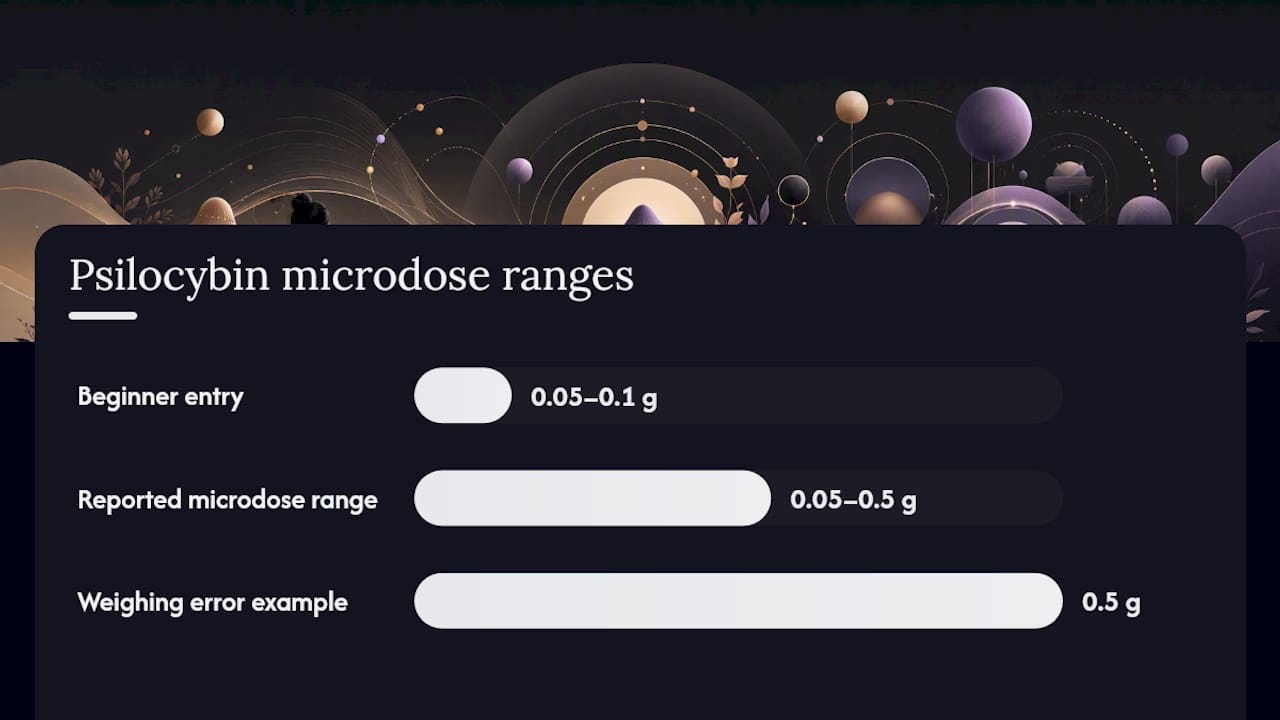
Pre-measured products solve most of this problem outright. Capsules and standardized gummies remove the guesswork of weighing dried material, which matters most in week one when you have no personal reference point for what “too much” feels like for you specifically.
What Should You Track During Your First Week?
A trustworthy first week depends on consistent, structured notes, not vague memories of “felt pretty good today.” Structured logging with specific numeric scales tends to surface clearer patterns by week two through four than freeform journaling does, mostly because numbers are easier to compare across days than adjectives are.
Record these metrics every single day, dose or not:
- Mood, on a simple 1 to 10 scale, logged at the same time each day.
- Energy level, same scale, same consistency.
- Focus or mental clarity, rated the same way.
- Anxiety level, since this is often the first thing to shift, up or down.
- Sleep quality from the night before, rated on waking.
- A short freeform note for anything the numbers don’t capture, like a stressful meeting or a skipped meal.
Log at four points on dose days for the most useful comparison: a baseline reading before dosing, then again at roughly one hour, three hours, and six hours after. That cadence catches the onset window, the middle of the day when subtle effects are most likely to register, and the tail end when you’re checking for lingering anxiety or fatigue. On off days, one or two check-ins are enough since you’re mainly watching for carryover effects from the previous dose day.
- Copy a simple template to your phone notes app or a small notebook: date, dose (or “off day”), mood, energy, focus, anxiety, sleep, and a one-line note.
- Keep the format identical every day. Changing your rating scale midweek makes the whole week harder to read later.
- Note anything unusual outside the substance itself, like poor sleep, a skipped meal, or a stressful commute, since these confound your data more than people expect.
When you sit down to review your first week, resist the urge to draw conclusions from three or four dose days. One week is barely enough to spot a pattern, let alone confirm one. Read back through your notes looking for direction rather than certainty. Did dose days trend even slightly higher on mood or focus than off days? Did any single dose produce a red flag? Those are the only two questions week one can actually answer.
What Are The Safety Red Flags To Watch For In Week One?
Certain people should not microdose without a serious conversation with a clinician first. A personal history of psychosis, schizophrenia, or unstable bipolar disorder is the clearest line here, since psychedelics carry a documented risk of destabilizing these conditions. Anyone taking SSRIs, MAOIs, or other serotonergic medications also needs to talk to a doctor before starting, since combining these with psilocybin carries interaction risks that are not fully mapped and can vary significantly by individual.
Statistic Callout: Public health drug fact summaries list nausea, headache, and anxiety as the most commonly reported acute effects of hallucinogens, alongside a recommendation for harm-reduction practices around dosing and use. That’s your baseline for what “normal but unpleasant” looks like, versus something more serious.
Stop and seek medical help immediately if you notice any of the following on a dose day:
- Severe anxiety or a panic response that doesn’t settle within an hour or two.
- Strong perceptual distortions, meaning visuals, sounds, or a sense of time that feels significantly altered rather than subtly shifted.
- Chest pain, a racing heartbeat that doesn’t calm down, or any symptom that feels physically alarming rather than just uncomfortable.
- Confusion or disorientation that interferes with basic tasks like driving or holding a conversation.
Simple harm-reduction habits make week one meaningfully safer. Choose a morning with no obligations, so an unexpectedly strong reaction doesn’t collide with a meeting or a drive. Skip alcohol and any unfamiliar medications on dose days. Harm-reduction guidance also recommends having a sober person reachable, even just by phone, during your first couple of dose days, purely as a safety net while you’re still learning how your body responds.
When Do Microdosing Effects Actually Show Up?
Week one rarely tells the full story. Observational research tracking microdosers over six weeks found the clearest trends, including reductions in depression and stress scores, emerging across the full tracking period rather than in the opening days. Week one is closer to a pilot test than a verdict.
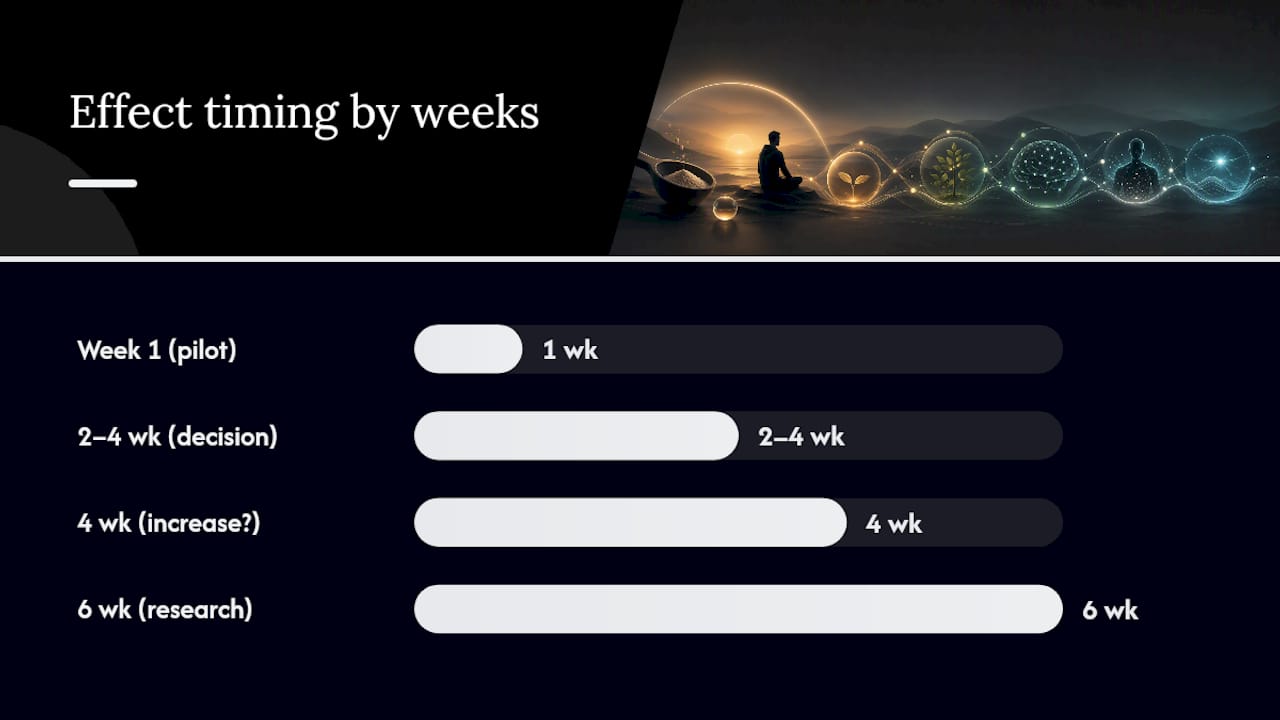
That distinction matters for how you interpret cumulative versus immediate effects. The subtle mood lift you might feel three hours after a dose is a direct pharmacological effect, gone by the next day. The broader shift some people report in focus or emotional resilience over several weeks is a different phenomenon entirely, built from repeated exposure and, frankly, still not fully separated from expectation effects in the research. Randomized studies examining this gap have found limited or no significant effect compared with placebo in some cases, which is a real reason to stay skeptical of dramatic claims and lean on your own structured data instead of anecdotes.
Use these decision rules once you have two to four weeks of notes:
- If dose days consistently trend better than off days on two or more metrics, stay the course at your current dose.
- If nothing has moved after four weeks of consistent dosing and tracking, consider a small increase rather than assuming microdosing “doesn’t work” for you.
- If you noticed any red flag effects, even mild ones, reduce your dose before extending the trial further.
- If off days start looking as good as dose days, you may be experiencing carryover benefits, or you may simply be having a good stretch unrelated to the substance. More weeks of data resolve that ambiguity better than guessing does.
Sourcing Notes From Elevated Remedies On Product Consistency
Getting your first week right depends almost entirely on knowing exactly what you’re taking, dose after dose. That’s the part beginners underestimate. A kitchen scale and a bag of dried mushroom introduce more variability than most people expect, especially when a single stem fragment or a slightly damp cap can shift the weight of a “measured” dose.
Some retailers stock mushroom capsules built for microdosing and standardized mushroom gummies specifically because pre-measured products remove that variability from the equation. Community practice increasingly favors these formats for exactly this reason: pre-measured capsules and edibles dramatically reduce dosing error compared to weighing dried material by hand, which matters most in week one when you have no personal baseline to sanity-check against.
A common recommendation for first-dose days is to pick one product, note the batch or lot information if it’s listed, and stick with that exact product through the entire first tracking cycle. Switching between different capsules or a different edible batch mid-week introduces a variable you can’t account for in your journal. Juiced, writing on behalf of Elevated Remedies, has covered microdosing workflows and safety practices in detail elsewhere on this site, and those posts are worth a read if you want more depth on structuring a full month, not just a first week. If you’re comparing specific products, check individual product pages for batch and consistency information before your first order.
What The Research Actually Supports About Week One
The honest takeaway from the research is less exciting than most microdosing content wants it to be. Week one is a screening tool, not a transformation window, and the loudest anecdotal reports online almost never mention the weeks of unremarkable data that came before whatever breakthrough they’re describing.
Conventional advice tends to undersell the tracking piece and oversell the dosing piece. People spend hours researching exact milligram ranges and almost no time deciding how they’ll actually record what happens. That’s backwards. A slightly imperfect dose paired with rigorous journaling teaches you more in a month than a perfectly calibrated dose tracked with vague memory ever will.
If you take one thing from this article, prioritize the log over the milligrams. Start low, pick the Fadiman protocol unless you have a specific reason not to, and write down your numbers every single day, dose or not. The dose you land on by week four matters far less than whether you have the data to justify it.
— Juiced
How Elevated Remedies Helps You Start Microdosing Right
Elevated Remedies exists for exactly the moment you’re in right now: standing at the start of a first week, wanting a product you can trust without weighing anything yourself. We carry mushroom capsules built specifically for microdosing and standardized gummies, so your dose on day one 4 is the same as your dose on day four, without a scale, a guess, or a stem fragment throwing off your math.

Buying safely starts with asking the right questions. Before you order anything, ask about batch potency testing, and lean toward pre-measured formats over loose dried product if you’re new to this. If you’re also interested in complementary calming support alongside your microdosing routine, products like CBD Classique are worth a look for adjunctive use on higher-stress days. Keep in mind that regulations around psilocybin products vary by state, so check what applies where you live before ordering.
Curious what’s actually in an amanita muscaria product versus a psilocybin one? Our page on what amanita muscaria actually is breaks down the difference so you order the right product for your goals, not just the first thing that shows up in a search.
Where To Go For Deeper Research On Microdosing
The dosing ranges, safety notes, and timeline claims throughout this guide draw on a mix of clinical and observational sources, and reading them directly is worth your time if you want to go deeper than a single article can take you. The double-blind placebo-controlled study on psilocybin microdosing is the clearest primary source on dose ranges and controlled outcomes. The six-week observational tracking study is the best available look at how effects unfold across multiple weeks rather than a single dose day.
For safety framing, NIDA’s drug facts summary on hallucinogens is a concise government resource worth bookmarking. If you want to see what active research looks like in real time, Clinicaltrials shows how much is still being studied, and how far the field is from settled conclusions. For a closer look at building your own tracking system, our guide on psilocybin journaling for mental wellness offers a more detailed template than the one above.
This article is general information, not a substitute for advice from a qualified doctor. Consult a qualified healthcare professional about your own circumstances before acting on anything here.
Sources
- Microdosing with psilocybin mushrooms: a double-blind placebo-controlled study
- The phenomenon of ‘microdosing’: observational study tracking psychological functioning
- Clinicaltrials
- Relevant clinical/experimental findings (doi reference)