
Journaling is a practical, evidence-backed integration tool that helps translate psilocybin experiences into lasting mental-wellness gains. The ADAA identifies journaling as a key integration strategy for consolidating memories, regulating emotions, and carrying insights into daily life. The NCCIH notes that clinical research shows psilocybin-assisted approaches can produce rapid, meaningful reductions in depression and anxiety symptoms in some trials, with a 2023 study reporting symptom reduction within 8 days and benefits lasting at least 6 weeks; other work shows antidepressant effects lasting up to a year for some patients. The single next step you can take right now: open any notebook and write three lines about what you noticed today, physically, emotionally, and mentally.
Three core benefits make this worth doing consistently:
- Memory consolidation: Writing externalizes fleeting impressions before they dissolve.
- Emotional processing: Naming an emotion on paper creates distance from it, reducing reactivity.
- Behavior change: A written insight with a one-line next action is far more likely to stick than a mental note.
Disclaimer: Journaling is a supportive practice. If you experience persistent distress, panic, or suicidal thoughts, contact a licensed mental health professional immediately. This article is general information, not clinical advice.
Table of Contents
- Why does journaling work after a psychedelic session?
- How do you build a 5–10 minute daily journaling routine?
- What prompts should you use at each phase?
- How do you turn journal entries into real behavior change?
- What should you track when journaling about microdosing or edibles?
- What safety and legal cautions apply to U.S. readers?
- Key Takeaways
- A note from Elevated Remedies on what we see at the counter
- Theelevatedremedies carries what you need to start
- Useful sources
Why does journaling work after a psychedelic session?
Psilocybin temporarily reduces activity in the brain’s default mode network, the region associated with self-referential rumination, while increasing connectivity between regions that rarely communicate. That window of heightened plasticity is exactly when new perspectives form. Journaling captures those perspectives before ordinary mental habits reassert themselves.
Clinical research shows psilocybin can produce rapid, meaningful reductions in depression and anxiety, with some trials documenting antidepressant effects lasting up to a year. But the experience alone does not guarantee lasting change. Integration, the deliberate work of making sense of what happened, is what sustains outcomes. Journaling functions as a structured container for that work.
Mindful journaling interventions are associated with reduced depressive symptoms and improved self-awareness in multiple program evaluations. The mechanism is straightforward: writing activates the prefrontal cortex while dampening amygdala reactivity, which is the same direction psilocybin-assisted therapy pushes the brain. Journaling reinforces that shift.
Practically, this means:
- Write within 24 hours of any significant experience while sensory detail is still accessible.
- Aim for consistency over length. A daily 5–10 minute entry beats a two-hour session once a month.
- Focus entries on emotions and body sensations first, then meaning and behavior.
For a deeper look at how psilocybin shapes this process, Theelevatedremedies has a dedicated resource on psilocybin emotional processing worth reading before you start.
How do you build a 5–10 minute daily journaling routine?
A short, consistent daily window is the most sustainable format. Experts recommend a quiet space, a set time, and 3–5 slow breaths before writing to build a durable habit. Here is a repeatable routine:
- Arrive (1 minute). Sit somewhere quiet. Take 3–5 slow breaths, letting your shoulders drop on each exhale. Notice one physical sensation in your body.
- Write your three lines (5–7 minutes). Use this template: Right now I notice [thought]. I feel [emotion]. In my body I sense [sensation]. Then add one sentence about what the experience meant or what it reminded you of.
- Close with one action (1–2 minutes). Underline one insight and write a single next step: something small and concrete you can do in the next 24 hours.
Paper vs. app: Paper wins for privacy and focus. A locked physical notebook keeps sensitive content off cloud servers. If you prefer digital, choose an encrypted app and disable automatic backups to shared accounts.
Pro Tip: Set a gentle timer for 8 minutes. When it goes off, finish your sentence and stop. A hard container prevents journaling from becoming rumination.

What prompts should you use at each phase?
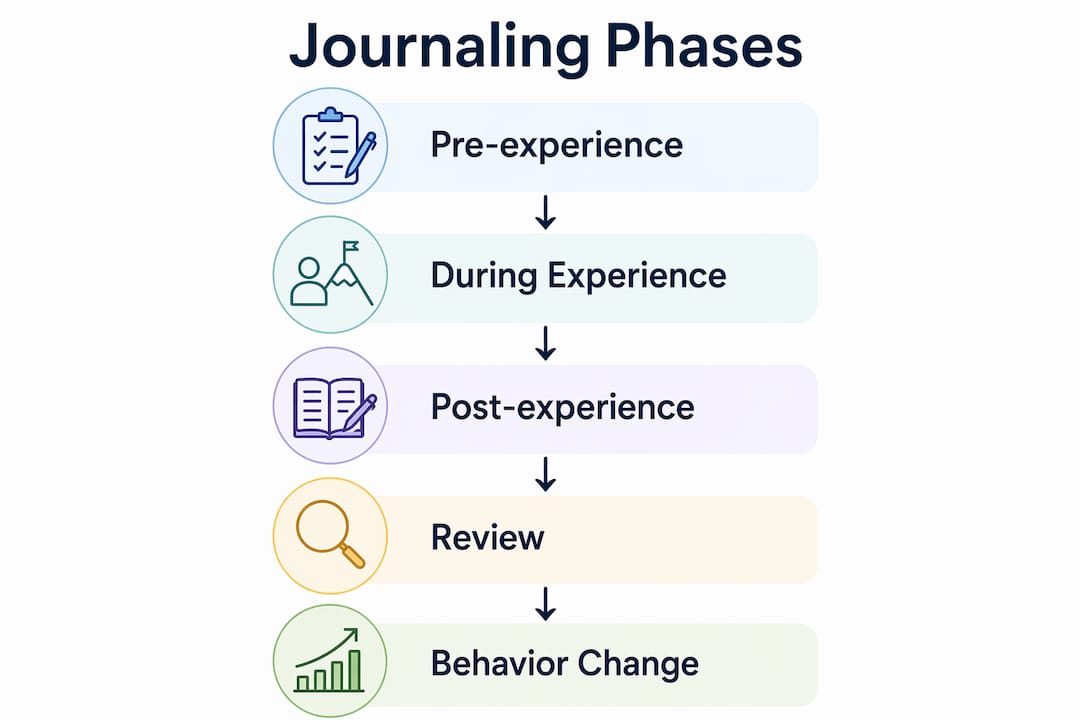
Phase-specific prompts capture sensory details and emergent insights that fade quickly without a record. Integration guides distinguish between a landing phase (24–48 hours post-experience) and a deepening phase (1–4 weeks out), and both serve different psychological purposes.
Pre-experience prompts (intention-setting):
- Why am I doing this, and what do I hope to understand?
- What feels unresolved in my life right now?
- Who is my support person if I need help afterward?
Sample entry: “I want to understand why I keep pulling back from close relationships. My support person is [name]. I feel nervous but ready.”
During / in-session notes (optional, brief):
Keep a notepad nearby for single words or short phrases only. “Colors shifting.” “Grief, chest.” “Something about my father.” Stop writing if it pulls you out of the experience.
Immediate landing prompts (0–48 hours):
- What images or feelings are still with me?
- What surprised me most?
- What do I want to remember in a month?
Sample entry: “Kept seeing water. Felt like something released in my chest. Want to remember: I am allowed to rest.”
Deepening prompts (1–4 weeks):
- What patterns do I keep noticing in my entries?
- What is one belief I held before that feels less true now?
- What is one small change I can make this week?
Sample entry: “Three entries mention isolation. I think I use busyness to avoid people. Experiment: say yes to one social invitation this week.”
Compact prompts reference table:
| Phase | Core prompt | Focus |
|---|---|---|
| Pre-experience | Why am I doing this? What do I need? | Intention and safety |
| In-session | One word or phrase only | Sensory anchors |
| Landing (0–48 hrs) | What surprised me? What do I want to remember? | Memory capture |
| Deepening (1–4 wks) | What patterns appear? What changes? | Behavior and meaning |
How do you turn journal entries into real behavior change?
Scheduled review turns fragmented insights into measurable change. Without a review habit, even the best entries sit unread. Integration resources consistently emphasize that journaling, psychotherapy, and community support work together to make insights durable. The journal is only half the loop.
- Weekly review (10 minutes). Reread the week’s entries. Highlight recurring words or themes. Rate each theme by urgency: high (affecting daily life), medium, or low.
- Pick one experiment. Choose the highest-urgency theme and write one micro-action to test it. Keep it small: a single conversation, a 10-minute walk, one email sent.
- Monthly review (20 minutes). Compare this month’s themes to last month’s. Note what shifted and what did not. Adjust the next experiment accordingly.
Example: A landing entry reads, “I keep saying I’m fine when I’m not.” The weekly review flags this three times. The micro-action: tell one person something true about how you feel before Friday. The monthly review checks whether that felt easier or harder than expected.
What should you track when journaling about microdosing or edibles?
Track variables, not doses. The goal is pattern recognition, not a medical log. Whether you are using mushroom capsules or edibles, the same tracking framework applies.
Key variables to note:
- Time of ingestion and product form (capsule vs. edible)
- Onset time and duration of noticeable effects
- Mood baseline before and after
- Tasks or activities during the window
- Context: sleep quality, food, stress level that day
Edibles, including chocolates and gummies, tend to have more variable onset times than capsules because digestion rate affects absorption. Noting this in your journal helps you attribute mood or focus changes correctly rather than assuming they are purely psychological. For a breakdown of how different product forms compare, this edible vs. magic mushroom guide covers the key differences.
Microdosing tracker template:
| Day | Product form | Onset (min) | Peak effects | Mood rating (1–10) | Notes |
|---|---|---|---|---|---|
| Day 1 | Capsule | — | Mild focus, calm | 7 | Good sleep night before |
| Day 3 | Edible | — | Relaxed, slight visual | — | Ate a large meal first |
Safety note: If you notice unexpected or distressing effects, stop and contact a healthcare provider. A journal log is useful context to share with a clinician, but it is not a substitute for professional evaluation.
What safety and legal cautions apply to U.S. readers?
Journaling is low-risk, but it can surface strong emotions. Have a support plan before you start, and know the red flags that require professional help.
Seek immediate professional support if you experience:
- Panic attacks that do not resolve within an hour
- Suicidal ideation or self-harm thoughts
- Dissociation that persists beyond the session
- Paranoia or confusion lasting more than 24 hours
Privacy practices:
- Use a locked physical notebook or an encrypted digital app.
- Avoid storing sensitive entries in unprotected cloud folders or shared devices.
- Be aware that journal content could be discoverable in legal contexts. Write with that in mind.
U.S. legal cautions: Federal law still classifies psilocybin as a Schedule I substance. A small number of states and cities, including Oregon and Colorado, have created regulated frameworks, but rules vary significantly by jurisdiction. Ann Arbor, Michigan, deprioritized enforcement of personal possession in 2021, but that is not the same as legalization. Always verify current local rules before purchasing or possessing any psilocybin product. Theelevatedremedies carries legal amanita muscaria products and related accessories; for a clear picture of what is available and what is legal in your area, check responsible psychedelic wellness coverage for current guidance.
Key Takeaways
Psilocybin journaling for mental wellness works best as a short, consistent daily practice that captures insights immediately after an experience and converts them into one small, concrete behavior change each week.
| Point | Details |
|---|---|
| Start within 24 hours | Write your first entry while sensory detail and emotion are still accessible. |
| Keep sessions short | A 5–10 minute daily entry is more sustainable than occasional long sessions. |
| Use phase-based prompts | Pre, landing, and deepening prompts each serve a different psychological purpose. |
| Review and act weekly | Spot recurring themes and pick one micro-action to test before the next review. |
| Theelevatedremedies | Carries legal mushroom edibles and capsules in Ann Arbor, with educational resources to support safe integration practice. |
A note from Elevated Remedies on what we see at the counter
At Theelevatedremedies, we talk to customers every day who are curious about psilocybin products but unsure what to do after the experience. The most common gap we see is not the product choice. It is the lack of a simple structure for what comes next. Customers who come back and tell us something shifted for them almost always mention that they wrote things down.
Two things we tell people consistently: start your journal entry the same day, even if it is just three words, and keep your notebook somewhere you will actually see it. A journal on a shelf you never open is not an integration practice. One on your nightstand is.
For readers who want to understand the psychedelic integration process more fully before they start, that resource covers the practical post-session framework in plain language.
Theelevatedremedies carries what you need to start
If you are ready to pair a journaling practice with a quality product, Theelevatedremedies stocks legal amanita muscaria gummies, mushroom capsules for microdosing, and a full range of smoking accessories at 1123 Broadway St in Ann Arbor, Michigan. Products are sourced for consistency, which matters when you are trying to track subjective effects accurately in a journal.
Capsules are particularly useful for journaling purposes because their onset is more predictable than edibles, making it easier to attribute what you notice in your entries. Visit the store or browse online to find the format that fits your practice. For product details and safe-use education, the amanita muscaria product page is the clearest starting point.
Useful sources
Clinical evidence:
- Psilocybin as a Disease-Modifying Drug: A Salutogenic Approach in Psychiatry (PMC) — supports rapid antidepressant effects and integration rationale
- Psilocybin for mental health and addiction: What you need to know (NCCIH) — 2023 trial findings on symptom reduction timelines
- Johns Hopkins Center for Psychedelic and Consciousness Research — landmark safety and efficacy research
Integration guidance:
- Your Psychedelic Therapy Journey Continues: Integration 101 (ADAA) — integration strategies including journaling
- Journaling for psychedelic integration (Beckley Retreats) — phase-based prompts and sample entries
Practical journaling how-tos:
- 7 Exercises to Help You Journal Your Way to Mindfulness (Mindful) — accessible techniques for beginners
- How Mindful Journaling Can Help Your Daily Practice (Mindful) — mechanisms and benefits overview
- Journaling for mindfulness: Prompts, examples and exercises (PositivePsychology.com) — evidence base for journaling as a wellness practice
- How to start a mindful journaling practice (MindTastik) — routine structure and safety cautions
- 12 tips and techniques: How to start a mindfulness journal (The Healthy Habit Hub) — session length, arrival ritual, and habit formation
Recommended
- How Psilocybin Shapes Emotional Processing: A Science Guide – Elevated Remedies
- Psilocybin Chocolate Benefits for Mental Wellness: 2026 – Elevated Remedies
- Psilocybin Dosage Guide for Michigan Wellness in 2026 – Elevated Remedies
- Top magic mushroom wellness tips for safe, effective use – Elevated Remedies