
TL;DR:
- Psychedelic integration involves actively processing insights from a session to foster lasting personal growth. It includes stages such as stabilization, meaning-making, and behavioral change, often supported by personalized methods like journaling, therapy, and nature. Ongoing, intentional work after a psychedelic experience is essential for meaningful transformation and mental well-being.
Psychedelic integration is defined as the intentional process of understanding, processing, and applying insights from a psychedelic experience to create lasting personal growth and healing. This is not the same as the psychedelic session itself. Defining psychedelic integration clearly matters because most of the real transformation happens after the experience ends. Tools like journaling, meditation, somatic bodywork, and therapy are the core methods practitioners use. Whether you worked with psilocybin mushrooms, participated in a guided ceremony, or explored microdosing, what you do in the days and weeks following shapes how much benefit you actually carry forward.
What is psychedelic integration, exactly?
Psychedelic integration is a distinct process occurring after the psychedelic session, designed to bridge insights from an altered state into daily life for sustainable growth. The word “integration” comes from the Latin integrare, meaning to make whole. That framing is useful. The goal is not to analyze the trip endlessly but to weave what you experienced into who you are and how you live.
A 2022 review identified integration as revisiting, working through, and translating psychedelic content toward internal and external wholeness. That definition is more precise than most people expect. It is not passive reflection. It is active, structured work.
Integration is also an individualized process combining psychological, somatic, and creative methods to transform experience into change. No single formula works for everyone. One person may need talk therapy. Another may need movement, art, or time in nature. The practice is personal by design.
How does psychedelic integration differ from psychedelic-assisted therapy?
These two terms get confused constantly, and the confusion matters. Psychedelic-assisted therapy is a structured clinical protocol that includes preparation sessions, a controlled dosing session, and follow-up integration work. It is a complete treatment model, often conducted under the supervision of licensed clinicians.
Integration, by contrast, is the ongoing phase. It begins after the dosing session and can unfold over weeks or months. You can engage in integration work whether or not you participated in a formal clinical program. Someone who took psilocybin mushrooms independently still benefits from structured integration practices.
The table below clarifies the key differences:
| Dimension | Psychedelic-Assisted Therapy | Psychedelic Integration |
|---|---|---|
| Setting | Clinical or supervised retreat | Personal, therapeutic, or community-based |
| Timing | Preparation, dosing, and follow-up | Primarily post-experience, ongoing |
| Goal | Treat specific mental health conditions | Translate insights into daily life changes |
| Duration | Defined treatment protocol | Weeks to months, non-linear |
| Professionals involved | Licensed therapists, psychiatrists | Integration coaches, therapists, peer support |
The two are complementary. Therapy without integration often produces short-lived results. Integration without any therapeutic grounding can leave people processing difficult material without adequate support. The Fireside Project, a nonprofit psychedelic support line, works specifically with people navigating integration outside formal clinical settings.
What are the core phases and methods of effective integration?
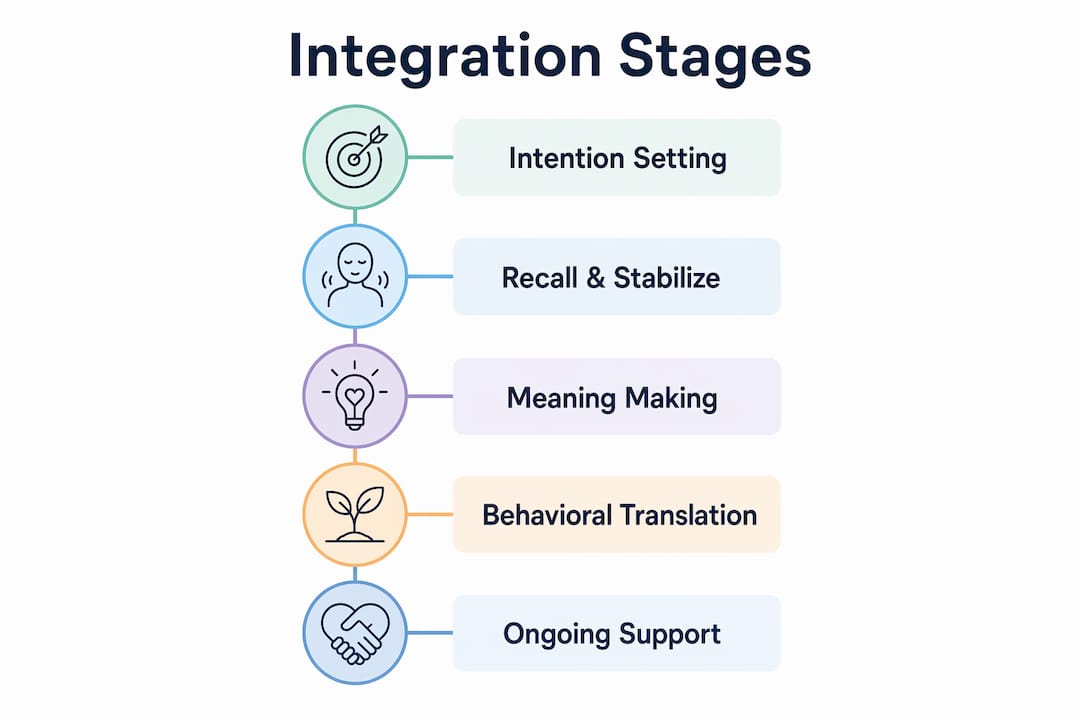
The phases of integration follow a logical sequence. A 2022 review outlined three stages: recall and stabilization, meaning-making, and behavioral translation. Each phase requires different tools and a different quality of attention.

Recall and stabilization happens in the first 24–72 hours. Your nervous system is still processing. The priority is grounding, rest, and gentle documentation of what arose. Meaning-making follows over the next days and weeks. Here you ask what the experience revealed about your patterns, relationships, or values. Behavioral translation is the final and most important phase. This is where insight becomes habit.
Here are six proven integration methods to work through those phases:
- Journaling. Write freely within 24 hours of the experience. Capture images, emotions, and themes without editing. Return to these notes weekly.
- Meditation. Sitting practice helps you observe thoughts without reacting. Even 10 minutes daily maintains the reflective state that integration requires.
- Somatic bodywork. Practices like yoga, breathwork, or trauma-informed massage help process emotions stored in the body that words cannot reach.
- Therapy or integration coaching. A trained professional helps you contextualize difficult material and avoid misinterpretation of symbolic content.
- Creative arts. Drawing, music, or movement can express what language cannot. Many people find that visual art captures the texture of their experience more accurately than writing.
- Time in nature. Spending time outdoors supports nervous system regulation and often reactivates the sense of connection that emerged during the experience.
Pro Tip: Integration actually starts before the experience with clear intention setting. Writing down what you hope to understand or heal before a session acts as a compass for the work that follows. Intentions improve recall and give your integration practice a direction.
You do not need to use every method. Start with two or three that feel natural and build from there. The goal is consistency, not complexity.
Why is psychedelic integration crucial for lasting growth?
The most important insight in this field is also the least intuitive. The neuroplastic window after a psychedelic experience is when integration work is most effective. The experience itself does not produce transformation. Transformation happens in the quiet, consistent work that follows.
This matters practically. If you have a profound psilocybin session and then return immediately to your old routines without reflection, the insights fade. The brain is temporarily more receptive to new patterns, and integration practices are what capitalize on that window.
The benefits of consistent integration work include:
- Emotional processing. Difficult emotions that surfaced during the experience get worked through rather than suppressed.
- Behavioral change. Insights translate into new habits, communication patterns, and relationship choices.
- Resilience building. Regular reflection builds the psychological flexibility to handle future stress more effectively.
- Mental health stability. Processing the experience reduces the risk of confusion, anxiety, or destabilization in the weeks following.
“Integration is not about fixing the experience but embracing uncertainty and gradual meaning-making.” — Grof Psychedelic Training Academy
That framing is worth sitting with. Many people approach integration expecting clarity and resolution. The actual process is messier and more patient. You are not solving a puzzle. You are gradually making sense of something that operates on a different level than ordinary thought.
For those exploring psilocybin for mental wellness, integration is what separates a meaningful experience from a lasting one.
What challenges do people face during integration?
Integration is not always smooth. Knowing the common pitfalls in advance prevents you from getting stuck.
- Passive approach. Waiting for insights to “settle on their own” rarely works. Integration requires ongoing intentional work and unfolds over weeks or months, not days.
- Chasing perfect clarity. Some experiences remain symbolic or ambiguous. Demanding a clean narrative creates frustration and blocks the natural meaning-making process.
- Avoiding professional support. Integration is not a substitute for mental health care. Symptoms that feel unsafe, including persistent anxiety, dissociation, or intrusive thoughts, require professional attention.
- Dramatic overhauls. People sometimes feel compelled to quit their jobs, end relationships, or relocate after a powerful experience. Small, sustainable routine changes are more effective than dramatic life alterations and produce better long-term outcomes.
- Isolation. Processing alone without any community or professional support increases the risk of misinterpreting difficult material.
Pro Tip: Behavioral translation is the most grounding integration practice available. If your experience revealed gratitude as a core value, translate that into a concrete daily habit. Write one appreciation note to a friend each morning. Specific, small actions prevent insight fade better than any amount of reflection alone.
Understanding microdosing vs. full psychedelic experiences also helps set realistic expectations for what integration looks like at different intensity levels.
Key takeaways
Psychedelic integration is the structured, ongoing work of translating insights from a psychedelic experience into real behavioral change, emotional growth, and lasting mental wellbeing.
| Point | Details |
|---|---|
| Integration is post-experience work | The real transformation happens after the session, not during it. |
| Three core phases guide the process | Recall and stabilization, meaning-making, and behavioral translation structure effective integration. |
| Methods must be personalized | Journaling, therapy, somatic work, and creative arts each serve different needs. |
| Small changes outperform dramatic ones | Sustainable daily habits produce better long-term outcomes than major life overhauls. |
| Professional support is sometimes necessary | Unmanageable symptoms after a psychedelic experience require clinical care, not just self-reflection. |
What i’ve learned about integration that most articles miss
Most writing about psychedelic integration focuses on the tools: journal here, meditate there, find a therapist. That advice is not wrong. But it misses the harder truth about what makes integration actually work.
The people who benefit most are not the ones with the most elaborate practices. They are the ones who show up consistently to small, unglamorous habits for months after the experience. A five-minute journaling session every morning beats a three-hour processing session once a month. The nervous system learns through repetition, not intensity.
The second thing most articles miss is the role of patience with ambiguity. Not every insight resolves into a clear directive. Some experiences leave you sitting with a feeling or an image for months before its meaning becomes clear. Forcing resolution too quickly produces false conclusions. The Grof Psychedelic Training Academy puts it well: integration is about embracing uncertainty, not eliminating it.
The third thing worth saying directly: integration is not a spiritual bypass. It does not replace therapy, medication, or other mental health support when those are needed. The people I have seen struggle most with integration are those who treated it as a replacement for professional care rather than a complement to it. Know the difference before you start.
— Juiced
Start your integration journey with the right support

At Theelevatedremedies, we believe the experience is only the beginning. What you do after matters just as much as the session itself. For those in Ann Arbor looking to support their integration practice with consistent, quality products, our mushroom capsules are a popular choice for maintaining a steady microdosing routine that complements daily reflection and habit formation. We also carry Amanita muscaria products for those exploring broader mushroom wellness. Our team at 1123 Broadway St is here to help you find what fits your practice. Come in and ask us anything.
FAQ
What is the simplest definition of psychedelic integration?
Psychedelic integration is the process of understanding and applying insights from a psychedelic experience to create lasting personal change. It occurs after the session and can unfold over weeks or months.
How long does psychedelic integration take?
Integration is a non-linear process that typically unfolds over weeks to months following an experience. There is no fixed endpoint, and progress often comes in gradual, small shifts rather than sudden breakthroughs.
Do i need a therapist for psychedelic integration?
A therapist is not always required, but professional support is necessary when symptoms feel unmanageable or unsafe. Practitioners emphasize that integration is not a substitute for clinical mental health care.
What is the most effective integration method?
No single method works for everyone, but behavioral translation is widely considered the most grounding practice. Turning symbolic insights into specific daily habits prevents insight fade and anchors growth in real life.
How is integration different from just reflecting on a trip?
Reflection is one part of integration, but the full process includes stabilization, meaning-making, and behavioral change. Passive reflection without structured practice rarely produces lasting results.
Recommended
- Defining Psychedelic Blends: Types, Effects, and Safety – Elevated Remedies
- Defining Adaptogens in Psychedelics: What You Need to Know – Elevated Remedies
- Psychedelic strains guide: Michigan magic mushrooms – Elevated Remedies
- Microdosing vs psychedelic experiences: 5 key differences – Elevated Remedies