
Psilocybin works on your emotions through a precise molecular chain: after ingestion, your body converts it into psilocin, which then acts as a partial agonist at 5-HT2A serotonin receptors concentrated in the prefrontal cortex and amygdala. These two brain regions sit at the center of how you process fear, regulate mood, and respond to stress. Activating them with psilocin doesn’t just produce a psychedelic experience. It reshapes the neural circuits that govern emotional life, sometimes for weeks after a single dose.
Here’s the core mechanism at a glance:
- Psilocybin is a prodrug. Your gut and liver convert it into psilocin before it crosses into the brain.
- Psilocin binds primarily to 5-HT2A receptors in the prefrontal cortex and amygdala, triggering increased neuronal firing and downstream signaling cascades.
- This receptor activation modulates circuits responsible for emotional regulation, threat detection, and mood.
- Acute effects include reduced reactivity to negative stimuli and a shift toward positive affect.
- Longer-term effects involve brain plasticity, enhanced connectivity, and what researchers now call emotional flexibility.
How psilocybin affects the amygdala and mood over time
The amygdala is your brain’s threat detector. Under psilocybin, it quiets down. Studies show that acute psilocybin reduces amygdala reactivity to negative emotional stimuli, and that dampening correlates directly with increases in positive mood. Put simply: when the amygdala stops overreacting to threat cues, your emotional baseline shifts upward.
What happens over the following weeks is more nuanced. Research tracking participants one week and one month after a single high dose found that negative affect and amygdala response to facial expressions were reduced at one week, then returned toward baseline at one month. Positive affect, however, stayed elevated at the one-month mark, and trait anxiety remained reduced. The amygdala’s acute suppression appears transient; the mood benefit is not.
| Timepoint | Amygdala Response | Positive Affect | Negative Affect |
|---|---|---|---|
| Baseline | Normal | Normal | Normal |
| 1 week post-dose | Reduced | Elevated | Reduced |
| 1 month post-dose | Returned to baseline | Still elevated | Returned to baseline |
Alongside these affective changes, resting-state functional connectivity across brain networks increased at both the one-week and one-month timepoints. That global connectivity shift, persisting well past the acute experience, is one of the clearest neural signatures of psilocybin’s lasting emotional impact.
Key finding: A single high dose produced global increases in functional brain connectivity at both one week and one month post-psilocybin, suggesting a domain-general cortical plasticity process that supports sustained changes in emotional processing.
What makes psilocybin therapy different from SSRIs
The comparison to escitalopram, a standard SSRI antidepressant, cuts to the heart of what makes psilocybin’s therapeutic mechanism distinctive. Both treatments shift emotional processing in a more positive direction. The difference is in how they do it.
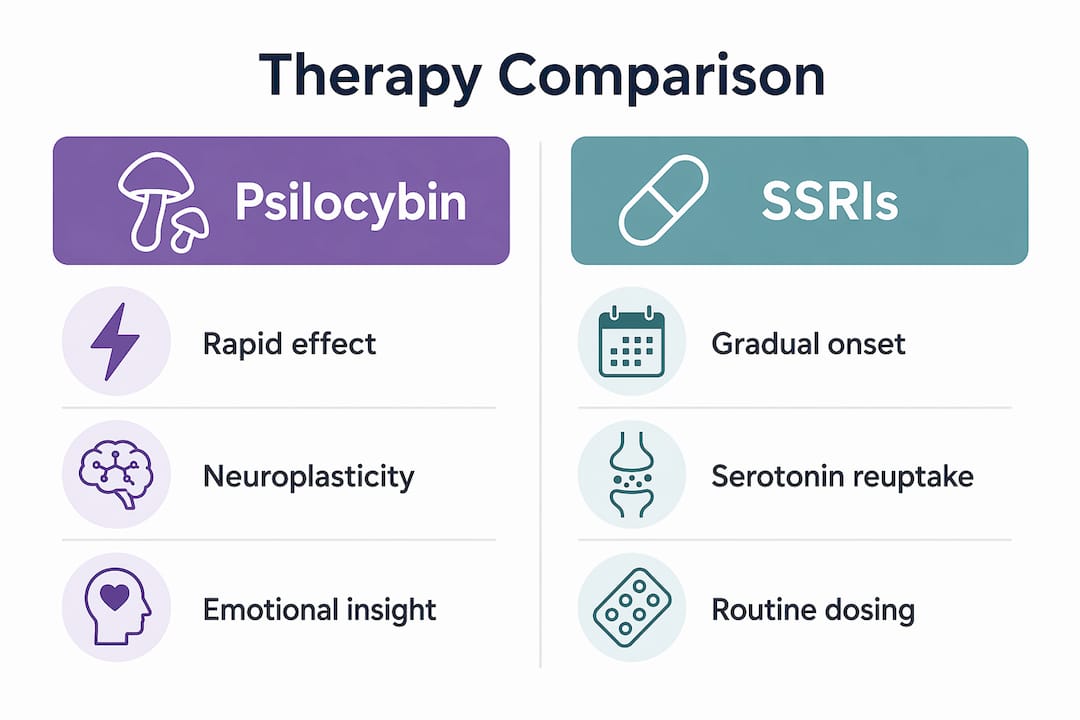
SSRIs like escitalopram tend to blunt emotional intensity across the board, reducing both negative and positive affect. Psilocybin does the opposite: it promotes emotional engagement rather than blunting, helping people reconnect with suppressed feelings rather than muting them. Researchers describe this as emotional recalibration, not emotional suppression.
Key therapeutic pathways supported by clinical research:
- Emotional breakthrough experiences during sessions serve as moderators for long-term symptom improvement, particularly through the release of suppressed emotions.
- Mystical experiences contribute to outcomes, but emotional breakthroughs may be more predictive of clinical improvement than mystical ones.
- Reduced negative affective bias shifts how patients interpret social cues, facial expressions, and memories.
- Increased cognitive flexibility allows people to update entrenched negative beliefs more readily.
- Faster onset compared to SSRIs, likely because psilocybin acts directly on serotonin receptors rather than gradually increasing synaptic serotonin.
Pro Tip: If you’re preparing for a therapeutic session, emotional readiness matters more than trying to engineer a mystical experience. Research suggests that willingness to engage with difficult feelings, rather than avoid them, is what drives lasting clinical benefit.
Brain plasticity and the integration window after dosing
Psilocybin doesn’t just change how you feel during a session. It induces neuroplasticity in the prefrontal cortex and limbic areas, including synaptogenesis (new synaptic connections), dendritogenesis (growth of dendritic branches), and neurogenesis. These structural changes create a window of heightened brain flexibility in the days and weeks after dosing.

| Plasticity Process | Brain Region | Relevance to Emotion |
|---|---|---|
| Synaptogenesis | Prefrontal cortex, hippocampus | Supports new emotional learning |
| Dendritogenesis | Limbic areas | Enhances connectivity in mood circuits |
| Increased functional connectivity | Whole brain networks | Sustains adaptive emotional processing |
This plasticity window is not passive. Therapeutic integration, the deliberate psychological work done after a session through therapy, journaling, or guided reflection, is most effective precisely during this period. The brain is more receptive to new emotional patterns, making it the optimal time to reinforce insights from the experience. Skipping integration after a psilocybin session is like doing physical therapy once and never following up.
Research note: Persistent structural remodeling in neuronal connectivity in the medial prefrontal cortex has been proposed as a key mechanism for psilocybin’s long-lasting antidepressant effects, involving TrkB, mTOR, and AMPA receptor activation.
Why measuring emotional change under psilocybin is harder than it looks
Standard emotion research uses simple positive/negative frameworks. Psilocybin breaks those categories. The need for emotional granularity in psychedelic research reflects a growing recognition that what people experience during and after sessions is far more textured than “felt better” or “felt worse.”
Emotional granularity refers to the ability to discriminate among specific emotional states: distinguishing grief from shame, or awe from anxiety, rather than lumping them into “negative affect.” Psilocybin appears to increase this capacity, which may itself be a therapeutic mechanism. People who can name and differentiate their emotions tend to cope with them more adaptively.
Methodological challenges the field is actively working through:
- Standard mood scales (like the PANAS) don’t capture the complexity of psychedelic emotional states.
- Emotional flexibility, the ability to shift between emotional states fluidly, is emerging as a more accurate therapeutic target than simple symptom reduction.
- Acute neurophysiological effects (amygdala dampening) are transient, while psychological benefits (emotional flexibility, reduced trait anxiety) endure, requiring different measurement timelines.
- Self-report during altered states is inherently unreliable, complicating real-time data collection.
Practical guidance for navigating psilocybin’s emotional effects
Understanding the science is useful. Knowing what to do with it during an actual experience is where it gets practical. Psilocybin reliably surfaces suppressed emotions, and that process can feel destabilizing if you’re not prepared for it.
Set and setting shape outcomes more than most people expect. A supportive environment, a trusted guide or sitter, and a clear personal intention all influence whether emotional material that surfaces gets processed productively or becomes overwhelming. The emotional breakthroughs most associated with clinical improvement tend to happen when people surrender to the experience rather than resist it.
Pro Tip: Surrender doesn’t mean passivity. It means meeting difficult emotions with curiosity instead of control. Research consistently links this orientation to better therapeutic outcomes.
Do’s and don’ts grounded in clinical and scientific evidence:
- Do set a clear intention before your session. Not a goal to achieve, but a question or area of life you want to bring awareness to.
- Do plan for integration. Schedule time with a therapist, counselor, or trusted person in the days following your experience.
- Don’t use psilocybin to avoid emotional pain. The mechanism works by engaging with it, not bypassing it.
- Don’t combine with SSRIs without medical guidance. SSRIs blunt 5-HT2A receptor activity and may significantly reduce psilocybin’s effects.
- Do research strain differences. Different psilocybin strains affect emotional states differently, and knowing what you’re working with matters.
- Do read up on psychedelic integration practices before your session, not just after.
Theelevatedremedies carries dried mushrooms, capsules, and chocolates sourced for consistency, and the team at 1123 Broadway St in Ann Arbor is available to help you understand what you’re choosing and why.
How psilocybin’s emotional mechanisms compare to other psychedelics
Psilocybin shares its primary mechanism with other classic serotonergic psychedelics: LSD, DMT, and mescaline all act on 5-HT2A receptors. The differences lie in duration, receptor binding profile, and the subjective quality of emotional processing they produce.
LSD binds to a broader range of receptors, including dopamine receptors, and produces a longer experience (8–12 hours versus 4–6 hours for psilocybin). That extended duration can amplify both emotional breakthroughs and emotional overwhelm. DMT acts faster and more intensely but is far shorter, making sustained emotional processing during the experience more difficult. Psilocybin’s 4–6 hour window is often considered therapeutically optimal: long enough for emotional material to surface and be worked through, short enough to remain manageable.
MDMA, while not a classic psychedelic, is worth noting here. It works primarily through serotonin, dopamine, and norepinephrine release rather than receptor agonism, producing emotional openness through a fundamentally different pathway. Its emotional effects tend toward warmth and connection rather than the introspective depth that characterizes psilocybin. For trauma processing specifically, the two compounds are being studied for different but potentially complementary roles. Cannabinoids, including CBD products designed for mood support, operate through entirely separate receptor systems (CB1 and CB2) and produce milder, more diffuse emotional modulation without the neuroplastic depth of psilocybin.
Risks and emotional side effects you should know about
Psilocybin’s capacity to surface suppressed emotions is also its primary risk. Challenging experiences, sometimes called “difficult trips,” are not rare, and they can include acute anxiety, panic, paranoia, and emotional overwhelm. These experiences are not inherently harmful and can sometimes be therapeutically valuable, but they require a safe container to process.
The National Center for Complementary and Integrative Health notes that psilocybin’s effects are hard to predict and vary widely between individuals. Dose, personal history, mental health status, and environment all interact. People with a personal or family history of psychosis or bipolar disorder face elevated risk of adverse psychological reactions and should approach psilocybin only under qualified clinical supervision, if at all.
Microdosing carries its own risk profile. Sub-perceptual doses can cause increased anxiety, disrupted sleep, poor mood, and impaired focus in some people, particularly with frequent use. The assumption that smaller doses are automatically safer doesn’t hold across all users.
Emotional side effects to be aware of include:
- Acute anxiety or panic during the session, especially when resisting difficult material.
- Emotional lability in the days following a session, as suppressed feelings continue to surface.
- Temporary increases in amygdala sensitivity approximately one month post-dose, as noted in clinical research.
- Rare but documented cases of prolonged perceptual disturbances (HPPD) following high doses.
Key Takeaways
Psilocybin converts to psilocin in the body, which activates 5-HT2A serotonin receptors in the amygdala and prefrontal cortex, producing acute mood shifts and lasting neuroplastic changes that underpin its therapeutic potential.
| Point | Details |
|---|---|
| Core mechanism | Psilocin activates 5-HT2A receptors in the amygdala and prefrontal cortex, modulating emotional circuits. |
| Amygdala response | Acute amygdala dampening reduces negative affect at one week; positive affect remains elevated at one month. |
| Psilocybin vs. escitalopram | Psilocybin promotes emotional engagement; SSRIs like escitalopram tend to blunt emotional intensity. |
| Plasticity window | Neuroplastic changes post-dose create a critical period where integration therapy produces the most lasting benefit. |
| Emotional granularity | Psilocybin research requires nuanced emotional measurement beyond simple positive/negative frameworks. |

Theelevatedremedies stocks a curated selection of psilocybin products at 1123 Broadway St in Ann Arbor, Michigan, including dried mushrooms, microdose capsules, and chocolates. Whether you’re approaching this for the first time or deepening an existing practice, the team can point you toward the right product and the right resources. Visit the store or explore magic mushroom options online to get started.
Recommended
- Psilocybin Strain Emotional Effects: A 2026 Breakdown – Elevated Remedies
- Why Compare Psilocybin Species: Effects and Potency Guide – Elevated Remedies
- Psilocybin Chocolate Benefits for Mental Wellness: 2026 – Elevated Remedies
- Magic Mushrooms Explained: Science, Safety & Wellness Guide – Elevated Remedies