
TL;DR:
- Microdosing psilocybin may improve focus and wellbeing temporarily, but scientific evidence shows mixed results.
- A structured, trackable workflow with safety precautions and precise dosing is essential for responsible self-experimentation.
You’re in the middle of a deep work block, coffee going cold, inbox piling up, and your brain feels like it’s running through sand. A colleague mentions she’s been microdosing mushrooms to sharpen her focus. Another startup founder in your network swears by it. But you’ve also read that the science is murky, the legal landscape is fuzzy, and the last thing you want is to accidentally derail your week. If that scenario sounds familiar, this workflow is built for you. We’re cutting through the noise with a step-by-step, evidence-grounded approach designed for Ann Arbor professionals who want results, not experiments gone sideways.
Table of Contents
- Understanding microdosing for productivity: What the science says
- Get prepared: Assessing readiness, required tools, and safety
- Your microdosing workflow: Step-by-step process
- Troubleshooting and measuring results: What to expect (and what to watch for)
- Our take: Why self-experimentation beats the hype
- Explore safe, effective options for your productivity journey
- Frequently asked questions
Key Takeaways
| Point | Details |
|---|---|
| Conflicting research on benefits | Clinical trials find little cognitive boost, but some self-reports indicate productivity gains. |
| Start low, assess safety first | Check health and legal status, start with a small dose, and use safe tracking habits. |
| Track your own results | Personal productivity improvements require systematic self-tracking and reviewing outcomes over time. |
| No verified commercial products | Currently, there are no widely recommended, lab-tested microdosing psilocybin products available in Michigan. |
Understanding microdosing for productivity: What the science says
Microdosing means taking a sub-perceptual dose of psilocybin, typically between 0.05 and 0.3 grams of dried mushrooms, small enough that you won’t see trails or feel high, but potentially enough to nudge your mood, creativity, or focus. The concept has spread far beyond Silicon Valley. Ann Arbor’s own professional community has noticed, given that this city has always been home to researchers, engineers, and creative thinkers who aren’t satisfied with surface-level answers.
So what does the science actually say? The honest answer: it depends heavily on which kind of study you’re reading. The gap between self-reported data and controlled clinical trials is wide, and understanding that gap matters before you design your own protocol.
On the self-report side, the results look compelling. Self-reported data from 1,435 participants on the Microdose.me platform showed significantly higher wellbeing, productivity, focus, and creativity on microdosing days compared to non-dosing days (p<0.001). That’s a large sample, and the effect sizes weren’t trivial.
But here’s where it gets complicated. Double-blind placebo-controlled trials, the gold standard in research, found no significant cognitive or mood benefits from psilocybin microdosing beyond placebo in two longitudinal studies. And a meta-analysis of 14 studies with 1,614 participants found no overall cognitive benefit (d = -0.06) and actually identified a significant reduction in cognitive control (d = -0.34), which is the opposite of what most people are aiming for.
The takeaway isn’t that microdosing definitely doesn’t work. It’s that the population-level data doesn’t support universal claims. Individual variation is real. That’s exactly why a structured, trackable workflow matters so much.
| Study type | Sample size | Key finding |
|---|---|---|
| Self-report (Microdose.me) | 1,435 | Higher focus, wellbeing, productivity on dosing days |
| Placebo-controlled trial | Multiple cohorts | No significant benefit over placebo |
| Meta-analysis | 1,614 | No cognitive benefit; reduced cognitive control |
To understand where microdosing sits versus full psychedelic experiences, and why that distinction matters clinically and practically, it’s worth getting that foundation right before you start.
Get prepared: Assessing readiness, required tools, and safety
Understanding what microdosing can and can’t do scientifically, let’s set up your workflow starting with safety, preparation, and sourcing.
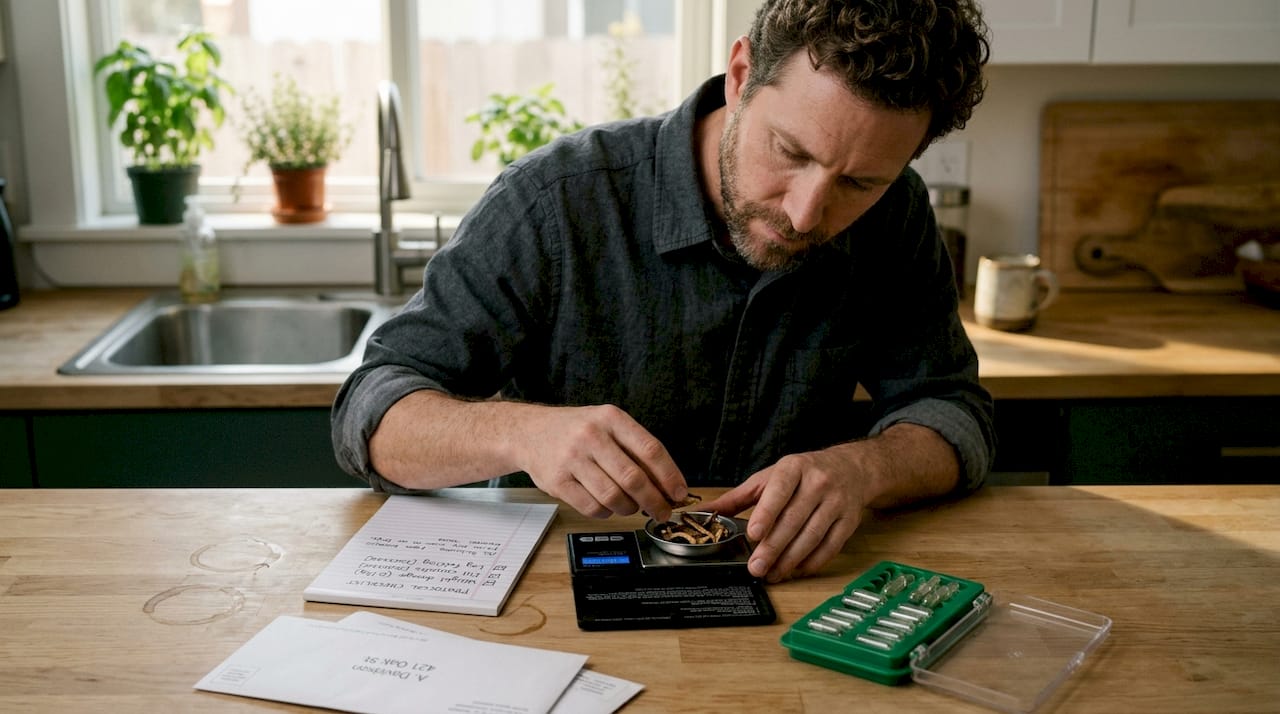
Before you weigh a single gram, you need an honest personal inventory. Microdosing is not risk-free, and it’s not right for everyone. Research indicates that risks are notably higher for individuals with cardiac conditions, neurological disorders, or a personal or family history of psychosis or bipolar disorder. If any of those apply to you, this is a conversation to have with your physician first, not after.
Mental health history matters beyond just contraindications. If you’re managing active anxiety, depression, or are in a period of high stress, psilocybin can amplify emotional states unpredictably, even at sub-perceptual doses for some people.
Local legal context in Ann Arbor
Ann Arbor has long held a progressive stance on personal freedom, and in 2020, the city passed a resolution making psilocybin enforcement the lowest law enforcement priority. This is decriminalization, not full legalization. There’s no licensed retail framework, no regulated product labeling, and no state-level protection. The University of Michigan Psychedelic Program emphasizes research over access and notes that no reliable commercial products are recommended from established sources. Local decriminalization reduces but does not eliminate your legal risk.
Learning how to microdose safely in Michigan and reviewing a thorough magic mushrooms safety guide are practical first steps that will ground your preparation in facts, not forum posts.
What you’ll need before you start
- A precise digital scale accurate to 0.01 grams (a kitchen scale won’t cut it)
- A dedicated journal or tracking app (Bearable, Daylio, or even a simple spreadsheet)
- A clear, defined productivity goal for each dosing period
- At least two weeks of baseline mood and focus tracking before your first dose
- A “set and setting” plan: know your work environment, your task list, and your personal intentions
Pro Tip: Don’t start a microdosing protocol during a high-stakes deadline week or a period of personal turbulence. Choose a “normal” week where you have some flexibility to observe effects without catastrophic downside if something feels off.
“Start at 0.1g and titrate only if needed. More is not better in microdosing. The goal is imperceptible, not noticeable.”
Your microdosing workflow: Step-by-step process
Once you’re ready and equipped, it’s time to walk through the workflow from mindful preparation to outcome tracking.
Step 1: Set your productivity intention
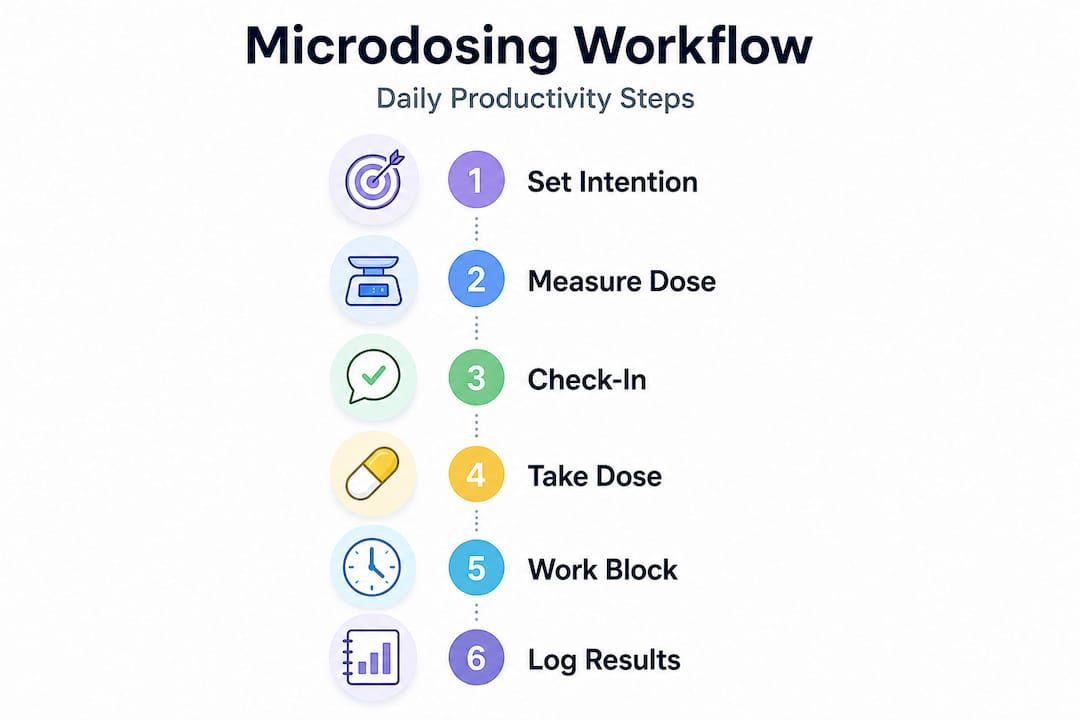
Before you dose, write down a single, specific productivity goal for the day. Not “be more focused” but “complete the first draft of the Q2 report by 2 p.m.” Vague intentions produce vague data. This step also starts activating the reflective, intentional mindset that may account for some of the benefits people report.
Step 2: Measure your dose
Using your precision scale, measure 0.1g to 0.2g of dried mushrooms. If you’re using mushroom capsules, note the labeled dose on each capsule. Record the exact amount in your tracking log. Consistency matters more than optimization at this stage.
Step 3: Pre-dose baseline check-in
Rate your current mood (1 to 10), focus level (1 to 10), and energy (1 to 10) before you take anything. This takes 60 seconds and is the most underused tool in most people’s protocols. You can’t know if something helped you if you don’t know where you started.
Step 4: Timing and environment
Take your dose in the morning, ideally within 30 minutes of waking and before caffeine. Many people report that combining microdosing with coffee amplifies stimulating effects in ways that aren’t always comfortable. Begin work within 60 to 90 minutes of dosing, which is when most people report subtle onset. Have a calm, structured environment ready. This is not the morning for a chaotic commute or a back-to-back meeting gauntlet.
Step 5: Work in focused blocks
Use a 90-minute focused work block immediately after the onset window. Keep your stated intention front and center. Take a short break at the 90-minute mark: walk outside, hydrate, do a brief body scan. Psilocybin is metabolized relatively quickly, and staying grounded with physical movement tends to help users maintain clarity rather than drift into unproductive rumination.
Step 6: Post-work check-in and logging
At end of your primary work block, re-rate your mood, focus, and energy using the same 1 to 10 scale. Note any side effects: headache, mild anxiety, emotional sensitivity, or unusual thought patterns. Also note your actual output. Did you complete your stated intention? This is your single most important data point.
Self-reports consistently suggest acute day-of benefits for focus and productivity, but rigorous randomized controlled trials indicate placebo effects are a dominant driver. Tracking personally is the only way to know which category you fall into.
For deeper context on integrating structure into your practice, the step-by-step mushroom effects workflow and microdose stacking protocols both offer layered guidance on timing and sequencing your approach.
Pro Tip: Follow the Fadiman Protocol as a starting framework: dose one day, skip two days, repeat. This prevents tolerance buildup and gives you clear off-day comparison data.
Troubleshooting and measuring results: What to expect (and what to watch for)
With the workflow underway, monitoring your outcomes and knowing when to adjust is key to success.
Most productivity gains people feel during microdosing are genuinely subjective and may be partly or fully driven by the expectation effect. That’s not a reason to dismiss them. Placebo-driven productivity is still productivity. But knowing the source helps you make smarter decisions about whether to continue.
Common positive signs to track
- Increased engagement with tasks (not just speed, but interest)
- Reduced mental resistance to starting difficult work
- Clearer articulation in writing or verbal communication
- Improved mood during and after focused work sessions
Warning signs that require immediate adjustment or stopping
- Persistent anxiety or agitation that lasts beyond the dosing day
- Mood swings or emotional volatility
- Difficulty concentrating, especially on complex sequential tasks
- Sleep disruption, even if you dose in the morning
- Any perceptual effects (if you notice visuals or dissociation, your dose is too high)
The meta-analysis of 1,614 participants found a significant reduction in cognitive control at the population level. For some individuals, this might show up as difficulty with logical sequencing, decision-making, or staying on task. If your work demands tight executive function, spreadsheet analysis, code review, or legal writing, watch for this effect specifically and log it honestly.
| Metric | Baseline day | Microdosing day | Delta |
|---|---|---|---|
| Focus (1-10) | ___ | ___ | ___ |
| Mood (1-10) | ___ | ___ | ___ |
| Energy (1-10) | ___ | ___ | ___ |
| Tasks completed | ___ | ___ | ___ |
| Side effects noted | None | ___ | ___ |
Run this comparison for at least two to four weeks before drawing conclusions. Single-day data is noise. Pattern data is signal.
Use a mental wellness checklist to monitor your broader wellbeing across the protocol, and if you’re curious about specific strains, the Blue Meanies microdosing guide breaks down one popular variety with practical notes on dosing and effects.
Pro Tip: If you have two or more consecutive dosing days where your warning sign score is higher than your positive sign score, that’s a clear signal to pause, not push through.
Our take: Why self-experimentation beats the hype
Here’s something we’ve noticed from working with Ann Arbor’s professional community over the years: the people who get the most out of microdosing aren’t the ones who believe in it the most. They’re the ones who track it the most carefully.
The loudest claims, both enthusiastic and skeptical, miss the same thing. Individual variation in response to psilocybin is enormous. What produces sharper focus for one person produces distraction in another. Neither the anecdote-heavy forums nor the population-level null results tell you what will happen in your specific neurobiology, under your specific workload, at your specific life stage.
What we think gets overlooked most often: the ritual itself may be doing a lot of the heavy lifting. When you set a clear intention, track your baseline, and evaluate your output honestly, you are practicing a form of structured self-reflection that most professionals almost never do. That practice alone, completely independent of the psilocybin, can improve productivity. We’re not saying the substance does nothing. We’re saying the workflow around it matters at least as much.
We’d also push back on the all-or-nothing framing that dominates most microdosing conversations. Microdosing doesn’t have to be your entire wellness strategy. Pairing it with solid sleep hygiene, strategic breaks, and well-chosen CBD as a wellness tool for anxiety or recovery can produce a more balanced, sustainable system than optimizing any single variable.
Finally, legal ambiguity is real. Decriminalization is not the same as safety from consequence. The responsibility sits entirely with you as the self-experimenter, which is exactly why preparation, sourcing from trustworthy places, and honest ongoing tracking are non-negotiable starting points, not optional extras.
Explore safe, effective options for your productivity journey
Now that you’re equipped with the evidence and a structured workflow, the practical next step is finding reliable products and resources that match your goals.
At Elevated Remedies, located at 1123 Broadway St in Ann Arbor, we carry mushroom capsules formulated for consistent microdosing, sourced for quality and clearly labeled so you know exactly what you’re working with. Whether you’re just starting out or refining an existing protocol, our team is here to walk you through your options without the guesswork. Curious about non-psilocybin alternatives? Our Amanita muscaria guide covers a completely different mushroom compound that some professionals are exploring for calm focus. Stop in, ask questions, and make your next step an informed one.
Frequently asked questions
Is microdosing psilocybin legal in Ann Arbor?
Psilocybin use is decriminalized (lowest law enforcement priority) in Ann Arbor, but it is not fully legal or regulated for commercial sale or possession. Decriminalization reduces risk but does not eliminate it.
What is a safe starting dose for microdosing psilocybin for productivity?
A common starting dose is 0.1 grams of dried mushrooms, titrating upward only if needed while closely monitoring mood, focus, and any side effects. Less is almost always more to start.
Are there proven productivity benefits to microdosing?
Self-reported data from large samples suggest acute focus and productivity gains on dosing days, but double-blind clinical trials find no significant benefits beyond placebo. Personal tracking is the most honest way to assess your individual response.
Can you buy safe, standardized microdosing products in Michigan?
Currently, no established sources recommend or supply verified, standardized psilocybin microdosing products in Michigan. Sourcing responsibly from knowledgeable local providers and doing your own quality checks remains the practical standard.
Recommended
- Step-by-Step Mushroom Effects Workflow for Michigan Microdosing – Elevated Remedies
- Microdosing vs psychedelic experiences: 5 key differences – Elevated Remedies
- Psilocybin Dosage Guide for Michigan Wellness in 2026 – Elevated Remedies
- Michigan mental wellness checklist 2026: anxiety & productivity – Elevated Remedies