
If you want precise microdoses and something to toss in a bag without a second thought, gummies usually win. If you want a slower, smoother, more ritualized edible experience, mushroom chocolate tends to fit better. The real tradeoff is dosing precision and sugar content versus a richer sensory experience and a gentler onset curve, and the right pick comes down to whether you’re optimizing for control or for the experience itself. The sections below walk through why.
TL;DR:
- Gummies provide faster onset and more precise dosing due to their water-based matrix, making them ideal for microdosing and travel.
- Chocolate’s fat content slows digestion, resulting in a delayed, longer-lasting effect and a richer sensory experience.
- Consistency is easier to achieve with gummies because each piece is manufactured to a specific weight and potency; chocolate dosing varies slightly.
- Storage stability favors gummies, which handle heat better, while chocolate requires cool, dry conditions to prevent melting and bloom.
- Your choice should depend on your goal: microdosing and control favor gummies, while a slower, indulgent experience suits chocolate better.
Table of Contents
- Mushroom Chocolate vs Gummies at a Glance
- How the Chocolate or Gummy Matrix Changes Absorption
- Which Format Gives You More Dosing Precision?
- How Long Onset and Effects Actually Last
- Comparing Ingredients, Nutrition, and Taste
- Storage, Shelf Life, and Taking It With You
- Matching the Format to Your Goals
- Smart Dosing Habits and Safety Basics
- What We’ve Learned Selling Both Formats
- Ready to Choose Your Format? Here’s What Elevated Remedies Carries
- Sources
Mushroom Chocolate vs Gummies at a Glance
Before choosing a format, it helps to see how each one behaves across the factors that actually change your day to day experience. Neither format is objectively better. They’re built for different jobs.
- Onset window: Gummies typically kick in faster because their gel or water-based matrix breaks down quickly in the gut. Chocolate’s fat content usually delays and smooths the curve.
- Dosing clarity: Gummies are almost always pre-dosed per piece, making math simple. Chocolate bars rely on scored squares, which can vary slightly in actual weight if you snap them by hand.
- Portability and heat risk: Gummies handle warm cars and gym bags better. Chocolate melts, softens, and can bloom (that gray film) if it swings between hot and cold too many times.
- Ingredients and nutrition: Gummies lean on sugar, gelatin or pectin, and flavoring. Chocolate carries cocoa solids, cocoa butter, and often more fat and calories per serving.
- Best use case: Gummies suit microdosing routines and travel. Chocolate suits slower, more deliberate sessions where taste and texture are part of the point.
None of these differences is minor once you’re actually using the product weekly instead of just reading the label once at checkout.
How the Chocolate or Gummy Matrix Changes Absorption
The format you choose isn’t just a taste preference. It’s a delivery mechanism, and the two mechanisms behave differently in your gut.
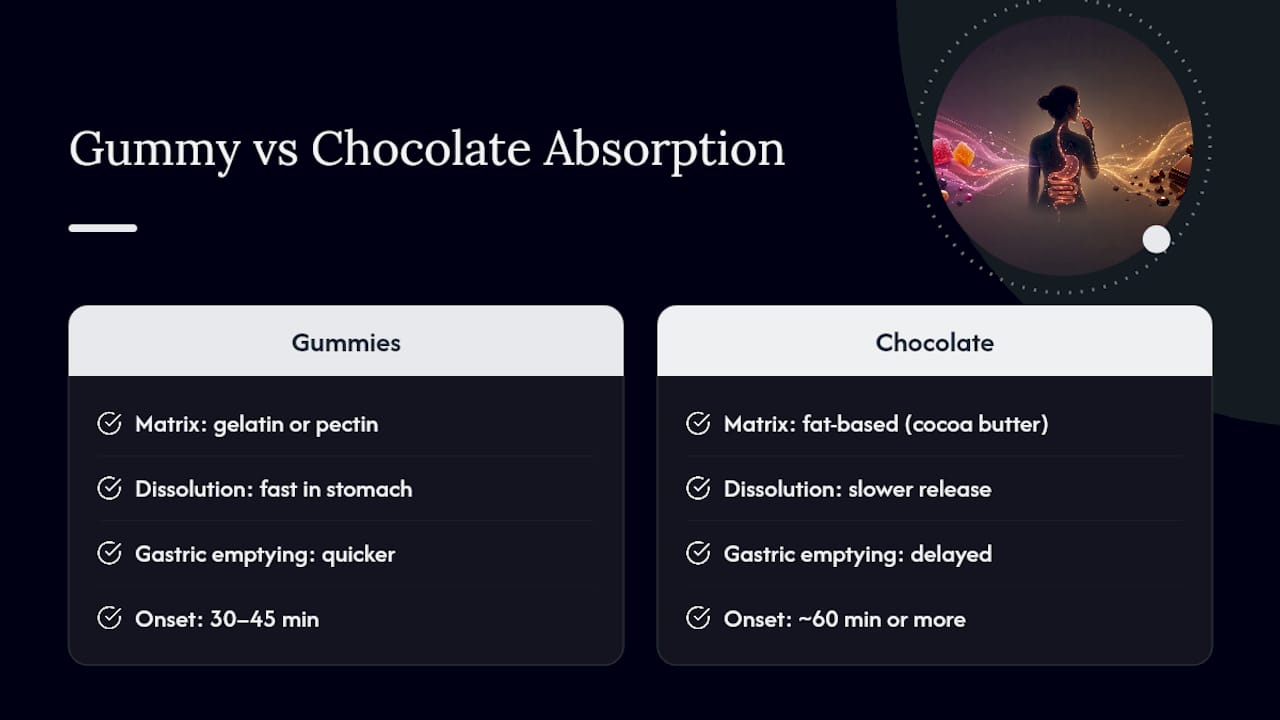
Chocolate is a fat-based matrix. Cocoa butter and other fats slow gastric emptying, which means the stomach releases its contents into the small intestine more gradually. Food-science research on fortified chocolate shows this fat content directly affects how and when nutrients and compounds get released during digestion. That slower release is the mechanical reason people describe chocolate edibles as having a gentler, more drawn-out curve rather than a sharp onset.
Gummies work on the opposite principle. Their gelatin or pectin base dissolves relatively quickly once it hits stomach acid and moisture, which lets the water-soluble components move into the small intestine sooner. There’s no fat buffer slowing things down, so the release happens in a tighter window.
This isn’t just theoretical. Some researchers have gone as far as experimenting with mushroom fermentation of cocoa beans itself, and one lab study found that fermenting cocoa with mushrooms actually increased theobromine and altered polyphenol content in the resulting chocolate. That’s a research finding, not a commercial product on shelves today, but it underscores something real: chocolate’s chemistry is more complex and more manipulable as a carrier than a lot of buyers assume. It’s not just sugar and flavor, it’s an active matrix that changes how compounds move through your system.
The practical consequence: if you’ve noticed a gummy hits within 30 to 45 minutes while a chocolate square takes closer to an hour or more to fully settle in, that’s not inconsistency. That’s food matrix chemistry doing exactly what it does.
Which Format Gives You More Dosing Precision?
If dose control is your top priority, gummies generally make the math easier. Each piece is manufactured to a target weight and potency, so one gummy usually equals one known amount. Chocolate bars are typically segmented into scored squares, which is convenient but less exact. Squares can vary slightly if the bar wasn’t cut with perfect precision, and half a square is a guess, not a measurement.
Here’s a simple process for dosing either format with more confidence:
- Read the label for three numbers: milligrams per serving, milligrams per piece or square, and total milligrams in the package.
- Confirm the math checks out. If a package claims 10 pieces at 50mg each, that should total 500mg. Mismatched math is a red flag.
- Look for a certificate of analysis (COA), ideally accessible via QR code or a link on the packaging, showing potency and contaminant testing.
- Start with a half serving the first time you try a new batch, especially with chocolate, where squares can vary in actual cut weight.
- Log what you take and when, so you’re titrating based on your own data instead of guessing week to week.
Pro Tip: Before you buy, check whether the COA lists a batch number that matches the one on your package. A generic COA that isn’t batch-specific tells you almost nothing about what’s actually in your hands.
Gummies win on precision because uniformity is built into the manufacturing process. Chocolate can still be dosed reliably. It just asks a little more attention from you.
How Long Onset and Effects Actually Last
Timing expectations matter more than most buyers realize going in, and the two formats genuinely diverge here.
Gummies tend to have a quicker perceived onset because their gel matrix dissolves faster and doesn’t compete with fat for digestive priority. Chocolate typically runs slower, with users commonly describing onset as more gradual and lasting longer once effects set in. Consumer comparisons and food-science findings on fat’s role in digestion both point to the same mechanism behind that gap.
Three variables shift these windows more than the format itself:
Taking either product on a full stomach slows absorption further, sometimes significantly, because your gut is already busy processing other food. Dose size matters too. A larger amount doesn’t just mean stronger effects, it can mean a longer total duration. And individual metabolism varies enough that two people eating the same gummy from the same batch can report meaningfully different timelines.
It’s worth separating what’s subjective from what’s measurable. Most of what’s reported here, including the ranges above, comes from consumer experience and product comparisons rather than controlled lab measurement of blood compound levels. That doesn’t make the pattern unreliable. Reported timing has been consistent enough across formats and users to be a genuinely useful planning tool, even without pharmacokinetic data behind every number.
Comparing Ingredients, Nutrition, and Taste
The active ingredient isn’t the only thing you’re putting in your body, and the surrounding ingredients change both how a product tastes and how it fits your diet.
Gummies typically consist of sugar, a gelling agent (gelatin or pectin for vegan options), citric acid, and artificial or natural flavoring. Chocolate typically consists of cocoa solids, cocoa butter, sugar, and often milk solids, which introduces a common allergen that gummies usually avoid.
- Sugar and calories: Gummies are almost entirely sugar-based, meaning fewer calories from fat but a bigger sugar hit per serving.
- Fat and satiety: Chocolate’s cocoa butter adds calories but also a heavier, more satisfying mouthfeel that some people find curbs the urge to overconsume.
- Allergen risk: Milk chocolate introduces dairy; gelatin-based gummies aren’t vegan, though pectin versions are.
- Nutritional upside: Some formulations go further. Trials adding freeze-dried mushroom powder to chocolate at 4 to 8 percent inclusion levels measurably boosted protein, fiber, and mineral content while keeping the taste acceptable in sensory testing.
- Flavor and perceived potency: A more intense flavor, dark chocolate especially, can make a dose feel “stronger” simply because the sensory experience is more concentrated, even when the actual milligram count is identical to a milder product.
Storage, Shelf Life, and Taking It With You
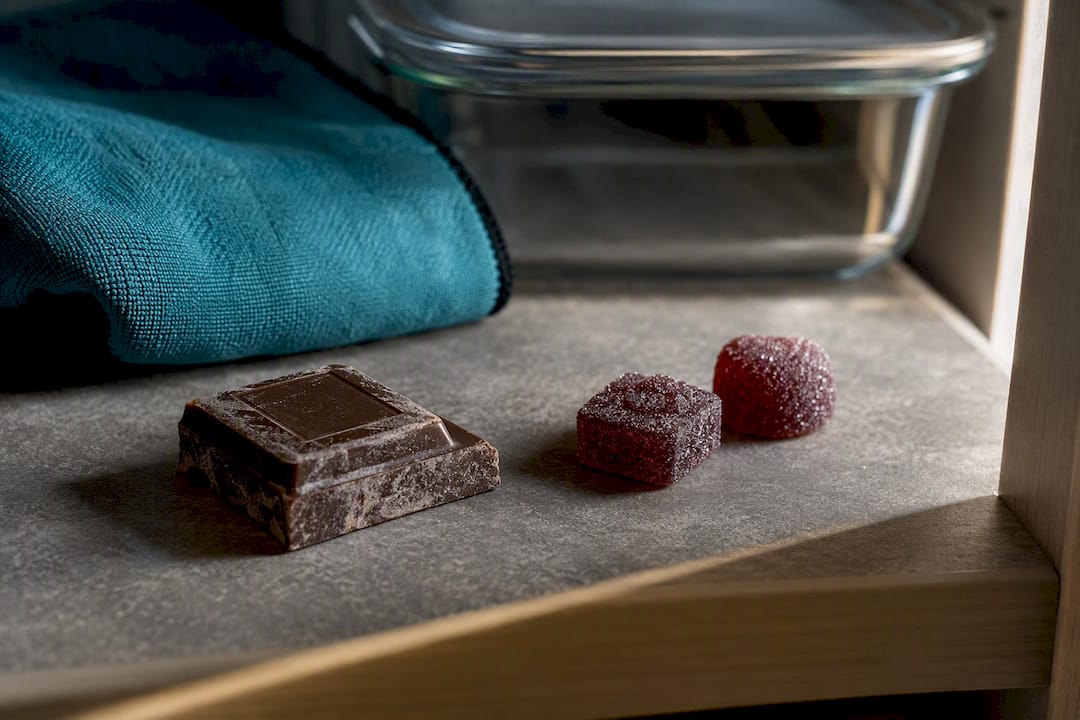
Chocolate is the more fragile format in your kitchen or your backpack. It’s sensitive to both heat and humidity. Warm temperatures cause melting and bloom, that dusty gray surface that shows up when cocoa butter separates and recrystallizes. Ideal storage sits in a cool, dry, dark spot, and proper storage habits matter more for chocolate’s texture and potency consistency than most buyers expect.
Gummies hold up better across a wider temperature range and don’t visibly degrade the same way, though extreme heat can still make them melt together or turn tacky.
When you’re evaluating a package at the shelf, look for a tamper-evident seal, child-resistant packaging, and a COA that’s actually accessible, not just referenced. Those three signals tend to correlate with better manufacturing practices overall.
If you’re traveling, keep products in original packaging and check local law before you cross state lines. Legal status for mushroom products varies significantly by jurisdiction in the US, and coverage of the branded mushroom chocolate market has flagged this regulatory patchwork as one of the biggest practical headaches for buyers right now.
Matching the Format to Your Goals
Four buyer types show up again and again, and each one tends to have an obvious best fit.
The microdoser wants small, consistent, repeatable amounts on a schedule, which makes gummies the natural choice because of their per-piece precision. The ritual or indulgence user is looking for a slower session with more sensory payoff, and that’s where chocolate edibles built for microdosing tend to earn their price. The on-the-go user needs something heat-stable and easy to portion in a bag, again favoring gummies. The taste-first buyer who dislikes the sugary gummy profile will usually prefer chocolate’s richer flavor.
Run through this checklist before you commit to a format:
- Do I need exact, repeatable dosing, or is some variance fine?
- Do I want a fast onset or a slower, smoother one?
- How will I actually store and carry this day to day?
- Which taste profile will I actually stick with long term?
- Am I comfortable with the sugar or fat tradeoff each format carries?
Smart Dosing Habits and Safety Basics
However you land on format, a few habits reduce risk regardless of which one you choose.
- Start with a half serving on your first try of any new batch, then wait a full 90 minutes before considering more. Chocolate’s slower onset makes it especially easy to misjudge and “redose” too early.
- Space repeat sessions out rather than stacking doses in the same day, particularly while you’re still learning how a specific product affects you.
- Read the certificate of analysis before you buy: confirm potency numbers, a contaminant screen, a specific batch ID matching your package, and a testing date that isn’t years old.
- Avoid use during pregnancy, avoid mixing with medications without talking to a doctor first, and never drive or operate machinery after taking either format.
Pro Tip: Keep a simple log of product, batch number, dose, and how you felt over the next few hours. It sounds tedious the first time, but it’s the fastest way to titrate confidently instead of guessing every single time.
For a deeper walkthrough of how to read labels and packaging cues before checkout, Elevated Remedies’ consumer quality guide covers what separates a well-made product from one cutting corners.
What We’ve Learned Selling Both Formats
Most comparison content treats this as a neutral toss-up, and that’s a disservice to anyone actually trying to decide. The honest answer is that your goal should dictate the format, not the other way around, and too many buyers pick based on marketing appeal rather than fit.
Chocolate has genuine formulation upside that gets undersold. Research into mushroom-fortified chocolate shows it can carry real nutritional value, protein, fiber, minerals, without sacrificing taste, which means the “chocolate is just a treat” framing misses what’s actually possible with intentional formulation. At the same time, gummies deserve more credit for precision than they usually get. Per-piece dosing supports better consistency if that is the priority.
At Elevated Remedies, we carry both formats specifically because the “one true format” debate misses the point. Our mushroom gummies are built for people who want predictable, repeatable dosing, and our chocolate offerings lean into the slower, richer experience that draws people to the format in the first place. We also break down the real differences between dried mushrooms and chocolate formats for readers weighing options beyond just these two.
— Juiced
Ready to Choose Your Format? Here’s What Elevated Remedies Carries
If everything above pointed you toward gummies for microdosing or chocolate for a slower, richer session, you don’t have to keep researching. Elevated Remedies stocks both, sourced and labeled with the dose clarity this whole comparison has been about.

Our gummies are built for buyers who want per-piece consistency they can actually plan around, while our chocolate options are formulated for people prioritizing flavor and a smoother, slower curve. If you’re still deciding between mushroom formats broadly, our page on Amanita Muscaria breaks down what the product class actually is and how it’s typically used. And before you place your first order, our guide to ordering safely walks through label checks, storage, and what a legitimate COA should include.
Browse the current lineup, pick the format that matches your goal, and place your order today.
This article is general information, not a substitute for advice from a qualified lawyer. Consult a qualified legal professional about your own circumstances before acting on anything here.
Sources
- Fortification of chocolates with mushroom powder (PMC)
- Development of a Novel Chocolate Utilizing Mushroom Fermentation
- Boosting chocolate nutrition with mushroom powder (MDPI)
- Mushroom chocolates are fancier than ever (Bon Appétit)