
Concurrent use of psilocybin and an SSRI is not off the table, but it is not risk-free either. The honest answer sits in the middle: research points to two dominant outcomes. Your SSRI probably blunts the psilocybin experience, and in rare cases the combination can push serotonin activity into dangerous territory. Neither outcome is guaranteed, but both are documented well enough that flying blind is a bad idea.
The trade-off in plain terms:
- Weaker trip, not zero trip. A large retrospective survey found roughly 47% of people taking SSRIs reported weaker-than-expected psilocybin effects, and that dampening can linger for months after stopping the medication.
- Rare but real medical risk. Isolated case reports link the combination to serotonin toxicity, a serotonin-driven medical emergency.
- Stopping your SSRI on your own carries its own danger, including withdrawal symptoms and rebound depression or anxiety.
Pro Tip: Before you plan anything, talk to the prescriber who manages your SSRI. Never stop or taper an antidepressant on your own to “clear the way” for psilocybin. That decision belongs in a conversation with a clinician who knows your history, not in a forum thread.
Key Takeaways
Combining psilocybin with an SSRI usually dampens the psychedelic experience rather than eliminating it, and while serious harm is rare, it is well documented enough to warrant a conversation with your prescriber before you try it.
| Point | Details |
|---|---|
| Attenuation is common | A substantial portion of SSRI users report weaker-than-expected psilocybin effects, sometimes for several months after stopping the medication. |
| Serious harm is rare but real | Documented case reports link the combination to serotonin toxicity, so red-flag symptoms need immediate medical attention. |
| Never self-taper | Stopping an SSRI without supervision risks withdrawal and depressive rebound, a trade you should never make alone. |
| Trials require washouts for a reason | FDA draft guidance and trial protocols exclude recent SSRI users to protect participants and produce cleaner safety data. |
| Consult before you combine | Theelevatedremedies offers educational resources and product information for adults exploring psilocybin, but any decision involving your SSRI belongs with your prescriber first. |
Primary Sources Behind This Article
- Attenuation of psilocybin mushroom effects during and after SSRI/SNRI antidepressant use, the retrospective survey behind the 47% attenuation figure and the three-month persistence finding.
- Acute Effects of Psilocybin After Escitalopram or Placebo Pretreatment, the randomized crossover trial showing reduced adverse effects without loss of positive mood effects.
- Concomitant use of antidepressants and classic psychedelics: A scoping review, the literature synthesis highlighting evidence gaps and the need for controlled trials.
- Case Study Ties Psilocybin to Serotonin Toxicity When Used with Antidepressants, documenting rare clinical instances of serotonin toxicity.
- FDA draft guidance for clinical trials of psychedelic drugs, explaining why trial protocols manage concomitant medications so carefully.
Table of Contents
- How Psilocybin and SSRIs Both Act on Serotonin
- What Does the Research Say About Psilocybin and SSRIs?
- What Are the Real Safety Risks of Mixing SSRIs and Psilocybin?
- How Should You Talk to Your Prescriber About This?
- Why Do Clinical Trials Exclude Current SSRI Users?
- Frequently Asked Questions
- Sources
How Psilocybin and SSRIs Both Act on Serotonin
Psilocybin itself is inactive. Once ingested, your body converts it into psilocin, the compound that actually crosses into the brain and binds to serotonin receptors, mainly the 5-HT2A receptor. That binding is the core engine of the psychedelic experience: the visual distortions, the shifts in mood and perception, the sense of ego dissolution people report. It is a short, intense receptor-level event.
SSRIs work on an entirely different timescale and mechanism. Rather than directly stimulating serotonin receptors, selective serotonin reuptake inhibitors block the transporter that normally clears serotonin out of the synapse, so more serotonin lingers and keeps signaling. Over weeks of continuous use, the brain adapts to that constant elevated exposure. Receptors downregulate. Sensitivity to serotonin at various receptor subtypes shifts. This is why SSRIs take weeks to produce a mood benefit and why stopping them abruptly causes withdrawal effects rather than an instant return to baseline.
Here is where the two drugs collide. If your 5-HT2A receptors have already adapted to chronic serotonin elevation from an SSRI, there may be fewer or less-responsive receptors available for psilocin to activate strongly. That is the leading theory behind why so many SSRI users report a muted trip. It is not that psilocybin “does not work” on antidepressants. It is that the receptor landscape it is trying to act on has already been reshaped.
The flip side of that same overlap is the theoretical risk. Psilocybin adds an acute wave of serotonergic activity on top of a system already running with reuptake blocked. In most people, the body handles this without incident. In a smaller subset, particularly those on higher SSRI doses, multiple serotonergic medications, or with individual sensitivity, that stacking of serotonergic activity can tip into excess.
Timing matters here too, and it is often overlooked. Psilocin has a relatively short half-life, generally cleared within a matter of hours. Most SSRIs do not work that way. Fluoxetine, for example, has an active metabolite with a half-life measured in days to weeks, meaning its serotonergic footprint does not disappear just because you stopped taking the pill last week.
A few mechanism-level points worth holding onto:
- Psilocin’s short half-life means its acute effects fade quickly, but the SSRI’s influence on receptor sensitivity does not fade on the same schedule.
- Long-acting SSRIs like fluoxetine keep affecting your serotonin system for weeks after the last dose, which matters enormously for anyone planning a washout.
- Receptor downregulation from chronic SSRI use does not reset the moment you stop the medication. It normalizes gradually, which likely explains why attenuation of psilocybin’s effects can outlast the SSRI itself.
You can read a deeper breakdown of these receptor dynamics in how psilocybin affects the serotonin system, which walks through the ten specific effects at play.
What Does the Research Say About Psilocybin and SSRIs?
The evidence here breaks into four distinct types, and each one answers a slightly different question. None of them, alone, gives you the full picture. Together, they paint a consistent story: attenuation is common, serious harm is rare, and the research base is still thinner than the topic deserves.
The randomized trial. The strongest design in this space is a double-blind, placebo-controlled crossover study that pretreated healthy volunteers with escitalopram for 14 days before giving them psilocybin. The result was not a simple story of “SSRIs kill the trip.” Escitalopram pretreatment reduced the adverse physiological responses and unpleasant subjective effects of psilocybin, things like anxiety spikes and uncomfortable bodily sensations, without significantly reducing the positive mood effects participants reported. That is a meaningfully different finding than most people assume. It suggests SSRIs might dampen the rough edges of a psilocybin experience while leaving some of the beneficial emotional effects intact, at least in short-term pretreatment among healthy subjects.
The retrospective survey. A much larger dataset comes from a survey of 611 reports of people combining mushrooms with an antidepressant. Notably, that dampening did not always end when people stopped their medication. Many respondents reported reduced psilocybin effects persisting for up to three months after discontinuation, a finding that lines up with what we would expect from slow receptor renormalization after chronic SSRI exposure.
A related prospective survey study published in the Journal of Psychopharmacology adds a layer of nuance here. It found reduced subjective intensity was common among current antidepressant users, even as some measures of well-being and depressive symptoms still moved in a positive direction. The picture that emerges is not “SSRIs cancel psilocybin’s benefits.” It is closer to “SSRIs reshape the experience, and the therapeutic signal does not necessarily disappear along with the intensity.”
The scoping review. Pulling the available literature together, a scoping review of concomitant antidepressant and classic psychedelic use found no robust evidence of markedly elevated risk across the studies it examined, but it stopped well short of declaring the combination safe. The review’s own conclusion is that the evidence base has real gaps and that controlled trials in clinical populations, not just healthy volunteers, are still needed before anyone can make a confident safety claim.
The case reports. On the harm side, documented case reports tie psilocybin combined with antidepressants to serotonin toxicity in specific individuals. These are valuable because they show the theoretical risk is not purely theoretical. But case reports carry an inherent reporting bias: clinicians write up the alarming outlier, not the thousands of unremarkable combined uses that never make it into a journal. A handful of published cases against an unknown, likely much larger, denominator of people who combine the two without incident tells you the risk exists, not how common it actually is.
| Evidence type | Design | Main finding | Key limitation |
|---|---|---|---|
| Randomized crossover trial | 14-day escitalopram pretreatment, healthy volunteers | Reduced bad effects and physiological strain; positive mood effects preserved | Short pretreatment window, healthy subjects only |
| Retrospective survey | Self-reported, n = 611 | 47% reported weaker-than-expected effects; attenuation up to 3 months post-discontinuation | Self-report, recall bias, no control group |
| Scoping review | Literature synthesis | No robust signal of markedly elevated risk, but major evidence gaps | Limited to existing studies, mostly small samples |
| Case reports | Individual clinical accounts | Documented serotonin toxicity in specific patients | Rare events, reporting bias, no denominator |
None of these study types was designed to give a definitive population-level risk number, and that is worth sitting with. The trial used healthy volunteers and a short two-week pretreatment window, nothing like the years-long SSRI use many patients actually have. The survey relied on memory and self-report from an anonymous population, with no way to verify dosages or confirm psychiatric diagnoses. The scoping review can only summarize what already exists, and what exists is thin. The honest takeaway is that attenuation is well-documented and reasonably common, while serious harm is documented but appears rare, and “rare” is not the same as “impossible.”
What Are the Real Safety Risks of Mixing SSRIs and Psilocybin?
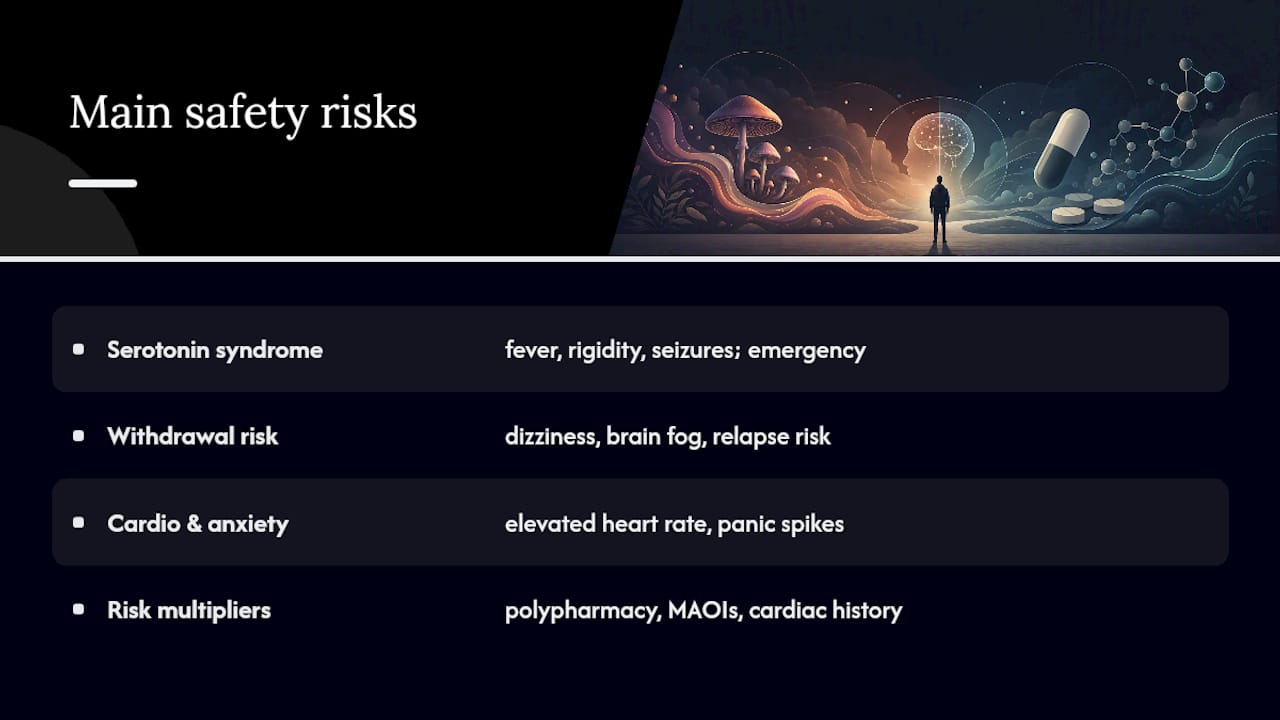
Serotonin syndrome (serotonin toxicity) is the sharpest concrete risk. It happens when serotonergic activity in the body exceeds what the nervous system can handle. Red-flag symptoms include agitation, rapid heart rate, high blood pressure, muscle rigidity or twitching, heavy sweating, dilated pupils, fever, and in severe cases seizures or loss of consciousness. Mild cases can resolve with removal of the triggering substance and supportive care. Severe cases require emergency treatment. If someone develops a fever with muscle rigidity and confusion after combining psilocybin with an SSRI, that is an emergency room visit, not a “wait it out” situation.
Withdrawal and rebound risk sits on the other side of the ledger. Antidepressant withdrawal syndrome can bring dizziness, brain fog, irritability, flu-like symptoms, and a sharp return, or worsening, of the depression or anxiety the medication was treating. People sometimes stop their SSRI abruptly in the mistaken belief that a “clean” nervous system will produce a better psilocybin session. That instinct is understandable, but it trades a manageable, well-understood risk for an unmanaged one.
Acute cardiovascular and anxiety events during a psilocybin session, elevated heart rate, blood pressure spikes, and panic reactions, are already a known part of the psychedelic experience for a subset of users. The escitalopram pretreatment trial’s finding that SSRIs reduced these adverse physiological responses is genuinely interesting here. It hints that, in some cases, staying on your SSRI might blunt the scariest physical parts of a difficult session, even as it also blunts the peak of the experience.
Risk multipliers deserve their own line. Polypharmacy, being on multiple serotonergic medications, MAOIs specifically, or having a cardiac history all raise the stakes considerably. MAOIs combined with any serotonergic substance carry a well-established serotonin syndrome risk and should never be combined with psilocybin without direct medical guidance. A cardiac history adds concern because psilocybin’s acute cardiovascular effects, elevated heart rate and blood pressure, are not trivial for someone with existing heart disease.
Pro Tip: If you or someone with you develops a fever, muscle rigidity, or confusion during or after a psilocybin session while on any serotonergic medication, treat it as a medical emergency and seek care immediately. Serotonin toxicity can escalate quickly, and waiting to see if it passes is the wrong call.
How Should You Talk to Your Prescriber About This?
The single most useful thing you can do before combining psilocybin with an SSRI is have a direct, specific conversation with the clinician who prescribes it. Vague questions get vague answers. Specific questions get useful ones.
- Name the exact medication, dose, and how long you have been on it. Fluoxetine at 6 months and sertraline at 3 weeks carry very different pharmacokinetic profiles, and your clinician needs the specifics to give you real guidance.
- Disclose every other medication and substance, including supplements, other psychiatric drugs, and recreational substance use. Interactions compound; your prescriber cannot assess a risk they do not know about.
- Mention any cardiac history, anxiety disorders, or prior adverse reactions to medications. These shift the risk calculation meaningfully.
- Ask directly about washout timing if a taper is being considered. Trial protocols often use exclusion windows of two to four weeks off SSRIs before dosing, but survey data suggests attenuated psilocybin effects can persist up to three months after stopping, particularly after long-term use. Those two numbers are not the same thing, and the gap between them matters. A short washout may satisfy a research protocol’s inclusion criteria without actually restoring your baseline receptor sensitivity.
If tapering is on the table at all, it needs medical supervision, not a personal timeline built around an upcoming weekend. A supervised taper includes a monitoring plan and a clear course of action if withdrawal symptoms or depressive rebound appear.
If staying on your SSRI is the right call for your mental health, and often it is, set realistic expectations going in. Expect a less intense subjective experience. Plan any session with extra attention to a calm setting, since SSRIs may reduce panic-type physiological reactions but will not eliminate anxiety entirely. Keep a trusted person present, and keep your prescriber in the loop rather than treating psilocybin use as something separate from your ongoing care.
Pro Tip: Harm-reduction fundamentals still apply even with medication in the picture. Session setting, a sober sitter, and a calm environment do more for safety than most people credit. Practical session planning is covered in more detail in magic mushroom wellness tips for safe, effective use.
Why Do Clinical Trials Exclude Current SSRI Users?
Most psilocybin-assisted therapy trials require participants to be off SSRIs for a defined washout period before dosing, and this is not bureaucratic caution for its own sake. The FDA’s draft guidance for psychedelic drug trials explicitly calls for careful study design around concomitant medications and safety monitoring, which is exactly why sponsors build washout requirements into their protocols.
A few things follow from that:
- Washout periods exist to reduce both the confound of attenuated effects and the theoretical serotonin toxicity risk during dosing sessions.
- Clinics running legitimate psychedelic-assisted therapy programs manage medication transitions medically, with tapering schedules and monitoring, not a blanket “just stop taking it” instruction.
- For patients who cannot safely taper off an SSRI, whether due to relapse risk or medical complexity, other options such as ketamine therapy are sometimes considered, since ketamine’s mechanism does not carry the same 5-HT2A interaction profile.
- The scoping review’s own conclusion is blunt about the gap here: most existing data comes from healthy volunteers with short pretreatment windows, not clinical populations who have been on SSRIs for years. Longer-term, patient-population studies remain a real research need.
Where to Go for Deeper Background
Theelevatedremedies covers the science behind psilocybin’s effects on serotonin and emotional processing in more depth across its educational content. If you want to go further into the mechanism discussed above, how psilocybin affects the serotonin system breaks down ten specific receptor-level effects, and how psilocybin shapes emotional processing explains the psychological mechanisms researchers believe are involved. None of this replaces a conversation with your prescriber or a licensed mental health professional. It is educational background, not medical advice, and any decision about your medication belongs with a clinician who knows your full history.
Curiosity deserves caution, not fear
The instinct to explore psilocybin while managing a mental health condition with an SSRI is not reckless. It is a reasonable question that deserves a reasonable answer, and the honest one is that the science is still catching up to the question. What frustrates us most about how this topic gets discussed online is the false binary: either psilocybin and SSRIs are declared totally safe to combine, or the combination gets treated as an automatic emergency. Neither framing matches the evidence.
The randomized trial data and the survey data actually tell a fairly consistent story once you stop expecting a single clean verdict. Effects get dampened for a lot of people, sometimes for months after stopping medication, and severe harm is documented but appears to be the exception rather than the rule. That nuance is uncomfortable for anyone wanting a simple yes or no, but it is the truthful picture. Respect it by looping in your prescriber before you act on it, not after.
Educational Resources, Not a Substitute for Clinical Care
Everything above is meant to inform, not to replace a conversation with a licensed clinician. Theelevatedremedies serves as Ann Arbor’s magic mushroom dispensary and smoke shop, and the products on our shelves, including amanita muscaria offerings, are consumer wellness and recreational items, not medical treatments prescribed for a diagnosed condition.

If you are on an SSRI and curious about microdosing or exploring psilocybin products, the smartest first move is the same one we have repeated throughout this article: talk to the clinician managing your prescription before you change anything. Once you have that green light, Theelevatedremedies gives you a straightforward, transparent place to learn about product options and dosing frameworks without the guesswork of unregulated online sellers. Stop by our Ann Arbor location at 1123 Broadway St or browse our product pages online to see what fits your situation, and bring your questions with you. Our team can walk you through the differences between our capsules, edibles, and dried products, but the medical judgment call about mixing anything with your SSRI stays with your prescriber.
Frequently Asked Questions
Does an SSRI make psilocybin completely ineffective? No. Research points to attenuation, not elimination.
How long after stopping an SSRI does psilocybin work normally again? There is no fixed number, and it varies by person and by which SSRI was used. Survey respondents reported attenuated effects persisting up to three months after discontinuation in some cases, likely tied to how long receptor adaptations take to normalize.
Is it dangerous to microdose psilocybin while on an SSRI? Microdosing on antidepressants has not been studied with the same rigor as full-dose use, but the same underlying serotonergic overlap applies. Lower doses likely lower the acute risk, but “lower risk” is not “no risk,” and the conversation with your prescriber still matters.
What should I do if I think I am experiencing serotonin syndrome? Treat it as a medical emergency. Fever, muscle rigidity, rapid heart rate, and confusion after combining psilocybin with an SSRI warrant immediate emergency care, not a wait-and-see approach.
Can I just stop my SSRI for a week before trying psilocybin? That is a decision for your prescriber, not a DIY schedule. Trial protocols use two to four week washouts under medical supervision, and even that may not fully restore baseline receptor sensitivity. Stopping abruptly on your own also risks withdrawal symptoms and depressive rebound.
Sources
- Attenuation of psilocybin mushroom effects during and after SSRI/SNRI antidepressant use - PubMed
- Acute Effects of Psilocybin After Escitalopram or Placebo Pretreatment in a Randomized, Double-Blind, Placebo-Controlled, Crossover Study in Healthy Subjects. - Europe PMC
- Concomitant use of antidepressants and classic psychedelics: A scoping review
- Psychiatrist
- FDA issues first draft guidance for clinical trials of psychedelic drugs - FDA