
Precision microdosing, in the context of GLP-1 therapy, means administering drugs like semaglutide or tirzepatide at carefully controlled, lower-than-standard doses, calibrated to each patient’s genetic makeup and clinical profile. The goal is straightforward: get meaningful therapeutic benefit, whether that’s weight loss or better glucose control, while keeping side effects manageable enough that patients actually stay on the medication. This is not the same as simply taking a smaller pill. It is a structured, data-driven approach to titration that draws on personalized medicine principles.
Key GLP-1 medications involved in precision microdosing protocols include:
- Semaglutide, marketed as Wegovy (for weight management) and Ozempic (for type 2 diabetes)
- Tirzepatide, marketed as Mounjaro (for type 2 diabetes) and Zepbound (for weight management)
What separates precision microdosing from standard dosing is the emphasis on incremental, individually tailored adjustments rather than following a fixed manufacturer schedule. Genetic factors, metabolic rate, and real-time clinical feedback all shape how doses are set and changed over time.
Table of Contents
- What is precision microdosing and how does it work?
- How genetic testing shapes your GLP-1 dosing plan
- Typical GLP-1 microdosing protocols and medication options
- Safety, risks, and the experimental status of GLP-1 microdosing
- How your genetics influence GLP-1 drug response
- Key Takeaways
- Theelevatedremedies: microdosing products you can actually trust
What is precision microdosing and how does it work?
Microdosing in clinical pharmacology refers to administering subtherapeutic doses to assess safety and pharmacokinetics with minimal physiological disruption. Applied to GLP-1 receptor agonists, this principle gets extended into a full treatment strategy: start low, move slowly, and let the body adapt before increasing exposure.
GLP-1 receptor agonists work by mimicking the glucagon-like peptide-1 hormone, which slows gastric emptying, suppresses appetite, and stimulates insulin release. At standard doses, these effects can arrive faster than the gastrointestinal tract can adapt, which is why nausea, vomiting, and abdominal discomfort are so common early in treatment. Precision microdosing addresses this by keeping initial doses well below the therapeutic target and raising them only when the patient tolerates the current level without significant side effects.
The pharmacological rationale is receptor modulation. Gradual exposure allows GLP-1 receptors to adjust incrementally, reducing the risk of receptor desensitization and the sharp side effect spikes that come with aggressive titration. The practical result is better tolerability, which directly improves adherence. A patient who stays on the medication long enough to reach an effective dose gets far more benefit than one who quits at week three because of relentless nausea.
Precision microdosing also aligns with the broader shift toward personalized medicine, where treatment parameters are set by individual biology rather than population averages. The key mechanisms at work:
- Gradual receptor adaptation reduces acute gastrointestinal burden
- Slower titration gives clinicians time to identify individual tolerance thresholds
- Lower starting doses reduce peak plasma concentration spikes
- Continuous monitoring allows dose adjustments based on real patient response
- The approach supports long-term adherence by making early treatment more tolerable
How genetic testing shapes your GLP-1 dosing plan
Not everyone responds to semaglutide or tirzepatide the same way, and the reason is largely genetic. Polymorphisms in GLP-1 receptor genes influence how strongly a patient responds to therapy, how much weight they lose, and how prone they are to side effects. Two patients on identical doses can have dramatically different outcomes because their receptor sensitivity and metabolic enzyme activity differ at the genetic level.
Genetic testing can identify these variations before treatment begins, giving clinicians a head start on dose selection. Rather than defaulting to the manufacturer’s standard starting dose, a provider can use genetic data to choose a lower or higher initial dose, select between semaglutide and tirzepatide based on receptor pathway compatibility, and anticipate which patients are likely to need slower titration. Genetic tests that map peptide pathway variations allow for this kind of personalized starting point, improving tolerability and outcomes from the first dose.
The benefits of integrating genetic insights into a dosing plan include:
- Matching the right GLP-1 medication to the patient’s receptor profile
- Setting a starting dose that reflects actual metabolic capacity, not a population average
- Reducing trial-and-error titration that wastes time and causes unnecessary discomfort
- Predicting adverse effect risk before it becomes a clinical problem
- Building a care plan that evolves as genetic and clinical data accumulate
Pro Tip: Precision dosing guided by genetic testing is a clinical service, not something you can replicate at home. Volumetric dosing techniques, which involve dissolving an active substance in a measured solvent volume for milliliter-based dosing, are used in some personal microdosing contexts, but they carry no pharmaceutical quality controls. For GLP-1 medications specifically, DIY approaches introduce serious accuracy and safety risks that supervised clinical protocols are designed to prevent. Learn more about the clinical versus DIY distinction before making any decisions.
Typical GLP-1 microdosing protocols and medication options
Standard manufacturer titration schedules for semaglutide and tirzepatide build in gradual dose increases, and precision microdosing may start below those starting points and extend the time between increases based on patient response. The pace is set by patient response, not a calendar.

For semaglutide (Wegovy/Ozempic), the clinical starting dose is often set by manufacturers with a period held before any increase. A precision microdosing approach might begin at a fraction of that, with increases only when the patient reports consistent tolerability. Tirzepatide (Mounjaro/Zepbound) follows a similar dosing strategy with intervals between dose steps per standard protocols, which may be adjusted in microdosing.
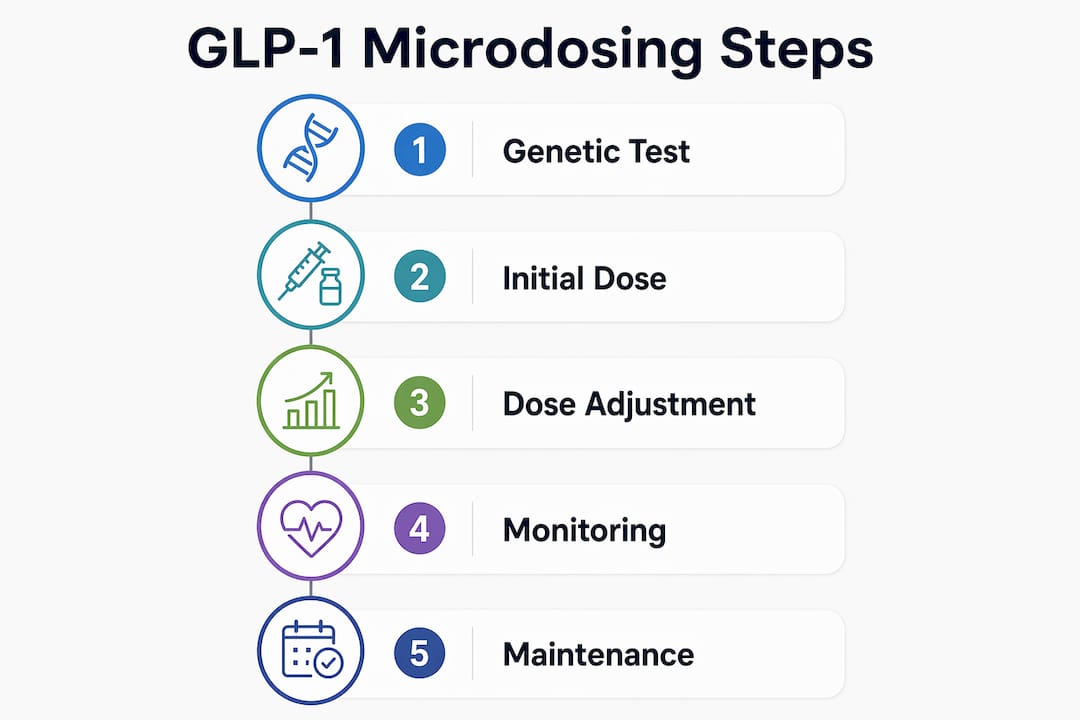
Patient monitoring is continuous throughout. Clinicians track weight, blood glucose, gastrointestinal symptoms, and any emerging adverse effects at each visit, using that data to decide whether to hold, increase, or temporarily reduce the dose.
| Medication | Brand Names | Standard Starting Dose | Titration Interval | Max Approved Dose |
|---|---|---|---|---|
| Semaglutide | Wegovy, Ozempic | standard starting dose per product labeling | standard titration interval varies | maximum approved dose as per regulatory labeling |
| Tirzepatide | Mounjaro, Zepbound | standard starting dose per product labeling | standard titration interval varies | maximum approved dose as per regulatory labeling |
Key features of a precision microdosing protocol:
- Initial doses set below standard starting points based on patient profile
- Titration intervals extended beyond four weeks when tolerability requires it
- Weekly or biweekly check-ins during early treatment phases
- Dose holds implemented at any sign of significant adverse effects
- Adjustments made based on objective clinical data, not fixed timelines
For patients curious about how consistent dosing accuracy affects outcomes across different microdosing contexts, the principle is the same: small errors in dose measurement compound over time.
Safety, risks, and the experimental status of GLP-1 microdosing
GLP-1 microdosing is not an FDA-approved protocol. The Endocrine Society has explicitly flagged that microdosing GLP-1 medications remains an unofficial approach without regulatory backing, and clinicians caution against unsupervised use due to the risk of unknown adverse effects. That does not mean the approach is without merit, but it does mean patients need medical supervision, full stop.
Even at low doses, GLP-1 receptor agonists carry a real side effect profile. The FDA-approved labeling for semaglutide confirms that gradual dose escalation reduces gastrointestinal side effects, but does not eliminate them. Common adverse reactions include:
- Nausea and vomiting, particularly in the first weeks of treatment
- Diarrhea and abdominal discomfort
- Decreased appetite, which can become problematic if too pronounced
- Injection site reactions for subcutaneous formulations
- Rare but serious risks including pancreatitis and thyroid C-cell tumors (noted in animal studies)
The lack of large-scale clinical trial data specifically on microdosing protocols, as distinct from standard titration, is a genuine gap. Gradual dose titration mitigates side effects but remains off-label without broad clinical trial support, meaning providers are working from general pharmacological principles and observational data rather than a validated microdosing-specific evidence base.
Self-administered microdosing without pharmaceutical-grade verification is a separate and more serious problem. Unregulated DIY microdosing drastically reduces dosing accuracy and increases adverse risk, a warning that applies directly to anyone attempting to modify their GLP-1 dose outside of a clinical relationship. The medications involved are not over-the-counter products, and the consequences of dosing errors are not trivial.
Provider supervision is not optional in GLP-1 microdosing. Regulatory bodies and clinical experts consistently emphasize that unsupervised use carries risks that no amount of online research can adequately mitigate.
How your genetics influence GLP-1 drug response
The genetic basis for variable GLP-1 response is well established. Variations in the gene encoding the GLP-1 receptor alter how efficiently the receptor binds to semaglutide or tirzepatide, which directly affects how much appetite suppression and glucose regulation a patient experiences at a given dose. Separately, genetic differences in metabolic enzymes influence how quickly the drug is cleared from the body, affecting both duration of action and side effect intensity.

These variations have concrete implications for microdosing strategy. A patient with reduced receptor sensitivity may need a higher dose to reach the same therapeutic effect as someone with high receptor sensitivity, and pushing that patient through a slow microdosing titration may delay meaningful benefit without reducing their side effect risk. Conversely, a patient with high receptor sensitivity may experience pronounced effects at doses that would be subtherapeutic for most people, making a lower starting point genuinely protective.
Genetic insights also inform which medication fits best. Tirzepatide acts on both GLP-1 and GIP receptors, so a patient’s GIP receptor genetics become relevant when choosing between Mounjaro/Zepbound and semaglutide-based options. Precision microdosing that ignores this layer of biology is less precise than it claims to be.
Practical implications of genetic variation for microdosing:
- Receptor gene polymorphisms predict weight loss response variability before treatment starts
- Enzyme metabolism variants affect drug half-life and dosing frequency requirements
- Dual-receptor medications like tirzepatide require assessment of both GLP-1 and GIP receptor genetics
- Genetic data reduces the number of titration cycles needed to find a tolerable, effective dose
- Therapeutic monitoring practices can be calibrated to a patient’s predicted clearance rate
For patients interested in how safe microdosing in Michigan works in practice, understanding your own genetic profile is increasingly part of the conversation, whether the substance in question is a GLP-1 medication or a psilocybin product.
Key Takeaways
Precision microdosing of GLP-1 medications is most effective when genetic testing, clinical supervision, and individualized titration work together from the start.
| Point | Details |
|---|---|
| Definition of precision microdosing | Carefully controlled, low-dose GLP-1 administration tailored to individual genetic and clinical profiles. |
| Genetic testing matters | Polymorphisms in GLP-1 receptor genes drive response variability, making genetic data critical for dose selection. |
| Experimental status | GLP-1 microdosing lacks FDA-approved protocols; medical supervision is required to manage adverse risk. |
| Side effects persist at low doses | Nausea, vomiting, and abdominal discomfort occur even with gradual titration, per FDA semaglutide labeling. |
| Theelevatedremedies | For those exploring psilocybin-based microdosing products in Ann Arbor, Theelevatedremedies carries capsules and mushroom products sourced for consistency. |
Theelevatedremedies: microdosing products you can actually trust
GLP-1 microdosing requires a prescribing clinician, a pharmacy, and a personalized medical plan. That path is well defined. But for people in Ann Arbor who are also curious about psilocybin-based microdosing for wellness, the sourcing question is just as critical, and far less regulated.

Theelevatedremedies, located at 1123 Broadway St in Ann Arbor, Michigan, is one of the city’s go-to destinations for magic mushroom products sourced for quality and consistency. The shop carries dried magic mushrooms, microdosing capsules, and mushroom chocolates, with staff who can actually walk you through the options rather than leaving you to guess. Whether you are a first-time explorer or someone who already has a protocol in mind, the team at Theelevatedremedies can point you toward products that fit your goals. Stop in, ask questions, and leave with something you can trust.