
TL;DR:
- Potency determines whether a microdose supports mood and focus or causes unwanted effects. Unpredictable variability from sources like mushroom strain and storage affects safety and results; standardized, lab-tested capsules offer more consistent dosing. Proper control of potency enhances safety, improves reliability, and makes self-tracking more meaningful.
Potency is defined as the concentration of active compounds, primarily psilocybin and its metabolite psilocin, in a given microdose. The role of potency in microdosing determines whether you stay in the sub-perceptual zone that supports mood and focus, or accidentally cross into territory that disrupts your day. A recommended microdose sits between 0.1g and 0.3g of dried mushroom powder. That narrow window only works when the material inside it carries a predictable chemical load. Without that predictability, your results become a guessing game, and your mood and productivity tracking becomes meaningless.
How does the role of potency in microdosing shape your experience?
Potency does not just determine how strong a dose feels. It determines whether a dose does anything at all. At sub-perceptual levels, the goal is a subtle lift in mood, sharper focus, and reduced mental friction, without visual distortions or altered perception. When potency is too low, you feel nothing. When it runs high, you risk crossing into a full psychedelic response. That threshold is the entire game in microdosing.
The pharmacokinetics behind this are worth understanding. Psilocybin is a prodrug. Your body converts it into psilocin, the compound that actually binds to serotonin receptors and produces effects. Individual metabolic differences alter how efficiently that conversion happens, meaning the same 0.2g capsule can produce different plasma levels in two different people. One person feels a clean, productive lift. Another feels nothing. A third feels too much. Potency and metabolism interact, and you cannot separate them.
This is why understanding potency in microdosing matters beyond just picking a number on a scale. Your experience on any given day reflects the chemical concentration in your material, your metabolic rate that morning, what you ate, and your stress level. Potency is the variable you can actually control. The others require adaptation.

Why does potency vary so much between batches?
Psilocybin concentrations vary widely across species, strains, individual fruiting bodies, mushroom parts, and successive flushes. This is not a minor fluctuation. It is a structural problem with using whole dried mushrooms as a dosing vehicle.
Here is what drives that variability:
- Species and strain differences. Psilocybe cubensis is the most common microdosing mushroom, but potency differs significantly between strains like Golden Teacher, Penis Envy, and B+. Penis Envy strains, for example, are widely reported to carry substantially higher psilocybin concentrations than standard cubensis varieties.
- Mushroom part. Caps typically carry higher psilocybin concentrations than stems. A capsule made from whole ground mushroom blends both, but the ratio varies by batch.
- Flush cycle. First-flush mushrooms from a single grow often differ in potency from second or third-flush mushrooms from the same substrate. The species and strain guide at Theelevatedremedies covers this in practical detail.
- Storage degradation. Moisture, temperature, light, and oxygen exposure all degrade psilocybin over time. Proper storage can extend potency stability from months to over a year. Poor storage can cut that window dramatically.
- The scale problem. A digital scale measures mass, not chemistry. Weighing dried material controls how many grams you take, not how many milligrams of psilocybin those grams contain. This creates what researchers call a “silent swing” in effective dose.
Pro Tip: Store dried mushroom material in an airtight glass container with a food-grade desiccant packet, away from light and heat. A 10°C rise in storage temperature can double the rate of psilocybin degradation, so a cool, dark cabinet beats a kitchen counter every time.
What does the science say about potency and microdosing outcomes?
The research on microdosing potency effects is more nuanced than popular coverage suggests. Clinical evidence shows real but modest benefits, and the line between pharmacological effect and expectation is genuinely blurry.
An 8-week clinical trial on LSD microdosing found mood improvements on dosing days, with participants reporting feeling happier and more creative. No significant tolerance or sensitization developed during titrated dosing of 6–20 micrograms. That finding matters because it confirms that low, consistent doses can produce real mood shifts without the dose needing to escalate over time.
“Many double-blind, placebo-controlled studies struggle to replicate claims of cognitive enhancement from microdosing. Subtle subjective mood shifts are more commonly evidenced than measurable gains in cognitive performance.” Meta-analyses on microdosing cognitive effects
That distinction is critical. Mood benefits appear more reliable than cognitive ones. When potency swings unpredictably, mood tracking becomes unreliable, and the already modest cognitive signals get buried in noise. Methodological variability across studies, including differences in mushroom species, dose standardization, and participant metabolism, makes it hard to draw firm conclusions about the impact of potency on microdosing at the population level.
Placebo effects significantly shape perceived benefits in microdosing. Ritual, expectation, and belief in the practice can drive mood improvements that look pharmacological but are not. This does not mean microdosing is fake. It means potency is one factor in a complex system. A consistent dose at the right potency level gives you a stable foundation. Expectation and context build on top of that. Neither replaces the other.
The practical takeaway: potency variability creates noise in your self-reported data. If your material shifts in concentration between batches, you cannot tell whether a good week reflects the dose or the placebo effect. Standardized potency removes that uncertainty.
How can you manage potency variability for consistent results?
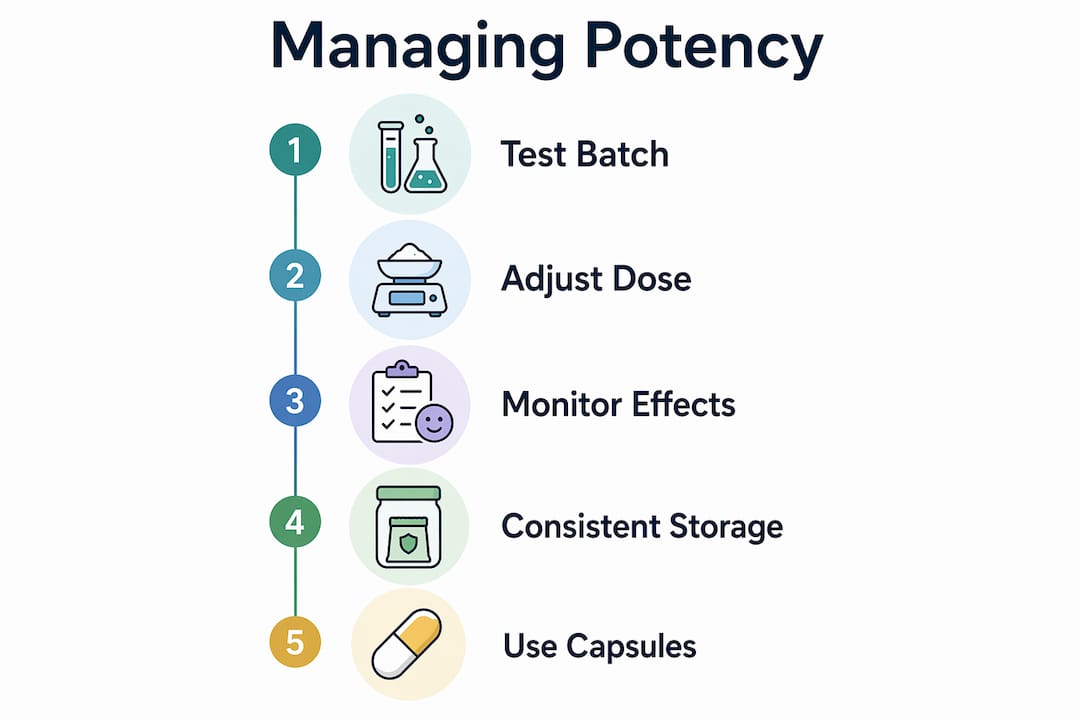
Controlling the impact of potency on microdosing requires discipline across three areas: sourcing, storage, and measurement. Here is a practical framework.
- Source standardized material. Lab-tested mushroom powder or pre-measured capsules remove the guesswork from batch-to-batch variability. When a product lists a consistent psilocybin concentration per capsule, you are dosing chemistry, not just mass.
- Dry material thoroughly before storage. Residual moisture accelerates degradation. Mushrooms should reach cracker-dry consistency before going into long-term storage. A food dehydrator set to low heat achieves this without cooking off active compounds.
- Store correctly. Use airtight glass containers with desiccant packets. Keep them in a cool, dark location. Refrigeration works well for long-term storage when the container is sealed to prevent condensation.
- Use a calibrated digital scale. Measure to 0.01g precision. A scale accurate only to 0.1g introduces dosing errors that matter at the 0.1g–0.3g range.
- Keep a dosing log. Record your dose, the batch, the time of day, what you ate beforehand, and your subjective experience rating. After two to three weeks, patterns emerge. If a new batch produces different effects at the same weight, potency has shifted.
Pro Tip: When switching to a new batch of mushroom material, drop your dose by 20% for the first week. Different batches carry different potency levels, and starting conservatively protects you from an unintended strong experience.
The microdosing protocols guide at Theelevatedremedies outlines structured approaches to dosing schedules that pair well with these potency management strategies. Combining a reliable protocol with consistent material is the most direct path to stable results.
| Management strategy | Why it works |
|---|---|
| Lab-tested capsules | Removes batch-to-batch chemical variability |
| Airtight, cool storage | Slows psilocybin degradation significantly |
| 0.01g precision scale | Reduces mass measurement error at low doses |
| Dosing log | Reveals potency shifts across batches over time |
| Conservative new-batch start | Prevents accidental overdose from higher-potency material |
What are the safety risks of potency variability in microdosing?
Potency variability is not just an inconvenience. At certain thresholds, it becomes a safety issue. Exceeding the sub-perceptual range triggers overt psychedelic effects, including visual distortions, emotional intensity, and impaired judgment. That outcome is the opposite of what microdosing is designed to produce.
Key safety considerations include:
- The threshold problem. Visual distortions are the clearest signal that a dose is too strong. If you experience them, the material is either more potent than expected or the dose was too high. Both require immediate adjustment downward.
- Medication interactions. Monoamine oxidase inhibitors (MAOIs) block the enzyme that breaks down psilocin, effectively amplifying the potency of any given dose. People taking MAOIs, certain antidepressants, or lithium face elevated risk from even modest potency swings.
- Cardiovascular considerations. Psilocybin produces mild increases in heart rate and blood pressure at standard doses. Higher-than-expected potency amplifies this effect, which matters for people with existing cardiovascular conditions.
- Psychological risk. Unexpected strong experiences can cause acute anxiety, disorientation, or distress. These outcomes are more likely when potency is unknown and the person is in an unsupportive environment.
- Start low, titrate slowly. The standard clinical recommendation is to begin at 0.1g and adjust upward only after observing effects across multiple sessions. This approach gives you time to identify your personal threshold before potency variability creates a problem.
The difference between microdosing and full psychedelic doses is not just a matter of quantity. It is a matter of control. Potency management is how you maintain that control.
Key Takeaways
Potency is the single most controllable variable in microdosing, and managing it directly determines whether your results are consistent, safe, and worth tracking.
| Point | Details |
|---|---|
| Potency defines the sub-perceptual zone | Active compound concentration determines whether a dose produces benefits or unwanted effects. |
| Variability is structural, not accidental | Species, strain, flush cycle, mushroom part, and storage all shift psilocybin levels between batches. |
| Mood benefits are more reliable than cognitive ones | Clinical trials show modest mood improvements; cognitive enhancement claims are harder to replicate. |
| Storage discipline protects potency | Airtight containers, cool temperatures, and desiccants can extend potency stability from months to over a year. |
| Safety requires conservative titration | Starting at 0.1g and adjusting slowly protects against potency swings causing unintended strong experiences. |
Potency is the variable most microdosers underestimate
I have talked with a lot of people who track their microdosing carefully, log their moods, follow a protocol, and still get inconsistent results. Almost every time, the culprit is batch-to-batch potency variation. They weigh the same amount, but the material changed. The scale said 0.2g both times. The chemistry did not cooperate.
The uncomfortable truth is that whole dried mushrooms are a poor delivery vehicle for precise dosing without lab analysis. The plant matrix is inconsistent by nature. That is not a reason to abandon microdosing. It is a reason to be more disciplined about sourcing. Pre-measured, standardized capsules solve most of this problem before it starts.
The other thing I want to push back on is the idea that potency is everything. It is not. Expectation, sleep quality, stress load, and the structure of your day all shape how a microdose lands. Potency gives you a stable floor. What you build on that floor is still up to you. The goal is to remove potency as a source of noise so the other variables become legible. Once you do that, your data actually means something.
— Juiced
Consistent microdosing starts with consistent capsules
If potency variability has been making your microdosing results unpredictable, the most direct fix is switching to a product where the work has already been done for you.
Theelevatedremedies carries mushroom capsules sourced for quality and consistency, designed specifically for people who want reliable sub-perceptual effects without the batch-to-batch guesswork. Each capsule delivers a measured dose, making it easier to track your mood, productivity, and overall experience with confidence. Visit Theelevatedremedies at 1123 Broadway St in Ann Arbor, Michigan, or browse online to find the right option for your microdosing practice.
FAQ
What is the recommended microdose range for psilocybin?
The standard starting point is 0.1g of dried mushroom powder, titrating up to a maximum of 0.3g. Any dose that causes visual distortions has exceeded the sub-perceptual threshold and should be reduced.
Why does the same dose feel different from batch to batch?
Psilocybin concentration varies between strains, flush cycles, mushroom parts, and storage conditions, so the same weight of material can carry a different chemical load each time.
Does microdosing actually improve mood and productivity?
Clinical evidence shows modest mood improvements on dosing days, but double-blind studies have not consistently replicated cognitive enhancement claims. Mood benefits are the most reliably documented outcome.
How does storage affect microdosing potency?
Moisture, heat, light, and oxygen all degrade psilocybin over time. Airtight containers stored in cool, dark conditions can preserve potency for over a year compared to months under poor conditions.
Is microdosing safe if potency is uncertain?
The primary risk of unknown potency is accidentally exceeding the sub-perceptual threshold, which triggers psychedelic effects. Starting at 0.1g, keeping a dosing log, and using standardized capsules reduces this risk significantly.
Recommended
- Why Compare Mushroom Strains? Potency, Safety & Results – Elevated Remedies
- How to microdose safely in Michigan: A 2026 guide – Elevated Remedies
- Magic Mushroom Potency Explained: Know Strength & Quality – Elevated Remedies
- Microdosing vs psychedelic experiences: 5 key differences – Elevated Remedies