
TL;DR:
- Mushroom lineage determines a strain’s ability to produce active compounds and adapt to environments. Tracking genetic heritage helps ensure potency, consistency, and successful cultivation. Without lineage records, growers risk unreliable results and unpredictable therapeutic effects.
Mushroom lineage is defined as the complete genetic ancestry of a strain, encoding every trait from bioactive compound production to environmental tolerance. Understanding why mushroom lineage matters is the difference between a consistent, potent harvest and a frustrating, unpredictable one. Genetics governs how a mushroom synthesizes psilocybin, responds to substrate, and holds up across successive grows. For anyone working with Psilocybe cubensis or exploring psilocybin for wellness, lineage is not background information. It is the foundation every cultivation and therapeutic decision rests on.
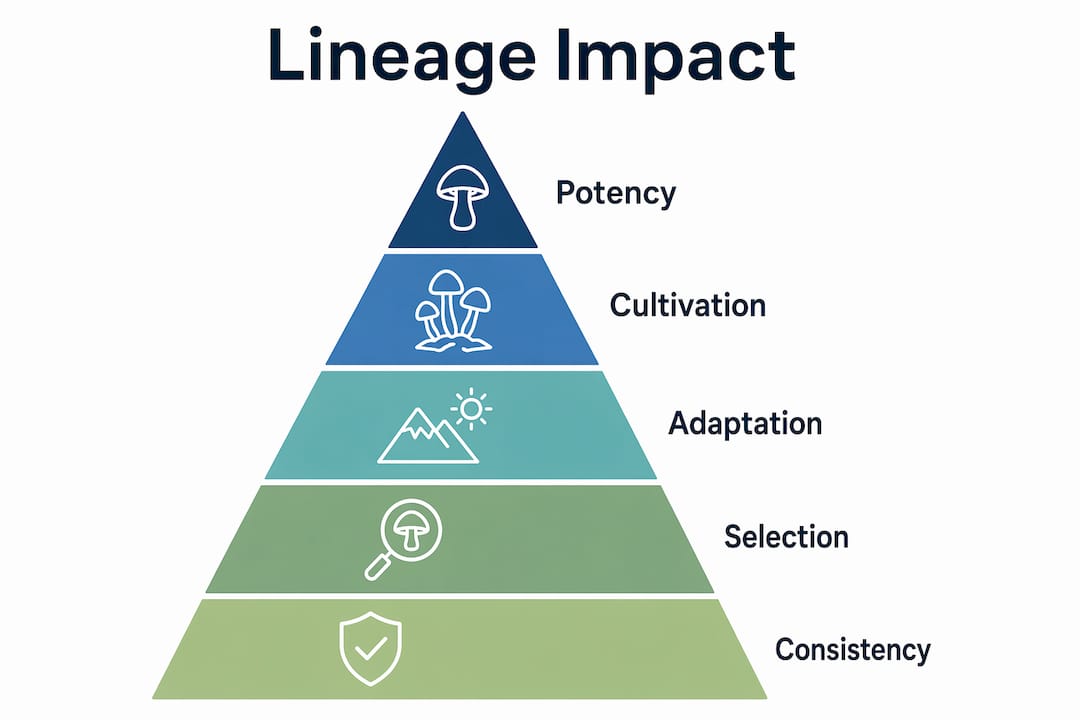
Why mushroom lineage matters for bioactive compound production
Mushroom lineage directly controls which therapeutic compounds a strain can produce and in what quantities. Gene clusters responsible for polysaccharides, psilocybin, and triterpenoids are inherited through ancestry, meaning a strain’s lineage predicts its medicinal ceiling before a single spore germinates. Studies in Ganoderma lucidum and Pleurotus eryngii confirm that specific genetic backgrounds activate distinct biosynthetic pathways. A strain without the right ancestral gene clusters simply cannot produce certain compounds, regardless of how well you optimize its environment.
Genomic mining technology now allows researchers to scan a mushroom’s genome and identify which biosynthetic gene clusters are present. This means lineage predicts potency in a way that visual inspection never could. For psilocybin specifically, the genes encoding the enzymes PsiD, PsiK, PsiM, and PsiH must all be present and functional. A strain missing or carrying degraded versions of these genes will underperform therapeutically, no matter how carefully it is cultivated.
The practical implication is significant. Two strains that look identical under a microscope can produce radically different psilocybin concentrations based solely on their genetic heritage. Choosing a strain without understanding its ancestry is essentially guessing at potency. For anyone using mushrooms for microdosing or wellness, that guesswork carries real consequences.
- Psilocybin synthesis genes are inherited, not acquired through growing conditions
- Polysaccharide and triterpenoid production in medicinal species like Ganoderma lucidum is lineage-specific
- Genomic mining identifies active biosynthetic pathways before cultivation begins
- Therapeutic ceiling is set by genetics, not substrate or humidity
Pro Tip: Before selecting a strain for therapeutic use, look for documented lineage records that confirm the presence of psilocybin biosynthetic gene clusters. A strain with verified ancestry removes the guesswork from potency.
How does genetic consistency affect mushroom cultivation success?
Genetic consistency is the single biggest factor separating reliable harvests from erratic ones. Cultivated strains are vegetative clones prone to genetic drift over successive propagations, meaning each transfer introduces the possibility of mutation. Those mutations accumulate quietly, and growers often notice them only when fruiting bodies start looking or performing differently than expected.
The biological reason for this instability runs deep. Mushroom mycelium is dikaryotic, meaning it carries two distinct genomes simultaneously. This dual-genome structure creates cultures that are not genetically uniform. Under environmental pressure, one genome can begin to dominate, shifting the strain’s expressed traits in ways the grower never intended. Sectors appearing on agar plates from a single culture are a visible sign of this divergence in action.
Undocumented lineages compound the problem significantly. Without traceable lineage, guaranteeing potency and growth consistency becomes nearly impossible. Many cultivators work with strains that have passed through dozens of hands, each transfer adding genetic noise. The result is a strain that shares a name with its ancestor but may behave nothing like it.
Here is how genetic drift typically unfolds across a cultivation cycle:
- Generation 1: The original culture performs as expected, with consistent colonization speed and fruiting density.
- Generation 3–5: Minor phenotypic shifts appear, such as slower colonization or altered cap morphology, often dismissed as environmental variation.
- Generation 7+: Significant divergence becomes undeniable. Potency drops, contamination resistance weakens, and fruiting becomes irregular.
- Undocumented stage: Without lineage records, the grower cannot trace when or where the drift began, making correction impossible.
- Restart required: The only reliable fix is returning to a genetically verified source culture.
Pro Tip: Keep a cultivation log that records the generation number of every transfer. Limiting vegetative propagation to five or fewer generations before returning to a verified source dramatically reduces genetic drift.
What are the challenges of identifying mushroom lineage?
Traditional identification methods fail at the genetic level. Morphological convergence causes misidentification because mushrooms that look nearly identical can belong to entirely different genetic lineages with different chemical profiles. An experienced collector relying on visual cues alone is working with incomplete information. Cryptic speciation, where genetically distinct species appear morphologically identical, makes this problem worse.
ITS barcoding, the most common molecular identification tool, has real limits. It works well for broad species-level identification but lacks the resolution to distinguish closely related strains or reveal lineage-specific biosynthetic capacity. The field is now shifting toward genome-scale datasets that provide far more accurate species boundaries and lineage resolution.
| Identification method | Lineage resolution | Key limitation |
|---|---|---|
| Morphological assessment | Low | Cryptic speciation causes frequent errors |
| ITS barcoding | Moderate | Cannot resolve closely related strains |
| Multigene sequencing | High | Requires lab access and technical expertise |
| Genome-scale phylogenomics | Very high | Resource-intensive but most accurate |
| Multi-omics integration | Highest | Combines genomics, transcriptomics, and metabolomics |
Multi-omics integration is now reshaping fungal systematics by combining genomics, transcriptomics, proteomics, and metabolomics into a single analytical framework. This approach reveals not just what genes a strain carries, but which ones are actively expressed under specific conditions. For cultivators and researchers, that level of detail transforms lineage from a historical curiosity into a practical cultivation tool.
How does lineage impact environmental adaptation and strain selection?
Lineage determines how a mushroom responds to its environment at a genetic level. Psilocybe cubensis and its sister species Psilocybe ochraceocentrata diverged approximately 1.5 million years ago, a split that aligns with ancient herbivore migration patterns and shaped each species’ tolerance for different dung types, climates, and substrates. That ancient divergence still shows up in how modern strains perform in your grow tent today.
Differences in Psilocybe species lineage correspond with adaptations to specific geographic ranges and substrate preferences. A strain with tropical ancestry will colonize faster in warm, humid conditions but may struggle in cooler, drier environments. A strain from a temperate lineage may fruit more reliably at lower temperatures. Selecting a strain without knowing its ancestry is like planting a crop without knowing its climate of origin.
Knowing a strain’s lineage gives you a practical framework for substrate and environment selection:
- Substrate compatibility: Strains with dung-adapted ancestry perform better on manure-based substrates. Strains from wood-decomposing lineages favor hardwood sawdust or grain.
- Temperature tolerance: Tropical lineages favor 75–82°F fruiting conditions. Temperate lineages often fruit reliably at 68–74°F.
- Humidity sensitivity: Lineage influences how tightly a strain’s fruiting is tied to humidity fluctuations. Some ancestral lines are far more forgiving than others.
- Contamination resistance: Strains from lineages with long histories of competitive natural environments tend to colonize aggressively, outpacing common contaminants.
Understanding mushroom genetics significance at this level lets you match a strain to your specific setup rather than forcing a strain to adapt to conditions it was never built for. The result is faster colonization, more consistent fruiting, and better potency retention across harvests.
Pro Tip: If you are sourcing a new strain, ask specifically about its geographic origin and substrate history. That information tells you more about how it will perform than any marketing description.
For those interested in how bioactive-rich mushroom blends are formulated with lineage in mind, the intersection of genomics and metabolomics is producing products with far more predictable therapeutic profiles than traditional single-strain approaches.
Key Takeaways
Mushroom lineage is the genetic foundation that determines potency, cultivation consistency, and environmental performance, making it the most critical variable in both therapeutic and cultivation contexts.
| Point | Details |
|---|---|
| Lineage controls potency | Biosynthetic gene clusters for psilocybin are inherited, not acquired through growing conditions. |
| Genetic drift is real | Vegetative clones accumulate mutations across generations, causing measurable phenotypic divergence. |
| Traditional ID methods fall short | Morphological assessment and ITS barcoding cannot resolve strain-level lineage differences accurately. |
| Environment selection depends on ancestry | A strain’s geographic and substrate history predicts how it performs in specific grow conditions. |
| Documentation prevents failure | Traceable lineage records are the only reliable way to maintain potency and consistency over time. |
What I have learned from watching lineage get ignored
Most cultivation failures I have seen trace back to the same root cause: someone trusted a name instead of a genotype. A strain called “Golden Teacher” or “B+” tells you almost nothing about its actual genetic state after years of undocumented transfers. The name is a label. The lineage is the truth.
The most consistent growers I know treat their source cultures the way a winemaker treats a grape variety. They document every generation, return to verified stock regularly, and never assume that a strain performing well today will perform the same way in six months without active lineage management. That discipline is not obsessive. It is the minimum standard for reliable results.
The therapeutic side of this equation is even less forgiving. If you are using psilocybin products for wellness or microdosing, the effects you experience are directly tied to the genetic integrity of the strain behind the product. A strain that has drifted genetically may still produce some psilocybin, but the concentration and the ratio of related compounds can shift in ways that change the experience entirely. That is not a minor variable. It is the whole point.
My recommendation for anyone serious about strain potency and wellness outcomes is simple: demand lineage transparency from your sources. If a supplier cannot tell you where a strain came from, how many generations it has traveled, and what substrate history it carries, that is a gap worth taking seriously.
— Juiced
Theelevatedremedies sources mushrooms with lineage in mind
Theelevatedremedies, located at 1123 Broadway St in Ann Arbor, Michigan, carries magic mushroom products sourced for genetic consistency and therapeutic reliability. Every product on the shelf reflects a commitment to quality that starts at the strain level, not the packaging level.

Whether you are microdosing for focus and mood support or exploring psilocybin wellness more broadly, the genetic integrity of what you consume shapes every outcome. Theelevatedremedies stocks dried magic mushrooms, capsules, and chocolates with that standard in mind. Visit the Amanita muscaria product page to see how curated sourcing translates into a more consistent experience. Stop in or reach out to the team at Theelevatedremedies for guidance on which product fits your goals.
FAQ
Why does mushroom lineage matter for psilocybin potency?
Psilocybin biosynthesis depends on specific gene clusters inherited through lineage. A strain lacking or carrying degraded versions of these genes produces less psilocybin regardless of growing conditions.
What is genetic drift in mushroom cultivation?
Genetic drift occurs when mutations accumulate across successive vegetative propagations, causing a strain to diverge from its original phenotype. Cultivated strains are clones and are particularly vulnerable to this over multiple generations.
Can two mushrooms look the same but have different lineages?
Yes. Cryptic speciation means genetically distinct species can appear morphologically identical. Genome-scale sequencing is now the most reliable method for distinguishing them accurately.
How does lineage affect which substrate a strain prefers?
Ancestral adaptation to specific dung types, wood, or geographic climates shapes substrate compatibility at the genetic level. Strains from tropical dung-adapted lineages perform best on manure-based substrates, while wood-decomposing lineages favor grain or hardwood sawdust.
How can I verify a mushroom strain’s lineage?
Request documented propagation records from your source and look for strains with traceable genotype origins. For high-resolution verification, multigene sequencing or genome-scale phylogenomics provides the most accurate lineage confirmation available.