
TL;DR:
- Entheogenic experiences involve altered consciousness induced by psychoactive substances to promote spiritual insight and healing. Neuroscience shows psychedelics temporarily quiet the Default Mode Network, enabling ego dissolution and neural plasticity. Setting clear intentions and proper integration are essential for lasting benefits and meaningful transformation.
An entheogenic experience is an altered state of consciousness induced by specific psychoactive substances that facilitate spiritual insight, healing, or transcendence. The term “entheogen” itself means “generating the divine within,” a phrase coined to separate sacred, intentional use from clinical or recreational contexts. Explaining entheogenic experiences accurately requires merging neuroscience, spiritual tradition, and practical preparation. Substances like psilocybin, peyote, and ayahuasca sit at the center of this conversation. Understanding what actually happens in the brain, why these states feel so profound, and how to work with them responsibly is the foundation of any serious exploration.
What happens in the brain during an entheogenic experience?
The brain changes during an entheogenic experience are measurable, reversible, and profound. Neurobiological studies show psychedelics suppress the Default Mode Network (DMN) and open critical periods of neural plasticity. The DMN is the brain’s default operating system, responsible for self-referential thinking, rumination, and the sense of a fixed “I.” When it goes quiet, the rigid boundaries between brain regions dissolve.

The result is what researchers call an entropic brain state. DMN suppression creates a temporary condition where novel neural connections form without lasting harm. Think of it as the brain’s usual traffic patterns shutting down, allowing cars to take entirely new routes. This is the neurobiological basis of ego dissolution, the feeling that the self has temporarily ceased to exist.
Ego dissolution is frequently misunderstood. The sensation of losing oneself can instead be experienced as liberation and is central to healing in entheogenic journeys. People who resist this state often report difficult or frightening experiences. People who surrender to it frequently describe it as the most meaningful event of their lives.
Increased cross-region connectivity also explains the sensory blending many people report. Sounds become colors. Abstract emotions take on physical weight. This cross-talk between brain areas that rarely communicate directly produces the vivid, symbolic quality of entheogenic states. The neurobiology does not diminish the experience. It explains why the experience feels so different from ordinary waking life.
Pro Tip: If you want to understand your own entheogenic experience more clearly, research the Default Mode Network before your session. Knowing what is happening neurologically makes the process far less frightening and far more navigable.
How are mystical experiences defined and measured in psychedelic research?
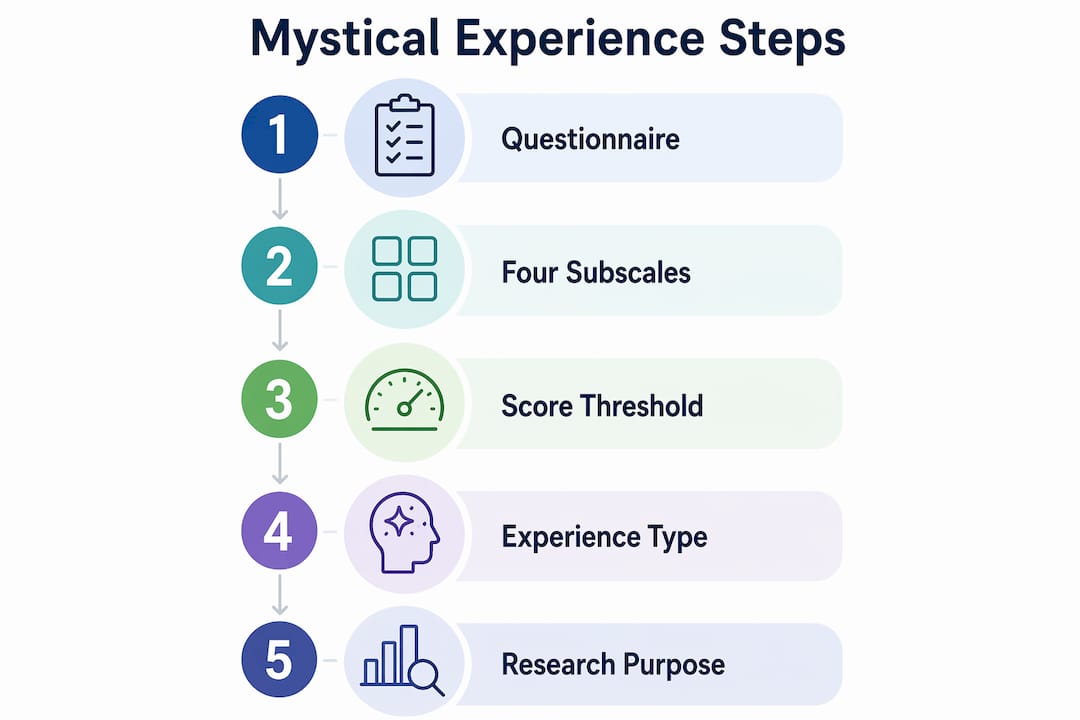
Researchers needed a way to measure something deeply subjective. The Mystical Experience Questionnaire, known as the MEQ30, is the primary tool used in clinical psychedelic research to quantify the depth of an entheogenic state. It measures four subscales: unity, sacredness, deeply felt positive mood, and transcendence of time and space.
A complete mystical experience is defined as scoring above 60% on all four MEQ30 subscales simultaneously. This threshold matters because it predicts sustained therapeutic outcomes and lasting personality changes. Scoring high on three of four subscales does not qualify. All four must cross the threshold at the same time.
What separates a mystical trip from a recreational one?
The distinction is not about the substance or the dose alone. It is about the quality of the experience itself. A recreational trip may produce visual effects, euphoria, and altered perception without touching the deeper dimensions the MEQ30 measures. A mystical experience produces a felt sense of unity with all things, a conviction of sacredness, and a dissolution of ordinary time.
Research protocols designed to reliably provoke complete mystical experiences use controlled environments, curated music playlists, and trained guides. These elements are not decorative. They shape the neurological and psychological conditions that allow the MEQ30 threshold to be crossed.
Key characteristics of a complete mystical experience include:
- Unity: A felt sense of oneness with the universe or all living things
- Sacredness: A conviction that the experience carries deep spiritual significance
- Deeply felt positive mood: Profound peace, awe, or gratitude, not just pleasure
- Transcendence of time and space: The ordinary sense of past, present, and future dissolves
| MEQ30 Subscale | What it measures | Why it matters |
|---|---|---|
| Unity | Sense of oneness with all things | Predicts lasting shifts in worldview |
| Sacredness | Felt spiritual significance | Linked to sustained meaning-making |
| Positive mood | Awe, peace, and gratitude | Associated with reduced depression and anxiety |
| Time/space transcendence | Dissolution of ordinary temporal sense | Marker of depth of ego dissolution |
What is the spiritual and cultural significance of entheogenic experiences?
The word “entheogen” carries its meaning in its roots. The term was popularized in 1979 to reframe psychedelic substances away from clinical or recreational connotations and toward sacred, ritualistic, and healing contexts. It was a deliberate act of renaming to honor what indigenous cultures had always known.
Entheogenic substances like psilocybin and peyote have been used in spiritual, shamanic, and religious contexts across cultures for centuries. The Aztecs and Maya used them alongside meditation, chanting, and dance to induce altered states for healing and divine communication. These were not casual acts. They were structured rituals embedded in cosmology, community, and purpose.
“The entheogenic experience is not an escape from the world. It is a return to the world as it actually is, stripped of the filters we normally apply.” This framing, common in indigenous and shamanic traditions, captures why these experiences carry such weight across cultures.
The modern revival of entheogenic practice in therapeutic and spiritual contexts draws directly from this lineage. Researchers at Johns Hopkins University and NYU have built clinical protocols that echo the structure of traditional ceremonies, even if the language is scientific rather than sacred. The setting, the guide, the intention, and the music all serve the same function they always have. They create the conditions for genuine encounter.
The distinction between spiritual and recreational use is not a moral judgment. It is a practical one. Intentional use within a structured context produces reliably deeper and more lasting effects than unstructured use. The tradition understood this long before the neuroscience confirmed it.
How do intentions and preparation influence entheogenic experiences?
Preparation is the most underestimated variable in the quality of an entheogenic experience. Individuals with spiritual or personal growth intentions are more likely to have complete mystical experiences than those with primarily recreational motives. Intention acts as a gatekeeper, shaping which neural doors open and which stay closed.
Psychological openness and absorption traits predispose individuals to deeper experiences. Absorption refers to the capacity to become fully immersed in an experience, whether music, nature, or imagination. People high in this trait tend to cross the MEQ30 threshold more readily. This does not mean others cannot have profound experiences. It means preparation can cultivate the mental conditions that absorption provides naturally.
Practical preparation practices that consistently improve experience quality include:
- Intention setting: Write down a clear, honest question or purpose before the session. Not a demand, but an inquiry.
- Reducing psychological noise: Address unresolved conflicts, fears, or anxieties in the weeks before. Therapy or journaling both work.
- Physical preparation: Sleep, nutrition, and avoiding alcohol in the days prior create a cleaner neurological baseline.
- Environmental design: Choose a safe, comfortable, and familiar setting. Remove unpredictable variables.
- Trusted support: Have a sober, trusted person present or nearby, especially for higher doses.
The mental state you bring into an entheogenic experience shapes the experience more than almost any other factor. Resistance amplifies difficulty. Openness amplifies depth. This is not mysticism. It is consistent with what the neuroscience of DMN suppression predicts.
What is integration and why is it critical after an entheogenic experience?
Integration is the process of translating what happened during an entheogenic experience into lasting change in daily life. Integration is where the lasting benefits are consolidated, using practices like therapy, meditation, and journaling during a window of heightened neuroplasticity. Without integration, even the most profound experience fades into memory without changing behavior or perspective.
Psychedelic-induced mystical experiences often feel more real than normal waking consciousness. That intensity is precisely what makes integration both necessary and challenging. The experience may have shown you something true and important. Integration is the work of figuring out what to do with it.
A practical integration sequence looks like this:
- Rest immediately after. The nervous system needs time to settle. Avoid stimulating environments for at least 24 hours.
- Journal within 48 hours. Write down images, feelings, and insights before they fade. Do not try to interpret yet. Just record.
- Seek integration support. A therapist familiar with psychedelic experiences, a trusted community, or a structured psychedelic integration guide can help you process what emerged.
- Build new habits during the neuroplasticity window. The brain is more receptive to change in the weeks following a session. This is the time to start meditation, exercise, or therapy.
- Revisit your intention. Compare what you set out to explore with what actually arose. The gap between the two is often where the real insight lives.
Pro Tip: Treat the two weeks after an entheogenic experience as a dedicated integration period. Schedule fewer social obligations, increase sleep, and spend time in nature. The experience opened a window. Integration is what you build while it is open.
Mystical experiences blur the divide between scientific understanding and spiritual meaning, allowing you to hold both perspectives simultaneously. Integration is where that dual understanding becomes practical wisdom rather than abstract memory.
Key Takeaways
Entheogenic experiences produce measurable neurological changes, follow definable criteria, and require intentional preparation and integration to deliver lasting benefit.
| Point | Details |
|---|---|
| DMN suppression drives the experience | Psychedelics temporarily quiet the Default Mode Network, enabling ego dissolution and novel neural connections. |
| MEQ30 defines complete mystical experiences | Scoring above 60% on all four subscales simultaneously predicts lasting therapeutic and personality change. |
| Intention shapes experience quality | Spiritual or growth-oriented intentions reliably produce deeper, more complete entheogenic states than recreational motives. |
| Integration consolidates the benefits | Therapy, journaling, and meditation during the post-session neuroplasticity window prevent insights from fading. |
| Cultural context validates intentional use | Centuries of indigenous and shamanic practice confirm that structured, purposeful use produces the deepest results. |
The part most people skip entirely
I have watched a lot of people approach entheogenic experiences the way they approach a concert. They show up, they have the experience, and they go home. Then they wonder why nothing changed. The science and the tradition agree on this: the experience is not the destination. It is the beginning of a process.
What I find most misunderstood is ego dissolution. People read about it and brace for annihilation. What actually happens, when you stop fighting it, is closer to relief. The part of you that is exhausted from maintaining a fixed identity gets a break. That break is where healing enters. Researchers at institutions like Johns Hopkins have documented this consistently, and it matches what shamanic traditions have described for centuries.
The other thing I want to say plainly: you do not need to choose between the science and the spiritual interpretation. Mystical experiences blur that divide by design. Holding both frameworks simultaneously is not a contradiction. It is actually the more accurate picture. The neurobiology explains the mechanism. The spiritual tradition explains the meaning. You need both to understand what happened to you.
Approach these experiences with respect, preparation, and a real commitment to integration. That combination produces results. Anything less is leaving most of the value on the table.
— Juiced
How Theelevatedremedies supports your entheogenic wellness
If you are in Ann Arbor and ready to explore psilocybin with intention, Theelevatedremedies at 1123 Broadway St is where to start. The team carries dried magic mushrooms, microdosing capsules, and magic mushroom chocolates, all sourced for quality and consistency. Whether you are preparing for a first experience or working through integration, the staff can point you toward the right product and the right resources.
For those curious about less familiar entheogenic options, Theelevatedremedies also offers a clear breakdown of Amanita muscaria and its distinct effects. CBD products from trusted partners like Kush Queen can also support the integration phase by reducing anxiety and improving sleep during the neuroplasticity window. Come in, ask questions, and leave with what you actually need.
FAQ
What is an entheogenic experience?
An entheogenic experience is an altered state of consciousness induced by substances like psilocybin or peyote, designed to facilitate spiritual insight, healing, or transcendence. The term distinguishes intentional, sacred use from recreational consumption.
How does psilocybin produce a mystical experience?
Psilocybin suppresses the Default Mode Network and increases cross-region brain connectivity, creating the neurological conditions for ego dissolution and profound altered states. This brain state is the mechanism behind what researchers measure with the MEQ30.
What is the MEQ30 and why does it matter?
The MEQ30 is the Mystical Experience Questionnaire used in clinical psychedelic research to measure the depth of an entheogenic state across four subscales. Scoring above 60% on all four simultaneously predicts lasting therapeutic outcomes.
How long does integration take after an entheogenic experience?
Integration is an ongoing process, but the most critical window is the two to four weeks following a session, when the brain remains in a heightened state of neuroplasticity. Therapy, journaling, and meditation during this period produce the most durable benefits.
Does intention really affect the experience?
Research confirms that individuals entering with spiritual or personal growth intentions are significantly more likely to reach the complete mystical experience threshold than those with recreational motives. Intention is not just mindset. It is a measurable predictor of outcome.