
Microdosing remains illegal under federal law, and employers may legally enforce drug-free workplace policies regardless of state decriminalization or how small the dose. Research on day-level mood and creativity boosts is real but inconsistent, riddled with placebo effects, and nowhere close to justifying the job risk. If you’re weighing microdosing at work, you’re weighing a mild, unproven productivity edge against your paycheck.
TL;DR:
- Microdosing substances like psilocybin and LSD involve inconsistent potency and unverified dosing, making precise intake difficult outside regulated environments.
- Reported mood and creativity boosts are mostly day-specific and heavily influenced by placebo effects, with little evidence of lasting benefits.
- Federal law classifies microdosing as illegal, and employers maintain the right to enforce drug-free policies, regardless of local decriminalization.
- Workplace drug tests rarely detect psilocybin reliably, but specialized assays could potentially identify use; legal access does not equate to employer tolerance.
- Long-term psychological and health effects remain unknown due to a lack of extensive, long-duration research, so personal risks are largely unquantified.
Table of Contents
- Microdosing at Work: What It Actually Means
- Is Microdosing Effective? What the Evidence Actually Shows
- Is Microdosing Legal in the Workplace?
- How Should Employers Handle Microdosing Policies?
- What Should Employees Consider Before Microdosing?
- Long-Term Cognitive and Psychological Effects Nobody Talks About Enough
- Microdosing and Medication Interactions Employees Should Know
- The Ethics of Microdosing Culture in the Workplace
- What Occupational Health and HR Professionals Should Take Away
- Why the “Silicon Valley Secret” Framing Gets This Wrong
- Explore Legal Mushroom Options at Elevated Remedies
- Primary Sources for Employers and Professionals
- Sources
- FAQ
Microdosing at Work: What It Actually Means
A microdose is roughly one tenth to one twentieth of a recreational dose. That’s small enough to avoid a full psychedelic experience but large enough, in theory, to produce subtle shifts in mood or focus. Psilocybin mushrooms and LSD are the two substances people cite most often when talking about microdosing at work, with psilocybin dominating in states where mushroom access has loosened.
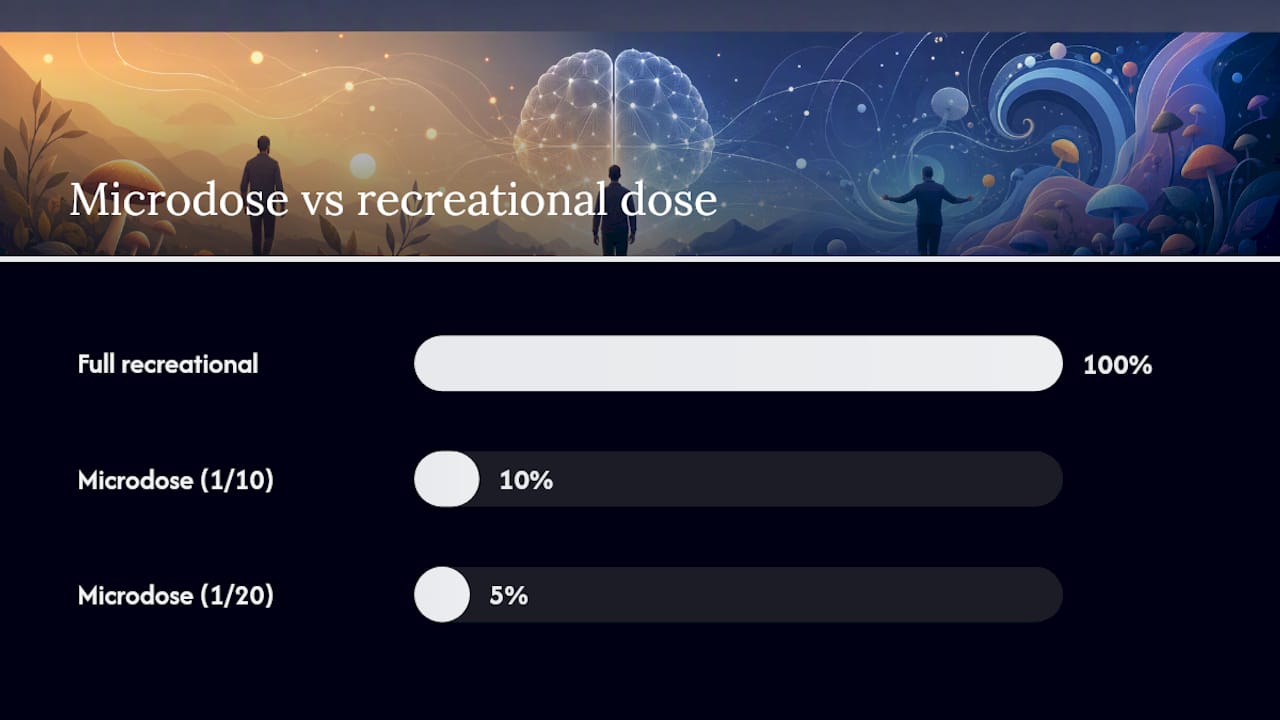
Regimens vary widely, but a common pattern involves dosing every third day, or following a schedule like one day-on and two off, to reduce tolerance buildup. Some people stack their microdose with lion’s mane mushroom or vitamin B3, a practice popularized informally online with little clinical backing.
Precision is the real problem. Dried mushroom potency swings based on species, growing conditions, and even which part of the mushroom you eat. LSD comes in blotter tabs, liquid drops, or gel tabs, each with its own dosing inconsistencies. Outside a lab, nobody can guarantee that a “10 milligram” microdose is actually 10 milligrams.
- Psilocybin and LSD are the two substances most associated with microdosing.
- Typical doses run about 1/10 to 1/20 of a full recreational amount.
- Dosing schedules commonly follow a one day on, two days off rhythm.
- Stacking with lion’s mane or vitamin B3 is popular but unverified by controlled research.
- Potency and purity are inconsistent outside regulated settings, making exact dosing guesswork.
Is Microdosing Effective? What the Evidence Actually Shows
The honest answer is: it depends on which study you’re reading and how much weight you put on self-reported data. A large observational analysis pooling 11 studies and 3,262 adults found that 72.7% of studies reported at least one positive health outcome, and that 86% of people microdose for performance reasons rather than a diagnosed medical condition. That’s a meaningful signal that people believe it works. Belief and proof are different things.
By the Numbers: A 2025 daily-diary study of 1,435 participants found microdosing lifted mood and mental functioning on the days people actually dosed, but those gains did not carry over to the following days.
That day-specific pattern shows up again in a prospective study of roughly 1,000 psilocybin microdosers tracked against a control group, which found small-to-medium improvements in mood and mental health over about a month. Encouraging, but modest, and observational, meaning it can’t rule out expectancy effects.
That’s the catch controlled science keeps running into. Harvard Health points out that much of the reported benefit may come from people expecting to feel better rather than from the drug itself, and systematic reviews of randomized controlled trials consistently show mixed or small effects once you strip out placebo response with a blinded design.
- Observational studies report mood, focus, and creativity gains, often day-specific rather than lasting.
- Blinded, controlled trials show smaller and less consistent effects than open-label or self-reported studies.
- Sample sizes remain small relative to the claims circulating online.
- Long-term data on tolerance, cognitive effects, and safety essentially doesn’t exist yet.
Is Microdosing Legal in the Workplace?
No, not under federal law, and that single fact overrides almost everything else in this conversation. Psilocybin and LSD are both Schedule I controlled substances, the same federal classification as heroin, meaning federal law treats them as having no accepted medical use and a high potential for abuse. State or city decriminalization measures, including the ones several Michigan municipalities have passed, change local enforcement priorities. They do not touch federal law, and they do not obligate a private employer to tolerate drug use.
That distinction matters enormously for anyone assuming decriminalization equals workplace protection. According to a legal analysis from Harvard Law’s Petrie Flom Center, employers generally retain broad discretion to enforce drug-free workplace policies and can discipline or terminate an employee for using a Schedule I substance, microdose or not, disclosed or discovered.
Testing adds another layer of uncertainty. Standard workplace drug panels don’t reliably flag psilocybin the way they flag THC or opioids. Detection depends heavily on which assay a lab runs and which metabolites it screens for, so assuming you’re “safe” because a basic panel wouldn’t catch it is a bad bet, not a strategy.
- Federal Schedule I status makes microdosing illegal nationwide, regardless of local decriminalization.
- Employers can generally enforce zero-tolerance drug policies without violating employee rights.
- Standard drug tests don’t reliably detect psilocybin, but specialized assays sometimes can.
- ADA accommodation protections almost never extend to Schedule I substances, so “medical use” is rarely a valid defense.
How Should Employers Handle Microdosing Policies?
HR teams can’t out-legislate federal law, but they can write policies that are clear, fair, and defensible instead of vague and reactive. Legal scholars specifically recommend moving away from blanket, unspecific bans toward language that names microdosing explicitly and ties enforcement to safety outcomes rather than moral judgment.
- Update your drug-free workplace policy to name psychedelics specifically, not just “illegal drugs,” and define what counts as a safety-sensitive role.
- Carve out stricter rules for safety-sensitive positions like machine operation, driving, or roles involving critical real-time decisions, where any impairment risk is unacceptable.
- Set a clear response protocol for suspected impairment: remove the employee from task, document observed behavior with specifics, and involve a second manager as a witness.
- Standardize your investigation process so every case gets the same documentation, timeline, and confidentiality treatment, regardless of who’s involved.
- Loop in legal counsel before disciplinary action in any gray-area case, especially where a state decriminalization law might create local nuance.
- Train managers to recognize impairment signs without assuming every mood shift is drug related, and give employees a confidential channel, like an EAP, to ask questions before they become HR incidents.
Pro Tip: A policy that only says “no illegal drugs” leaves managers guessing when psilocybin comes up. Naming it directly, alongside a clear safety-sensitive carve-out, protects both the company and the employee from ambiguous enforcement.
What Should Employees Consider Before Microdosing?
Before anything else, run the honest math: legal exposure, job risk, and whether your role touches safety-sensitive work at all. If you operate machinery, drive for work, or make high-stakes calls under time pressure, the calculus changes fast, and no productivity anecdote is worth that trade.
If you decide to move forward anyway, harm reduction matters. That means sourcing from a consistent, known supplier, starting at the lowest end of a dosing range, and tracking day-level effects honestly instead of assuming every good day is the mushroom talking. Schedule dosing days around low-stakes work, not client presentations or safety-critical tasks.
Disclosure to an employer is rarely wise. It doesn’t create legal protection, since ADA accommodations almost never cover Schedule I substances, and it does create a paper trail. If you’re exploring cognitive or mood support through legal channels first, look at sleep, exercise, and structured routines before assuming a substance is the only lever available.
- Assess job risk first: safety-sensitive roles carry the highest stakes.
- Practice harm reduction: known sourcing, low starting doses, honest effect tracking.
- Avoid disclosure unless a genuine medical accommodation applies, and understand it rarely helps.
- Consider legal, non-substance strategies before assuming microdosing is the answer.
Long-Term Cognitive and Psychological Effects Nobody Talks About Enough
Here’s what gets lost in the productivity-hack framing: nobody actually knows what happens after months or years of regular microdosing, because the long-term data doesn’t exist yet. Most studies run for weeks, not years, and rely on self-report rather than objective cognitive testing.
Cultural anthropology research on workplace microdosing offers a useful reframe. It suggests microdosing tends to amplify whatever cognitive work someone is already doing rather than creating new mental capacity. If your baseline focus is scattered, a microdose likely won’t fix that; it may just make the scattered feeling more noticeable.
Tolerance is the other quiet risk. Regular users report needing longer breaks or higher doses over time to feel the same effect, which is exactly the pattern that turns a casual habit into a dependency risk. Combine that with the total absence of data on years-long psychological effects, mood stability, or motivation changes, and you’re left making a personal bet with incomplete information. That’s not a reason to panic. It’s a reason to treat “I’ve been doing this for two years with no issues” as anecdote, not evidence.
Microdosing and Medication Interactions Employees Should Know
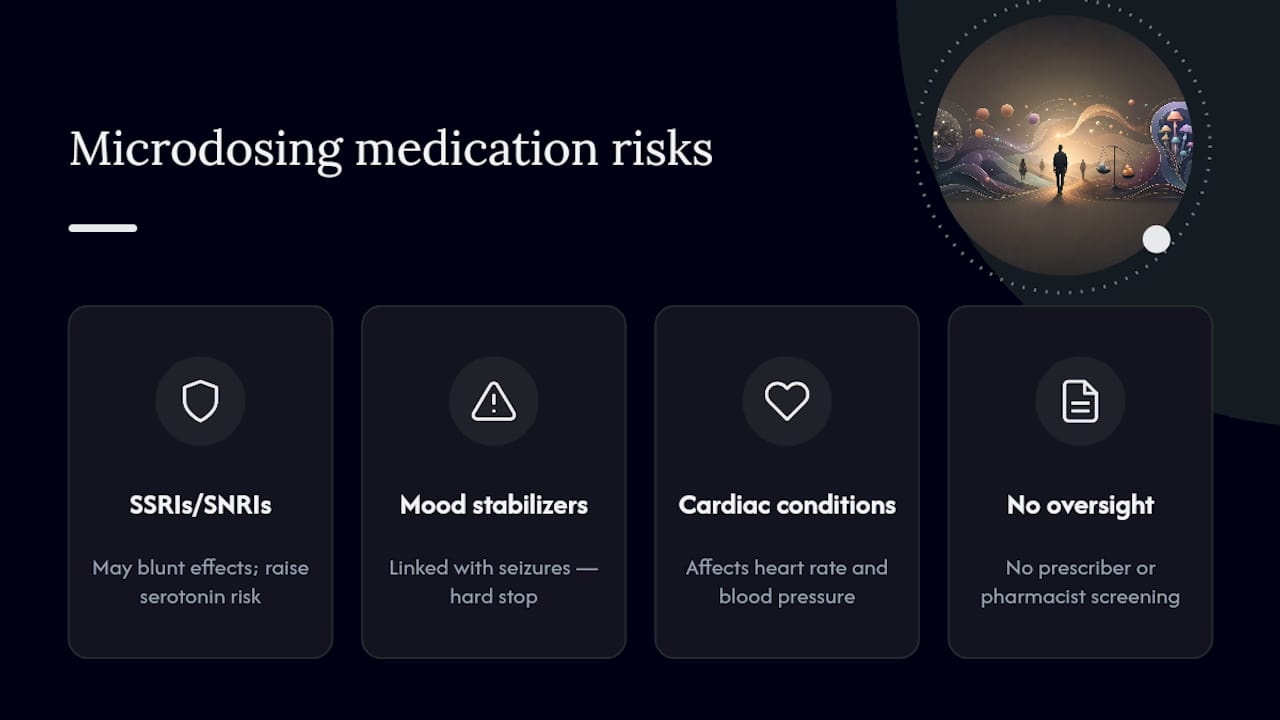
Psilocybin and LSD both act on serotonin receptors, which puts them in direct conflict with an entire category of medications many employees already take. SSRIs and SNRIs, some of the most commonly prescribed antidepressants in any workplace, can blunt psychedelic effects or, in rarer cases, interact in ways that raise serotonin-related risks.
Lithium and other mood stabilizers carry a more serious warning. Case reports have linked combining lithium with psychedelics to seizures, so anyone managing bipolar disorder or another condition requiring mood stabilizers should treat this combination as a hard stop, not a personal experiment.
Cardiovascular conditions matter too. Psychedelics can affect heart rate and blood pressure, so an employee with hypertension, arrhythmia, or a history of cardiac events is taking on meaningfully more risk than a healthy adult microdosing occasionally. And because these substances remain illegal and unregulated at the federal level, there’s no prescribing physician checking interactions, no pharmacist flagging conflicts, and no standardized dosing sheet warning about contraindications the way there would be with an approved medication.
For HR and occupational health teams, the takeaway isn’t to police employees’ private medication lists. It’s to recognize that “just a microdose” carries the same interaction risks as any psychoactive substance, and any workplace wellness conversation about mental health support should include this blind spot.
The Ethics of Microdosing Culture in the Workplace
Microdosing at work raises an uncomfortable fairness question: if one employee gains a mood or creativity edge from an illegal substance, does that create quiet pressure on peers to do the same? Workplace culture has a way of normalizing whatever the most visible high performers are doing, and psychedelics are no exception.
There’s also a consent and safety gap that most casual conversations skip. Coworkers who work alongside someone microdosing, particularly in collaborative or safety-relevant settings, haven’t agreed to that risk exposure, and they usually don’t know it’s happening at all. That’s different from an employee’s private choice to drink coffee or take a legal supplement.
Then there’s the honesty problem. A workplace culture where microdosing is whispered about but never acknowledged tends to breed exactly the kind of quiet, inconsistent enforcement that damages trust when it eventually surfaces, usually after an incident forces the issue. Companies that address this directly, through clear policy and open (if brief) acknowledgment that the topic exists, tend to handle it far better than companies that pretend it isn’t happening until an investigation proves otherwise.
What Occupational Health and HR Professionals Should Take Away
Strip away the hype, and the scientific consensus lands somewhere modest: microdosing may produce real, measurable mood and creativity boosts on the specific days someone doses, but those effects are inconsistent, hard to separate from placebo, and unsupported by any long-term safety data. That’s not a condemnation. It’s just where the evidence currently sits.
For occupational health teams, the practical guidance is straightforward. Treat microdosing as you would any undisclosed substance use: focus policy and enforcement on performance and safety outcomes, not on moralizing about the substance itself. Update drug-free workplace language to name psychedelics specifically rather than leaving room for ambiguity. Train managers to document impairment based on observed behavior, not assumption.
For HR leaders building broader wellness strategy, the research supports a clear message to employees: whatever mood or focus benefit microdosing offers is likely small, short-lived, and confounded by expectancy. Employees chasing a durable performance edge are better served by addressing sleep, workload, and mental health support directly, tools that carry zero legal risk and, unlike microdosing, actually have long-term data behind them.
Why the “Silicon Valley Secret” Framing Gets This Wrong
The popular narrative treats microdosing like a discovered productivity hack, quietly used by high performers who are simply ahead of the curve. That framing undersells the actual risk profile and oversells the evidence. A day-specific mood boost in a 1,400-person diary study isn’t nothing, but it’s a long way from the durable cognitive edge the hype suggests.
What gets underestimated is how much of this decision is really a legal and career bet dressed up as a wellness choice. Employees weighing microdosing at work aren’t just asking “does this help me focus.” They’re accepting Schedule I legal exposure and unclear ADA protection in exchange for an effect that even its own researchers describe as transient. That’s a trade worth naming honestly instead of glossing over with productivity-culture language.
Some local vendors sell legal mushroom and hemp-derived products in Ann Arbor, and some prefer to point people toward accurate information rather than let hype outrun the evidence. Our position isn’t that microdosing has zero merit. It’s that anyone considering it deserves the full legal and scientific picture, not the shortened version that circulates on social media.
— Juiced
Explore Legal Mushroom Options at Elevated Remedies
If the legal and workplace risk of psilocybin microdosing gives you pause, you’re not without options. Some retailers carry legal alternatives, including amanita muscaria products, alongside educational resources built to help you make an informed choice rather than a guess.
Amanita muscaria operates under different legal status than psilocybin and LSD, which is exactly why it’s worth understanding before you assume your only choice is an illegal Schedule I substance. That said, buying a legal product doesn’t erase every risk. Interactions, dosing sensitivity, and individual health conditions still apply, so a conversation with a clinician and a look at your local regulations remain smart first steps regardless of which product you’re considering.
Some local teams build educational content specifically for people navigating this exact decision. If you want to understand what amanita muscaria actually is and how it compares to the substances discussed in this article, that page is the place to start before you make a purchase.
Primary Sources for Employers and Professionals
- Petrie Flom Center, Harvard Law: Microdosing at Work legal analysis
- Harvard Health: The popularity of microdosing psychedelics
- UBC Okanagan: microdosing mood and creativity study
- SHRM: microdosing as a leadership issue
- Nature Scientific Reports: psilocybin microdosing prospective study
This article is general information, not a substitute for advice from a qualified doctor. Consult a qualified healthcare professional about your own circumstances before acting on anything here.
Sources
- Microdosing at Work: Business and Legal Implications — Petrie Flom (Harvard)
- The popularity of microdosing of psychedelics: What does the science say? — Harvard Health
- UBCO study finds microdosing can temporarily improve mood, creativity — UBC Okanagan News
- Microdosing psychedelics: systematic and controlled trials review — PubMed entry
FAQ
What Amount Is Considered a Microdose?
A microdose typically runs about one tenth to one twentieth of a standard recreational dose, though exact amounts vary widely due to inconsistent potency in mushrooms and LSD delivery forms.
Can My Employer Fire Me for Microdosing?
Generally yes. Psilocybin and LSD remain federally illegal under Schedule I classification, and most employers retain the legal right to enforce drug-free workplace policies regardless of state decriminalization.
Does Microdosing Actually Improve Productivity?
The evidence is mixed. A 1,435-person diary study found mood and creativity gains on dosing days specifically, but controlled trials show smaller effects once placebo response is accounted for.
Will Psilocybin Show Up on a Standard Workplace Drug Test?
Standard panels don’t reliably detect psilocybin the way they flag THC or opioids, but detection depends on the specific assay a lab uses, so it isn’t a guaranteed pass.
Is Microdosing Legal if My State Has Decriminalized Psilocybin?
No. State or city decriminalization changes local enforcement priorities but doesn’t override federal Schedule I status, and it doesn’t require employers to accommodate psilocybin or LSD use.