
TL;DR:
- Ceremonial microdosing involves sub-perceptual psilocybin doses practiced within structured rituals like meditation and journaling. This approach aims to foster emotional resilience and personal growth by combining neurochemistry with intentional habits. It differs from casual use by emphasizing discipline, honest self-inquiry, and integrating daily practices over a set protocol.
Ceremonial microdosing is defined as the intentional, ritualized practice of taking sub-perceptual psilocybin doses, typically 5–10% of a recreational amount, alongside structured daily practices like meditation, journaling, and breathwork. The industry term for this approach is “intentional microdosing,” though “ceremonial microdosing” captures its defining feature: the ritual itself is as important as the dose. This practice differs sharply from casual microdosing, which treats psilocybin as a supplement for mood or focus. Ceremonial microdosing combines neuroscience and tradition to build emotional resilience and support genuine personal growth over time.
What is ceremonial microdosing and how does it work?
Ceremonial microdosing is a structured neuropsychological practice designed to rewire emotional patterns, not simply elevate mood. The dose stays sub-perceptual, meaning you feel no hallucinations or significant psychedelic effects. The ritual surrounding that dose is what separates this practice from taking a capsule and going about your day.

The standard dose range sits between 0.1 and 0.3 grams of dried psilocybin mushrooms. At this level, psilocybin engages serotonin 5-HT2A receptors without triggering perceptual distortion. The neurochemical door opens slightly, and your daily practices determine what walks through it.
Two protocols dominate this space. The Fadiman Protocol follows a 1 day on, 2 days off schedule, which prevents tolerance buildup and allows integration between doses. The Stamets Protocol runs 4 days on, 3 days off, often paired with adjunct substances like lion’s mane mushroom or ceremonial cacao to deepen neuroplasticity. Both protocols pair well with cacao when combined with daily intentional practices.
The ritual elements that define ceremonial microdosing include:
- Morning intention setting: Stating a clear purpose before dosing anchors the experience to personal growth rather than passive consumption.
- Meditation: Even 10–15 minutes of seated breathwork after dosing deepens present-moment awareness.
- Journaling: Writing observations, emotions, and insights creates a record of your internal shifts over weeks.
- Mindful movement: Yoga, walking in nature, or gentle stretching helps the body process what the mind is working through.
- Evening reflection: Closing the day with gratitude or a brief review of what surfaced reinforces neural learning.
Pro Tip: Set your intention out loud before your dose. Practitioners report that speaking your intention, rather than just thinking it, creates a stronger sense of accountability and presence.
How does ceremonial microdosing differ from casual use?
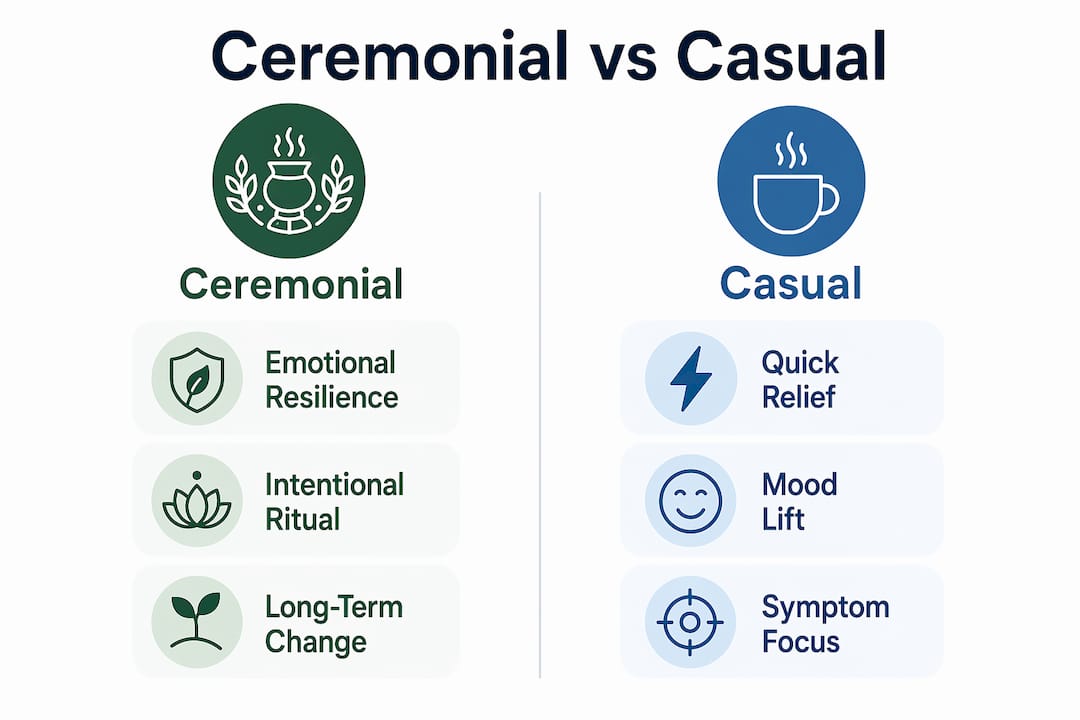
The difference between ceremonial and casual microdosing is not just the ritual. It is the underlying goal and the relationship you build with the practice over time.
Casual microdosing treats psilocybin as a tool for quick symptom relief, a mood lift on a hard Monday, or sharper focus during a work sprint. Ceremonial microdosing treats it as a temporary scaffold for healing, a structured period of neurological openness that you actively fill with growth-oriented habits. The medicine creates the window. You do the work.
The table below shows where these two approaches diverge most clearly.
| Feature | Ceremonial microdosing | Casual microdosing |
|---|---|---|
| Primary goal | Emotional resilience and spiritual growth | Mood boost or productivity |
| Ritual structure | Daily practices built around dosing | Dose taken without structured context |
| Integration focus | Journaling, reflection, movement | Minimal or none |
| Duration | Defined protocol with clear end point | Ongoing, often indefinite |
| Risk of dependency | Lower, due to intentional scaffolding | Higher, if used as emotional avoidance |
A critical pitfall in casual use is spiritual bypassing. Spiritual bypassing means using microdosing to avoid difficult emotional work rather than engage with it. You feel better without actually changing the patterns driving your distress. Ceremonial practice guards against this by requiring honest self-inquiry alongside every dose.
Pro Tip: If you notice you are reaching for a dose whenever you feel uncomfortable, pause. That discomfort is the material the practice is designed to help you work through, not avoid.
What are the benefits and brain mechanisms behind this practice?
The effects of ceremonial microdosing operate through two primary neurochemical pathways: serotonin receptor engagement and BDNF-driven neuroplasticity. Understanding both helps you appreciate why the ritual matters as much as the molecule.
Psilocybin at sub-perceptual doses activates serotonin 5-HT2A receptors in the prefrontal cortex. This activation increases cognitive flexibility and emotional fluidity without producing hallucinations. The brain becomes more receptive to new patterns of thought and behavior. That receptivity is the neuroplastic window practitioners refer to.
BDNF, or brain-derived neurotrophic factor, is a protein that supports the growth and maintenance of neurons. Psilocybin microdosing promotes BDNF expression, which means the brain is literally more capable of forming new connections during a dosing period. Pair that with daily journaling or meditation, and you are giving those new connections a direction to grow.
Ceremonial cacao adds a meaningful layer to this picture. Theobromine in cacao supports vascular health, improving blood flow to the brain. The cacao-psilocybin combination also modulates the endocannabinoid system through anandamide, sometimes called the “bliss molecule,” which supports emotional regulation and sustained neuroplasticity. Practitioners who use a ceremonial cacao elixir alongside their protocol often report deeper emotional openness and more consistent mood stability.
The documented benefits of this practice include:
- Improved emotional fluidity: Less reactivity to stress, greater capacity to sit with difficult feelings.
- Present-moment awareness: Reduced rumination and stronger engagement with daily life.
- Cognitive flexibility: More creative thinking and reduced rigid thought patterns.
- Nervous system regulation: Gradual shift from chronic stress states toward greater baseline calm.
- Spiritual connection: A deeper sense of presence and connection to self and others, rather than escape from reality.
How to responsibly practice ceremonial microdosing
Responsible ceremonial practice starts with choosing a validated protocol and sticking to it. Pick either the Fadiman or Stamets schedule and commit to it for at least four weeks before evaluating results. Switching protocols mid-course disrupts the neuroplastic rhythm you are trying to build.
- Set your dose precisely. Start at 0.1 grams if you are new to psilocybin. Increase to 0.2 or 0.3 grams only after two weeks of consistent practice at the lower dose. Precision matters because the sub-perceptual threshold is the entire foundation of this approach.
- Build your morning ritual before you start dosing. Establish your meditation, journaling, and movement habits for one week before your first dose. The ritual should feel natural, not forced, when the medicine is present.
- Use a journal with structure. Write three things before dosing: your intention, your current emotional state, and one pattern you want to shift. Write three things after: what you noticed, what surprised you, and one small action you will take today.
- Incorporate ceremonial cacao on dosing days. Prepare it as a warm drink in the morning, ideally before or alongside your dose. The aromatherapy and ritual context of preparing cacao mindfully deepens the sense of ceremony and supports the neurochemical environment.
- Plan your off days as actively as your on days. Integration happens between doses. Use off days for longer journaling sessions, nature walks, or reflective conversations with trusted people.
- Set a clear end date. Most practitioners run a ceremonial protocol for 4–12 weeks, then take a full break. The medicine opens a window for change, but the goal is to build lasting habits that no longer require the medicine to sustain.
Pro Tip: Track your sleep, mood, and energy in a simple daily log alongside your journal. Patterns that emerge over weeks often reveal more than any single dosing session.
Key Takeaways
Ceremonial microdosing works because the ritual, not just the dose, is what drives lasting emotional and neurological change.
| Point | Details |
|---|---|
| Dose range matters | Standard ceremonial doses run 0.1–0.3 grams of dried psilocybin mushrooms. |
| Protocol structure | Fadiman and Stamets protocols prevent tolerance and support consistent integration. |
| Ritual is the mechanism | Journaling, meditation, and movement direct neuroplasticity toward lasting growth. |
| Cacao enhances the practice | Ceremonial cacao supports BDNF expression and emotional regulation via the endocannabinoid system. |
| Avoid spiritual bypassing | Microdosing is a catalyst for emotional work, not a substitute for it. |
Why the scaffold matters more than the dose
I have seen people approach microdosing the same way they approach a new supplement: take it, wait for results, and move on if nothing happens in two weeks. That approach misses the entire point of ceremonial practice.
The psilocybin opens a neuroplastic window. That is real and well-supported. But a window is just an opening. What you do with the light that comes through is entirely up to you. The practitioners I find most credible are the ones who treat the medicine as a temporary tool, not a permanent solution. They build their journaling practice, their movement routine, and their self-inquiry habits with the clear intention of maintaining them after the protocol ends.
The most honest thing I can tell you is this: the ceremony is not decoration. It is the mechanism. Gratitude, breathwork, and honest reflection during dosing shift the experience from passive to active. That shift is where the growth actually lives. If you are not willing to do the daily work alongside the dose, the medicine will not do it for you.
— Juiced
Psilocybin products and guidance at Theelevatedremedies
Theelevatedremedies, located at 1123 Broadway St in Ann Arbor, Michigan, carries dried magic mushrooms, microdosing capsules, and magic mushroom chocolates sourced for quality and consistency. Whether you are starting your first ceremonial protocol or refining an existing practice, the team at Theelevatedremedies can help you choose the right product and dose for your goals.
Ann Arbor has always been a city that takes wellness seriously, and Theelevatedremedies fits that culture. For readers who want to go deeper on the science and practice, the psychedelic wellness resource on the Theelevatedremedies blog covers responsible use, current research, and practical guidance for 2026. Stop in, ask questions, and get the support your practice deserves.
FAQ
What does ceremonial microdosing mean?
Ceremonial microdosing means taking sub-perceptual psilocybin doses, typically 0.1–0.3 grams, within a structured ritual that includes meditation, journaling, and intention setting. The ceremony is what distinguishes this practice from casual or supplemental microdosing.
How is ceremonial microdosing different from regular microdosing?
Regular microdosing focuses on symptom relief or productivity, while ceremonial microdosing prioritizes emotional resilience and spiritual growth through daily integrative practices. The ritual context, not just the dose, drives the outcomes.
What are the main benefits of this practice?
The primary benefits include improved emotional fluidity, greater present-moment awareness, cognitive flexibility, and nervous system regulation. These effects build gradually over a 4–12 week protocol when paired with consistent daily habits.
Is ceremonial microdosing safe?
Sub-perceptual doses do not produce hallucinations and carry a low risk of acute adverse effects. The main risk is spiritual bypassing, which practitioners avoid by pairing dosing with honest self-inquiry and structured integration work.
How long should a ceremonial microdosing protocol last?
Most practitioners run a ceremonial protocol for 4–12 weeks, followed by a full break. The goal is to build lasting emotional and behavioral habits that persist after the protocol ends, not to rely on the medicine indefinitely.
Recommended
- How to microdose safely in Michigan: A 2026 guide – Elevated Remedies
- Mushroom Protocols Defined: Your 2026 Microdosing Guide – Elevated Remedies
- Step-by-Step Mushroom Effects Workflow for Michigan Microdosing – Elevated Remedies
- Microdosing vs psychedelic experiences: 5 key differences – Elevated Remedies