
TL;DR:
- Tryptamine content varies over sevenfold across mushroom strains, affecting potency and experience.
- Knowing the alkaloid profile and applying precise dosing improves safety and consistency during use.
Tryptamine content in mushroom strains is defined as the total concentration of psychoactive alkaloids, primarily psilocybin, psilocin, baeocystin, and norbaeocystin, measured by dry weight. These compounds determine how intense, how fast, and how long a psychedelic experience unfolds. Total tryptamine concentrations vary by more than 7.8-fold across strains, ranging from 2.62 to 20.65 mg/g. That gap is not a minor detail. It is the difference between a gentle afternoon and an experience that demands serious preparation. Whether you are microdosing for focus, exploring psilocybin for therapeutic benefit, or planning a full-dose session, knowing your strain’s alkaloid profile is the most important variable you control.
1. Which mushroom strains have the highest tryptamine content?
The highest tryptamine content mushroom strains fall into two categories: wild species with naturally elevated alkaloid loads, and selectively cultivated Psilocybe cubensis mutations bred for potency.
Wild high-potency species:
- Psilocybe azurescens holds the record among documented species. Psilocybin reaches 1.78% by dry weight, with psilocin at 0.38% and baeocystin at 0.35%. Total alkaloids run roughly 3–4 times higher than standard P. cubensis. This species grows wild in the Pacific Northwest and is not forgiving of dosing errors.
- Psilocybe cyanescens runs close behind, with consistently higher alkaloid levels than most cultivated cubensis strains. It thrives in wood chip beds and temperate climates.
Top cultivated P. cubensis strains:
- Enigma: A non-sporulating blob mutation that tested above 3.5% total tryptamines by dry weight. This is the highest confirmed figure for any cubensis variant.
- Toque: Another competition-grade mutation, testing at 3.3% total tryptamines. Developed through selective pressure for maximum alkaloid yield.
- Penis Envy: The most widely recognized high-potency cubensis strain. It measures 1.5 to 2 times the psilocybin content of common cubensis strains. Dense stems and a compact cap are its physical signatures.
- Mak IND: A lesser-known but verified high-potency isolate with alkaloid levels well above the cubensis average.
- Golden Teacher: The benchmark for moderate potency at roughly 0.6% total tryptamines. Widely available and forgiving for newer users.
Pro Tip: Never assume potency based on appearance alone. Strain names circulate without verification. Lab testing is the only reliable way to confirm tryptamine levels before dosing.
2. How do tryptamine levels vary within the same strain?
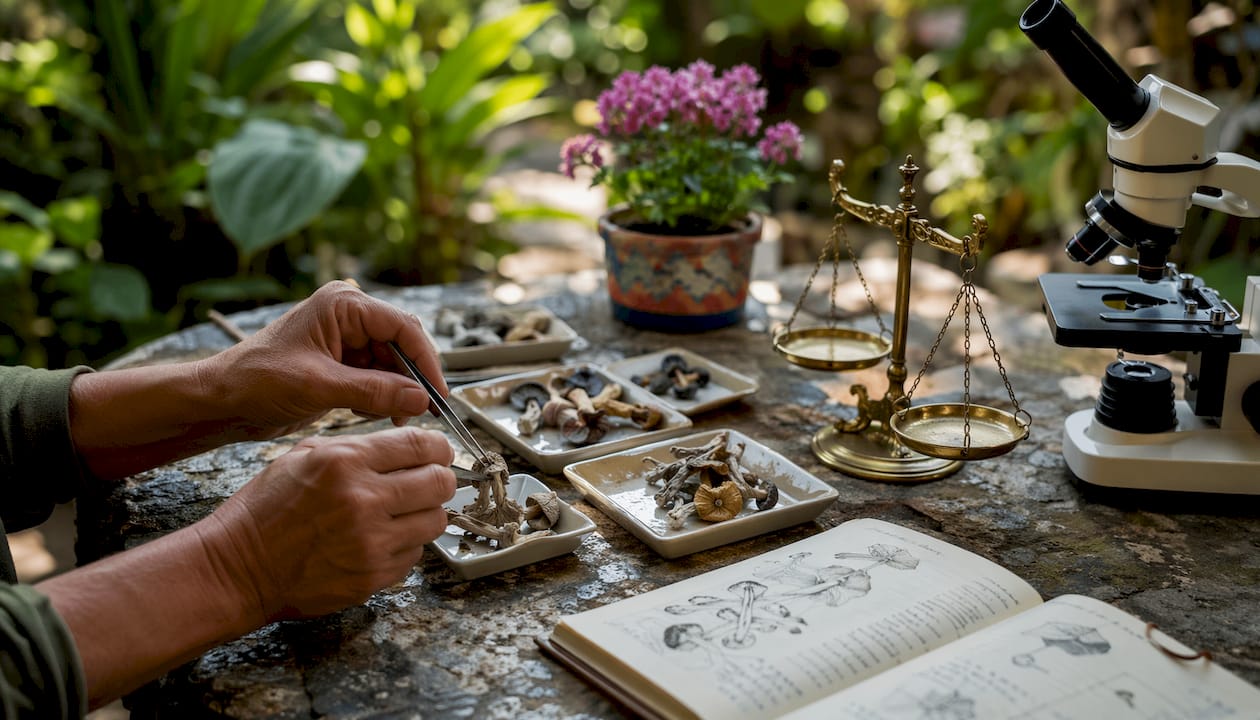
Strain genetics set a ceiling, but they do not guarantee a consistent floor. Coefficients of variation up to 23.39% have been documented within single strains grown under identical lab conditions. That means two mushrooms from the same grow, same substrate, same harvest, can differ significantly in potency.
Caps and stems carry different alkaloid densities. Caps tend to concentrate more psilocybin, while stems carry lower amounts. Eating only caps from a high-potency strain and only stems from another batch creates a compounding inconsistency.
Harvest order also matters. First-flush mushrooms often carry higher alkaloid loads than later flushes from the same substrate block. Potency tends to decline with each successive harvest as the mycelium depletes available nutrients.
Storage degrades alkaloids over time. Heat, light, and moisture accelerate breakdown of psilocybin into less active compounds. Properly dried and vacuum-sealed mushrooms stored in a cool, dark environment retain potency significantly longer.
| Variable | Effect on tryptamine levels |
|---|---|
| Strain genetics | Sets the upper range; Enigma and Toque reach 3.3–3.5% |
| Intra-strain variation | Up to 23% coefficient of variation within same strain |
| Cap vs. stem | Caps typically higher in psilocybin than stems |
| Flush order | First flush generally most potent |
| Storage conditions | Heat and light degrade alkaloids over weeks |
3. What are the key tryptamine compounds and how do they shape effects?
Psilocybin is the primary compound in most psychedelic mushroom strains. The body converts it to psilocin, which crosses the blood-brain barrier and binds serotonin receptors to produce psychoactive effects. Psilocybin itself is pharmacologically inactive until that conversion happens. This is why onset typically takes 20–45 minutes after ingestion.
Baeocystin and norbaeocystin may contribute uniquely to the experience, with researchers suggesting roles in visual intensity and body sensation. Their exact pharmacology is still being studied, but their presence in the alkaloid profile appears to shape the character of the experience beyond what psilocybin alone would predict.
The concept of the “entourage effect” applies here. Just as cannabis alkaloids and terpenes interact to modify each other’s effects, mushroom alkaloids likely work together rather than in isolation. A strain with high psilocybin but low baeocystin may feel different from one with a balanced alkaloid ratio, even at the same total tryptamine dose.
Key alkaloids and their roles:
- Psilocybin: Primary compound; converts to psilocin in the body
- Psilocin: The active molecule; produces visual, cognitive, and emotional effects
- Baeocystin: Possible contributor to body load and visual texture
- Norbaeocystin: Least studied; may modulate overall experience character
Pro Tip: Total alkaloid content shapes the experience more than psilocybin percentage alone. A strain with 1% psilocybin and significant baeocystin may hit harder and differently than a strain with 1.5% psilocybin and minimal supporting alkaloids.
4. How to compare mushroom strains by potency tier
Classifying strains into potency tiers gives you a practical framework for matching a strain to your goal. The three tiers below reflect the range documented in current research.
Low potency (under 0.5% total tryptamines) Strains in this range include many common cubensis varieties sold under generic names. They suit absolute beginners and people microdosing who want the smallest possible active dose. The margin for error is wider, and the experience is easier to manage.
Moderate potency (0.5–1.0% total tryptamines) Golden Teacher sits in this range at roughly 0.6%. This tier covers the majority of widely cultivated cubensis strains. Microdosing benefits depend more on dosing consistency than on potency spikes, making moderate strains the preferred choice for therapeutic protocols.
High potency (above 1.0% total tryptamines) Penis Envy, P. azurescens, Enigma, and Toque all fall here. These strains require dose reduction relative to what you would use with a moderate strain. A standard 3.5g dose of Golden Teacher becomes the equivalent of a much larger dose when swapped for Enigma at 3.5% total tryptamines.
| Potency tier | Total tryptamines | Best use case | Dosing caution |
|---|---|---|---|
| Low | Under 0.5% | Beginners, microdosing | Minimal; wider margin |
| Moderate | 0.5–1.0% | Therapeutic, wellness | Standard caution applies |
| High | Above 1.0% | Experienced users, deep sessions | Significant; reduce dose by 50–75% |
Pro Tip: Precision scales reading to 0.01g are a non-negotiable safety tool when working with high-potency strains. A 0.1g error on Enigma is not the same as a 0.1g error on Golden Teacher.
You can also explore mushroom strain effects in more depth to understand how potency tier translates into real-world mind and body responses.
5. What practical factors affect tryptamine content?
Genetics set the potential. Growing conditions, processing, and storage determine how much of that potential survives to the dose you actually take.
Cultivation variables:
- Substrate: Nutrient-rich substrates like brown rice flour and vermiculite support higher alkaloid expression than depleted or low-nutrition media.
- Temperature and humidity: Stress during fruiting can reduce alkaloid production. Consistent conditions produce more predictable potency.
- Harvest timing: Mushrooms harvested just before the veil breaks tend to carry peak alkaloid loads.
Processing and storage:
- Drying method: Low-temperature drying (under 95°F) preserves alkaloids better than high heat. A food dehydrator set correctly outperforms an oven.
- Homogenization: Grinding a whole batch into powder averages out the cap-to-stem and mushroom-to-mushroom variability. This is the single most practical step for consistent dosing without lab access.
- Storage: Vacuum-sealed, kept in a dark and cool environment, properly dried mushrooms retain potency for months.
Testing and safety:
- Laboratory chemical analysis is the only method that confirms actual tryptamine levels. Home reagent tests like Ehrlich reagent confirm the presence of indole alkaloids but do not quantify them.
- Dose-response relationships with high-potency strains are non-linear. Small increases in dose produce disproportionately intense experiences. This is not a linear scale where twice the dose means twice the effect.
For a structured approach to safe dosing, the 2026 microdosing guide at Theelevatedremedies covers protocols built around potency awareness. If you want to understand how alkaloids work beyond tryptamines, the role of alkaloids in mushrooms resource breaks down health and cognition effects in plain language.
Key Takeaways
Tryptamine content varies by more than sevenfold across mushroom strains, making strain selection and dose calibration the two most critical factors for safe and effective psilocybin use.
| Point | Details |
|---|---|
| Strain potency range | Total tryptamines span 2.62 to 20.65 mg/g across documented strains. |
| Highest potency strains | Enigma, Toque, and P. azurescens lead all documented strains in alkaloid concentration. |
| Intra-strain variability | Same-strain mushrooms can vary up to 23% in potency even under identical grow conditions. |
| Alkaloid profile matters | Total alkaloid mix, not psilocybin alone, shapes the character and intensity of effects. |
| Dosing precision | Grinding whole batches and using 0.01g scales are the two most practical safety steps. |
What I’ve learned about potency that most guides skip
The conversation around mushroom potency almost always focuses on the top end. Which strain is strongest? Which mutation tested highest? That framing misses the more practical problem: variability within a single batch is the real risk, not just the strain label on the bag.
I have seen people dose confidently with a strain they know, get a batch from a different flush or grow, use the same weight, and have a completely different experience. The 23% coefficient of variation is not an abstract number. It shows up in real use. The mushroom you weighed last month and the mushroom you weigh today from the same jar may not be the same dose.
The fix is not complicated. Grind the whole batch. Weigh with a proper scale. Start lower than you think you need to with any new batch, even if it is the same strain name. High-potency strains like Enigma and Penis Envy deserve genuine respect, not just a reduced dose on paper. The non-linear dose-response curve means a small miscalculation hits harder than expected.
For therapeutic and microdosing use, consistency matters more than chasing the highest potency strain. A moderate strain you understand well will serve you better than a high-potency strain you are guessing about. Pair your dose with clear intention and a safe setting. The chemistry is only one part of the equation.
— Juiced
Theelevatedremedies carries quality mushroom products in Ann Arbor
Knowing the science behind tryptamine levels is only useful when the products you buy reflect that quality. Theelevatedremedies, located at 1123 Broadway St in Ann Arbor, Michigan, carries dried magic mushrooms, microdosing capsules, and mushroom chocolates sourced for consistency and quality.
Whether you are building a microdosing protocol or preparing for a more intentional session, the team at Theelevatedremedies can help you match the right product to your goal. For a deeper look at what makes certain strains worth choosing, visit the magic mushroom page for product details and educational context. If you want a broader look at potent options beyond dried mushrooms, extra-strength mushroom chocolates offer a consistent-dose format worth considering.
FAQ
What are tryptamines in mushrooms?
Tryptamines are a class of psychoactive alkaloids that include psilocybin, psilocin, baeocystin, and norbaeocystin. They are the compounds responsible for the psychedelic effects produced by Psilocybe species.
Which mushroom strain has the highest tryptamine content?
Psilocybe azurescens holds the highest documented psilocybin concentration at 1.78% by dry weight. Among cultivated P. cubensis strains, Enigma has tested above 3.5% total tryptamines, making it the most potent cubensis variant on record.
Why does potency vary within the same mushroom strain?
Intra-strain variability reaches up to 23% even under identical growing conditions, driven by differences between caps and stems, harvest flush order, and biological variation within the fruiting body. Grinding a whole batch into powder is the most practical way to reduce this inconsistency.
How should I dose a high-potency mushroom strain?
Reduce your starting dose significantly compared to what you would use with a moderate strain like Golden Teacher. Use a precision scale reading to 0.01g, and treat any new batch as an unknown until you have tested your response at a low dose.
Are high-tryptamine mushrooms better for microdosing?
No. Microdosing benefits depend on consistency, not maximum potency. Low-to-moderate strains are better suited for microdosing protocols because they offer a more predictable dose-response relationship and a smaller margin for error.