
TL;DR:
- Psychedelic harm reduction involves structured practices before, during, and after use to minimize psychological risks and promote positive outcomes. It emphasizes preparation, supportive environments, and integration to increase safety and long-term well-being. Community-based support and accurate information are crucial for effective harm reduction in diverse contexts.
Psychedelic harm reduction is defined as a set of intentional practices designed to minimize psychological and physical risks while increasing the likelihood of safe, beneficial outcomes during psychedelic use. Unlike harm reduction for opioids or alcohol, the primary risks are psychological rather than physiological, meaning the biggest dangers come from uncontrolled settings, poor preparation, and lack of support rather than toxicity alone. Organizations like the Zendo Project and clinical frameworks like the Psychedelic Harm Reduction and Integration model (PHRI) have formalized these practices into structured, evidence-backed approaches. Whether you are using psilocybin mushrooms for the first time or have years of experience, understanding harm reduction in psychedelics is the foundation of every responsible session.
What is harm reduction in psychedelics, and why does it matter?
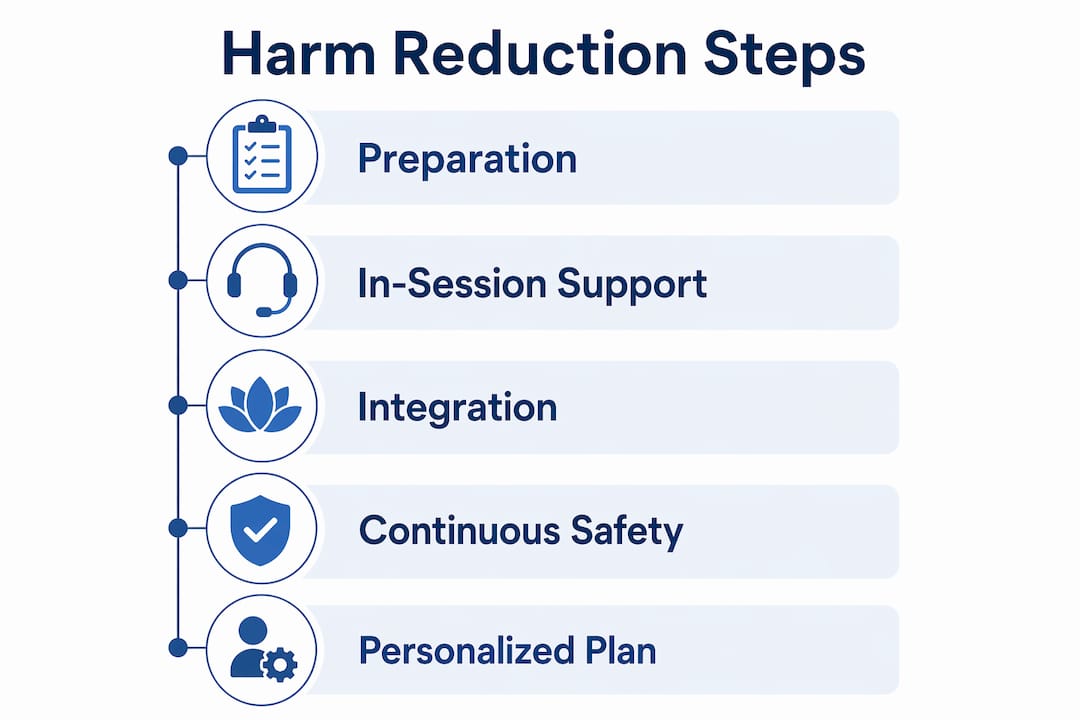
Harm reduction in psychedelics refers to a structured, three-phase approach covering preparation before use, support during the experience, and integration afterward. A 2025 PubMed review confirmed that physical risks from classic psychedelics like psilocybin are low, but psychological risks in uncontrolled settings are meaningfully higher. That distinction matters because most people using psychedelics today are doing so outside clinical trials, at home, at festivals, or in informal group settings.
The core insight is this: harm reduction does not eliminate risk, but it dramatically shifts the odds in your favor. Research shows that more harm reduction practices correlate with more positive emotional breakthroughs and fewer difficult experiences. That is not a coincidence. Preparation, environment, and post-session support each act as a layer of protection, and together they form what the PHRI model calls a multi-layered safety net.
Harm reduction also applies across the full spectrum of psychedelic use. Whether you are microdosing versus taking a full dose, the principles of intention, setting, and integration remain relevant. The scale of the experience changes, but the framework does not.
What are common harm reduction strategies before psychedelic use?
Preparation is where most of the real safety work happens. The decisions you make before a session determine the ceiling of what can go wrong during it. Community-based research identifies several pre-use harm reduction steps that experienced users consistently recommend:
- Set a clear intention. Know why you are using psychedelics. Curiosity, healing, creativity, and spiritual exploration are all valid, but vague or impulsive motivations increase the chance of a disorienting experience.
- Control your environment. Choose a space that feels safe, familiar, and free from unexpected interruptions. A comfortable home setting beats an unfamiliar venue every time.
- Source responsibly. Obtain psychedelics from trusted, reputable sources. Accurate dosing starts with knowing what you actually have.
- Use drug checking. While harmful adulterants like fentanyl are rare in psychedelic samples, testing your substance with a reagent kit or a drug checking service removes one layer of uncertainty entirely.
- Measure your dose accurately. A milligram-precise scale is not optional for anyone serious about safety. Eyeballing doses is one of the most common avoidable mistakes.
- Plan your timing. Allow a full day with no obligations. Rushing a psychedelic experience because of a commitment later in the day creates unnecessary pressure.
- Arrange a sitter. A trusted, sober person present during the session is one of the highest-value safety decisions you can make, especially for higher doses or first experiences.
Experience level genuinely shapes which of these steps people prioritize. First-time users tend to focus on setting and dosage, while more experienced users often invest more in intention and integration planning. Both are right for where they are.
Pro Tip: Match your harm reduction plan to your actual motivation for the session. Someone using psilocybin for grief processing needs different preparation than someone exploring it recreationally. A one-size approach misses the point entirely.
How to practice harm reduction during the psychedelic experience
Once the experience begins, harm reduction shifts from planning to presence. The goal is to create conditions where the experience can unfold without unnecessary interference, while having support structures ready if things become difficult.
- Have a sitter you trust. The Zendo Project, which has over a decade of peer support experience at festivals and events worldwide, trains sitters specifically in compassionate psychedelic care. Their core principle is “sitting, not guiding.” A good sitter does not direct the experience. They hold space.
- Minimize external stimulation. Loud music, bright lights, and unexpected visitors all increase the chance of a disorienting moment becoming a difficult one. Curated playlists, dim lighting, and a tidy space reduce cognitive load during the experience.
- Recognize psychological challenges without fighting them. Fear, ego dissolution, and emotional intensity are common at moderate to high doses. The PHRI framework teaches that resisting difficult states often amplifies them. Accepting and moving through them is the more effective response.
- Use grounding techniques. Slow, deliberate breathing, physical contact with the floor or a blanket, and gentle body awareness all help anchor attention when the experience feels overwhelming.
- Avoid risky behaviors. Do not drive, operate machinery, or make significant decisions during a session. This sounds obvious, but impaired judgment during a psychedelic experience can lead to real-world consequences that preparation cannot undo.
Pro Tip: If someone in your group is having a difficult experience, the most effective response is calm, compassionate presence. Avoid trying to talk them out of what they are feeling. Acknowledge it, stay close, and let the experience move through them.
What does harm reduction look like after use? The role of integration
Integration is not a bonus step. It is a core harm reduction intervention that addresses the psychological volatility that can follow a significant psychedelic experience. The days and weeks after a session often bring heightened emotional sensitivity, shifts in perspective, and sometimes distress. Without intentional processing, those states can become destabilizing rather than transformative.
The PHRI clinical model treats integration as a structured process focused on psychological flexibility, meaning the ability to hold new insights without being overwhelmed by them. This involves journaling, somatic practices, therapy with a psychedelic-informed counselor, and community support groups. For many people, the integration period is where the real value of the experience gets locked in.
| Integration practice | Benefit |
|---|---|
| Journaling within 24 hours | Captures insights before they fade and identifies emotional themes to process |
| Somatic movement or yoga | Releases physical tension stored during the experience and reconnects body awareness |
| Psychedelic-informed therapy | Provides professional support for processing difficult material or trauma that surfaced |
| Community integration circles | Reduces isolation and normalizes the range of post-experience emotions |
| Rest and reduced stimulation | Allows the nervous system to recalibrate without additional stress inputs |
The window immediately after a session is also when people are most vulnerable to making impulsive decisions based on the emotional intensity of what they just experienced. Slowing down, avoiding major life changes for at least a week, and talking to someone you trust are all practical harm reduction steps that cost nothing but time.
How do harm reduction strategies vary by individual experience and context?
No two people need the same harm reduction plan. A dosage and setting feedback loop means that the strategies most relevant to you depend on what you are taking, how much, where, and why. This is one of the most underappreciated aspects of psychedelic safety guidelines.
Several factors shape which practices matter most for any given person or session:
- Dosage. A microdose requires minimal preparation compared to a high-dose ceremony. The higher the dose, the more layers of support become necessary.
- Experience level. First-time users benefit most from conservative dosing, a sitter, and a familiar setting. Experienced users may need less hand-holding but more attention to intention and integration.
- Motivation. Recreational use, therapeutic exploration, and spiritual practice each carry different risk profiles and call for different preparation.
- Social context. Using alone carries different risks than using in a group. Festival settings introduce variables like noise, strangers, and unpredictable environments that require additional planning.
- Mental health history. A personal or family history of psychosis or bipolar disorder significantly changes the risk calculus and warrants consultation with a healthcare provider before any use.
One persistent challenge is that low uptake of drug checking and distrust of official harm reduction services limit effectiveness in community settings. Trusted peer networks and accessible education consistently outperform institutional campaigns in reaching people who actually use psychedelics. This is why community-based resources and peer-trained support matter so much. You can learn more about psychedelic blends and safety to understand how substance combinations change the risk profile entirely.
What are common misconceptions about psychedelic harm reduction?
The most persistent misconception is that harm reduction enables or excuses drug use. It does not. Harm reduction focuses on reducing immediate risk and supporting personal autonomy, not on promoting use or replacing recovery pathways. It is a practical framework that meets people where they are.
Several other misunderstandings are worth addressing directly:
- “If it’s natural, it’s safe.” Psilocybin mushrooms are natural, but dose, set, and setting still determine whether an experience is beneficial or harmful. Natural does not mean risk-free.
- “Harm reduction is only about physical safety.” The psychological dimension is where most of the real risk lives. Emotional preparation and post-session integration are just as critical as knowing your dose.
- “Experienced users don’t need harm reduction.” Research shows experienced users actually adopt more harm reduction practices over time, not fewer. Experience teaches respect for the process, not immunity from it.
- “One safety tactic is enough.” Relying only on a trusted setting, or only on drug checking, leaves gaps. The multi-layered approach is the point.
Pro Tip: Harm reduction and abstinence are not opposites. Someone who chooses not to use psychedelics and someone who uses them with full preparation and support are both making informed, autonomous decisions. The goal is always informed choice.
Key takeaways
Psychedelic harm reduction works because it addresses the actual risk profile of these substances: psychological, context-dependent, and highly responsive to preparation and support.
| Point | Details |
|---|---|
| Harm reduction is three-phase | Preparation, in-session support, and integration each address distinct risk windows. |
| Psychological risk is primary | Physical toxicity is low; uncontrolled settings and poor preparation drive most harms. |
| Integration is not optional | Post-session processing is a core intervention, not an afterthought, for long-term well-being. |
| Context shapes strategy | Dosage, motivation, and setting determine which harm reduction practices matter most for you. |
| Peer support outperforms institutions | Trusted community networks increase uptake of safety practices more effectively than official campaigns. |
Why harm reduction is the most honest conversation in psychedelics right now
People are using psychedelics in growing numbers, in their homes, at retreats, and at festivals, mostly without clinical oversight. That is the reality. Pretending otherwise does not make anyone safer.
What I find genuinely compelling about the current research is that harm reduction is not just about avoiding bad outcomes. It is about increasing the probability of meaningful, positive experiences. That reframes the entire conversation. You are not just protecting yourself from a bad trip. You are actively building the conditions for something valuable to happen.
The PHRI model gets this right. It treats the full arc of a psychedelic experience, from preparation through integration, as a single therapeutic container. That is not overcautious. That is just good design. And the Zendo Project’s decade-plus of peer support work at real-world events proves that compassionate, non-clinical support is both scalable and effective.
The part most people skip is integration. I have seen it repeatedly. Someone has a profound experience, feels transformed for a few days, and then the insights fade because there was no structure to hold them. Integration is where the experience becomes a resource rather than just a memory. If you take one thing from this article, make it that.
Harm reduction is not a ceiling on your experience. It is the floor that makes the ceiling possible.
— Juiced
Explore safe psychedelic use with Theelevatedremedies
Theelevatedremedies is Ann Arbor’s go-to destination for quality psilocybin products and honest education about safe use. If you are putting harm reduction principles into practice, starting with accurately dosed products is one of the most concrete steps you can take. Our mushroom capsules are sourced for consistency and designed for people who take dosing seriously, whether you are microdosing for wellness or preparing for a deeper experience. Explore our full range of magic mushroom wellness tips for guidance that aligns directly with the preparation and integration principles covered here. Stop by 1123 Broadway St in Ann Arbor, or browse online. Our team is here to help you make informed decisions.
FAQ
What is psychedelic harm reduction in simple terms?
Psychedelic harm reduction is a set of practices used before, during, and after a psychedelic experience to minimize psychological and physical risks. It covers preparation, environment, dosing, sitter support, and post-session integration.
Is drug checking worth it for psychedelics?
Drug checking is a valuable safety step even though harmful adulterants are rare in psychedelic samples. It removes uncertainty about what you are consuming and is especially important when sourcing from unfamiliar channels.
What is integration and why does it matter?
Integration is the process of making sense of a psychedelic experience through reflection, therapy, journaling, or community support after the session ends. Research identifies it as a core harm reduction intervention that reduces post-session distress and supports long-term psychological well-being.
Do experienced users still need harm reduction practices?
Yes. Research shows that more experienced psychedelic users actually adopt more harm reduction practices over time, not fewer. Experience increases awareness of what can go wrong, not immunity from it.
How is harm reduction different from enabling drug use?
Harm reduction focuses on reducing immediate risk and supporting informed personal choice. It does not promote drug use or replace recovery pathways. It is a practical framework that prioritizes safety and autonomy over judgment.
Recommended
- Defining Psychedelic Blends: Types, Effects, and Safety – Elevated Remedies
- Magic Mushrooms Explained: Science, Safety & Wellness Guide – Elevated Remedies
- Michigan guide: psilocybin product examples & safe use – Elevated Remedies
- How to purchase psychedelic mushrooms safely in Michigan – Elevated Remedies