
TL;DR:
- Not all magic mushroom strains are identical, and Koh Samui stands out for its clear-headed, uplifting effects favored by wellness seekers. Its moderate potency, natural landrace origin, and sociable experience make it popular in Michigan, despite federal illegality. Microdosing benefits remain self-reported and scientifically inconclusive, so users should start with low doses, source reputable products, and prioritize safety and informed choices.
Not all magic mushrooms hit the same. If you’ve heard that one strain is basically interchangeable with another, that idea deserves a serious second look. The Koh Samui strain has built a distinct reputation among experienced users and wellness-minded beginners alike, valued for a profile that feels different from the strains most people encounter first. Interest in psilocybin for mental wellness is climbing across Michigan, and curiosity about specific strains like Koh Samui is growing right along with it. This guide walks you through what makes Koh Samui stand out, how it works in the body, what microdosing research actually says, and how to stay safe and informed in Michigan.
Table of Contents
- What sets Koh Samui mushrooms apart?
- How Koh Samui mushrooms work: Effects, timeline, and wellness
- Microdosing Koh Samui mushrooms: What’s proven and what’s hype
- Safety, sourcing, and legal considerations in Michigan
- The uncomfortable truth: Why personal experience often trumps the science (for now)
- Explore safe, quality mushroom wellness options with Elevated Remedies
- Frequently asked questions
Key Takeaways
| Point | Details |
|---|---|
| Koh Samui’s appeal | Koh Samui mushrooms offer a distinct profile valued by many for their balanced, clear effects. |
| Evidence vs. experience | Michigan users report benefits from microdosing, but rigorous studies show limited confirmed results. |
| Safety comes first | Always prioritize reputable, lab-tested products and check legal guidelines before sourcing or using mushrooms in Michigan. |
| Application matters | Approach microdosing with caution, start low, and focus on both research and personal experience to guide your wellness journey. |
What sets Koh Samui mushrooms apart?
The Koh Samui strain takes its name from the Thai island where it was originally collected. Ko Samui is a tropical island in the Gulf of Thailand, and the humid, warm climate there shaped a mushroom with distinct physical and chemical characteristics. Ethnomycologist John Allen is widely credited with bringing this strain to wider attention after collecting samples during travels through Southeast Asia in the 1990s. That backstory matters because it tells you something important: this isn’t a lab-created hybrid. It’s a landrace strain, meaning it evolved naturally in a specific environment before being cultivated more broadly.
Visually, Koh Samui mushrooms tend to grow shorter and stockier than strains like Golden Teacher or B+. They often have a caramel to golden-brown cap with a thick, dense stem. Growers frequently note that Koh Samui fruits abundantly and colonizes relatively quickly, making it popular in cultivation circles. But for wellness seekers in Michigan, appearance matters less than what the experience actually feels like.
Users consistently describe Koh Samui as producing a clear-headed, functional high compared to some more visually intense strains. Many report that the experience feels uplifting and sociable rather than disorienting. That reputation makes it particularly interesting for people who want to explore psilocybin but feel cautious about losing clarity or feeling overwhelmed. The comparing mushroom strains breakdown is worth reading if you want to put Koh Samui in context with other popular varieties.
In terms of potency, Koh Samui falls in a moderate range. Psilocybin converts to psilocin in the body, interacting with serotonin receptors to produce effects that typically last four to six hours, with potency varying considerably by strain and individual biology. That variability is real, and Koh Samui is no exception.
| Characteristic | Koh Samui | Golden Teacher | B+ |
|---|---|---|---|
| Origin | Thailand (landrace) | Unknown/cultivated | Cultivated hybrid |
| Cap appearance | Caramel/golden, wide | Golden with wavy cap | Light brown, large |
| Reported experience | Clear, uplifting, sociable | Introspective, gentle | Warm, visual, euphoric |
| Potency range | Moderate | Low to moderate | Moderate |
| Common use | Wellness, social, microdose | First-timer, therapy | Recreation, exploration |
Key traits Michigan users highlight about Koh Samui:
- Relatively manageable intensity, especially at lower doses
- Clear-headed quality compared to strains with stronger visual effects
- Uplifting mood shift reported frequently in community reviews
- Solid yield during cultivation, meaning wider availability
- Reputation for consistency across grows when conditions are controlled
Pro Tip: If you’re new to psilocybin and considering Koh Samui, the clear-headed reputation is appealing, but starting low still applies. Even moderate strains can produce strong effects if your set and setting aren’t right.
How Koh Samui mushrooms work: Effects, timeline, and wellness
Now that you know why Koh Samui stands out, it’s crucial to understand exactly how these mushrooms work in the body and what to expect from their use.
When you consume psilocybin mushrooms, your digestive system breaks down psilocybin into psilocin. Psilocin is the compound that actually crosses the blood-brain barrier and binds primarily to serotonin receptors, especially the 5-HT2A receptor. This binding disrupts the brain’s default mode network (the part responsible for self-referential thinking and the mental chatter that runs constantly in the background). That disruption is widely thought to be behind the shifts in perception, emotion, and thought that characterize a mushroom experience.
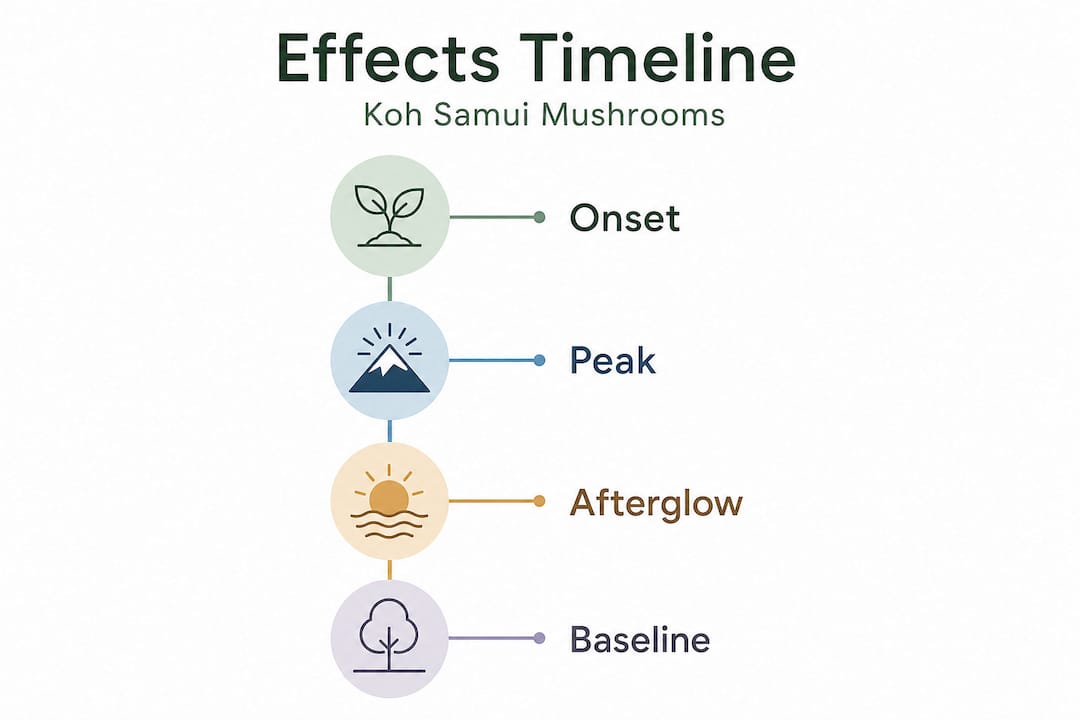
For most people, the mushroom effects workflow follows a recognizable pattern. Onset typically begins 20 to 60 minutes after ingestion. The peak hits somewhere between 90 minutes and three hours. Effects then gradually taper over the following two to three hours. Total duration lands in the four to six hour range for most people, though this depends heavily on dose, body weight, metabolism, and what you ate beforehand.
With Koh Samui specifically, users in wellness-focused communities frequently note that the experience feels more present than some other strains. Less dreamlike. More connected to actual surroundings. That quality makes it appealing for people curious about psilocybin for social connection, creative work, or emotional processing without wanting to feel completely untethered.
Commonly reported wellness benefits from Koh Samui and psilocybin generally:
- Elevated mood and reduced emotional heaviness
- Increased sense of connection to other people and the environment
- Heightened creativity and novel thinking
- Reduced rumination (less “stuck” mental patterns)
- Feelings of gratitude and perspective shifts
The wellness angle has real data behind it, at least at the observational level. Self-reported microdosing improvements in wellbeing, productivity, creativity, and focus were documented in an observational study of 1,435 participants. That’s a large sample with meaningful patterns, even if it isn’t a randomized controlled trial.
| Experience type | Typical dose (dried mushroom) | What to expect |
|---|---|---|
| Microdose | 0.05 to 0.3g | Sub-perceptual, subtle mood lift |
| Low/museum dose | 0.5 to 1g | Mild perceptual shifts, social ease |
| Moderate dose | 1 to 2.5g | Clear psychedelic effects, introspection |
| Higher dose | 2.5g+ | Strong visuals, ego dissolution possible |
What Michigan users should keep in mind:
- Individual variability is real. Same dose, very different experiences between two people.
- Empty stomach means faster onset and potentially stronger effects.
- Anxiety before the experience can shape how it unfolds. Mindset matters.
- Avoid combining with SSRIs or MAOIs without serious research and medical guidance.
Microdosing Koh Samui mushrooms: What’s proven and what’s hype
With the basic effects explained, let’s dig into microdosing, a major trend among Michigan wellness explorers.
Microdosing means taking psilocybin at doses too low to produce noticeable psychedelic effects, typically somewhere between 0.05g and 0.3g of dried mushrooms. The goal isn’t to trip. It’s to access subtle improvements in mood, focus, or creativity while functioning completely normally throughout the day. Koh Samui’s clear-headed reputation makes it a natural candidate for this approach.
The evidence picture on microdosing is genuinely complicated, and honesty about that complexity matters. Here’s what the research currently shows:
-
Observational data looks promising. The large observational study mentioned above found self-reported improvements across wellbeing, productivity, creativity, and connectedness among people who microdosed on dosing days. This matches what a huge number of users report anecdotally.
-
Controlled trials tell a different story. Placebo-controlled trials and meta-analyses have found no significant cognitive benefits from psilocybin microdosing, with mixed results for mood and depression. When you control for placebo effects, the signal gets much weaker.
-
The expectation effect is powerful. People who believe microdosing will help them tend to report that it did. This isn’t unique to mushrooms. It’s a well-documented feature of how humans perceive and report wellness interventions.
-
Research is still early. Most placebo-controlled microdosing studies have used small samples over short timeframes. The science isn’t settled, and dismissing all microdosing benefits because of current study limitations would be as overreaching as claiming it’s definitely transformative.
“The gap between what people self-report and what controlled studies measure isn’t proof that microdosing doesn’t work. It’s proof that we don’t yet have the tools to fully measure what’s happening.”
So where does that leave a Michigan beginner thinking about trying Koh Samui for microdosing? Here’s a grounded approach:
-
Define your intention clearly. What are you hoping to notice? Mood, focus, creativity, reduced anxiety? Having a specific target helps you evaluate results honestly rather than just hoping to “feel better.”
-
Start very small. Many experienced microdosers start at 0.05g to 0.1g and adjust slowly over several weeks. Lower than you think is almost always the right starting point.
-
Follow a dosing schedule. The most common protocols involve one dosing day followed by two or three off days. This prevents tolerance buildup and makes it easier to notice effects clearly.
-
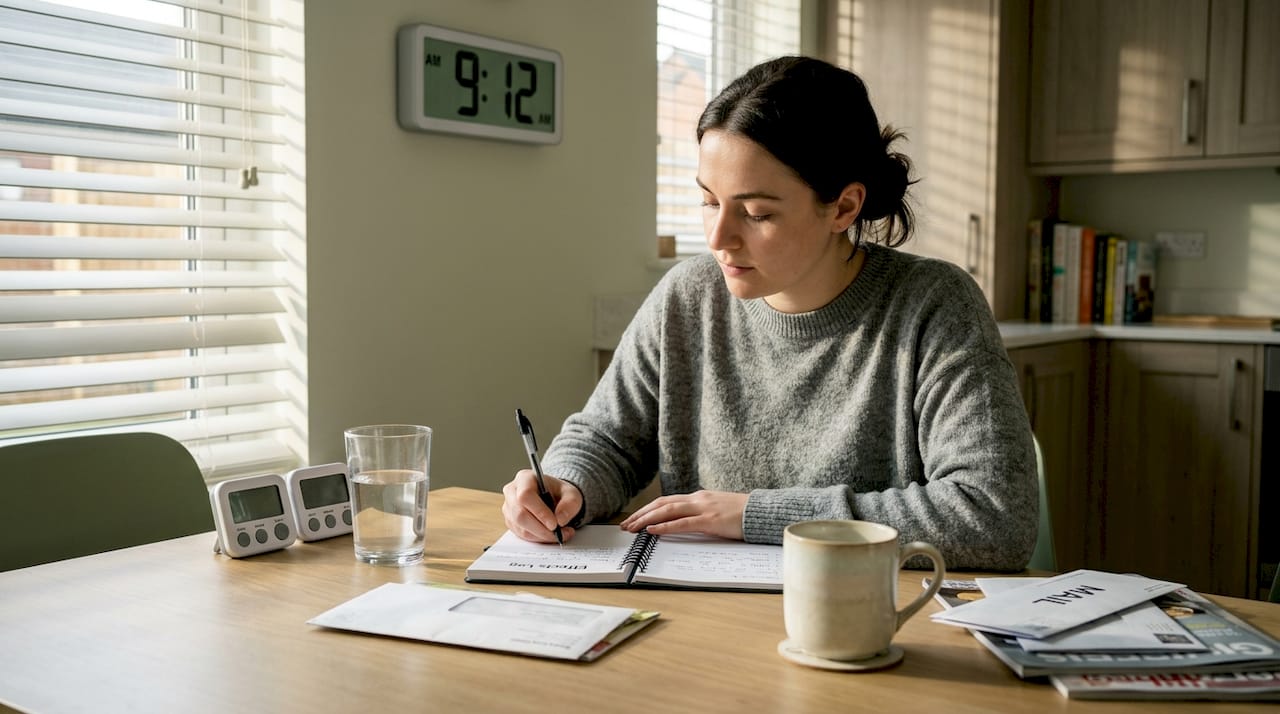
Keep a journal. Mood, sleep, focus, social interactions. Written observations cut through the noise of expectation much better than memory alone.
-
Respect the pause. If something feels off on a dosing day, skip it. Microdosing should always feel like a conscious choice, not a routine you feel locked into.
For a deeper look at whether microdosing is appropriate for anxiety specifically, the microdosing for anxiety guide is worth your time. And if you’re trying to figure out whether microdosing or a full psychedelic experience fits your goals better, the psychedelic vs microdosing breakdown lays that out clearly.
Pro Tip: Track your baseline for one full week before your first microdose day. Write down your mood, energy, and focus ratings each evening. Having real baseline data makes it far easier to notice genuine changes versus expectation.
Safety, sourcing, and legal considerations in Michigan
No matter your interest level, safety and legality should come first, especially in Michigan. Here’s what you need to know.
Psilocybin remains a Schedule I substance federally, which means it’s illegal to possess, sell, or use under federal law. Michigan has not passed state-level decriminalization or legalization of psilocybin mushrooms as of 2026, though certain Michigan cities like Ann Arbor have taken steps to deprioritize enforcement of personal use. Ann Arbor specifically passed a resolution in 2020 making personal possession and use of entheogenic plants among the city’s lowest law enforcement priorities. That’s meaningfully different from legal, and it’s important not to confuse the two.
Key safety and sourcing practices for Michigan users:
- Source from identifiable, reputable suppliers. Products with transparent sourcing and clear labeling reduce the risk of contamination or inaccurate dosing.
- Prioritize lab-tested products when available. Testing for purity and potency matters, especially for capsules or chocolates where the dose is harder to eyeball.
- Avoid combining with prescription medications without researching interactions carefully. SSRIs and MAOIs carry specific and serious risks when mixed with psilocybin.
- Choose your environment deliberately. First experiences especially should happen in a safe, familiar space with a trusted person present.
- Know the signs of a difficult experience. Extreme anxiety, paranoia, or disorientation can occur. Having someone present who can help you stay grounded is not optional for higher doses.
The Michigan psilocybin safety resource gives detailed guidance tailored specifically to Michigan users navigating this landscape. For questions about product form, the dried mushrooms vs. chocolates comparison is a practical starting point for beginners trying to decide how they want to consume.
Pro Tip: If you’re unsure about legality in your specific city or situation in Michigan, err toward caution and consult a legal resource before acting. Ann Arbor’s deprioritization policy applies locally and is not a legal shield.
The uncomfortable truth: Why personal experience often trumps the science (for now)
Here’s what most articles on psilocybin won’t say directly: the scientific method, as currently applied to psychedelics, is genuinely bad at capturing what many people experience. That’s not an attack on science. It’s an observation about the limits of blinding, placebo design, and short study windows when the intervention being studied profoundly changes how people interpret their own inner lives.
The observational data showing self-reported wellness improvements from microdosing reflects something real about thousands of people’s lived experience. The placebo-controlled data showing weak effects is also methodologically sound. Both things are true at the same time. What that tension really tells us is that the science isn’t ready to confirm or deny what many Michigan users feel in their bones.
What fills that gap right now is community. People in Michigan who are exploring psilocybin for wellness are sharing protocols, journaling their experiences, and building informal support networks. That kind of practical, communal knowledge-building isn’t a replacement for controlled research, but it’s not nothing either. It’s how humans have always navigated territory that institutions haven’t mapped yet.
The wellness mushroom insights resource reflects this tension honestly. Our take is this: base your choices on the best evidence available, hold your conclusions loosely, go slowly, and stay curious. The people getting the most out of psilocybin exploration in Michigan aren’t the ones who went all-in based on hype. They’re the ones who treated it like a practice worth learning carefully, not a shortcut.
Explore safe, quality mushroom wellness options with Elevated Remedies
Ready to explore with confidence? Elevated Remedies in Ann Arbor is built for exactly this moment in Michigan’s wellness scene.
Whether your interest in Koh Samui has you curious about capsules for microdosing, or you want to explore adjacent options like our mushroom gummies or learn more about Amanita muscaria as an alternative, our team is ready to help you find what fits your goals. Our mushroom capsules are a popular starting point for Michigan microdosers who want precise, consistent dosing without guesswork. Everything we carry is selected for quality and consistency, and our staff can walk you through options in plain language. Come see us at 1123 Broadway St, Ann Arbor, MI.
Frequently asked questions
Are Koh Samui mushrooms legal to use in Michigan?
Psilocybin mushrooms, including Koh Samui, are classified as Schedule I federally, making possession and use illegal in Michigan outside of approved research contexts, though Ann Arbor has deprioritized personal use enforcement locally.
What makes the Koh Samui strain unique compared to other magic mushrooms?
Koh Samui is a Southeast Asian landrace strain with a reputation for producing clear-headed, uplifting effects. Because potency varies by strain, its moderate range and sociable quality distinguish it from more intensely visual or introspective varieties.
Does microdosing Koh Samui mushrooms really boost mood or productivity?
The answer depends on which evidence you weight. Large observational studies show self-reported improvements in mood, creativity, and productivity, while placebo-controlled trials show inconsistent or negligible effects beyond placebo.
What should a beginner know to microdose safely in Michigan?
Start at a very low dose, track your baseline before you begin, and only source products with clear labeling and verifiable quality. Understanding that psilocybin is federally illegal and knowing your local legal context before starting is non-negotiable.
Recommended
- Magic Mushrooms Explained: Science, Safety & Wellness Guide – Elevated Remedies
- Top magic mushroom wellness tips for safe, effective use – Elevated Remedies
- Magic mushroom consumption: Safe steps for Ann Arbor users – Elevated Remedies
- Magic mushroom dosage guide: safe & effective use in Michigan – Elevated Remedies