
The Fadiman microdosing schedule follows a 1/3/1 pattern: take a microdose on day one, rest for two days, then repeat. Most people run this cycle for 4 to 8 weeks, followed by a 2 to 4 week break before starting again. The evidence behind it is mostly observational, drawn from self-reports rather than controlled trials, so treat it as a structured experiment, not a verified treatment, and talk to a doctor before you start.
TL;DR:
- The 1/3/1 microdosing schedule reduces tolerance buildup and enhances personal contrast by spacing doses every three days, with two rest days in between.
- Doses typically range from 0.05 to 0.15 grams of dried mushrooms or 5 to 15 micrograms of LSD, with calibration tools essential due to potency variability.
- Most cycles last 4 to 8 weeks, with a mandatory 2 to 4 week break to reset tolerance and maintain schedule effectiveness.
- Self-blinding studies reveal perceived benefits may stem more from placebo effects and expectation than actual pharmacological action.
- Consistent, lab-tested products and careful tracking are key to effective microdosing, with professional advice recommended before starting.
Table of Contents
- What Is the Fadiman Protocol and Why Do People Use It?
- How Much Should You Take, and How Do You Measure It?
- How Long Should a Fadiman Cycle Run?
- What Does the Actual Evidence Show?
- How Do You Track Doses Safely and Watch for Problems?
- How Do You Know If the Cycle Is Working?
- What a Consistent Microdosing Routine Actually Requires
- What Fadiman Got Right (and What He Couldn’t Have Known)
- Where to Find Dosing-Friendly Microdosing Products
- Sources
- FAQ
What Is the Fadiman Protocol and Why Do People Use It?
James Fadiman didn’t invent microdosing, but he did more than anyone to organize it into something people could actually follow. As a psychologist who spent decades studying psychedelics, Fadiman collected self-reports from thousands of people experimenting with tiny doses of psilocybin or LSD, then distilled a pattern that showed up again and again in his correspondence: dose, rest, rest, repeat. That rhythm became known as the Fadiman protocol or the 1/3/1 schedule.
The math is simple. If your dose day is day 1, your rest days are day 2 and day 3, and day 4 becomes your next dose day. Then day 5, 6, rest, and day 7 is dose day again. Mapped across a week, a dose day tends to land on days 1, 4, and 7, which is why some people call it “every third day” instead of 1/3/1. Both descriptions point to the same calendar.
Why two rest days instead of one, or none at all? Two reasons keep surfacing in the research and in practitioner write-ups.
- Tolerance management. Psychedelics act on the 5-HT2A serotonin receptor, and that receptor down regulates fast with repeated daily exposure. Spacing doses by 72 hours gives receptors time to reset, which is part of why daily “stacking” style approaches (closer to what mycologist Paul Stamets popularized) work on a different biological assumption than Fadiman’s.
- Within person contrast. Two full rest days give you a clean baseline to compare against. If day 1 felt sharper than day 2 or day 3, you have something to actually journal and compare, rather than a blurred week where every day looks the same.
That contrast is the whole point of the schedule, according to the systematic review of microdosing psychedelics, which describes the 1/3/1 rhythm as the most commonly documented microdosing pattern in self-reported data. The review also traces the surge in interest back to Fadiman’s own writing and the online communities that grew around it.
The Fadiman vs. Stamets question comes up constantly, and the short answer is that they’re built on different theories. Stamets stacking runs days on followed by days off, often paired with lion’s mane mushroom and niacin, based on the idea that near-daily exposure supports neurogenesis. Fadiman’s approach assumes less is more: minimize total exposure, maximize contrast, and let the rest days do the work. Neither has been validated head to head in a controlled trial, so the choice mostly comes down to which theory resonates and how your body responds.

How Much Should You Take, and How Do You Measure It?
Conservative is the operating word here. Practitioner guides built around Fadiman’s protocol, including iMicrodosing’s breakdown of the schedule, point to psilocybin ranges around 0.05 to 0.15 grams of dried mushroom per dose, and LSD ranges around 5 to 15 micrograms. Those numbers describe a sub-perceptual or barely-perceptual dose, meaning you should not feel intoxicated, visually altered, or impaired. If you feel high, the dose was too much.
Potency variability is the single biggest reason people get inconsistent results. Dried mushrooms from different batches, different strains, or even different parts of the same cap can vary in psilocybin content by a wide margin, so eyeballing a dose from a whole dried mushroom is guesswork dressed up as precision. A milligram scale is the minimum tool for anyone measuring dried material at home. Pre-measured capsules or lab-tested edibles remove that guesswork entirely, which is part of why calibrated products have become popular with people who want to run the protocol without a scale on their kitchen counter.
Here’s a practical way to titrate without overshooting:
- Start at the low end. Begin around 0.05 grams dried psilocybin equivalent, or 5 micrograms for LSD, rather than jumping to the middle of the range.
- Test for sub-perceptual threshold. On your first dose day, go about your normal routine and note whether you feel anything at all. A trace of color enhancement or mild focus shift is common; visual distortion or a body high means you went too high.
- Adjust slowly across 2 to 3 dose days. If the first dose produced nothing noticeable and no useful mood or focus shift, increase by a small increment on your next dose day, not your next dose hour.
- Hold once you find your range. Most people land somewhere in the stated range and stay there for the rest of the cycle rather than continuing to escalate.
Pro Tip: Keep your dose day products in a labeled, dated container separate from anything else in your stash. Mixing up a microdose capsule with a full dose capsule is one of the most common and entirely avoidable mistakes people report.
Product format matters more than people expect. A dried mushroom you weigh yourself carries the batch-to-batch variability problem baked in. A capsule or gummy made from a homogenized, lab-tested batch does not, because the potency per unit has already been standardized. That consistency is exactly why format choice belongs in the same conversation as dosing math, not as an afterthought.
How Long Should a Fadiman Cycle Run?
Most guidance settles on a 4 to 8 week cycle, followed by 2 to 4 weeks completely off before starting again. That off cycle isn’t a suggestion to ignore once things are going well. It’s the part of the protocol that keeps tolerance from creeping up and keeps you from losing the baseline contrast that makes the whole schedule useful in the first place.
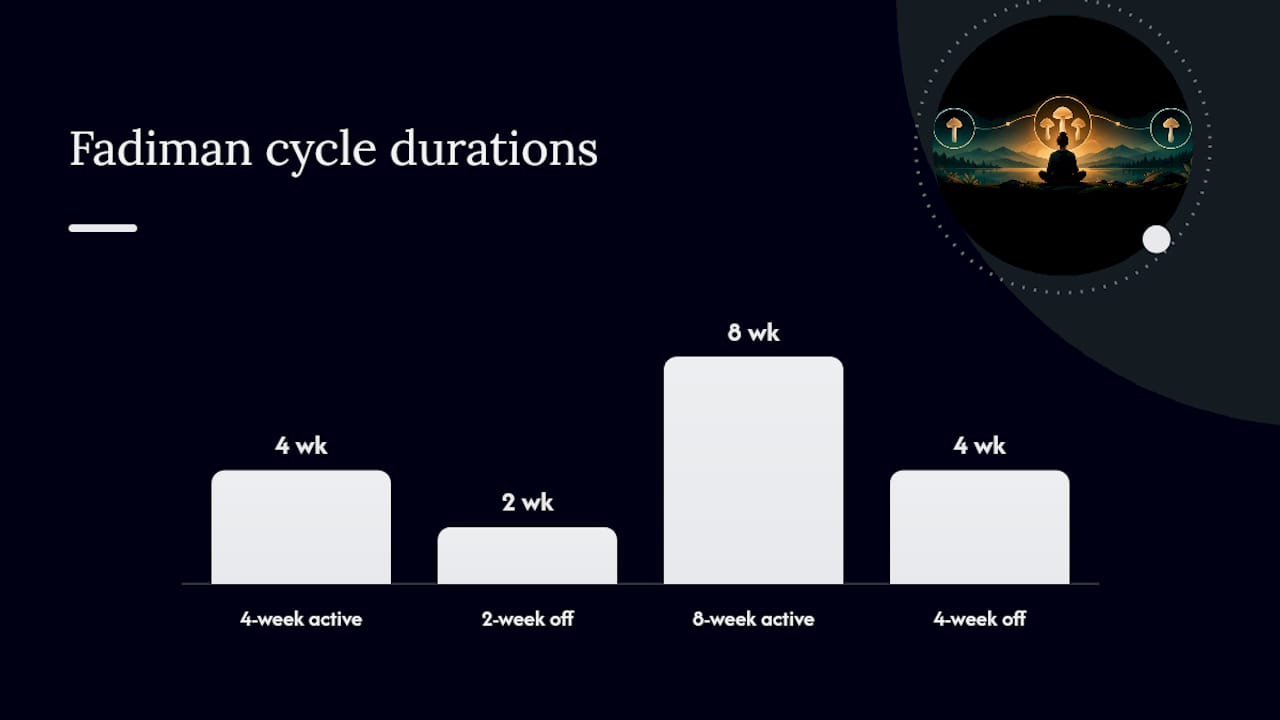
The dose day math is worth doing before you commit to a length. On a strict 1/3/1 rhythm, a 4 week cycle produces roughly 9 to 10 dose days, according to a practitioner comparison of Fadiman and Stamets protocols. Double the cycle to 8 weeks and you roughly double the dose days, landing around 18 to 20. That’s meaningfully fewer total exposures than a Stamets-style four-on, three-off schedule run over the same window, which is part of the appeal for people who want to minimize cumulative exposure while they figure out if microdosing does anything for them at all.
How do you pick between a 4 week and 8 week starting point?
- A 4 week trial suits someone testing the waters, someone with a specific short-term goal (a work deadline stretch, a season of higher stress), or anyone who wants a fast read on whether it’s worth continuing.
- An 8 week exploratory cycle suits someone chasing a slower-moving target, like mood stability or a longer-term creative or focus goal, where a single month may not produce enough data points to judge.
- Either length should end the same way: a full off cycle before you decide to repeat, extend, or stop.
Skipping the break because “it’s working” is one of the most common protocol deviations people report, and it’s also the one most likely to blunt the effect you were chasing in the first place.
What Does the Actual Evidence Show?
Fadiman’s own dataset is large by self-report standards. Collected accounts from over a thousand microdosers form the backbone of his published observational work with Sophia Korb, and it remains the largest descriptive source behind the 1/3/1 schedule. That scale is genuinely useful. It’s how a specific dosing rhythm went from one researcher’s hunch to a pattern documented across a wide swath of independent, unconnected people.
But self-reports can’t establish causality, and the field’s best controlled attempt to test that gap produced an uncomfortable finding.
A large self-blinding citizen-science study had participants microdose without knowing whether their capsules contained an active substance or a placebo. Perceived improvements in mood and other measures showed up in both groups, active and placebo alike, which means people often couldn’t tell the difference between a real microdose and an inert one.
That result comes from the self-blinding trial led by Szigeti and colleagues, and it’s the single most important caveat in this entire topic. It doesn’t prove microdosing does nothing. It proves that expectation, ritual, and the act of tracking your own experience can produce real, felt improvements independent of the substance itself.
The biological rationale for the schedule itself, meanwhile, stands on firmer ground than the efficacy claims do. Repeated daily exposure to a 5-HT2A agonist produces measurable receptor tolerance, a pharmacological pattern described in research on psychedelic receptor pharmacology. That’s real and reasonably well established. Whether spacing doses by exactly 72 hours produces measurably better outcomes than spacing them by 48 or 96 hours has not been tested head to head.
Read personal reports, including your own, with that split in mind: the schedule’s tolerance logic has a plausible mechanism behind it, but the benefits people describe have not been separated from placebo in the way a skeptic would need to see. Both things are true at once.
How Do You Track Doses Safely and Watch for Problems?
A tracking sheet is the difference between an informed decision and a vague impression. Log five things on both dose days and rest days: mood on a simple 1 to 10 scale, focus or productivity, sleep quality the night before, whether that day was a dose day or rest day, and any side effects (headache, mild nausea, anxiety, appetite change). A shared spreadsheet or a dedicated notebook works fine. Reviewing our guide to psilocybin journaling can help you build a template that captures the right details without turning tracking into a chore.
Before you start any cycle, run through this checklist:
- Check medication interactions first. SSRIs and other serotonergic antidepressants can blunt or unpredictably alter psychedelic effects, MAOIs carry serious interaction risk, and stimulant medications can compound anxiety or cardiovascular strain when combined with a microdose.
- Screen for high-risk conditions. A personal or family history of bipolar disorder or psychosis is widely flagged as a reason to avoid psychedelics entirely, including at microdose levels, and pregnancy is an automatic stop.
- Know your baseline vitals. If you have a cardiovascular condition, understand that even small doses of a serotonergic compound can affect heart rate and blood pressure.
- Watch for escalating side effects. Persistent anxiety, sleep disruption, or mood instability that worsens across dose days, rather than improving, is a signal to stop the cycle, not push through it.
Pro Tip: If you notice you’re increasing your dose specifically to feel something, rather than to reach your original sub-perceptual target, that’s a sign to pause the cycle and reassess, not a sign to keep titrating upward.
The NIDA drug facts sheet on hallucinogens is a solid, plain-language reference for baseline risk information if you want a government source alongside the practitioner guides. Legally, psilocybin remains a Schedule I substance under federal law in the United States, though some states and cities have adopted decriminalization or regulated access measures. Check your local rules and talk to a clinician, particularly if you take any prescription medication, before you begin.
How Do You Know If the Cycle Is Working?
Look at your tracking sheet at the end of the cycle, not halfway through it. What matters is whether dose days show a consistent, repeatable pattern against your rest day baseline, not whether one great Tuesday happened to fall on a dose day.
A few decision rules make this easier:
- If two full cycles pass with no consistent difference between dose days and rest days, that’s a reasonable point to stop or reassess rather than keep going indefinitely.
- If you see a clear, repeatable pattern (better focus, steadier mood) that holds across multiple dose days, it’s reasonable to continue into another cycle after your off period.
- If side effects show up consistently, even mild ones, that outweighs a marginal perceived benefit and is a reason to stop.
- If you want a more rigorous read on whether the effect is real, comparing your notes against how microdosing differs from a full psychedelic experience can help you separate expectation from something more concrete.
Two clean cycles with no signal is usually enough data to conclude this particular protocol isn’t doing much for you specifically, even if it works for someone else.
What a Consistent Microdosing Routine Actually Requires
Most of the frustration people report with microdosing traces back to inconsistent products, not a flawed schedule. Starting at 0.05 to 0.1 grams and tracking daily is the conservative baseline worth sticking to for at least your first full cycle. Calibrated capsules or lab-tested mushroom products solve the measurement problem directly, because the potency per unit is already known instead of estimated with a kitchen scale and a guess.
Some mushroom product providers source their products with batch testing in mind, aiming for the kind of dose-to-dose consistency that a structured protocol like Fadiman’s actually depends on. That consistency matters more here than in almost any other use case, since the entire point of tracking dose days against rest days falls apart if the dose itself is a moving target. None of this replaces a conversation with a doctor, especially if you’re on medication or managing a health condition already.
What Fadiman Got Right (and What He Couldn’t Have Known)
Fadiman handed the microdosing world something rare: a simple, repeatable structure built from real pattern-spotting across thousands of accounts, at a time when almost no formal research existed. That’s a genuine contribution, and it’s why the 1/3/1 rhythm is still the default starting point a decade later.
What he couldn’t have known is how much the self-blinding data would complicate the story. The honest takeaway isn’t that the schedule is worthless. It’s that it works best as a disciplined self-experiment, tracked carefully, interpreted skeptically, and run past a clinician, rather than as a settled answer.
— Juiced
Where to Find Dosing-Friendly Microdosing Products
Getting the Fadiman schedule right depends less on willpower and more on whether your doses are actually consistent from one dose day to the next. Theelevatedremedies is built around exactly that problem: instead of eyeballing dried mushroom on a kitchen scale, you get product formats designed for repeatable measurement.

Our Mushroom Capsules come pre-dosed, which removes the biggest source of titration error people run into on their first cycle. If you’d rather microdose in edible form, our Mushroom Gummies and mushroom chocolate bars can be portioned to a consistent unit as well. Every batch we sell is claimed to go through lab testing aimed at dosing consistency and sourcing quality, which is the exact variable that trips up most people trying to run a 1/3/1 cycle on their own. Browse the current lineup online or stop by our Ann Arbor location at 1123 Broadway St, and our team can walk you through which format fits the schedule you’re planning to run.
This article is general information, not a substitute for advice from a qualified doctor. Consult a qualified healthcare professional about your own circumstances before acting on anything here.
Sources
- A systematic study of microdosing psychedelics
- Self-blinding citizen science to explore psychedelic microdosing (Szigeti et al., 2021)
- The Fadiman Protocol — iMicrodosing
FAQ
What Is the Fadiman Protocol for Microdosing?
The Fadiman protocol is a 1/3/1 microdosing schedule: take a microdose on day one, rest for two days, then repeat. It’s typically run for 4 to 8 weeks, followed by a 2 to 4 week break, and it’s the most documented microdosing pattern in self-reported data.
How Many Times Can You Microdose in a Week?
On the 1/3/1 schedule, you microdose about twice per week, since dose days fall roughly every third day (day 1, day 4, day 7, and so on). Dosing more frequently, such as daily, shifts you into a different approach entirely, closer to Stamets-style stacking, which carries a different tolerance profile.
How Long Does It Take to See Results From Microdosing?
Most people track a full cycle, typically 4 to 8 weeks, before drawing any conclusion, since a single dose day rarely produces a clear pattern. The honest caveat is that a large self-blinding trial found perceived improvements occurred under both active and placebo conditions, so consistent journaling across the full cycle matters more than any single day’s impression.
Is Fadiman’s Schedule Better Than Stamets Stacking?
Neither has been tested head to head in a controlled trial, so “better” depends on your goal. Fadiman’s 1/3/1 rhythm minimizes total dose days and maximizes rest-day contrast, while Stamets stacking runs closer to daily and assumes more frequent exposure supports its intended effects.
Where Can I Get Consistent Products for Microdosing?
Look for lab-tested, pre-dosed formats rather than raw dried mushroom measured by hand, since potency varies significantly between batches. Theelevatedremedies offers Mushroom Capsules and Mushroom Gummies built for that kind of dose-to-dose consistency.