
TL;DR:
- Preparing your mindset and environment deliberately enhances safety and therapeutic outcomes in psychedelic experiences.
- Research shows that set and setting are active factors influencing effects, not just background conditions.
“Set” is your mindset walking into a session. “Setting” is everything around you: the room, the people, the sounds, the cultural expectations you carry. Together, they shape whether a psychedelic experience becomes therapeutic, neutral, or genuinely difficult. That’s not folk wisdom. ReSPCT reporting guidelines now identify roughly 30 extra-pharmacological variables that clinical trials should document, treating setting as an active part of the intervention rather than background noise. A PubMed correlational study found that growth motivation, natural environments, and the presence of trusted companions each predicted less psychopathology and greater meaningfulness after a session.
The practical takeaway is this: prepare your mindset deliberately, and curate your environment intentionally. Those two steps lower risk and improve therapeutic outcomes more than any other non-pharmacological variable.
Before your session, confirm:
- Your emotional state is stable (no acute crisis, recent trauma, or untreated psychosis)
- You have disclosed current medications to a clinician or knowledgeable sitter
- Your physical space is clean, safe, and free of unexpected interruptions
- A trusted person knows your plan and can reach you
- You have a clear intention, even a simple one
Table of Contents
- Where did the idea of set and setting come from?
- What does “set” actually include, and how do you shape it?
- What does “setting” include, and how do you configure it?
- How do set and setting actually change what happens?
- How to prepare: a step-by-step guide for before, during, and after
- What does the clinical literature actually say?
- How to reduce harm and manage a difficult session
- Key Takeaways
- Why set and setting deserve more respect than they usually get
- Theelevatedremedies: preparation support and products in Ann Arbor
- Useful sources and further reading
Where did the idea of set and setting come from?
The phrase has roots predating the 1960s by more than a century. Nineteenth-century accounts of hashish clubs in Paris, particularly those associated with the Club des Hashischins, already described how the social atmosphere and physical surroundings shaped the character of the experience. Writers like Théophile Gautier documented that the same substance produced very different effects depending on the mood of the group and the décor of the room.
The formal vocabulary came later. Timothy Leary popularized “set and setting” in the early 1960s as a framework for understanding LSD experiences, and Norman Zinberg later gave it scholarly rigor in his 1984 book Drug, Set, and Setting, which examined how social controls and environmental factors moderated drug use outcomes across populations. Zinberg’s work was the first systematic argument that context was not incidental to drug effects but constitutive of them.
“Set and setting are embedded in broader sociocultural conditions. Individual settings never exist in a vacuum.” — Hartogsohn, Drug Science, Policy and Law, 2016
Historical scholarship by Hartogsohn traces this evolution carefully, showing that collective cultural context shapes individual set and setting in ways that practitioners often underestimate. What feels like a personal mindset is partly a product of the era, the community, and the belief system a person inhabits.
The clinical turn came with the psychedelic renaissance of the 2000s and 2010s. Researchers at Johns Hopkins, NYU, and Imperial College London began designing trials with explicit set and setting protocols: standardized rooms, trained monitors, curated music playlists, and structured preparation sessions. By 2025, the field had produced the ReSPCT guidelines, a formal reporting framework that asks researchers to document everything from room temperature and lighting to the therapeutic relationship and post-session integration support. The shift from anecdote to standardized clinical variable is now essentially complete.
What does “set” actually include, and how do you shape it?
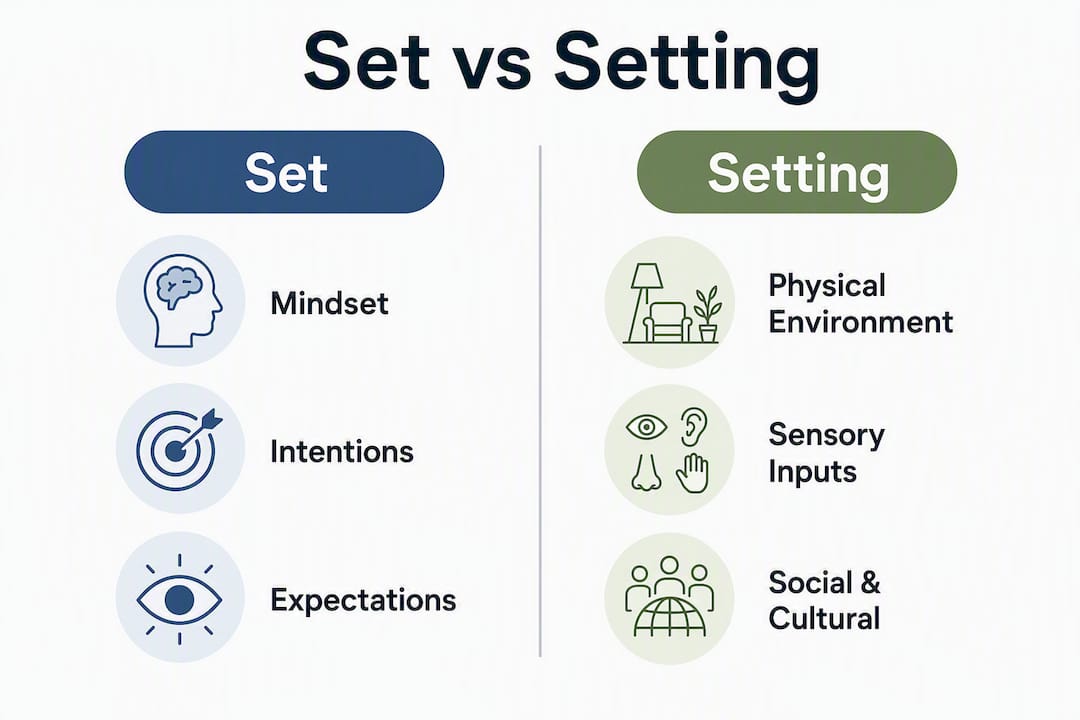
Set is not just your mood on the day. It encompasses your intentions going into the session, your expectations about what will happen, your emotional baseline over the preceding weeks, your sleep and nutrition in the 48 hours before, your psychiatric history, any current medications, and your prior experience with psychedelics. Each of these variables can tilt the experience toward difficulty or toward therapeutic benefit.
Intentions are probably the most modifiable component. Research consistently shows that growth motivation predicts greater wellbeing and meaningfulness after a session, while sessions entered with anxiety, avoidance, or unclear purpose tend toward more psychopathology. An intention does not need to be elaborate. “I want to understand why I keep avoiding this grief” is more useful than a vague wish to “feel better.”
Expectations work through something close to a placebo-adjacent mechanism. If you expect terror, your nervous system will interpret ambiguous stimuli as threatening. If you expect insight, you are more likely to approach difficult material with curiosity rather than resistance. Neither outcome is guaranteed, but the framing matters.
Psychiatric history and medications are where set intersects with genuine medical risk. Certain psychiatric medications, particularly lithium and some antidepressants, carry interaction risks with classic psychedelics. Anyone on a psychiatric medication should consult a clinician before a session. A history of psychosis or a first-degree family history of schizophrenia is a recognized contraindication in most clinical protocols.
Prior dosing history shapes tolerance and also shapes expectation. Someone with ten previous sessions brings a different interpretive frame than a first-timer. Neither is inherently safer, but the preparation approach differs.
Pro Tip: Three days before a session, write answers to three questions: What am I hoping to understand? What am I afraid might come up? What does a good outcome look like for me? Read them aloud to your sitter or therapist. The act of saying them out loud often surfaces anxiety that written words conceal.
One clear warning: if you are in an acute mental health crisis, experiencing active suicidal ideation, or have had a psychotic episode in the past year, postpone. No preparation protocol compensates for an unstable baseline. This is not a judgment; it is a clinical boundary that exists in every reputable trial protocol.
What does “setting” include, and how do you configure it?
Setting breaks into four practical layers: physical, sensory, social, and cultural. Each is configurable, and each carries measurable influence on outcomes.

Physical environment
The room should feel safe before it feels comfortable. That means no locked doors that could feel trapping, no sharp objects in reach, and a clear path to a bathroom. Beyond safety, comfort matters: a reclining surface (couch or mat), blankets within reach, dim adjustable lighting, and a temperature between 68°F and 72°F. Clinical trials typically use a living-room-style setup rather than a medical examination room, specifically because the latter activates threat associations.
Sensory environment
Music is the most studied sensory variable in psychedelic research. Curated playlists, often moving from ambient and grounding at the start to emotionally evocative in the peak and back to grounding at the close, are now standard in clinical protocols. Smell matters too. Familiar, calming scents (lavender, cedar) can anchor a person during difficult moments. Terpenes and scent profiles shape psychoactive experience in ways that are easy to underestimate. Visual stimuli should be minimal and controllable: an eye mask is standard in clinical settings for good reason.
Social environment
The sitter or therapist is arguably the most powerful setting variable. A Frontiers review connects well-designed settings to human dispositions for ritualized social connection, arguing that the therapeutic affordances of a session depend partly on the relational container the sitter provides. That means the sitter’s training, calm presence, and clear role boundaries matter as much as the room layout.
Setting checklist:
- Room is clean, private, and free of unexpected visitors or noise
- Phone notifications are silenced for all people present
- Water, light snacks, and a blanket are within reach
- An eye mask and headphones are available
- Lighting is adjustable (dimmer or lamp, not overhead fluorescents)
- A clear agreement exists about the sitter’s role (observer, guide, or both)
- Emergency contact information is written down and accessible
- Transportation home is arranged in advance
Cultural and collective context
This layer is easy to overlook. The broader social meaning attached to psychedelics in your community, your family’s beliefs about mental health, and the legal status of the substance in your state all form a kind of ambient setting that shapes how you interpret the experience before, during, and after. Hartogsohn’s historical work makes this point directly: individual settings are always embedded in collective ones. A session conducted in a context where psychedelics carry stigma will be processed differently than one conducted in a context of cultural acceptance, even if the room looks identical.
How do set and setting actually change what happens?
Three mechanisms are reasonably well-supported by the current evidence.
Psychological framing is the most direct. Expectations shape perception, and perception under a psychedelic is unusually plastic. A neutral stimulus, say, a shadow on the wall, gets interpreted through whatever emotional frame is most active. A calm, trusting mindset tends to produce curious interpretation. An anxious one tends to produce threatening interpretation. This is not metaphorical; it reflects how predictive processing works in the brain, and psychedelics appear to temporarily reduce the weight of prior predictions, making incoming experience more dependent on present context.
Social buffering is the second mechanism. The presence of a trusted person reduces threat responses at a physiological level. Heart rate, cortisol, and subjective distress all tend to be lower when a calm, known companion is present. This is why the sitter role is not ceremonial. It is a functional part of the therapeutic container.
Neuroplasticity windows are the third, and the most clinically significant for long-term outcomes. Imaging and preclinical work show rapid dendritic remodeling and network desynchronization that can persist for weeks after a high-dose session. This post-acute window of increased neuroplasticity means that what happens in the days after a session, the integration period, is not separate from the therapeutic work. It is part of it. The setting around integration, including therapy appointments, social support, and reduced stress, shapes whether the neurobiological opening translates into lasting change.
“Natural settings and the presence of significant others correlated with less psychopathology and greater meaningfulness.” — PubMed correlational study
One important caveat: most of the evidence linking set and setting to outcomes is correlational. Participants who choose natural settings and bring trusted companions may differ systematically from those who do not. Randomized designs that isolate specific setting variables are rare, and the field is still working toward the kind of controlled evidence that would establish causation cleanly.
How to prepare: a step-by-step guide for before, during, and after
48–72 hours before
- Complete a personal screening: no acute psychiatric crisis, no recent major trauma without support, no contraindicated medications without clinician clearance.
- Reduce alcohol and stimulants for at least 48 hours.
- Prioritize sleep. Two nights of poor sleep before a session is a documented risk factor for difficult experiences.
- Write your intention. One sentence is enough: specific, honest, and yours.
- Brief your sitter or therapist. Share your intention, your current emotional state, and any concerns. If this is your first session, ask them to walk you through what to expect step by step. Theelevatedremedies has a session walkthrough guide that covers this in practical detail.
- Prepare your physical space: clean the room, set up your mat or couch, gather blankets and water, test your music setup, and silence all devices.
- Arrange transportation. You should not drive for at least 12 hours after a session.
Day of the session
- Eat a light meal 3–4 hours before. A full stomach can intensify nausea; an empty one can amplify anxiety.
- Arrive at your space early. Spend 15–20 minutes in quiet, without screens.
- Confirm your sitter is present and calm. A brief check-in conversation grounds both of you.
- Start your music playlist before dosing.
During the session
- If distress begins, do not fight it. Slow, deliberate breathing (inhale 4 counts, hold 4, exhale 6) is the most reliable grounding tool.
- The sitter’s job is to stay calm and present, not to intervene unless safety is at risk. Unnecessary talking or reassurance can interrupt processing.
- If a participant becomes physically agitated, gentle physical contact (a hand on the shoulder, with consent established beforehand) can help.
- Adjust sensory input if needed: lower the music, add or remove a blanket, open a window slightly.
Within 24 hours after
- Rest. Avoid major decisions, difficult conversations, or stimulating environments.
- Write or voice-record whatever feels significant, without editing or judging it.
- Check in with your sitter or therapist within 24 hours.
- Schedule a formal integration session within 72 hours if possible.
Pro Tip: Integration is where most of the therapeutic work actually consolidates. Treat the 72 hours after a session as part of the session itself. Keep your schedule light, stay in contact with your support person, and return to your pre-session intention statement to see what has shifted.
What does the clinical literature actually say?
The evidence base has grown substantially since 2010, but it remains uneven. Psilocybin trials for depression, end-of-life anxiety, and addiction have consistently reported positive outcomes, and MDMA-assisted therapy trials for PTSD showed significant response rates in Phase 2 data. In virtually every trial, set and setting protocols were present. The question the field is now asking is which specific elements drive the effect.
A 2025 systematic review assessed 25 studies and identified 16 domains of set and setting used across trials. Reporting varied widely. Participant selection and safe environment creation were common across studies, but monitor training was inconsistently reported and visual distractor control was variably reported across trials. That inconsistency makes cross-study comparisons difficult and limits what can be concluded about which setting elements matter most.
| Study type | Sample | Set/setting domains controlled | Main outcomes |
|---|---|---|---|
| Psilocybin for depression (clinical trials) | Small to mid-size (n = 12) | Participant screening, room design, music, therapist training | Significant reductions in depression scores |
| MDMA for PTSD (Phase 2 trials) | n = 28 | Dyadic therapist model, preparation sessions, integration | High response and remission rates |
| Correlational survey (PubMed) | Large online sample | Natural setting, companion presence, growth motivation | Less psychopathology, greater meaningfulness |
| Systematic review (2025, 25 studies) | Pooled | 16 domains identified; wide reporting heterogeneity | Calls for standardization via ReSPCT |
The ReSPCT guidelines represent the field’s answer to this problem. By asking researchers to document roughly 30 extra-pharmacological variables across therapeutic framework, physical environment, staffing and training, session procedures, and post-session integration, ReSPCT makes setting a measurable intervention rather than an assumed constant. Adoption is still early, but the framework gives clinicians and researchers a shared vocabulary for the first time.
“Standardizing how set and setting are reported will improve reproducibility and help clinicians identify which environmental features drive outcomes.” — Systematic review, 2025
The honest summary: the evidence strongly suggests that set and setting matter. It does not yet tell us precisely how much each component contributes, or in what combination. That is the work of the next decade of trials.
How to reduce harm and manage a difficult session
Prevention is the most effective harm-reduction strategy. Most serious adverse events in psychedelic sessions are preceded by identifiable risk factors: contraindicated medications, a history of psychosis, an unstable emotional baseline, or an unsupported setting. A harm-reduction primer published on PubMed frames set and setting as central across four modalities: therapeutic, clinical-trial, ritualistic, and recreational. Each modality carries different risks and calls for different preparation. Recreational use without a sitter, for example, carries meaningfully higher risk than a clinically supervised session, not because the molecule is different but because the setting is.
Prevention checklist:
- Screen for contraindications: personal or family history of psychosis, current lithium or MAOI use, cardiovascular conditions
- Avoid combining psychedelics with alcohol, stimulants, or cannabis (especially high-THC products) without specific guidance
- Confirm your sitter has basic training or experience; a calm, informed presence is not optional
- Have a written emergency plan: who to call, what to say, and when
If distress occurs during a session:
- Slow the breath first. Physiological regulation precedes psychological regulation.
- Reorient to the physical: name five things you can feel (the blanket, the floor, the air)
- Reduce sensory input: lower music volume, dim lights further, remove the eye mask if it feels confining
- The sitter should speak calmly and sparingly: “You’re safe. This will pass. I’m here.”
- Do not administer additional substances to “calm” a difficult experience unless a clinician has specifically authorized a benzodiazepine rescue dose
Call emergency services if:
- The person is physically injuring themselves or others
- There is loss of consciousness or severe cardiovascular symptoms
- Distress does not reduce within 2–3 hours and is escalating
Post-session monitoring:
- Check in at 24 hours and 72 hours for mood, sleep, and any unusual perceptual experiences
- Prolonged perceptual disturbances (lasting more than a few days) warrant a psychiatric evaluation
- Seek medical or psychiatric help promptly if suicidal ideation emerges in the post-session window
For a deeper look at harm-reduction principles, Theelevatedremedies has a dedicated harm-reduction safety guide that covers these steps in additional detail.
This article is general educational information, not medical advice. Psychedelic substances remain federally controlled in the United States. Confirm the legal status in your state and consult a licensed clinician before making any medical decisions.
Key Takeaways
Set and setting are the two most powerful non-pharmacological variables in any psychedelic experience, and preparing both deliberately is the single most effective harm-reduction step available.
| Point | Details |
|---|---|
| Define both variables clearly | “Set” is your mindset, intentions, and emotional baseline; “setting” is your physical, social, and cultural environment. |
| Mechanisms are real and measurable | Psychological framing, social buffering, and post-session neuroplasticity windows each link set/setting to outcomes. |
| Prepare 48–72 hours out | Screen for contraindications, set a clear intention, brief your sitter, and configure your physical space before the day of the session. |
| Integration is part of the session | The neuroplasticity window persists for weeks; what you do in the 72 hours after shapes long-term outcomes as much as the session itself. |
| Theelevatedremedies | Offers educational resources, in-store guidance, and mushroom products for those preparing intentionally for a psychedelic experience in Ann Arbor, MI. |
Why set and setting deserve more respect than they usually get
Most people who read about set and setting treat it as a checklist: clean room, good music, trusted friend. Check, check, check. That framing misses the deeper point, and it is the part that actually determines outcomes.
The real insight from the clinical literature is that setting is not a backdrop. It is an active ingredient. The ReSPCT framework’s insistence on documenting 30 variables is not bureaucratic excess. It reflects the field’s growing recognition that two trials using the same molecule at the same dose can produce completely different results because the relational container, the room, the music, the therapist’s training, and the post-session support structure were different. That is a profound claim about pharmacology, and it has not fully landed in public understanding yet.
The second thing people underestimate is the cultural layer. Your individual mindset is not formed in isolation. It is shaped by what your community believes about psychedelics, what your family taught you about mental health, and what the legal context signals about whether this experience is legitimate or shameful. Those ambient beliefs enter the room with you. Preparation that ignores them is incomplete.
The third point, and the one I find most practically important: integration is not aftercare. It is the second half of the session. The neuroplasticity window that opens after a high-dose experience is an opportunity, not a guarantee. Whether that opportunity becomes lasting change depends almost entirely on what the setting around integration looks like: the quality of the therapeutic relationship, the social support available, and the degree to which the person can reduce stress and stay reflective. A well-prepared session followed by a chaotic, unsupported week is a missed opportunity. That is where most of the variance in long-term outcomes lives.
Theelevatedremedies: preparation support and products in Ann Arbor
If you are preparing for an intentional mushroom experience and want products sourced for quality and consistency, Theelevatedremedies carries amanita muscaria products, mushroom capsules for microdosing, and mushroom chocolates at 1123 Broadway St in Ann Arbor, Michigan. The in-store team can help you understand what you are working with and point you toward educational resources that support responsible preparation.
This is a retail and educational offering, not a medical treatment. Theelevatedremedies does not provide clinical therapy or promise therapeutic outcomes. For personal medical guidance, consult a licensed clinician. For preparation reading, the magic mushroom wellness tips guide is a practical starting point. Stop in, ask questions, and leave with what you actually need.
Useful sources and further reading
Systematic reviews and correlational studies:
- Set and setting predict psychopathology, wellbeing and meaningfulness of psychedelic experiences: a correlational study — PubMed
- Set and setting of psychedelics for therapeutic use in psychiatry: A systematic review — Journal of Psychopharmacology, 2025
Reporting guidelines and clinical frameworks:
- Reporting of Setting in Psychedelic Clinical Trials (ReSPCT) — Nature Medicine, 2025
- Set and Setting for Psychedelic Harm Reduction — PubMed harm-reduction primer
Historical and theoretical foundations:
- Constructing drug effects: A history of set and setting — Hartogsohn, Drug Science, Policy and Law
- Frontiers review on ritual and therapeutic mechanisms — Frontiers in Pharmacology
General reference:
Harm-reduction resources:
- Set & Setting — The Loop — drug-checking and harm-reduction organization
- Mongoose CBD Co. wellness services — partner resource for sensory and setting design in wellness contexts
Psychedelic substances are federally controlled in the United States. Legal status varies by state. Consult a licensed clinician and verify current law in your jurisdiction before proceeding.
Recommended
- Mushroom Therapy Session: What to Expect Step by Step – Elevated Remedies
- How Psilocybin Shapes Emotional Processing: A Science Guide – Elevated Remedies
- The Role of Terpenes in Mushroom Effects Explained – Elevated Remedies
- Explaining Entheogenic Experiences: What You Need to Know – Elevated Remedies