
TL;DR:
- The Stamets Stack combines psilocybin, Lion’s Mane, and niacin, often on a weekly cycle, for neuroplasticity benefits. Evidence is limited, mainly observational, with Lion’s Mane showing the strongest independent support. Safety and legality depend on individual health factors and local laws, emphasizing careful dosing and research.
The Stamets Stack combines a sub-perceptual psilocybin microdose, Lion’s Mane (Hericium erinaceus) extract, and niacin (vitamin B3) on a 4-days-on, 3-days-off schedule. The safety-first recommendation: establish a psilocybin-only baseline before adding the other two components, so you can actually tell what’s doing what. If psilocybin is illegal where you live, the legal half-stack (Lion’s Mane + low-dose niacin) is a real alternative worth considering.
TL;DR:
- Establish a baseline first. Run psilocybin alone for several weeks before introducing Lion’s Mane and niacin.
- Typical microdose range. 0.05–0.3 g dried Psilocybe cubensis; most people find 0.1–0.2 g workable.
- Legal alternative. Lion’s Mane (500–1,000 mg fruiting-body extract) + optional low-dose niacin carries no federal legal risk.
Psilocybin is a Schedule I controlled substance under federal law in the United States. Nothing in this article is medical or legal advice. Verify current rules with a qualified professional before acting on anything here.
Table of Contents
- What is the Stamets Stack and why do people combine these three things?
- What dose of each component should you actually use?
- How do you actually run the protocol week by week?
- What does the evidence actually say about this stack?
- Is the Stamets Stack safe, and is it legal in the U.S.?
- How do you track whether the stack is actually working?
- How do you source quality products for this stack?
- Key Takeaways
- The case for going slower than you think you need to
- Theelevatedremedies carries what you need to start the legal stack
- Useful sources and further reading
What is the Stamets Stack and why do people combine these three things?
The Stamets Stack was proposed and popularized by mycologist Paul Stamets, who holds a patent for a nootropic combination containing psilocybin mushrooms, Lion’s Mane, and niacin. The core idea is that each component targets a different piece of the neurological puzzle.
- Psilocybin microdose: Thought to promote neuroplasticity by acting on serotonin 5-HT2A receptors, potentially supporting new neural connections at sub-perceptual doses.
- Lion’s Mane (Hericium erinaceus): Contains hericenones and erinacines, compounds associated with nerve growth factor (NGF) and brain-derived neurotrophic factor (BDNF) pathways in preclinical research. Lion’s Mane is entirely non-psychedelic.
- Niacin (vitamin B3): Stamets proposed that niacin’s vasodilating “flush” effect helps distribute the other compounds to peripheral nerves. That distribution hypothesis is popular in the community but lacks controlled evidence. What niacin reliably does is cause flushing.
The mechanistic logic is plausible. Psilocybin may open a window of plasticity; Lion’s Mane may supply the neurotrophic support to capitalize on it; niacin may (or may not) improve delivery. Stamets himself described the combination as targeting “epigenetic neurogenesis.” The community picked it up fast, and surveys show it’s one of the most-discussed microdosing protocols online.
“Lion’s mane and psilocybin mushrooms have a complementary relationship that optimizes returns. Niacin is in the stack for deliverability.” — Paul Stamets, as described in community protocol documentation
The honest caveat: the synergy hypothesis is mechanistically interesting but unproven as a combined three-part stack in humans. Learn more about mushroom stacking basics before committing to a protocol.
What dose of each component should you actually use?
Dosing is where most people go wrong, either starting too high or adding all three components at once. Here’s what the practical guidance actually says.
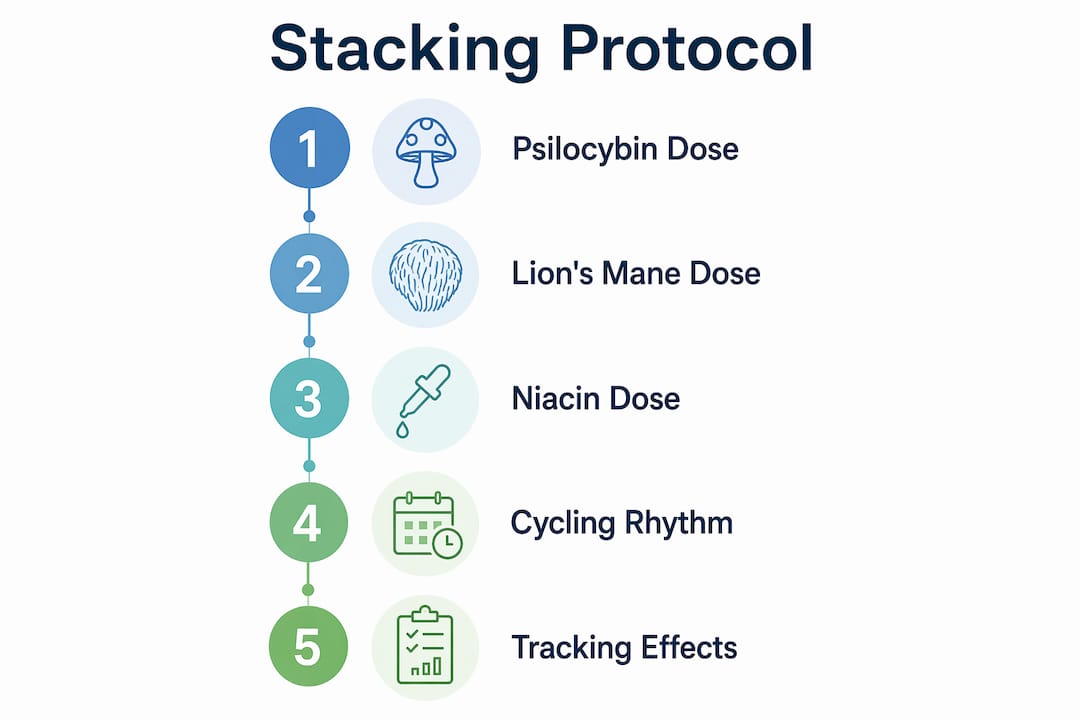
Psilocybin microdose
A microdose of dried Psilocybe cubensis is commonly cited as 0.05–0.3 g. Most people running the Stamets Stack use a small microdose. The goal is sub-perceptual: you should not feel high, see anything, or lose work capacity. If you do, the dose is too high.
Potency variability is a real problem. Alkaloid content in Psilocybe cubensis can shift substantially depending on strain, growing conditions, and storage. A 2020 study on psilocybin degradation found that potency drops over time, with the fastest degradation occurring at very cold temperatures. Store dried mushrooms at room temperature in the dark, and grind multiple specimens together before measuring to homogenize potency differences between caps and stems.
Lion’s Mane
Practical stack protocols recommend a daily dose of fruiting-body extract in a moderate range. Fruiting-body extracts are preferred over mycelium-on-grain products because the clinical and preclinical evidence for hericenone/erinacine activity was conducted on fruiting-body material. Benefits from Lion’s Mane tend to accumulate over weeks, not days.

Niacin
Start at 25–50 mg of flushing (non-flush-free) niacin and increase gradually to reduce discomfort. Many people find 100 mg workable after a few weeks of titration; some never get comfortable with the flush and drop niacin from the stack entirely. That’s a reasonable call.
Pro Tip: Before adding Lion’s Mane and niacin, run psilocybin alone for several weeks. If you introduce all three at once and something goes wrong, you won’t know which component caused it.
| Component | Common starting dose | Typical frequency | Primary risk |
|---|---|---|---|
| Psilocybin (P. cubensis) | small dried amount | On days only (4-on/3-off) | Perceptual effects if too high; legal exposure |
| Lion’s Mane extract | moderate fruiting-body dose | Daily (including off days) | Rare GI upset; quality variability |
| Niacin (flushing form) | low flushing dose | On days (optional on off days) | Skin flushing, GI discomfort, liver caution at high doses |
How do you actually run the protocol week by week?
The classic Stamets cycling rhythm is four days on, three days off. The off days exist to prevent tolerance buildup to psilocybin’s serotonergic effects. Lion’s Mane can be taken daily because it’s non-psychedelic and tolerance isn’t a concern. Niacin is typically taken on dosing days only, though some people include it on off days at lower amounts.
How the Stamets schedule compares to alternatives
The Fadiman protocol (one day on, two days off) is the other widely-used approach. It gives more recovery time between doses and is often recommended for beginners. A daily Lion’s Mane-only approach is the legal version: no psilocybin, no schedule constraints, just consistent supplementation for the NGF-related leg of the hypothesis.
For a deeper look at scheduling options, the 2026 microdosing protocol guide covers the full range of cycling approaches.
Step-by-step checklist for a 4-week trial
- Week 0 (preparation). Confirm no contraindicated medications (SSRIs, MAOIs, lithium). Set a journaling baseline: rate mood, focus, sleep, and anxiety on a 1–10 scale for 5–7 days before starting.
- Week 1. Begin psilocybin alone at 0.1 g on days 1–4. Rest days 5–7. No Lion’s Mane or niacin yet. Note any perceptual effects — if you feel anything, the dose is too high.
- Week 2. Add Lion’s Mane at 500 mg daily (including rest days). Keep psilocybin dose unchanged. Track whether anything shifts in cognition or mood.
- Week 3. Add niacin at 25 mg on dosing days only. Expect flushing 15–30 minutes after taking it. If flushing is severe, drop niacin and continue without it.
- Week 4 (evaluation). Compare journal scores to baseline. Decide whether to continue, adjust dose, or pause for a full reset (2–4 weeks off psilocybin).
On rest days: Continue Lion’s Mane daily. Niacin is optional. No psilocybin.
What does the evidence actually say about this stack?
The honest answer is: less than the community enthusiasm suggests, but not nothing.
The most-cited human data comes from a 2022 observational study published in Scientific Reports that followed 953 psilocybin microdosers and 180 non-microdosing controls over 30 days. Microdosers showed small-to-medium improvements in mood and mental health overall. The subset who added Lion’s Mane and niacin did not show broader mood advantages compared to psilocybin-only microdosers. The one notable exception: psychomotor performance gains in older adults who used the full stack.
“Stacking with Hericium erinaceus and B3 was linked to psychomotor improvements in older adults, but did not broadly change mood outcomes relative to psilocybin microdosing alone.” — Scientific Reports, 2022 observational study
Lion’s Mane has its own body of evidence, mostly preclinical. The hericenone and erinacine compounds show NGF and BDNF activity in animal models and cell studies. Some small human trials suggest cognitive benefits, but the mechanistic work is largely preclinical. The NGF/BDNF pathway research is real; the leap from “preclinical NGF activity” to “proven cognitive enhancement in humans” is not.
Key limitations of the current evidence:
- The Scientific Reports study was observational, not randomized or placebo-controlled. Self-selection and expectancy effects are real confounders.
- Participants self-reported doses with no verification of strain, potency, or actual psilocybin content.
- No controlled clinical trial has tested the three-part stack as a combined intervention.
- Community surveys skew toward people who already believe microdosing works.
There is no randomized, placebo-controlled clinical evidence confirming synergy between psilocybin, Lion’s Mane, and niacin. The enthusiasm is driven by mechanistic plausibility and community reports, which is a reasonable starting point for personal experimentation but not a clinical endorsement.
Is the Stamets Stack safe, and is it legal in the U.S.?
Safety checklist
Before starting, work through these honestly:
- Psychiatric history. People with a personal or family history of bipolar disorder, schizophrenia, or psychosis should avoid psilocybin, even at microdose levels. The risk of triggering a manic or psychotic episode is real.
- SSRIs and SNRIs. Combining psilocybin with serotonergic antidepressants can blunt effects or, in some cases, contribute to serotonin syndrome risk. Consult a clinician before combining.
- MAOIs. Combining psilocybin with monoamine oxidase inhibitors significantly amplifies effects and carries serious risk. Do not combine.
- Niacin and liver health. High-dose niacin is associated with liver toxicity. If you have liver disease or take hepatotoxic medications, avoid flushing niacin or consult a doctor first.
- Niacin flush populations. People with active peptic ulcers, gout, or low blood pressure should be cautious with flushing niacin forms.
For a practical safe microdosing guide that covers harm reduction in detail, that resource is worth reading before you start.
U.S. legal status
Psilocybin is a Schedule I controlled substance under the federal Controlled Substances Act. Possession, manufacture, and distribution are federally unlawful regardless of state law, with limited exceptions.
State and city-level exceptions exist. Oregon (Measure 109) and Colorado (Proposition 122) have created supervised therapeutic access programs, but these are regulated frameworks, not general legalization. Several cities (Denver, Seattle, Detroit, Ann Arbor) have deprioritized enforcement, but deprioritization is not decriminalization and certainly not legalization. Federal risk remains.
Steps to reduce legal and safety risk:
- Consider the legal half-stack: Lion’s Mane + niacin only, no psilocybin.
- If pursuing psilocybin, research your specific city and state laws carefully.
- Never source from unverified suppliers; potency and contamination risks are significant.
- Get medical clearance if you take any psychiatric medications.
- Do not drive or operate machinery on dosing days.
How do you track whether the stack is actually working?
Tracking is what separates a useful experiment from a vague feeling. Without a baseline, you can’t tell whether any change is from the stack, from placebo, from better sleep, or from something else entirely.
Daily and weekly metrics to log
- Mood (1–10): Rate morning and evening separately if you can.
- Focus and productivity: Did you complete what you planned? Any brain fog?
- Sleep quality (1–10): Total hours and subjective quality.
- Anxiety level (1–10): Note any spikes, especially on dosing days.
- Adverse effects: Flushing severity, GI symptoms, any perceptual effects.
Compact journal template
Use this structure across your trial:
- Baseline period (Days 1–7, pre-stack). Record all five metrics daily. This is your comparison point.
- Psilocybin-only phase (Weeks 1–2). Same metrics. Note any changes from baseline.
- Full stack introduction (Weeks 3–4). Track the same metrics plus niacin flush severity.
- 4–6 week evaluation. Average your scores by week and compare to baseline. If mood, focus, or sleep improved by a meaningful margin, that’s signal. If nothing changed, the stack may not be working for you. If things got worse, stop.
The mushroom effects workflow has additional tracking templates worth using alongside this one.
Red flags that mean stop immediately
- Emergent mania, racing thoughts, or grandiosity
- Worsening depression or suicidal ideation
- Severe or persistent anxiety that doesn’t resolve on rest days
- Jaundice, dark urine, or right-side abdominal pain (niacin liver warning signs)
- Any perceptual disturbances that persist beyond dosing days
Adjustment workflow
Change one variable at a time. If niacin flushing is intolerable, drop niacin first and run Lion’s Mane + psilocybin for 2–4 weeks before reassessing. If cognition seems to worsen after adding Lion’s Mane, stop it and re-evaluate. Never change dose and component simultaneously.
How do you source quality products for this stack?
Product quality is where a lot of people cut corners and then wonder why results are inconsistent.
What to look for on Lion’s Mane labels
- “Fruiting-body extract” is the phrase you want. The preclinical and clinical research on hericenones and erinacines used fruiting-body material, not mycelium grown on grain substrate.
- Third-party testing. Look for a certificate of analysis (COA) from an independent lab confirming potency and absence of heavy metals, pesticides, and microbial contaminants.
- Standardized content. Not all products list hericenone or erinacine percentages, but a COA showing actual beta-glucan content is a reasonable proxy for quality.
Pro Tip: Mycelium-on-grain products often contain significant starch from the grain substrate, which dilutes the active mushroom content. A COA that tests for actual beta-glucan content will reveal this quickly.
Psilocybin sourcing considerations
Psilocybin potency varies substantially by strain, batch, and storage conditions. Grinding multiple specimens together before measuring is the most practical way to reduce dose variability. Store dried material at room temperature in the dark. Avoid sourcing from unverified suppliers; contamination and mislabeling are genuine risks when there’s no regulatory oversight.
The legal-only alternative
Many people run Lion’s Mane (500–1,000 mg fruiting-body extract daily) plus optional low-dose niacin (25–50 mg) as a standalone stack. This approach targets the NGF-related leg of the Stamets hypothesis without any federal legal exposure. For those exploring curated mushroom blends, quality-verified products are available without the legal complexity of psilocybin.
Key Takeaways
The Stamets Stack’s strongest evidence is for psilocybin microdosing’s mood benefits and Lion’s Mane’s preclinical NGF activity; no controlled trial has confirmed synergy between all three components.
| Point | Details |
|---|---|
| Establish a baseline first | Run psilocybin alone for several weeks before adding Lion’s Mane and niacin to isolate each component’s effects. |
| Microdose range | 0.1–0.2 g dried Psilocybe cubensis is the typical Stamets Stack starting point; stay sub-perceptual. |
| Lion’s Mane is the best-supported leg | 500–1,000 mg fruiting-body extract daily has the strongest independent evidence and carries no legal risk. |
| Track with a journal | Log mood, focus, sleep, and anxiety daily; compare to a pre-stack baseline at 4–6 weeks to evaluate real change. |
| Theelevatedremedies for legal products | Theelevatedremedies carries lab-sourced mushroom capsules and Lion’s Mane options for those building a legal stack in Ann Arbor and beyond. |
The case for going slower than you think you need to
The Stamets Stack gets discussed as if the three components are a single unit you adopt all at once. That framing is the source of most of the confusion people report when they try it. They add psilocybin, Lion’s Mane, and niacin simultaneously, feel something shift, and have no idea whether it’s the psilocybin, the Lion’s Mane, the niacin flush creating a physiological response, or just the placebo effect of doing something intentional for their brain.
The observational data from Scientific Reports is worth sitting with. Psilocybin microdosing alone showed mood improvements. Adding Lion’s Mane and niacin didn’t improve mood outcomes broadly. The psychomotor gains in older adults are genuinely interesting, but they’re a single finding from a non-controlled study. That’s not a reason to dismiss the stack. It’s a reason to be precise about what you’re actually testing and what you’re hoping to get from it.
Lion’s Mane is the component with the cleanest risk profile and the most independent evidence; for exploring related options, see our overview of the best CBD for sleep and anxiety that complements cognitive wellness approaches. If you’re uncertain about psilocybin’s legal status in your area, starting with Lion’s Mane at 500–1,000 mg fruiting-body extract daily is not a compromise. It’s a reasonable first step that gives you real data on how your cognition responds to consistent NGF-pathway support before you add anything more complex.
The people who get the most out of this protocol are the ones who treat it like a personal experiment with a hypothesis, not a supplement routine they read about online. Write down what you expect to change. Measure it. Adjust based on what you actually observe, not what you hoped would happen.
Theelevatedremedies carries what you need to start the legal stack
If you’re ready to build a Lion’s Mane-based stack with quality-verified products, Theelevatedremedies makes that straightforward. The store carries mushroom capsules sourced for consistency and potency, along with educational resources on microdosing protocols so you’re not guessing at dosing or scheduling.
For those curious about legal mushroom alternatives beyond Lion’s Mane, the Amanita muscaria education page covers what that category actually is and how it differs from psilocybin products. Theelevatedremedies prioritizes product quality checks and transparent sourcing, which matters when you’re building a protocol where consistency is the whole point. Stop by 1123 Broadway St in Ann Arbor, or browse the full capsule selection online to find the right starting point for your stack.
Useful sources and further reading
These are the primary sources worth reading directly if you want to verify claims or go deeper on any component of this protocol.
-
Scientific Reports — 2022 Psilocybin Microdosing Observational Study: The most-cited human data on microdosing outcomes; covers the Lion’s Mane + niacin subset and psychomotor findings in older adults. Read this before drawing conclusions about the stack’s mood benefits.
-
iMicrodosing Research — The Stamets Stack: Detailed protocol description including the 4-on/3-off schedule, component rationale, and an honest note on the niacin distribution hypothesis lacking controlled support.
-
Microdosing Institute — Lion’s Mane Stacking Protocol: Practical dosing ranges for psilocybin and niacin, plus guidance on titrating niacin to manage flushing. Good starting reference for first-time stackers.
-
Erowid — Psilocybe cubensis Dosage Chart: The canonical community dosage reference for P. cubensis; includes threshold, light, common, strong, and heavy dose ranges with gram equivalents.
-
AddictionCenter — Microdosing Mushrooms Safety: Harm-reduction focused overview of safety considerations, contraindications, and drug interactions including SSRIs and psychiatric medication cautions.
-
PMC / PubMed Central — Microdosing Research: Peer-reviewed source for further reading on psychedelic microdosing research; useful for verifying mechanistic claims and study methodology.