
Most acute shroom trips last about 3 to 6 hours, with the strongest effects hitting between 1 and 3 hours after you take them. Onset usually starts in 20 to 60 minutes. That taper isn’t random: psilocin, the active compound your body converts psilocybin into, has a half-life of roughly 3 hours, which means the intensity you feel at hour one is mathematically cut in half by hour four.
Here’s the compressed version if you’re deciding whether to read further:
- Onset: 20 to 60 minutes after ingestion
- Peak: 1 to 3 hours in
- Total acute duration: typically 4 to 6 hours, with a practical range of 3 to 8 hours depending on dose and method
- Afterglow: mental and emotional residue can linger 24 to 48 hours
Higher doses stretch that window. Clinical trials running therapeutic-dose sessions plan for 6 to 8 hour supervised blocks, which tells you something useful: if you’re taking a strong dose, block off your whole afternoon and evening, not just a few hours.
Key Takeaways
Shroom trip duration follows a predictable pharmacological curve: onset in under an hour, peak within three hours, and full resolution within six to eight hours for most doses.
| Point | Details |
|---|---|
| Typical duration | Most acute trips run 4 to 6 hours, with a practical range of 3 to 8 hours based on dose. |
| Peak timing | Peak intensity hits 1 to 3 hours in, matching plasma psilocin’s peak around 90 to 120 minutes. |
| Method changes onset | Lemon tek speeds onset while capsules and high-fat edibles slow it down noticeably. |
| Testing reality | Standard workplace panels usually miss psilocybin; only specialized LC-MS/MS testing reliably detects it. |
| Afterglow is normal | Mental fatigue or reflectiveness lasting 24 to 48 hours afterward is typical, not a warning sign. |
Table of Contents
- How Long Do Shroom Effects Last? The Phase-by-Phase Timeline
- What Changes Shroom Duration: Dose, Species, and Method
- How Long Are Shrooms Detectable in Drug Tests?
- Safety and Aftereffects: What Happens After the Trip
- Preparing Properly Matters as Much as the Timeline Itself
- Choosing the Right Product for the Timeline You Want
- What the Timeline Actually Tells You
- Sources
How Long Do Shroom Effects Last? The Phase-by-Phase Timeline
A trip isn’t one flat experience. It moves through five fairly predictable phases, and knowing where you are in that sequence is often the difference between mild discomfort and genuine panic.
-
Onset (20 to 60 minutes). Your stomach may feel unsettled first. This is also when mild visual shimmer or a change in how colors read starts to creep in. Clinical onset data puts the earliest noticeable effects around the 20 minute mark on an empty stomach, later if you’ve eaten a full meal.
-
Come-up (30 to 90 minutes). Effects build quickly here. Emotions intensify, time sense starts to loosen, and physical sensations like light nausea or waves of warmth are common.
-
Peak (1 to 3 hours in, lasting roughly 1 to 2 hours). This is where the trip lives. Visual distortion, altered thought patterns, and emotional intensity are all at their highest. Plasma psilocin peaks around 90 to 120 minutes after ingestion, which lines up almost exactly with when most people report the strongest subjective effects.
-
Comedown. Intensity declines steadily as psilocin is metabolized. With a half-life of about 3 hours, this phase involves a gradual, predictable decrease in effects.
-
Afterglow (the following 24 to 48 hours). Acute effects are gone, but a residual mental clarity, emotional openness, or mild fatigue often sticks around into the next day or two.
Dose tier shifts all of this. A microdose (sub-perceptual, roughly 0.1 to 0.3 grams dried) may produce no distinct peak at all, just a subtle mood or focus shift lasting a few hours. A common dose (1 to 2.5 grams) fits the standard 4 to 6 hour arc described above. A strong dose (2.5 to 5 grams) can extend the peak and stretch total duration toward 7 or 8 hours. Heroic doses (5+ grams) push firmly into that clinical 6 to 8 hour supervised session range, and they’re not something to plan casually or alone.
What Changes Shroom Duration: Dose, Species, and Method
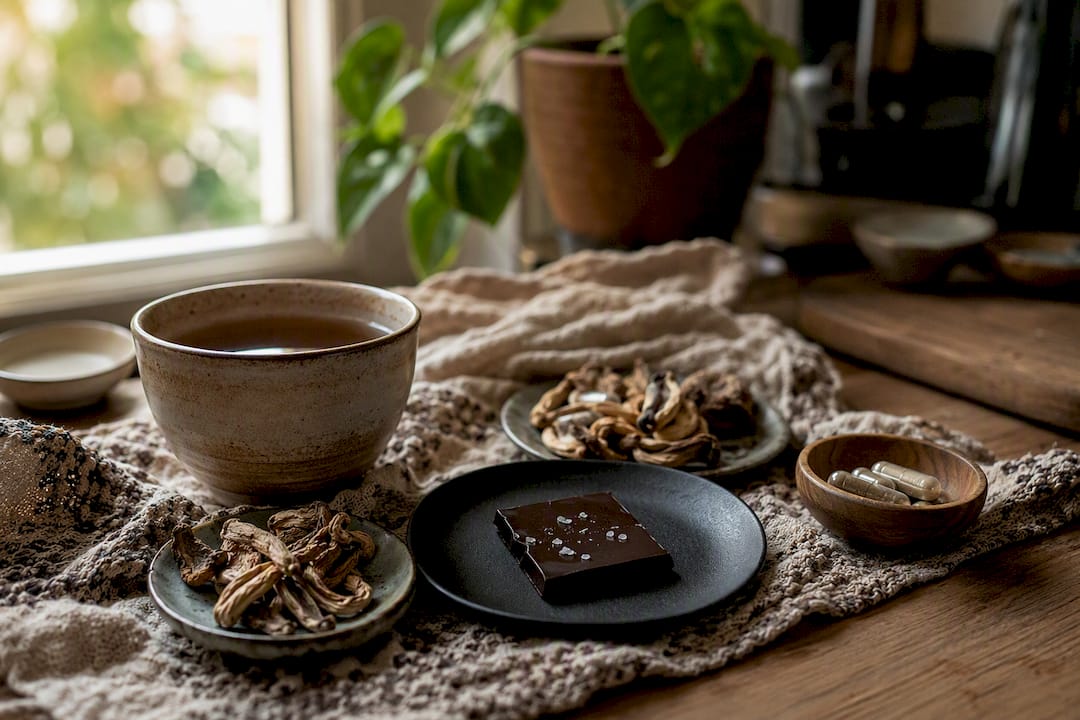
Two people taking what looks like the same amount of mushrooms can have wildly different experiences, and duration is usually the variable that shifts the most.
Dose is the biggest lever. More material means more psilocybin converting to psilocin, which means a longer runway before your liver clears it. This is why the tier system above matters more than any single “standard dose” number.
Species and potency change the math, not the shape of the curve. A gram of Psilocybe azurescens hits differently than a gram of Psilocybe cubensis because potency varies by species and even by growing batch. The timeline phases stay the same. What changes is how many grams it takes to reach a given phase’s intensity.
Method changes onset speed more than total duration.
- Tea extraction tends to bring effects on faster and can shorten the overall tail because less plant matter needs to be digested.
- Lemon tek (soaking ground mushrooms in lemon or lime juice before consuming) pre-converts some psilocybin to psilocin, which often produces a faster, more intense onset.
- Capsules delay onset because the capsule shell has to dissolve first, on top of normal digestion.
- Edibles, especially anything with real fat content, slow onset further since fat digestion takes longer.
Individual factors matter too. Body weight, metabolism, and a full stomach versus an empty one can shift onset by 30 minutes or more in either direction. Combining shrooms with alcohol or SSRIs is a separate concern. SSRIs can blunt or unpredictably alter the subjective effects, and alcohol adds its own impairment on top of an already altered state.
Pro Tip: If you want a shorter, more contained experience, skip the heavy meal beforehand and consider tea instead of raw material. If you want a longer, more predictable arc for a planned session, eat a light meal an hour before and stick to whole dried mushrooms rather than lemon tek.
How Long Are Shrooms Detectable in Drug Tests?
The high wearing off and the drug leaving your system are two different clocks, and mixing them up is where most confusion about testing comes from.
Psilocybin itself gets converted almost immediately into psilocin, and it’s psilocin that most specialized tests actually look for. Here’s roughly how long each test type can pick it up:
- Blood: a few hours, since psilocin clears quickly from circulation
- Saliva: similarly short, typically within hours of use
- Urine: around 24 hours under standard conditions, though specialized tests can push that window out a bit further
- Hair: technically weeks to months, but hair testing for psilocybin is rare outside of specific forensic cases
The part that actually matters for most people: standard 5-panel and 10-panel workplace drug screens don’t test for psilocybin at all. Detecting it reliably requires a specialized LC-MS/MS test, which is expensive and typically only ordered in forensic, clinical research, or targeted investigation contexts, not routine employment screening.
Safety and Aftereffects: What Happens After the Trip
Once the acute effects fade, most people experience some combination of mental fatigue, a reflective or introspective mood, and mild sensory sensitivity that can linger for a day or two; this is explored further in the context of cannabis’s angstlindernde Wirkung. This is normal and typically resolves on its own without intervention.
Rare but real risks exist. Hallucinogen persisting perception disorder (HPPD) and prolonged psychiatric symptoms can occur, particularly in people with a personal or family history of psychosis or other serious mental health conditions. This is the population where caution should be highest, not an afterthought.
If a trip turns difficult while it’s happening, here’s the actual sequence to follow:
- Move to a calm, familiar, low-stimulation environment.
- Focus on slow breathing and remind yourself the intensity is temporary and pharmacologically finite (psilocin clears steadily; it isn’t building forever).
- Have a sober person present who can offer reassurance and monitor for any escalation.
- Hydrate, but don’t force food if nausea is present.
- If there’s any sign of acute danger, chest pain, extreme confusion, thoughts of self-harm, call emergency services or contact the SAMHSA national helpline for immediate guidance.
Pro Tip: Time distortion during a trip is extremely common. If an hour feels like it’s lasting forever, that’s your perception, not the pharmacology. Psilocin clearance runs on a fixed clock regardless of how it feels in the moment.
If symptoms persist well beyond 48 hours, that’s a signal to talk to a clinician rather than wait it out.
Preparing Properly Matters as Much as the Timeline Itself
Knowing the timeline is only half the picture. How you prepare, and what you take, shapes the entire experience just as much as dose does.
Theelevatedremedies puts together wellness and safe-use guidance covering the basics that actually reduce risk: start low, wait long enough to feel the full onset before considering more, avoid mixing substances, and store any products in labeled, airtight containers well out of reach of kids or pets. For anyone considering a stronger session, the high-potency preparation guide walks through what to have on hand before you start, and the harm-reduction guide covers set and setting in more depth than we can fit here.
If you’re weighing formats, edibles with fat content genuinely do slow onset compared to capsules or dried product, which is worth factoring into your planning.
Choosing the Right Product for the Timeline You Want
If you’re picking a product based on how you want your day (or evening) to unfold, format matters more than most people realize. Theelevatedremedies carries mushroom capsules for a slower, more predictable onset that suits people who prefer easing into an experience rather than a fast ramp. For a defined, social-friendly session, the 1500mg mushroom gummy cubes offer a consistent starting dose, while the mushroom chocolate bar is worth understanding specifically because its fat content will delay onset compared to capsules or gummies, something to plan for rather than be surprised by. If you’re newer to the category and want to understand how Amanita muscaria differs from psilocybin mushrooms before buying anything, the Amanita muscaria explainer is the right starting point.
What the Timeline Actually Tells You
The conventional advice on shroom duration treats it like a single number: “it lasts six hours,” full stop. That’s not wrong, but it flattens something more useful, which is that the timeline is a curve, not a countdown. Understanding that psilocin clears on a fixed half-life changes how you experience the comedown. You’re not waiting for a switch to flip off; you’re watching a predictable decline, and that reframing alone helps people ride out a rough patch instead of panicking that it will never end.
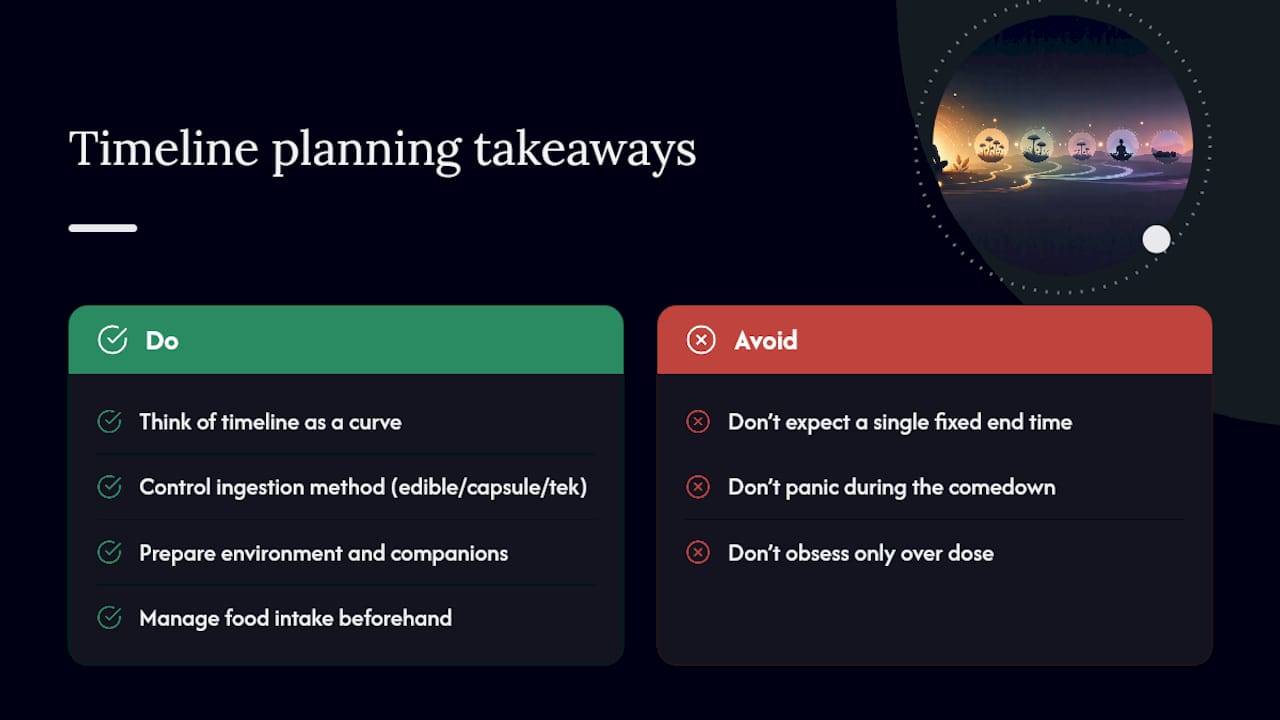
What’s underrated is method. Most guides obsess over dose and barely mention that a fatty edible versus a capsule versus lemon tek can shift your onset by an hour or more. If you’re planning around a schedule, that’s the variable to control first.
Prioritize preparation over prediction. You can’t know your exact timeline in advance, but you can control your environment, your food intake beforehand, and who’s with you. That’s where actual risk reduction happens.
— Juiced
This article is general information, not a substitute for advice from a qualified doctor. Consult a qualified healthcare professional about your own circumstances before acting on anything here.
Sources
- Clinical pharmacokinetic research on psilocin
- Review of psychedelic-assisted therapy and psilocybin timelines (NCBI)
- NIDA: drug testing overview
- SAMHSA national helpline